High Flow vs Standard Filter Cartridge
Which Filtration Solution Is Best for Your Industrial Water Treatment System?
Selecting the right filter cartridge is more than choosing a micron rating. The cartridge type directly affects system flow capacity, pressure drop, maintenance frequency, equipment footprint, and long-term operating costs.
Both high flow filter cartridges and standard filter cartridges are widely used in industrial water treatment, reverse osmosis (RO) pretreatment, power generation, food & beverage processing, and chemical manufacturing. While they perform the same basic function—removing suspended solids—their engineering design, hydraulic performance, and maintenance requirements differ significantly.
This engineering selection guide compares both technologies from a practical perspective, helping engineers, maintenance teams, and purchasing managers determine which solution best fits their operating conditions.
Quick Answer
If your system handles large flow rates, operates continuously, or requires minimal downtime, a high flow filter cartridge is generally the more efficient solution. A single high flow cartridge can often replace 18–30 standard 40-inch cartridges, reducing the number of housings, shortening replacement time, and lowering overall maintenance costs.
Standard filter cartridges remain an excellent choice for small and medium flow systems, final filtration, laboratory applications, and installations where existing housings are already designed for conventional 2.5-inch cartridges.
There is no universal "better" option. The correct selection depends on several engineering factors, including:
- Flow rate
- Contaminant loading
- Housing configuration
- Maintenance strategy
- Total cost of ownership (TCO)
—not simply the purchase price of the cartridge.
Key Takeaways
- One high flow cartridge typically replaces 18–30 standard 40-inch cartridges
- High flow cartridges reduce housing size, maintenance time, and labor costs
- Standard cartridges are ideal for low-flow systems and fine final filtration
- Lower pressure drop can reduce energy consumption and extend service intervals
- The best cartridge should be selected based on system design, not cartridge price alone
Quick Specs at a Glance
| Feature | High Flow Cartridge | Standard Filter Cartridge |
|---|---|---|
| Typical Diameter | 6 in (152 mm) | 2.5 in (63 mm) |
| Common Lengths | 20", 40", 60" | 10", 20", 30", 40" |
| Typical Flow per Cartridge* | Up to 70–110 m³/h (model dependent) | Typically 2–8 m³/h (application dependent) |
| Filtration Area | Very Large | Moderate |
| Cartridge Quantity Required | Low | High |
| Housing Size | Compact | Larger |
| Maintenance Frequency | Lower | Higher |
| Typical Applications | RO Pretreatment, SWRO, Power Plants, Municipal Water | Process Water, Food & Beverage, Laboratory, Final Filtration |
Engineering Note: Flow capacity varies with cartridge design, micron rating, fluid viscosity, and the manufacturer’s recommended pressure drop. Always verify the operating conditions rather than comparing cartridges by size alone.
What Is a High Flow Filter Cartridge?
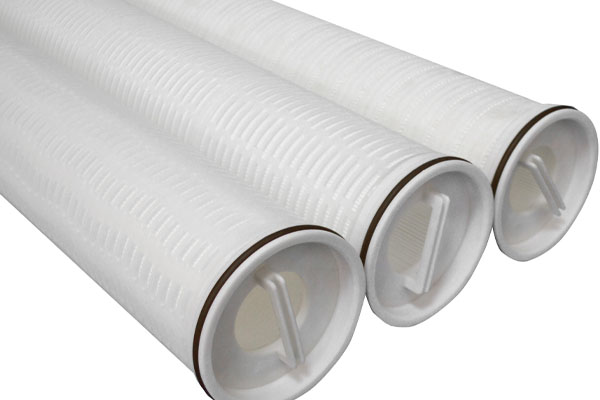
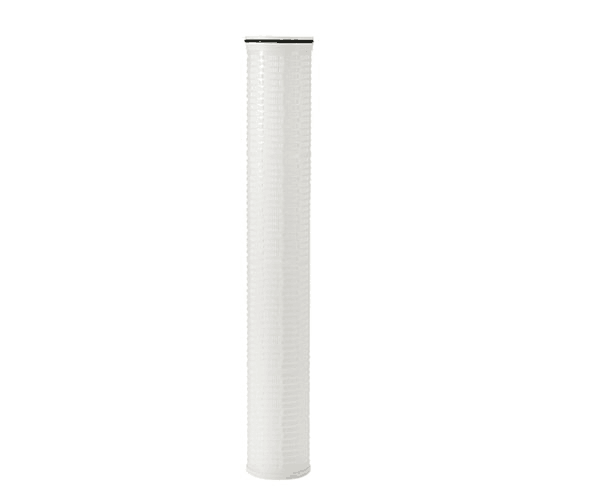
A high flow filter cartridge is a large-diameter, high-capacity filtration element specifically developed for industrial systems that require high flow rates with fewer filter elements.
Unlike conventional cartridges, a high flow cartridge provides a significantly larger filtration area and higher dirt-holding capacity. This allows each cartridge to process a much greater volume of water while maintaining a relatively low pressure drop.
Most high flow cartridges are available in 20-inch, 40-inch, and 60-inch lengths, with an outer diameter of approximately 6 inches. Depending on the manufacturer and cartridge design, they may use inside-to-outside or outside-to-inside flow patterns, along with different end-cap configurations for compatibility with existing filter housings.
Because fewer cartridges are required to achieve the same system flow, high flow filtration can simplify maintenance, reduce sealing points, minimize inventory requirements, and shorten shutdown periods during cartridge replacement.
Typical Applications
- Seawater desalination (SWRO)
- Reverse osmosis (RO) pretreatment
- Power plant condensate polishing
- Municipal water treatment
- Petrochemical processing
- Industrial process water
- Cooling water systems
Engineering Insight: High flow cartridges are not designed merely to increase flow rate. Their greatest advantage lies in reducing the total number of cartridges, filter housings, and maintenance operations required throughout the life of the system.
What Is a Standard Filter Cartridge?
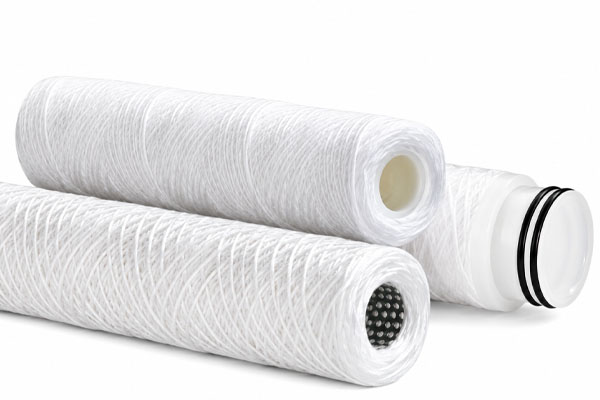
A standard filter cartridge is the traditional filtration element used in most industrial and commercial cartridge housings. It typically has an outer diameter of 2.5 inches and is available in a wide range of lengths, materials, and filtration technologies.
Standard cartridges include several construction types, such as:
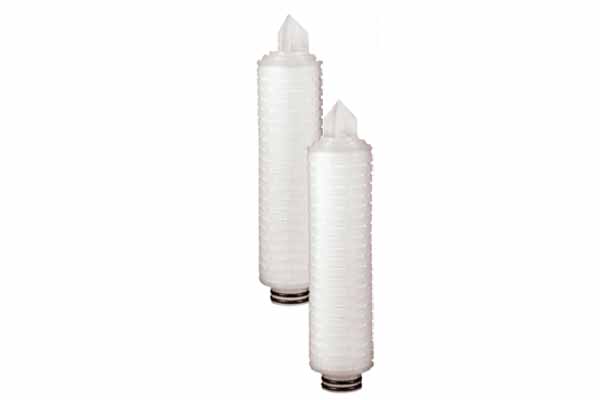
- PP Pleated Filter Cartridges
- Melt Blown Filter Cartridges
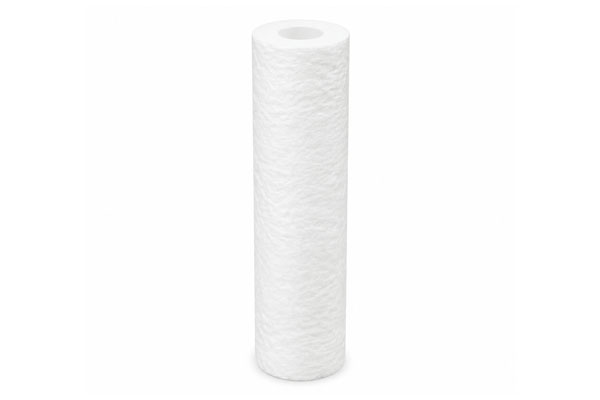
- String Wound Filter Cartridges
- Activated Carbon Cartridges
- Membrane Filter Cartridges (PES, PTFE, PVDF, Nylon)
Their versatility makes them suitable for applications ranging from coarse prefiltration to fine polishing and sterile filtration.
Although each cartridge handles a lower flow rate than a high flow cartridge, standard cartridges offer excellent flexibility for systems with lower throughput or applications requiring specialized filter media.
Typical Applications
- Food & Beverage Processing
- Pharmaceutical Manufacturing
- Electronics and Ultrapure Water
- Laboratory Systems
- Pilot-scale RO Units
- Fine Chemical Production
- Final Filtration Before Filling
Engineering Insight: Standard cartridges remain the preferred choice whenever filtration accuracy, specialized media, or compatibility with existing 2.5-inch housings is more important than maximizing flow capacity.
Engineering Comparison: High Flow vs Standard Filter Cartridge
At first glance, both high flow and standard filter cartridges perform the same function—removing suspended solids from liquids. However, their engineering design leads to significant differences in hydraulic performance, maintenance efficiency, equipment footprint, and operating costs.
Rather than asking "Which cartridge is better?", engineers should ask:
Which cartridge design best matches the operating conditions of the system?
The following comparison examines the most important engineering factors.
1. Flow Capacity
Flow capacity is the most obvious difference between the two cartridge designs.
A standard 2.5-inch filter cartridge is designed for relatively low individual flow rates. As system capacity increases, more cartridges and larger housings are required to maintain an acceptable pressure drop.
A high flow filter cartridge increases the available filtration area by using a much larger diameter and optimized media geometry. Instead of increasing the number of cartridges, the system increases the capacity of each cartridge.
This allows one housing to process significantly more water while maintaining stable hydraulic performance.
| Parameter | High Flow Cartridge | Standard Cartridge |
|---|---|---|
| Individual Flow Capacity | Very High | Low to Moderate |
| Typical System Capacity | Large Industrial Systems | Small & Medium Systems |
| Number of Cartridges Required | Low | High |
| Housing Footprint | Smaller | Larger |
Engineering Note: Higher flow capacity does not mean higher filtration velocity through the media. Because the filtration area is much larger, the face velocity is often lower, helping reduce pressure drop and extend cartridge service life.
2. Pressure Drop Performance
Pressure drop (ΔP) directly affects filtration efficiency, pump energy consumption, and cartridge replacement frequency.
When fluid passes through a filter cartridge, resistance is generated by both the filter media and the accumulated contaminants. As particles build up, pressure drop gradually increases until the cartridge reaches its replacement limit.
Because high flow cartridges provide a much larger effective filtration area, the fluid velocity through the media is reduced. Lower velocity generally results in:
- Lower initial pressure drop
- More uniform contaminant loading
- Slower pressure increase during operation
- Improved hydraulic stability
Standard cartridges can also achieve excellent filtration performance, but in large-flow systems they usually require many more elements to maintain the same pressure loss.
| Comparison | High Flow | Standard |
|---|---|---|
| Initial Pressure Drop | Lower | Higher |
| Pressure Rise During Operation | Slower | Faster |
| Pump Energy Requirement | Lower | Higher |
| Hydraulic Stability | Excellent | Good |
Engineering Note: Pressure drop should never be evaluated by cartridge size alone. Micron rating, filter media, contaminant characteristics, fluid viscosity, temperature, and operating flow all influence ΔP. Always compare cartridges under identical operating conditions.
3. Dirt Holding Capacity
Service life depends on far more than micron rating.
Two cartridges with the same filtration rating may exhibit completely different operating lifetimes because of differences in media structure and contaminant loading.
High flow cartridges generally provide:
- Larger filtration area
- Greater contaminant storage volume
- Better depth loading
- Reduced surface blinding
This allows contaminants to be distributed throughout the filter media instead of accumulating only on the outer surface.
Standard cartridges remain highly effective in low-flow applications, but under heavy contaminant loading they typically reach the replacement pressure much earlier.
| Feature | High Flow | Standard |
|---|---|---|
| Media Area | Large | Moderate |
| Dirt Holding Capacity | High | Moderate |
| Service Life in High Solids Applications | Longer | Shorter |
| Replacement Frequency | Lower | Higher |
4. Housing Requirements
The choice of cartridge affects the entire filtration system, not just the filter element itself.
Large industrial systems using standard cartridges often require multiple housings connected in parallel. This increases:
- Equipment footprint
- Installation cost
- Number of sealing points
- Maintenance complexity
Because each high flow cartridge processes significantly more water, fewer cartridges and fewer housings are required.
The result is a more compact filtration skid with simplified maintenance.
| Item | High Flow | Standard |
|---|---|---|
| Housing Quantity | Lower | Higher |
| Installation Space | Smaller | Larger |
| Number of O-rings | Fewer | More |
| Maintenance Complexity | Lower | Higher |
5. Maintenance Efficiency
Maintenance costs are often overlooked during equipment selection.
Replacing twenty standard cartridges typically requires:
- Opening multiple housing covers
- Removing each cartridge individually
- Inspecting numerous O-rings
- Cleaning every housing
- Installing all new cartridges
A high flow system performs the same maintenance with far fewer filter elements.
For plants operating 24/7, reducing maintenance time can significantly decrease production interruptions.
| Maintenance Item | High Flow | Standard |
|---|---|---|
| Cartridge Replacement Time | Short | Long |
| Labor Requirement | Low | High |
| Shutdown Duration | Short | Longer |
| Maintenance Frequency | Lower | Higher |
Engineering Note: In continuous-process industries such as seawater desalination, power generation, petrochemical processing, and municipal water treatment, maintenance labor often costs more than the filter cartridges themselves. Selecting a cartridge based only on purchase price may increase the total cost of ownership (TCO) over the life of the system.
6. Reliability and Operational Stability
Industrial filtration systems are expected to operate continuously under varying flow rates and contaminant loads.
A stable filtration system should maintain:
- Consistent flow
- Predictable pressure drop
- Reliable sealing
- Uniform contaminant retention
Because high flow systems use fewer cartridges and fewer sealing interfaces, there are fewer potential leakage points during installation and replacement.
This simplifies maintenance while improving operational consistency, particularly in large-scale water treatment systems.
Summary of Engineering Comparison
The table below summarizes the most important engineering differences between the two cartridge designs.
| Engineering Factor | High Flow Cartridge | Standard Cartridge |
|---|---|---|
| Flow Capacity | ★★★★★ | ★★☆☆☆ |
| Pressure Drop | ★★★★★ | ★★★☆☆ |
| Dirt Holding Capacity | ★★★★★ | ★★★☆☆ |
| Housing Footprint | ★★★★★ | ★★☆☆☆ |
| Maintenance Efficiency | ★★★★★ | ★★☆☆☆ |
| Initial Purchase Cost | ★★☆☆☆ | ★★★★★ |
| Total Operating Cost | ★★★★★ | ★★★☆☆ |
| Best for Large Industrial Systems | ✔ | Limited |
| Best for Small Systems | Good | Excellent |
Application Selection Guide
Different filtration systems have different operating priorities. Some require maximum flow capacity, while others prioritize filtration accuracy, compatibility, or specialized filter media.
Rather than asking which cartridge is "better," the right question is:
Which cartridge is better suited to your operating conditions?
The following guide summarizes the recommended cartridge type for common industrial applications.
Recommended Cartridge by Application
| Application | Recommended Cartridge | Primary Reason |
|---|---|---|
| Seawater Desalination (SWRO) | High Flow | High flow rate, reduced maintenance, compact housing |
| RO Pretreatment | High Flow | Lower pressure drop and fewer cartridge replacements |
| Municipal Water Treatment | High Flow | Continuous operation and high processing capacity |
| Power Plant | High Flow | Reduced downtime during maintenance |
| Cooling Water Systems | High Flow | High dirt holding capacity |
| Food & Beverage Process Water | Standard Pleated | Fine filtration and broad media options |
| Pharmaceutical Water | Standard Membrane | High filtration accuracy and sanitary compliance |
| Laboratory & Pilot Systems | Standard Cartridge | Lower flow demand and easier system integration |
| Electronics & Ultrapure Water | Standard Membrane | High-purity filtration requirements |
Engineering Decision Tree
Selecting the right cartridge becomes much easier when evaluated step by step.
Start
│
├── Is the system flow rate greater than 100 m³/h?
│       │
│       ├── YES
│       │      │
│       │      ├── Is reducing maintenance a priority?
│       │      │
│       │      ├── YES → High Flow Cartridge
│       │      │
│       │      └── NO → Compare housing availability
│       │
│       └── NO
│              │
│              ├── Is the existing housing designed for 2.5-inch cartridges?
│              │
│              ├── YES → Standard Cartridge
│              │
│              └── NO → Evaluate housing upgrade
│
└── Do you require sterile or ultra-fine filtration?
        │
        ├── YES → Standard Membrane Cartridge
        │
        └── NO → Select according to system capacity
Engineering Tip: Cartridge selection should begin with system design, not cartridge preference. Flow rate, housing configuration, maintenance objectives, and lifecycle cost are more important than choosing a familiar cartridge model.
Total Cost of Ownership (TCO)
Many purchasing decisions focus on the initial purchase price of a filter cartridge.
However, for industrial filtration systems, the Total Cost of Ownership (TCO) is usually much more important than the unit price.
The overall operating cost includes:
- Cartridge purchase
- Filter housing investment
- Installation labor
- Replacement labor
- System downtime
- Energy consumption
- Inventory management
- Waste disposal
A cartridge with a lower purchase price may result in significantly higher operating costs over several years.
Typical Cost Comparison
| Cost Factor | High Flow Cartridge | Standard Cartridge |
|---|---|---|
| Cartridge Purchase Price | Higher | Lower |
| Number of Cartridges Required | Lower | Higher |
| Housing Investment | Lower | Higher |
| Maintenance Labor | Lower | Higher |
| System Downtime | Lower | Higher |
| Inventory Requirement | Lower | Higher |
| Waste Disposal | Lower | Higher |
| Long-Term Operating Cost | Lower | Higher |
Example
Suppose an RO pretreatment system requires approximately 100 m³/h of filtration capacity.
A conventional solution may require:
- 20 standard filter cartridges
- Multiple filter housings
- 20 sealing points
- Longer cartridge replacement time
A comparable high flow solution may require:
- 1–2 high flow cartridges
- One compact filter housing
- Only a few sealing points
- Much shorter maintenance shutdowns
Although the initial cartridge cost is higher, the reduction in labor, downtime, equipment footprint, and operating complexity often results in a lower overall lifecycle cost.
Engineering Notes
Engineering Note 1: High Flow Is Not Always the Best Choice
High flow cartridges are designed for high-capacity industrial systems, but they are not automatically the best solution for every application.
For:
- Laboratory systems
- Pilot plants
- Sterile filtration
- Installations with existing 2.5-inch housings
standard cartridges may provide a more practical and cost-effective solution.
Choosing a cartridge that matches the operating conditions is always more important than simply selecting the largest cartridge available.
Engineering Note 2: Micron Rating Alone Does Not Determine Performance
Many buyers compare cartridges based only on micron rating.
In reality, filtration performance is also affected by:
- Filter media structure
- Effective filtration area
- Dirt holding capacity
- Flow velocity
- Pressure drop (ΔP)
- Contaminant characteristics
Two cartridges with the same 5 μm rating may have completely different service lives under identical operating conditions.
Engineering Note 3: Think Beyond Cartridge Price
The filter cartridge is only one component of the entire filtration system.
Engineering teams should evaluate:
- Pump energy consumption
- Housing configuration
- Maintenance manpower
- Production downtime
- Spare parts inventory
Optimizing the entire filtration system often delivers greater savings than simply purchasing the lowest-priced cartridge.
Which Cartridge Should You Choose?
The following recommendations provide a quick reference for common operating conditions.
| If Your Priority Is… | Recommended Solution |
|---|---|
| Maximum Flow Capacity | High Flow Cartridge |
| Lower Maintenance Frequency | High Flow Cartridge |
| Smaller Equipment Footprint | High Flow Cartridge |
| Lower Initial Investment | Standard Cartridge |
| Existing 2.5-inch Housing | Standard Cartridge |
| Sterile or Final Filtration | Standard Membrane Cartridge |
| Flexible Filter Media Options | Standard Cartridge |
Conclusion
There is no universal filter cartridge that is best for every application.
Choose a High Flow Filter Cartridge when your system requires:
- High throughput
- Continuous operation
- Reduced maintenance
- Compact equipment design
- Lower total operating cost
Choose a Standard Filter Cartridge when your priority is:
- Flexibility
- Fine or sterile filtration
- Compatibility with existing 2.5-inch housings
- Lower initial investment
- Specialized filtration media
Ultimately, the best engineering solution is not determined by the cartridge itself—but by how effectively it supports the performance, reliability, and long-term operating objectives of the entire filtration system.
Recommended Filtration Solutions
Choosing the right filter cartridge is only one part of designing a reliable filtration system.
The cartridge should always be selected within the context of the entire filtration process, including pretreatment equipment, operating conditions, contaminant characteristics, and downstream equipment protection.
The following recommendations provide a practical starting point for common industrial applications.
Reverse Osmosis (RO) Pretreatment
Reverse osmosis (RO) membranes are highly sensitive to suspended solids, colloids, and particulate contamination. Selecting the appropriate prefiltration cartridge is essential for maintaining stable differential pressure (ΔP) and extending membrane service life.
High flow filter cartridges are widely used in large RO pretreatment systems because they provide:
- High flow capacity
- Lower initial pressure drop
- Reduced cartridge replacement frequency
- Compact filter housing configuration
- Lower operating costs
Recommended Product
➡ [High Flow Filter Cartridge](https://ecofiltrone.com/high-flow-filter-cartridge/ "High Flow Filter Cartridge")
Learn More
➡ [RO Pretreatment Filtration Solution](https://ecofiltrone.com/solutions/seawater-desalination-filtration/ro-pretreatment-filtration-solution/ "RO Pretreatment Filtration Solution")
Seawater Desalination (SWRO)
Seawater desalination plants typically operate 24/7 under high-flow conditions. Seasonal algae blooms, organic fouling, and fluctuating seawater quality place significant demands on pretreatment filtration.
High flow cartridges help operators reduce maintenance frequency while maintaining consistent flow to RO membranes.
Typical applications include:
- UF downstream protection
- Cartridge filtration before SWRO membranes
- Intake water polishing
Recommended Product
Learn More
➡ Seawater Desalination Filtration
Power Plant Water Treatment
Power plants rely on stable filtration to protect condensate polishing systems, boiler feedwater equipment, and cooling water circuits.
Because unplanned shutdowns are expensive, reducing cartridge replacement time is often more valuable than minimizing cartridge purchase price.
High flow cartridges help reduce maintenance labor while supporting continuous plant operation.
Recommended Product
Learn More
Food & Beverage Processing
Unlike large industrial pretreatment systems, many food and beverage applications require fine filtration, sanitary processing, or final product polishing.
Typical applications include:
- Process water
- Ingredient water
- Beverage clarification
- Final filtration before filling
Depending on the filtration stage, PP pleated cartridges or membrane cartridges are often the preferred solution.
Recommended Products
➡ PES Membrane Filter Cartridge
Learn More
➡ Food & Beverage Water Filtration
Chemical & Petrochemical Processing
Chemical processing systems frequently handle fluids with varying viscosities, temperatures, and contaminant characteristics.
Cartridge selection should consider:
- Chemical compatibility
- Temperature resistance
- Differential pressure (ΔP)
- Dirt holding capacity
Depending on the application, both high flow and standard cartridges may be suitable.
Recommended Products
➡ String Wound Filter Cartridge
Recommended Products
The following cartridge types cover the majority of industrial liquid filtration applications.
High Flow Filter Cartridge
Best For
- RO Pretreatment
- Seawater Desalination
- Municipal Water Treatment
- Power Plants
- Petrochemical Processing
- Industrial Process Water
Key Advantages
- High flow capacity
- Large filtration area
- Lower pressure drop
- Longer service life
- Reduced maintenance frequency
- Compatible replacements for leading OEM brands
Learn More → High Flow Filter Cartridge
PP Pleated Filter Cartridge
Best For
- General industrial filtration
- Food & Beverage
- Process water
- Cooling water
- Fine particle removal
Key Advantages
- Large effective filtration area
- Wide micron range
- Low pressure drop
- Broad chemical compatibility
Learn More → PP Pleated Filter Cartridge
Melt Blown Filter Cartridge
Best For
- RO Pretreatment
- Municipal Water Treatment
- General particulate removal
Key Advantages
- Gradient density structure
- Excellent dirt holding capacity
- Cost-effective replacement
Learn More → Melt Blown Filter Cartridge
String Wound Filter Cartridge
Best For
- High suspended solids
- Viscous liquids
- Chemical processing
- Industrial process water
Key Advantages
- High dirt loading capacity
- Multiple material options
- Excellent mechanical strength
Learn More → String Wound Filter Cartridge
Related Troubleshooting Guides
Selecting the correct cartridge is only one part of achieving reliable filtration performance.
If your filtration system is already experiencing operational issues, the following troubleshooting guides may help identify the root cause.
Why Does Filter Cartridge Pressure Drop Increase Quickly?
Learn how suspended solids, colloids, algae, TEP, EPS, and operating conditions influence differential pressure and cartridge replacement frequency.
➡ Read the Troubleshooting Guide
Why Do Filter Cartridges Have a Short Service Life?
Discover the most common reasons for premature cartridge replacement, including:
- Incorrect micron selection
- Excessive contaminant loading
- Improper operating conditions
- Poor pretreatment performance
➡ Read the Troubleshooting Guide
Why Do Filter Bags Fail at the Bottom?
Understand how:
- Differential pressure
- Contaminant weight
- Hydraulic loading
- Cleaning methods
- Filter bag construction
affect filter bag service life.
➡ Read the Troubleshooting Guide
Continue Learning
If you’re comparing filtration technologies, the following engineering guides may also be useful.
Selection Guides
- Depth Filter vs Pleated Filter
- Melt Blown vs String Wound Filter Cartridge
- Nominal vs Absolute Filter Rating
- PP vs PES Filter Cartridge
- How to Select the Right Filter Cartridge
Engineering Basics
- What Is Differential Pressure (ΔP)?
- What Is SDI?
- What Is Beta Ratio?
- How Depth Filtration Works
- How Pleated Filters Work
Case Studies
- SWRO Pretreatment Upgrade
- Power Plant Cartridge Optimization
- Brewery Water Filtration Project
- Wastewater Reuse Filtration
Engineering Recommendation
If you’re still unsure whether a high flow filter cartridge or a standard filter cartridge is the better choice, don’t rely on cartridge dimensions alone.
The most accurate recommendation comes from evaluating the operating conditions of your entire filtration system.
Our engineering team can compare your current cartridge with compatible alternatives based on:
- Flow rate
- Micron rating
- Filter housing model
- Operating pressure
- Water quality
- Existing cartridge brand
- Target service life
By evaluating the complete system—not just the filter cartridge—we can recommend a solution that delivers the best balance of:
- Filtration performance
- Maintenance efficiency
- Equipment reliability
- Long-term lifecycle cost
Need a compatible replacement for Pall®, Parker®, 3M™, Pentair®, or other major brands? Contact our engineering team for application-specific recommendations and technical support.
Frequently Asked Questions (FAQ)
Can a High Flow Filter Cartridge Replace Standard Cartridges?
Yes—in terms of filtration capacity.
A single high flow filter cartridge can often replace the flow capacity of 18–30 standard 40-inch cartridges, depending on the cartridge design, micron rating, and operating conditions.
However, it cannot usually be installed directly into an existing standard cartridge housing. High flow cartridges use larger diameters, different end-cap designs, and different sealing mechanisms, which require compatible high flow filter housings.
If you are considering an upgrade, evaluate both the filter housing configuration and the system operating conditions before selecting a replacement.
How Many Standard Cartridges Equal One High Flow Cartridge?
There is no fixed conversion ratio because cartridge performance depends on:
- Flow rate
- Micron rating
- Filter media construction
- Differential pressure (ΔP)
- Manufacturer design
In many industrial water treatment systems, one high flow cartridge typically replaces between 18 and 30 standard 40-inch cartridges while delivering similar system flow capacity.
Using fewer cartridges offers several advantages:
- Shorter maintenance time
- Fewer sealing points
- Smaller filter housings
- Reduced inventory
- Lower maintenance costs
Can High Flow Filter Cartridges Reduce Operating Costs?
Yes—particularly in large industrial filtration systems.
Although the purchase price of a high flow cartridge is higher, the Total Cost of Ownership (TCO) is often significantly lower because fewer components are required throughout the filtration system.
Typical savings come from:
- Fewer cartridge replacements
- Lower maintenance labor
- Smaller filter housings
- Reduced production downtime
- Lower inventory requirements
- Reduced waste disposal
For continuous-process industries, lifecycle operating costs are generally more important than cartridge purchase price alone.
Does a High Flow Cartridge Always Last Longer?
Not necessarily.
Cartridge service life depends on the operating conditions rather than cartridge size alone.
Important factors include:
- Suspended solids concentration
- Particle size distribution
- System flow rate
- Pressure drop limit
- Filter media structure
- Seasonal water quality variations
A properly selected high flow cartridge generally provides greater dirt-holding capacity and a longer service life, but severe fouling conditions can still shorten replacement intervals.
When Should I Choose a Standard Filter Cartridge?
Standard filter cartridges remain the preferred solution when:
- System flow rates are relatively low
- Existing housings use standard 2.5-inch cartridges
- Fine or sterile filtration is required
- Specialized membrane media (PES, PTFE, PVDF, Nylon) are needed
- Initial equipment investment should be minimized
For these applications, standard cartridges often provide the most practical and cost-effective solution.
Which Industries Benefit Most from High Flow Filter Cartridges?
High flow filter cartridges are widely used in industries requiring continuous operation and high processing capacity, including:
- Seawater desalination (SWRO)
- Reverse osmosis (RO) pretreatment
- Municipal water treatment
- Power generation
- Petrochemical processing
- Mining
- Industrial wastewater reuse
These applications benefit from reduced maintenance frequency, lower pressure drop, and lower long-term operating costs.
Does a Lower Micron Rating Always Provide Better Filtration?
No.
A smaller micron rating captures finer particles, but it also increases flow resistance and may shorten cartridge service life if upstream water quality is poor.
The optimal micron rating should balance:
- Filtration efficiency
- Pressure drop
- Cartridge service life
- Downstream equipment protection
Selecting the smallest micron rating is not always the best engineering solution.
What Information Should I Prepare Before Selecting a Filter Cartridge?
To recommend the most suitable cartridge, engineers typically require the following information:
- System flow rate (m³/h)
- Required micron rating
- Operating pressure
- Water source or application
- Operating temperature
- Existing filter housing model
- Current cartridge brand or OEM part number
- Target cartridge service life
Providing this information allows a much more accurate recommendation than selecting a cartridge based only on dimensions.
Why We Wrote This Guide
Industrial filtration decisions are rarely straightforward.
Two cartridges with the same micron rating may deliver completely different service lives, pressure drop characteristics, maintenance requirements, and operating costs.
Over the years, our engineering team has worked with EPC contractors, system integrators, OEM equipment manufacturers, and industrial water treatment plants across industries including:
- Reverse osmosis (RO)
- Seawater desalination (SWRO)
- Power generation
- Food & Beverage
- Petrochemical processing
- Municipal water treatment
- Industrial process water
One question appears repeatedly:
"Should we continue using standard filter cartridges, or is it time to upgrade to high flow cartridges?"
This guide was created to answer that question using engineering principles and practical industrial experience, rather than marketing claims.
Our goal is to help engineers make informed filtration decisions, reduce unnecessary maintenance costs, and improve long-term system reliability.
References
The engineering information presented in this guide is based on publicly available industry standards and technical literature.
- ISO 16889 — Hydraulic Fluid Power — Multi-pass Method for Evaluating Filtration Performance.
- ISO 2941 — Hydraulic Filter Elements — Verification of Collapse/Burst Pressure.
- ASTM D4189 — Standard Test Method for Silt Density Index (SDI).
- AWWA Manual M46 — Reverse Osmosis and Nanofiltration.
- U.S. EPA — Membrane Filtration Guidance Manual.
- Pall Corporation — High Flow Filter Cartridge Technical Data Sheets.
- Parker Hannifin — Industrial Filtration Engineering Manual.
- 3M Purification — High Flow Filtration System Documentation.
- Pentair — Industrial Filtration Product Catalog.
Note: Actual cartridge performance varies according to operating conditions, filter media construction, contaminant characteristics, and manufacturer specifications. Engineering evaluation should always be performed before selecting or replacing filter cartridges.
Need Help Selecting the Right Filter Cartridge?
Every filtration system operates under unique conditions.
Rather than recommending a cartridge based solely on dimensions or micron rating, our engineering team evaluates your complete operating conditions to identify the most suitable filtration solution.
To receive an engineering recommendation, simply provide:
- ✓ System flow rate (m³/h)
- ✓ Required micron rating
- ✓ Existing filter housing model
- ✓ Current cartridge brand or OEM part number
- ✓ Water source or process application
- ✓ Operating pressure (if available)
We’ll compare your current cartridge with compatible alternatives and recommend a solution that balances:
- Filtration performance
- Pressure drop
- Cartridge service life
- Maintenance efficiency
- Total lifecycle cost
👉 Contact Our Engineering Team to Discuss Your Application
Related Engineering Resources
Continue exploring our engineering knowledge center to learn more about industrial filtration technologies.
Product Guides
| Guide | What You’ll Learn |
|---|---|
| High Flow Filter Cartridge | Specifications, compatible replacements, available micron ratings |
| PP Pleated Filter Cartridge | Applications, media options, filtration performance |
| Melt Blown Filter Cartridge | Gradient density filtration and RO pretreatment |
| String Wound Filter Cartridge | High sediment applications and industrial process filtration |
Solution Guides
| Guide | What You’ll Learn |
|---|---|
| RO Pretreatment Filtration | Protecting RO membranes with effective cartridge filtration |
| Seawater Desalination Filtration | Pretreatment strategies for SWRO systems |
| Power Plant Water Treatment | Filtration solutions for condensate and boiler feedwater |
| Food & Beverage Water Filtration | Process water and sanitary filtration solutions |
Troubleshooting Guides
| Guide | What You’ll Learn |
|---|---|
| Why Does Filter Cartridge Pressure Drop Increase Quickly? | Diagnosing rapid ΔP increase |
| Why Do Filter Cartridges Have a Short Service Life? | Identifying the root causes of premature replacement |
| Why Do Filter Bags Fail at the Bottom? | Understanding mechanical and hydraulic failure mechanisms |
Selection Guides
| Guide | What You’ll Learn |
|---|---|
| Depth Filter vs Pleated Filter | Compare filtration mechanisms and applications |
| Melt Blown vs String Wound Filter Cartridge | Choose the right depth filtration technology |
| Nominal vs Absolute Filter Rating | Understand filtration efficiency and Beta ratios |
| How to Select the Right Filter Cartridge | A complete engineering selection guide for industrial filtration |