Introduction
Chemical compatibility is the single most critical factor in filter cartridge material selection for chemical process industries, yet it is frequently misjudged or overlooked until a costly failure occurs. A filter cartridge that works perfectly in water service may fail catastrophically — swelling, dissolving, embrittling, or losing mechanical integrity — when exposed to concentrated acids, strong alkalis, organic solvents, or oxidizing agents.
The consequences of incompatibility extend beyond filter failure. A polypropylene cartridge dissolved by aromatic solvents releases fibers and polymer fragments into the process stream, contaminating product and fouling downstream equipment. A PES membrane swollen by DMF (dimethylformamide) loses its micron rating, allowing unfiltered particles to pass. A PVDF cartridge embrittled by prolonged exposure to strong bases cracks under pressure cycling, causing sudden bypass and potential safety hazards (cited, EngineerFix: What is chemical compatibility).
Chemical compatibility is not a binary "yes/no" rating. It is a function of concentration, temperature, exposure time, and mechanical stress. A material rated "resistant" to 10% sulfuric acid at 25 °C may fail rapidly in 70% sulfuric acid at 70 °C. A cartridge that survives continuous immersion may fail under pressure cycling or flow-induced flexing in the same chemical. Compatibility charts provide guidance, but real-world performance requires understanding the mechanisms of chemical attack and how process conditions accelerate or mitigate them.
This guide explains the five modes of chemical attack on filter cartridges (dissolution, swelling, oxidation, hydrolysis, embrittlement), provides detailed compatibility ratings for six common filter materials (polypropylene, PVDF, PTFE, PES, nylon, stainless steel) against major chemical classes (acids, alkalis, solvents, oxidizers), and presents a systematic methodology for material selection when compatibility data conflicts or is incomplete.
Key Takeaways
- Chemical compatibility depends on concentration, temperature, and time, not just the chemical name. A material "resistant" to dilute acid may fail in concentrated acid. Always confirm the specific concentration and temperature in compatibility charts.
- PTFE (polytetrafluoroethylene) has universal chemical resistance — compatible with virtually all acids, alkalis, solvents, and oxidizers at temperatures up to 200 °C+ (cited, PTFE vs PVDF comparative analysis). The tradeoff: PTFE is hydrophobic (requires pre-wetting for aqueous filtration), more expensive, and has lower mechanical strength than PVDF.
- PVDF (polyvinylidene fluoride) offers the best balance of chemical resistance, mechanical strength, and cost for most industrial chemical applications. Excellent resistance to acids, alkalis to pH 12, and most solvents. Not compatible with polar aprotic solvents (DMF, DMSO, NMP), strong bases >pH 13, or ketones (acetone, MEK) (cited, PVDF vs PTFE comparison).
- Polypropylene (PP) is cost-effective for acids and weak bases but fails with organic solvents and oxidizers. Excellent resistance to mineral acids (H₂SO₄, HCl, HNO₃ at moderate concentrations), weak alkalis (pH <10), and aqueous solutions. Incompatible with aromatic hydrocarbons (benzene, toluene, xylene), chlorinated solvents (methylene chloride, chloroform), and strong oxidizers (concentrated H₂O₂, hypochlorite) (cited, STEMCELL PP compatibility guide).
- PES (polyethersulfone) is not compatible with polar aprotic solvents (DMF, DMSO, NMP) or strong bases (pH >12). It swells and loses mechanical strength. Use PES only for aqueous solutions, weak acids (pH 2–9), and alcohols. Do not use PES for organic solvent filtration unless the solvent is specifically listed as compatible (cited, Cytiva membrane compatibility guide).
- Nylon (polyamide) degrades in acids (pH <4) and strong bases (pH >9). Excellent for neutral to slightly alkaline aqueous solutions, alcohols, and hydrocarbons. Not suitable for acidic chemicals (wine, acidic pharmaceuticals, metal plating baths) or caustic cleaning solutions (cited, compatibility charts).
- The five modes of chemical attack are: (1) Dissolution — polymer dissolves in the chemical; (2) Swelling — chemical absorbs into polymer, expanding dimensions and softening; (3) Oxidation — oxidizing agents break polymer chains; (4) Hydrolysis — water or steam breaks ester/amide bonds in polyester, nylon, PES; (5) Embrittlement — prolonged exposure causes hardening and cracking (cited, Atlas Fibre material selection). Each mode requires different mitigation strategies.
Quick Reference: Filter Material Selection by Chemical Class
| Chemical class | Examples | Compatible materials (ranked by resistance) | Incompatible materials |
|---|---|---|---|
| Mineral acids (dilute, <30%) | H₂SO₄, HCl, HNO₃, H₃PO₄ | 1. PTFE · 2. PVDF · 3. PP · 4. SS 316L | Nylon (degrades pH <4), PES (poor in strong acid) |
| Mineral acids (conc., >50%) | 70% H₂SO₄, 60% HNO₃ | 1. PTFE · 2. PVDF (temp-dependent) · 3. PP (room temp only) | Nylon, PES, carbon steel |
| Alkalis (weak, pH 8–10) | Ammonia, sodium carbonate | 1. PTFE · 2. PVDF · 3. PP · 4. PES · 5. Nylon | None (all common materials compatible) |
| Alkalis (strong, pH >12) | 10–50% NaOH, KOH | 1. PTFE · 2. PVDF (up to pH 12–13) · 3. Nylon (limited) | PP (swells/cracks at high conc.), PES (degrades >pH 12) |
| Organic solvents (polar) | Alcohols (methanol, ethanol, IPA) | 1. PTFE · 2. PVDF · 3. PP · 4. PES (alcohols OK) | Nylon (swells in methanol) |
| Organic solvents (nonpolar) | Hexane, heptane, mineral oils | 1. PTFE · 2. PVDF · 3. PES · 4. Nylon | PP (swells in hot oils) |
| Aromatic hydrocarbons | Benzene, toluene, xylene | 1. PTFE · 2. PVDF (limited) | PP (dissolves), PES (swells), Nylon (swells) |
| Chlorinated solvents | Methylene chloride, chloroform, TCE | 1. PTFE · 2. PVDF (limited temp/time) | PP (dissolves), PES (swells), Nylon (degrades) |
| Ketones | Acetone, MEK (methyl ethyl ketone), MIBK | 1. PTFE · 2. Nylon (limited) | PVDF (swells/cracks), PP (swells), PES (swells) |
| Esters | Ethyl acetate, butyl acetate | 1. PTFE · 2. PVDF (limited) | PP (swells), PES (swells), Nylon (degrades) |
| Polar aprotic solvents | DMF, DMSO, NMP, THF | 1. PTFE (only safe choice) | PVDF (swells), PP (swells), PES (dissolves), Nylon (dissolves) |
| Oxidizers (weak) | 3% H₂O₂, <100 ppm chlorine | 1. PTFE · 2. PVDF · 3. SS 316L | PP (degrades over time), PES (limited exposure), Nylon (yellows) |
| Oxidizers (strong) | 30% H₂O₂, 10% NaOCl (hypochlorite), ozone | 1. PTFE · 2. PVDF · 3. SS 316L (if corrosion-resistant grade) | PP (rapid degradation), PES (short life), Nylon (rapid degradation) |
All ratings assume room temperature (20–25 °C) and moderate exposure time (<1 year continuous). Elevated temperature, higher concentration, or longer exposure reduces resistance. Always consult manufacturer compatibility charts for specific conditions.
1. Mechanisms of Chemical Attack
Understanding how chemicals degrade filter materials allows you to predict failure modes and select appropriate materials even when specific compatibility data is missing.
1.1 Dissolution
Mechanism: The polymer dissolves in the chemical, losing all structural integrity. The filter cartridge softens, swells massively, and eventually disintegrates into the process stream.
Vulnerable materials:
- Polypropylene in aromatic solvents (benzene, toluene, xylene) or chlorinated solvents (methylene chloride, chloroform)
- PES in polar aprotic solvents (DMF, DMSO, NMP)
- Nylon in formic acid, phenol, or cresols
Symptoms: Cartridge swells to 2–5× original volume, becomes soft and pliable, loses shape, or breaks apart. Process stream becomes contaminated with polymer fragments and fibers.
Mitigation: Do not use the material. Switch to PTFE (universal solvent resistance) or PVDF (resistant to most solvents except polar aprotics and ketones).
1.2 Swelling
Mechanism: The chemical absorbs into the polymer matrix without dissolving it, causing dimensional expansion (5–30% volume increase), loss of mechanical strength, and softening. The filter may still appear intact but has lost its micron rating — pores enlarge, allowing particles to pass (cited, EngineerFix: Chemical compatibility and swelling).
Vulnerable materials:
- Polypropylene in hot mineral oils, fatty acids, or long-chain hydrocarbons
- PVDF in ketones (acetone, MEK) or esters (ethyl acetate)
- PES in dichloromethane or THF
- Nylon in methanol or glycols
Symptoms: Cartridge diameter increases, O-rings no longer seal properly, differential pressure increases (flow resistance), and particles that were previously retained now pass through.
Mitigation: If swelling is <5%, the material may be acceptable for short-term use. If swelling >10%, select an alternative material. PTFE does not swell in any common solvent.
1.3 Oxidation
Mechanism: Oxidizing chemicals (hydrogen peroxide, hypochlorite, ozone, nitric acid, chlorine dioxide) break polymer chains, causing embrittlement, discoloration, loss of tensile strength, and eventual cracking (cited, Roxia: Chemical degradation of filter cloth).
Vulnerable materials:
- Polypropylene (degrades in hypochlorite >200 ppm, ozone, or concentrated H₂O₂)
- PES (short life in hypochlorite >50 ppm, limited H₂O₂ resistance)
- Nylon (yellows and weakens in chlorine or hypochlorite)
- Polyester (degrades in strong oxidizers)
Symptoms: Cartridge becomes brittle, cracks or tears easily, color changes (white PP turns yellow or brown), tensile strength drops (cartridge may rupture under normal DP).
Mitigation: Use PTFE (completely inert to oxidizers) or PVDF (excellent oxidizer resistance). Stainless steel (316L) is also oxidizer-resistant but may pit in chloride-containing oxidizers (hypochlorite, seawater + chlorine).
1.4 Hydrolysis
Mechanism: Water, steam, or aqueous solutions at elevated temperature break ester bonds (in polyester, polycarbonate) or amide bonds (in nylon, PES) through hydrolytic cleavage. Polymer molecular weight decreases, leading to loss of mechanical strength and eventual failure (cited, Atlas Fibre: Hydrolysis in demanding environments).
Vulnerable materials:
- Nylon (hydrolyzes in hot water >80 °C, acids, or steam)
- PES (slow hydrolysis in hot water >100 °C or prolonged high-pH exposure)
- Polyester (hydrolyzes in acids or bases, especially at elevated temperature)
Symptoms: Gradual loss of tensile strength over weeks to months, cartridge becomes fragile, tears easily during handling or backwashing, and mechanical integrity fails before visible discoloration.
Mitigation: Use PTFE, PVDF, or polypropylene — fully hydrolysis-resistant. If nylon or PES must be used, limit water temperature to <60 °C and avoid prolonged exposure to pH extremes.
1.5 Embrittlement
Mechanism: Prolonged exposure to certain chemicals causes polymer chains to crosslink or crystallize excessively, hardening the material and making it brittle. The cartridge loses flexibility, cracks under mechanical stress (pressure cycling, flow surges, handling), and may shatter.
Vulnerable materials:
- Polypropylene in strong alkalis (>20% NaOH at elevated temperature)
- PVDF in polar aprotic solvents or ketones (causes stress cracking)
- PES in strong bases (>pH 13)
Symptoms: Cartridge becomes stiff, loses flexibility, develops surface crazing (fine cracks), and ruptures suddenly under pressure.
Mitigation: Avoid prolonged exposure (limit service life), reduce temperature (embrittlement accelerates with heat), or switch to PTFE (does not embrittle in any chemical).
2. Material-by-Material Compatibility
2.1 Polypropylene (PP)
Chemical structure: Saturated hydrocarbon polymer (C₃H₆)ₙ. No polar groups, no unsaturation. Resistant to hydrolysis but vulnerable to oxidation and solvent attack.
Strengths:
- Excellent resistance to mineral acids (H₂SO₄, HCl, H₃PO₄) at concentrations up to 70% and temperatures up to 60 °C (cited, compatibility charts)
- Good resistance to weak alkalis (pH 7–10) and salt solutions
- Low cost, widely available, thermally bondable (no adhesives required)
- Hydrolysis-resistant (does not degrade in water or steam at <80 °C)
Weaknesses:
- Incompatible with organic solvents: Aromatic hydrocarbons (benzene, toluene, xylene), chlorinated solvents (methylene chloride, chloroform, carbon tetrachloride), and hot mineral oils cause swelling or dissolution (cited, STEMCELL PP compatibility chart).
- Poor oxidizer resistance: Hypochlorite (bleach), hydrogen peroxide >10%, ozone, and chlorine dioxide cause rapid degradation (yellowing, embrittlement, cracking).
- Limited strong base resistance: Concentrated NaOH (>30%) at elevated temperature causes swelling and embrittlement.
- Temperature limit: 80 °C continuous, 100 °C short-term (rated).
Typical applications:
- Aqueous acid filtration (metal finishing, pickling, battery manufacturing)
- Neutral pH water (RO pretreatment, municipal water)
- Weak caustic solutions (pH 8–10, detergents, cleaners)
When NOT to use PP:
- Aromatic or chlorinated solvent filtration
- Oxidizer-containing solutions (chlorinated water, peroxide bleaching)
- Strong caustic (>20% NaOH) at >60 °C
2.2 PVDF (Polyvinylidene Fluoride)
Chemical structure: Partially fluorinated polymer (C₂H₂F₂)ₙ. High fluorine content provides chemical resistance; hydrogen atoms provide mechanical strength and processability.
Strengths:
- Excellent resistance to acids (all concentrations, all temperatures up to 100 °C)
- Excellent resistance to strong alkalis up to pH 12–13 and temperatures up to 60 °C (cited, PVDF vs PTFE comparative analysis)
- Good resistance to most organic solvents including aliphatic hydrocarbons, alcohols, and weak aromatics
- Excellent oxidizer resistance (hypochlorite, hydrogen peroxide, ozone, chlorine dioxide)
- Higher mechanical strength than PTFE (2–3× tensile strength) (cited, PVDF vs PTFE for fluid handling)
- Hydrophilic surface treatments available (for aqueous filtration without pre-wetting)
- Temperature range: 90–120 °C continuous, 150 °C short-term (rated, manufacturer-specific)
Weaknesses:
- Incompatible with ketones (acetone, MEK, MIBK) — causes swelling and stress cracking
- Incompatible with polar aprotic solvents (DMF, DMSO, NMP) — causes swelling
- Incompatible with esters (ethyl acetate, butyl acetate) at elevated temperature or concentration
- Limited resistance to strong bases >pH 13 (degrades over time)
- Naturally hydrophobic (requires surface treatment for aqueous filtration unless pre-wetted with alcohol)
Typical applications:
- Strong acid filtration (70% H₂SO₄, 60% HNO₃, 37% HCl)
- Caustic filtration (10–50% NaOH at pH ≤12)
- Oxidizer-containing solutions (bleach, peroxide, chlorine dioxide)
- Semiconductor ultrapure water (DI water, acids, bases)
- Pharmaceutical and biotech (aqueous buffers, acids, bases, alcohols)
When NOT to use PVDF:
- Ketone solvents (acetone, MEK)
- Polar aprotic solvents (DMF, DMSO, NMP, THF)
- Ester solvents at high concentration
PVDF vs PTFE decision:
- Use PVDF when: cost is a concern, mechanical strength is critical, or hydrophilic (self-wetting) membrane is needed
- Use PTFE when: chemical is incompatible with PVDF (ketones, polar aprotics), temperature >120 °C, or universal compatibility is required
2.3 PTFE (Polytetrafluoroethylene)
Chemical structure: Fully fluorinated polymer (C₂F₄)ₙ. No hydrogen atoms, completely inert to nearly all chemicals.
Strengths:
- Universal chemical resistance: Compatible with virtually all acids, bases, solvents, and oxidizers (cited, PTFE vs PVDF comparison)
- Highest temperature capability: 200–260 °C continuous (depending on grade) (rated)
- Lowest friction coefficient of any solid material (non-stick properties)
- Zero extractables (no leachables into ultrapure fluids)
Weaknesses:
- Hydrophobic — does not wet with water or aqueous solutions unless surfactant-treated or alcohol-primed. Not suitable for direct aqueous filtration without pre-wetting.
- Lower mechanical strength than PVDF — softer, more prone to deformation under pressure
- Higher cost than PP or PVDF (typically 2–4× the cost of PVDF)
- Cannot be thermally bonded (requires mechanical crimping or adhesive for cartridge construction, which may introduce extractables)
Typical applications:
- Aggressive solvent filtration (DMF, DMSO, THF, chlorinated solvents, aromatic hydrocarbons)
- Strong oxidizer filtration (fuming nitric acid, aqua regia, piranha solution)
- High-temperature chemical filtration (>120 °C acids, caustics, solvents)
- Air and gas filtration (tank vents, sterile air, process gas — hydrophobic membrane prevents liquid carryover)
- Pharmaceutical and semiconductor ultrapure applications (where zero extractables is critical)
When NOT to use PTFE:
- Aqueous filtration (unless pre-wetted or surfactant-treated) — water does not pass through hydrophobic PTFE
- Cost-sensitive applications where PVDF would suffice
- Applications requiring high mechanical strength or abrasion resistance
2.4 PES (Polyethersulfone)
Chemical structure: Aromatic ether-sulfone polymer. Hydrophilic, amorphous, rigid structure.
Strengths:
- Naturally hydrophilic (wets spontaneously with water, no pre-wetting required)
- Low protein binding (ideal for biotechnology, pharmaceutical filtration)
- Good resistance to aqueous acids and bases (pH 2–12) at moderate temperature (<60 °C)
- Autoclavable (steam sterilization at 121 °C for pharmaceutical applications)
- High flow rate (low intrinsic viscosity, minimal flow resistance)
Weaknesses:
- Incompatible with polar aprotic solvents (DMF, DMSO, NMP) — PES dissolves or swells severely
- Incompatible with strong bases (pH >12) — hydrolyzes over time
- Limited organic solvent resistance (swells in chlorinated solvents, ketones, esters)
- Hydrolyzes slowly in hot water (>100 °C continuous)
- Temperature limit: 80–90 °C continuous for chemical filtration (higher for short-term steam sterilization)
Typical applications:
- Aqueous pharmaceutical and biotech filtration (buffers, culture media, protein solutions, vaccines)
- Beverage sterile filtration (wine, beer, juice, soft drinks — see food & beverage article)
- Ultrapure water (DI water, SWRO permeate)
- Weak acids and bases (pH 3–10 aqueous solutions)
When NOT to use PES:
- Organic solvent filtration (use PVDF or PTFE instead)
- Strong caustic (>pH 12) or strong acid (concentrated H₂SO₄ or HNO₃)
- Polar aprotic solvents (DMF, DMSO)
- Hot water continuously >80 °C
2.5 Nylon (Polyamide)
Chemical structure: Amide linkages in the backbone. Hydrophilic, moderate chemical resistance.
Strengths:
- Naturally hydrophilic (good for aqueous filtration)
- Low cost (cheaper than PES or PVDF)
- Good resistance to hydrocarbons and oils (aliphatic, aromatic at room temperature)
- Good resistance to weak alkalis (pH 7–9)
- Good mechanical strength
Weaknesses:
- Degrades in acids (pH <4) — amide bonds hydrolyze, especially at elevated temperature
- Degrades in strong bases (pH >10) — amide hydrolysis
- Hydrolyzes in hot water (>80 °C) or steam
- Swells in alcohols (especially methanol)
- Absorbs water (dimensional changes in aqueous service)
- Poor oxidizer resistance (hypochlorite, hydrogen peroxide cause yellowing and degradation)
Typical applications:
- Neutral to slightly alkaline aqueous solutions (pH 6–9)
- Hydrocarbon filtration (oils, fuels, lubricants at room temperature)
- Solvent filtration (where acids/bases are absent)
- Air filtration (HVAC, cleanroom — nylon is hydrophilic, good for particle capture)
When NOT to use nylon:
- Acidic solutions (pH <4) — use PP, PVDF, or PTFE
- Strong caustic (pH >10) — use PVDF or PTFE
- Hot water (>60 °C) — use PVDF or PTFE
- Oxidizing solutions (hypochlorite, peroxide) — use PVDF or PTFE
2.6 Stainless Steel (316L Sintered)
Material: Sintered porous stainless steel, typically 316L (low carbon, 16–18% Cr, 10–14% Ni, 2–3% Mo).
Strengths:
- Excellent resistance to most acids (except hydrochloric acid and chlorides at high concentration)
- Excellent resistance to alkalis (all pH ranges)
- High temperature capability (150–400 °C continuous depending on grade)
- Backwashable (can be cleaned and reused indefinitely)
- No fiber migration or extractables (ideal for ultrapure applications)
Weaknesses:
- Pitting corrosion in chlorides (seawater, hypochlorite, HCl >5%) unless higher-grade alloy (904L, Hastelloy, titanium) is used
- Crevice corrosion in stagnant or low-flow areas
- Higher cost than polymer cartridges (initial cost offset by reusability)
- Heavy (requires robust housing)
Typical applications:
- High-temperature chemical filtration (>120 °C acids, caustics)
- Corrosive gases (steam, hydrogen sulfide, corrosive vapors)
- Backwashable chemical service (where long cartridge life is required)
- Nuclear, pharmaceutical, semiconductor (zero organics, no extractables)
When NOT to use stainless steel:
- Hydrochloric acid >5% or chloride-containing oxidizers (use Hastelloy, titanium, or PTFE)
- Hydrofluoric acid (use Monel, Hastelloy C, or PTFE)
3. Detailed Compatibility Tables
3.1 Acids
| Acid | Concentration | Temperature | PP | PVDF | PTFE | PES | Nylon | SS 316L |
|---|---|---|---|---|---|---|---|---|
| Acetic acid | 10–100% | 20 °C | ✓ | ✓ | ✓ | ✓ (dilute only) | ✗ (conc.) | ✓ |
| Acetic acid | 100% | 60 °C | ✓ | ✓ | ✓ | ✗ | ✗ | ✓ |
| Hydrochloric acid (HCl) | 10–37% | 20 °C | ✓ | ✓ | ✓ | △ (limited) | ✗ | △ (pitting risk) |
| Hydrochloric acid (HCl) | 37% | 60 °C | ✓ | ✓ | ✓ | ✗ | ✗ | ✗ (pitting) |
| Sulfuric acid (H₂SO₄) | 10–50% | 20 °C | ✓ | ✓ | ✓ | △ | ✗ | ✓ |
| Sulfuric acid (H₂SO₄) | 70–98% | 20 °C | ✓ | ✓ | ✓ | ✗ | ✗ | ✓ |
| Sulfuric acid (H₂SO₄) | 70% | 80 °C | △ | ✓ | ✓ | ✗ | ✗ | ✓ |
| Nitric acid (HNO₃) | 10–40% | 20 °C | ✓ | ✓ | ✓ | △ | ✗ | ✓ |
| Nitric acid (HNO₃) | 60% | 20 °C | △ | ✓ | ✓ | ✗ | ✗ | ✓ |
| Phosphoric acid (H₃PO₄) | 10–85% | 20 °C | ✓ | ✓ | ✓ | ✓ (dilute) | ✗ | ✓ |
| Formic acid | 10–90% | 20 °C | ✓ | ✓ | ✓ | △ | ✗ | ✓ |
| Citric acid | 10–50% | 20 °C | ✓ | ✓ | ✓ | ✓ | △ | ✓ |
| Hydrofluoric acid (HF) | <40% | 20 °C | ✓ | ✓ | ✓ | ✗ | ✗ | ✗ (use Monel) |
Legend: ✓ = Compatible (long-term service) · △ = Limited compatibility (short-term or lower temp/conc.) · ✗ = Incompatible (do not use)
3.2 Alkalis (Bases)
| Alkali | Concentration | Temperature | PP | PVDF | PTFE | PES | Nylon | SS 316L |
|---|---|---|---|---|---|---|---|---|
| Sodium hydroxide (NaOH) | 10% | 20 °C | ✓ | ✓ | ✓ | ✓ | △ | ✓ |
| Sodium hydroxide (NaOH) | 50% | 20 °C | △ | ✓ | ✓ | △ | ✗ | ✓ |
| Sodium hydroxide (NaOH) | 50% | 80 °C | ✗ | △ | ✓ | ✗ | ✗ | ✓ |
| Potassium hydroxide (KOH) | 10–50% | 20 °C | △ | ✓ | ✓ | △ | △ | ✓ |
| Ammonia (NH₃) | 10–28% | 20 °C | ✓ | ✓ | ✓ | ✓ | ✓ | ✓ |
| Sodium carbonate (Na₂CO₃) | 10–30% | 20 °C | ✓ | ✓ | ✓ | ✓ | ✓ | ✓ |
| Sodium hypochlorite (bleach) | 5–15% (pH 12–13) | 20 °C | ✗ | ✓ | ✓ | △ (short-term) | ✗ | △ (chloride pitting) |
3.3 Solvents
| Solvent | Class | PP | PVDF | PTFE | PES | Nylon | SS 316L |
|---|---|---|---|---|---|---|---|
| Methanol | Alcohol | ✓ | ✓ | ✓ | ✓ | △ (swells) | ✓ |
| Ethanol | Alcohol | ✓ | ✓ | ✓ | ✓ | ✓ | ✓ |
| Isopropanol (IPA) | Alcohol | ✓ | ✓ | ✓ | ✓ | ✓ | ✓ |
| Acetone | Ketone | ✗ (swells) | ✗ (swells/cracks) | ✓ | ✗ (swells) | △ | ✓ |
| MEK (methyl ethyl ketone) | Ketone | ✗ | ✗ | ✓ | ✗ | △ | ✓ |
| Toluene | Aromatic | ✗ (dissolves) | △ (limited) | ✓ | ✗ (swells) | △ | ✓ |
| Xylene | Aromatic | ✗ | △ | ✓ | ✗ | △ | ✓ |
| Hexane | Aliphatic | ✓ | ✓ | ✓ | ✓ | ✓ | ✓ |
| Methylene chloride (DCM) | Chlorinated | ✗ (dissolves) | △ (limited) | ✓ | ✗ (swells) | ✗ | ✓ |
| Chloroform | Chlorinated | ✗ | △ | ✓ | ✗ | ✗ | ✓ |
| DMF (dimethylformamide) | Polar aprotic | ✗ | ✗ (swells) | ✓ | ✗ (dissolves) | ✗ (dissolves) | ✓ |
| DMSO (dimethyl sulfoxide) | Polar aprotic | ✗ | ✗ | ✓ | ✗ (dissolves) | ✗ | ✓ |
| THF (tetrahydrofuran) | Ether | ✗ | △ | ✓ | ✗ (swells) | ✗ | ✓ |
| Ethyl acetate | Ester | ✗ (swells) | △ (limited) | ✓ | ✗ (swells) | ✗ | ✓ |
3.4 Oxidizers
| Oxidizer | Concentration | PP | PVDF | PTFE | PES | Nylon | SS 316L |
|---|---|---|---|---|---|---|---|
| Hydrogen peroxide (H₂O₂) | 3–10% | △ (limited life) | ✓ | ✓ | △ | ✗ | ✓ |
| Hydrogen peroxide (H₂O₂) | 30–50% | ✗ | ✓ | ✓ | ✗ | ✗ | ✓ |
| Sodium hypochlorite (NaOCl) | 5–15% | ✗ | ✓ | ✓ | △ (short-term) | ✗ | △ (pitting risk) |
| Chlorine dioxide (ClO₂) | <1000 ppm | ✗ | ✓ | ✓ | ✗ | ✗ | ✓ |
| Ozone (O₃) | Dissolved in water | ✗ | ✓ | ✓ | ✗ | ✗ | ✓ |
| Peracetic acid | 0.1–1% | △ | ✓ | ✓ | △ | ✗ | ✓ |
4. Material Selection Methodology
When compatibility data conflicts, is incomplete, or covers a chemical not in standard charts, use this systematic approach:
Step 1: Identify the chemical class
- Is it an acid, base, solvent, oxidizer, or mixture?
- What is the concentration and temperature?
- Is exposure continuous or intermittent?
Step 2: Consult multiple compatibility charts
- Manufacturer charts (filter supplier, resin supplier)
- Chemical supplier safety data sheets (SDS)
- Engineering handbooks (Perry’s Chemical Engineers’ Handbook, Corrosion Data Survey)
If ratings conflict: Use the most conservative rating (if one source says "incompatible" and another says "limited," treat as incompatible).
Step 3: Assess process conditions
- Temperature: Higher temperature accelerates all degradation modes. A material rated "compatible" at 20 °C may fail at 60 °C.
- Concentration: Dilute solutions are less aggressive. A material compatible with 10% acid may fail in 70% acid.
- Exposure time: Continuous immersion is more demanding than intermittent contact. A material acceptable for batch filtration (1–2 hours) may fail in continuous service (weeks to months).
- Mechanical stress: Pressure cycling, flow surges, and vibration accelerate failure. A material that survives static immersion may fail under dynamic flow.
- Cut a sample of the filter media (e.g., 2 cm × 5 cm strip)
- Weigh the dry sample (record initial weight, dimensions, flexibility)
- Immerse in the chemical at the actual process concentration and temperature
- Observe after 24 hours, 7 days, 30 days
- Measure weight change (swelling), dimensional change, tensile strength, and visual appearance (color, cracking, softening)
Pass/fail criteria:
- Weight change <5%: Good compatibility
- Weight change 5–10%: Marginal (may work for short-term use)
- Weight change >10%: Incompatible
- Any visible cracking, dissolution, or brittleness: Incompatible
Step 5: Start with a pilot or small-scale trial
Do not commit to large inventory or long-term deployment until field performance is validated. Install a small number of cartridges, monitor DP rise rate, inspect used cartridges for swelling/degradation, and analyze process stream for fiber shedding or leachables.
5. ECOFILTRONE Chemical-Resistant Filter Cartridges
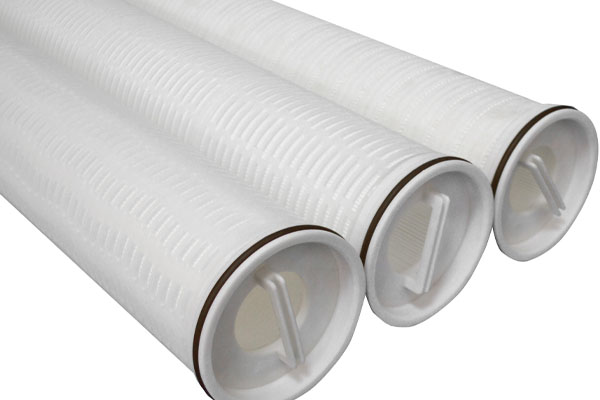
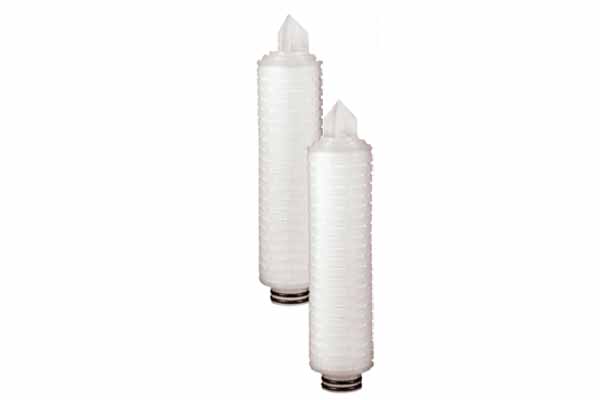
ECOFILTRONE PVDF Pleated Membrane Cartridge
Hydrophilic polyvinylidene fluoride (PVDF) membrane, pleated, absolute-rated 0.1–10 µm. Excellent resistance to acids (all concentrations), alkalis (pH ≤12), oxidizers (hypochlorite, peroxide, ozone), and most organic solvents. Temperature rating: 90 °C continuous, 120 °C short-term. DOE/SOE end caps, EPDM or Viton seals. Lengths: 10, 20, 30, 40 inches. For semiconductor, pharmaceutical, chemical process industries. Chemical compatibility chart and immersion test data available.
→ View specifications and compatibility chartsECOFILTRONE PTFE Membrane Cartridge
Hydrophobic polytetrafluoroethylene (PTFE) membrane, pleated or flat-sheet, absolute-rated 0.1–5 µm. Universal chemical resistance — compatible with all acids, alkalis, solvents, and oxidizers. Temperature rating: 200 °C continuous. Requires alcohol pre-wetting for aqueous service or available with surfactant treatment for direct water filtration. DOE/SOE end caps, PTFE or Viton seals. Lengths: 10, 20, 30, 40 inches. For aggressive solvent filtration (DMF, DMSO, chlorinated solvents, aromatic hydrocarbons), strong oxidizers, and high-temperature chemical service.
→ View specificationsECOFILTRONE Sintered Stainless Steel Cartridge (316L)
Porous sintered 316L stainless steel, absolute-rated 1–100 µm. Backwashable, chemically cleanable, zero fiber migration. Excellent resistance to acids (except HCl >5%), alkalis, high temperature (150–400 °C continuous). DOE/SOE end caps. Lengths: 10, 20, 30, 40 inches. For high-temperature chemical filtration, corrosive gases, and long-life backwashable service. Upgrade to 904L, Hastelloy C, or titanium for chloride-containing or hydrofluoric acid service.
→ View specifications
ECOFILTRONE provides detailed chemical compatibility tables, immersion test reports (weight change, dimensional change, tensile strength retention after 30-day immersion), and material certificates (resin grade, FDA compliance, extractables data) for all chemical-resistant cartridges. Custom seal materials (EPDM, Viton, Kalrez, PTFE) available for extreme chemical service.
6. Common Chemical Compatibility Problems
Problem 1: Cartridge swells, O-ring seals fail, bypass occurs
Causes:
- Filter material absorbs the chemical and swells (5–30% volume increase)
- O-ring material incompatible with the chemical (swells or shrinks)
- Housing not designed to accommodate swollen cartridges
Solutions:
- Switch to a non-swelling material (PTFE swells <1% in all chemicals)
- Match O-ring material to the chemical (Viton for acids/hydrocarbons, EPDM for aqueous, Kalrez for universal compatibility)
- Size housing with clearance for minor swelling (if <5% swelling is acceptable)
Problem 2: Cartridge becomes brittle, cracks under pressure
Causes:
- Oxidizer attack (hypochlorite, ozone, peroxide) on polypropylene, PES, or nylon
- Embrittlement due to prolonged strong base exposure (PP, PVDF)
- Hydrolysis (nylon in hot water or acids)
Solutions:
- Use PTFE (immune to oxidizers and embrittlement) or PVDF (excellent oxidizer resistance)
- Reduce exposure time (replace cartridges more frequently before embrittlement progresses)
- Lower temperature (embrittlement accelerates with heat)
Problem 3: Fibers or polymer fragments appear in the filtrate
Causes:
- Filter material dissolving in the chemical (PP in aromatic solvents, PES in DMF)
- Filter material degrading due to oxidation or hydrolysis
- Housing bypass due to seal failure (not actually a material compatibility issue, but often mistaken for one)
Solutions:
- Immediately stop filtration — contamination is occurring
- Replace with compatible material (consult compatibility tables in §3)
- Inspect housing seals and confirm no bypass paths exist
Problem 4: Cartridge looks intact but particles pass through (loss of micron rating)
Causes:
- Filter media has swollen, enlarging pores
- Chemical has softened the media, allowing particles to deform and pass
- Media structure has degraded microscopically (polymer chain breakage) without visible damage
Solutions:
- Perform integrity testing (bubble point test) — a swollen or degraded membrane will show lower bubble point than specification
- Monitor filtrate particle count or turbidity — if increasing over time, the filter is failing
- Replace with non-swelling material (PTFE or appropriate alternate)
Problem 5: Compatibility chart says "compatible" but field performance is poor
Causes:
- Chart rating is for lower concentration, temperature, or shorter exposure than your actual process
- Chart does not account for pressure cycling, flow surges, or mechanical stress
- Chemical is a mixture and the chart only covers individual components (mixture effects can be synergistic)
Solutions:
- Contact the filter manufacturer with complete process details (chemical, concentration, temperature, flow rate, DP, exposure time)
- Request immersion test data matching your conditions
- Conduct pilot testing before committing to large-scale deployment
7. Frequently Asked Questions
What is the difference between "compatible," "resistant," and "limited" in compatibility charts?
Compatible / Resistant: The material can be used long-term (months to years) without significant degradation. Weight change <2%, no visible damage, mechanical properties retained >90%.
Limited: The material may be acceptable for short-term or intermittent use but will degrade over extended exposure. Weight change 5–10%, some swelling or discoloration, mechanical properties reduced 10–30%. Suitable for batch processes or where frequent cartridge replacement is acceptable.
Incompatible / Not Recommended: The material will fail rapidly (days to weeks). Weight change >10%, visible swelling, cracking, or dissolution. Do not use.
Can I use a polypropylene cartridge in 10% sodium hydroxide?
Yes, at room temperature for short-term use (pH 10–11, <25 °C, <6 months). No, for strong caustic or elevated temperature (50% NaOH, >50 °C, or long-term continuous exposure). PP swells and becomes brittle in concentrated or hot caustic. Use PVDF or PTFE for strong bases.
Why does PTFE work for everything but is not always specified?
PTFE has universal chemical resistance but is hydrophobic (does not wet with water), more expensive, and mechanically weaker than PVDF. For aqueous filtration, PTFE requires pre-wetting with alcohol or surfactant treatment, adding complexity. For most aqueous acid/base/oxidizer applications, PVDF is a better choice — self-wetting, lower cost, higher strength. Use PTFE only when the chemical is incompatible with PVDF (ketones, polar aprotic solvents, strong bases >pH 13) or temperature >120 °C.
Is PES compatible with ethanol or isopropanol?
Yes, alcohols (ethanol, IPA, methanol) are compatible with PES for aqueous-alcohol mixtures or pure alcohol at room temperature. PES is widely used in pharmaceutical sterile filtration of alcohol-based solutions. PES is not compatible with ketones (acetone, MEK), esters, or polar aprotic solvents (DMF, DMSO).
What material should I use for acetone or MEK filtration?
PTFE is the only polymer membrane compatible with ketones (acetone, MEK, MIBK). PVDF, PP, PES, and nylon all swell or crack in ketones. Nylon has limited short-term compatibility with MEK but degrades over time. For long-term ketone service, use PTFE membrane or sintered stainless steel.
How do I know if my filter cartridge has failed due to chemical incompatibility?
Symptoms of chemical attack:
- Swelling (cartridge diameter increases, O-rings don’t seal)
- Softening (cartridge feels pliable, deforms under light pressure)
- Brittleness (cartridge cracks when handled, tears easily)
- Discoloration (white PP turns yellow/brown in oxidizers, nylon yellows in chlorine)
- Differential pressure rise faster than expected (pores clogging or swelling)
- Particles or fibers in filtrate (media dissolving or shedding)
- Loss of integrity (bubble point test fails, lower than specification)
If any of these occur, stop using that material and consult compatibility charts or conduct immersion testing with an alternative material.
Can I use the same filter material for a mixture of chemicals?
Not always. Compatibility with individual chemicals does not guarantee compatibility with the mixture. Some examples:
- Synergistic attack: Alcohol + water may swell nylon more than either alone
- Oxidizer formation: Mixing acids + peroxide creates peracetic acid (more aggressive than either component)
- pH shift: Adding base to an acidic solution changes pH, altering compatibility
Best practice: Test the actual mixture, not just the components. If mixture testing is not possible, choose a material compatible with the most aggressive component and the highest temperature in the process.
What seal material (O-ring) should I use for each filter media and chemical?
| Chemical class | Filter media | Recommended O-ring material |
|---|---|---|
| Acids (pH <4) | PP, PVDF, PTFE | EPDM (general), Viton (high temp/conc.), PTFE (fuming acids) |
| Alkalis (pH >10) | PVDF, PTFE | EPDM (preferred), Viton (limited to pH 12) |
| Hydrocarbons, oils | PP, PVDF, PTFE, nylon | Viton (excellent oil resistance) |
| Aromatic solvents | PTFE | Viton or Kalrez (PP/PVDF O-rings will swell) |
| Ketones, esters | PTFE | Kalrez (universal), PTFE encapsulated (Viton swells in ketones) |
| Oxidizers (hypochlorite, peroxide) | PVDF, PTFE | EPDM (peroxide), Viton (hypochlorite), PTFE (strong oxidizers) |
| Ultrapure water, DI water | PES, PVDF | Silicone (low extractables) or EPDM |
Kalrez (perfluoroelastomer) is universally compatible but expensive. Use only when no other O-ring material works (strong solvents, extreme pH, high temperature).
8. Conclusion
Chemical compatibility governs filter cartridge lifespan, process safety, and product quality in chemical process industries. A filter material that performs flawlessly in water may fail within hours in an incompatible chemical through dissolution, swelling, oxidation, hydrolysis, or embrittlement. Understanding these failure modes and matching materials to process chemistry, concentration, temperature, and exposure time is not optional — it is foundational to reliable filtration system design.
PTFE offers universal chemical resistance and the highest temperature capability but is hydrophobic, mechanically weaker, and more expensive than alternatives. PVDF provides the best balance of chemical resistance (acids, alkalis to pH 12, oxidizers, most solvents), mechanical strength, and cost for the majority of industrial applications, but fails in ketones, esters, and polar aprotic solvents. Polypropylene is cost-effective for aqueous acids and weak bases but incompatible with organic solvents and oxidizers. PES and nylon are limited to aqueous, near-neutral pH applications and should not be used in organic solvent or extreme pH service.
Compatibility charts provide guidance, but real-world performance depends on process-specific conditions. When data is incomplete, conduct immersion testing under actual operating conditions (concentration, temperature, exposure time) before committing to full-scale deployment. Pilot testing, DP monitoring, and post-use cartridge inspection are essential verification steps for chemically aggressive applications.
Material selection is only part of the equation — seal compatibility, housing material, and mechanical design must also be validated. A chemically resistant cartridge with an incompatible O-ring will fail just as surely as an incompatible filter media. Specify seal materials (EPDM, Viton, Kalrez, PTFE) based on the chemical environment, and verify that housings, piping, and instrumentation are also compatible.
Need Help Selecting Chemically Compatible Filter Cartridges?
If you are specifying filters for chemical process applications, share your chemical name, concentration, temperature, flow rate, and whether exposure is continuous or batch. Include any compatibility concerns or past filter failures.
ECOFILTRONE will provide detailed chemical compatibility charts, immersion test reports (weight change, dimensional stability, tensile strength retention), and material/seal recommendations for your specific process conditions.
WhatsApp: +86 131 8896 2285
Sources: Agilent syringe filter compatibility chart · Tisch Scientific material compatibility · Sterlitech chemical compatibility chart · STEMCELL polypropylene compatibility · Cytiva membrane compatibility guide · PTFE vs PVDF comparative analysis · PVDF vs PTFE for engineers · Advanced EMC: PVDF vs PTFE for fluid handling · Atlas Fibre: Material selection for demanding environments · EngineerFix: Chemical compatibility · Roxia: Filter cloth chemical degradation