
Industrial Water Treatment Filtration
Final-barrier particulate removal for RO pretreatment, process water clarification, and equipment protection—delivered through depth, pleated, and string-wound cartridge architectures matched to contaminant load, flow rate, and operating cycle requirements.
✔RO Pretreatment SDI₁₅ < 3 compliance ✔Boiler Feed Iron oxide & hardness control ✔ Process Water Clarification & reuse protection ✔Cooling Tower Scale, biofilm, silt removal✔Wastewater Tertiary polishing & discharge compliance
Operating Environment
Industrial Water Treatment Challenges
Cartridge filtration addresses suspended solids, biological fouling precursors, and upstream treatment carryover to maintain stable downstream performance and reduce chemical/energy consumption.
🌊
High Turbidity & TSS
Seasonal algae blooms, storm runoff, and raw water quality variability demand adaptable filtration strategies—depth media for high-load scenarios, pleated for consistency.
🦠
Biological Fouling Precursors
Bacteria, fungi, and organic matter accelerate RO biofouling. Cartridge filtration captures cells and particulate organic carbon (POC) that feed biofilm formation.
⚙️
Upstream Process Upsets
Coagulant carryover, clarifier breakthrough, and media filter channeling introduce sudden particulate spikes. Cartridges act as the final safeguard before expensive downstream assets.
🧲
Iron Oxide & Scale
Seasonal algae blooms, storm runoff, and raw water quality variability demand adaptable filtration strategies—depth media for high-load scenarios, pleated for consistency.
💧
SDI₁₅ Compliance
Reverse osmosis membrane manufacturers specify SDI₁₅ < 3 (often < 2). Consistent cartridge performance maintains this threshold across seasonal and operational cycles.
⏱️
Operational Continuity
Unplanned shutdowns for membrane cleaning or pump repair are costly. Cartridge differential pressure monitoring enables predictive replacement before fouling propagates downstream.
Contaminant Profile
Common Contaminants in Industrial Water
| CONTAMINANT TYPE | SOURCE | FILTRATION TARGET | RECOMMENDED CARTRIDGE TYPE |
|---|---|---|---|
| Suspended Solids (TSS) | Surface water, clarifier carryover, pipe corrosion | 5–50 μm particulate removal |
↗ melt-blown
↗ string-wound |
| Iron Oxide & Rust | Carbon steel piping, groundwater oxidation | 1–10 μm mechanical capture |
↗ depth-gradient
↗ pleated-nominal |
| Algae & Microorganisms | Open reservoirs, cooling towers, surface water | 3–20 μm cell capture, POC reduction |
↗ pleated-absolute
↗ membrane-pleated |
| Hardness Precipitates | Calcium carbonate, magnesium hydroxide scaling | 10–50 μm crystal removal |
↗ melt-blown
↗ string-wound |
| Silt & Clay Fines | Groundwater, multimedia filter carryover | 1–5 μm colloidal capture |
↗ pleated-depth
↗ high-flow |
| Coagulant Residuals | Alum, ferric chloride, polymer dosing drift | Floc capture before RO (prevents membrane gel layer) | ↗ depth-gradient |
Filtration Objectives
What Cartridge Filtration Achieves
🎯RO Membrane Protection
Reduces fouling layer formation, extends cleaning intervals from 3–4 months to 6–12 months, maintains stable salt rejection and permeate flux across membrane life.
🎯SDI₁₅ & Turbidity Control
Meets RO feed water specification (SDI₁₅ < 3, turbidity < 0.5 NTU) across seasonal variability, prevents warranty voidance, ensures design flux recovery.
🎯Pump & Equipment Longevity
Eliminates abrasive particles from high-pressure pumps, valve internals, and instrumentation—reduces wear-related maintenance by 30–60% in systems with proper prefilter staging.
🎯Process Stability
Buffers upstream treatment variability (clarifier upsets, filter media breakthrough) to deliver consistent water quality to sensitive downstream processes.
🎯Chemical & Energy Efficiency
Lower fouling rates reduce CIP chemical consumption (caustic, acid, biocide) and energy draw from membrane ΔP increases—typical ROI: 8–18 months on cartridge investment.
🎯Regulatory Compliance
Supports discharge permits (tertiary wastewater), boiler water specs (ASME guidelines), and cooling tower silt limits—verifiable via turbidity meters and particle counters.
Product Matching
Related Filter Cartridge Products
The following cartridge families support industrial water treatment applications. Selection depends on contaminant profile, upstream treatment quality, and replacement cycle requirements established in the strategy section above.
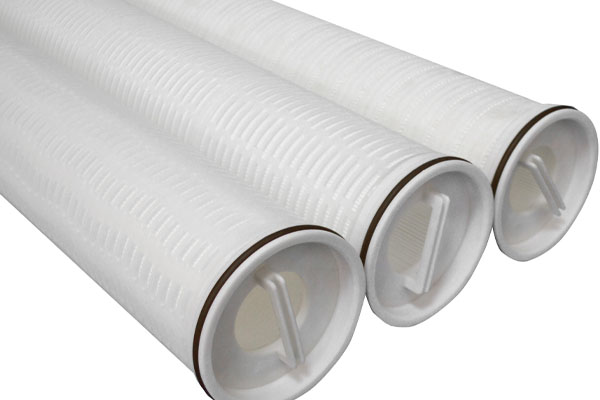
High Flow Filter Cartridge
Multi-layer gradient structure (20 → 5 μm OD-to-ID) for high dirt-holding in TSS-heavy applications. Handles coagulant carryover and clarifier upsets. Economical for frequent-replacement scenarios (< 30 days).
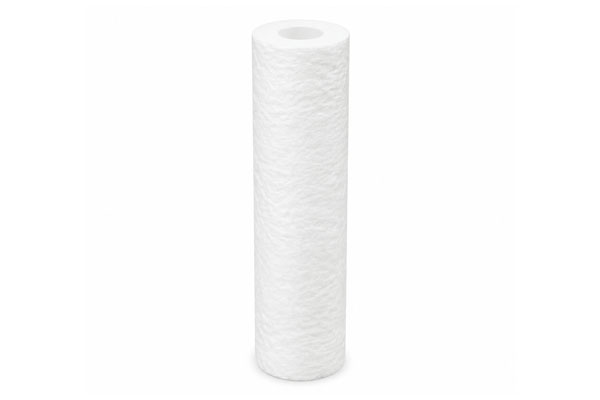
Melt Blown Filter Cartridge
Pure polypropylene thermal-bond construction for chemical compatibility (pH 1–14). Optimal for iron oxide, hardness precipitates, and general TSS removal where broad chemical resistance required.
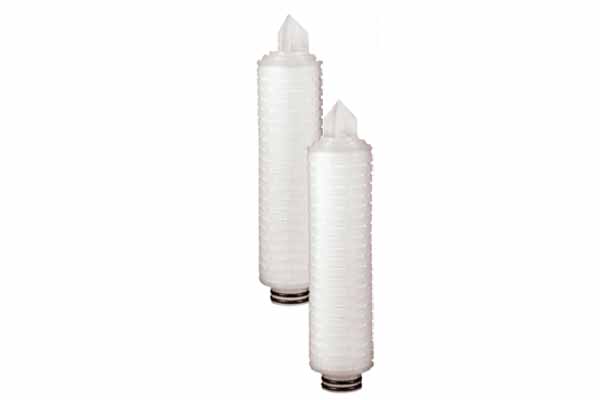
Membrane Pleated Filter (PES)
Absolute-rated 0.22–10 μm for RO pretreatment (SDI control), algae/bacteria capture, and tertiary wastewater polishing. Low extractables, hydrophilic, suitable for biological fouling mitigation.
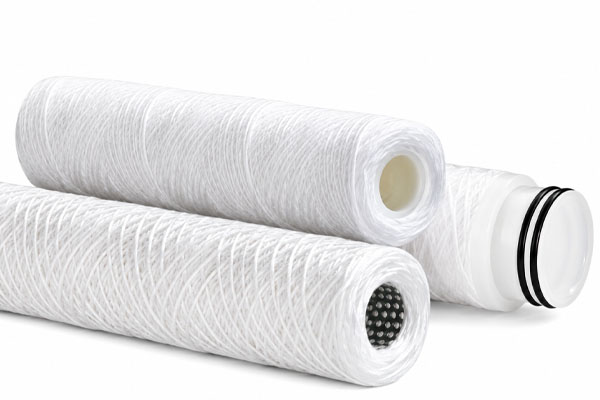
String Wound Filter Cartridge
Textile yarn wound over rigid core with density gradient (loose OD → tight ID). Cost-effective for cooling tower silt, groundwater sediment, and non-critical process water where rating precision not required.
Technical Q&A
Frequently Asked Questions
What is the difference between nominal and absolute filtration ratings in industrial water treatment?
Nominal rating (e.g., “5 μm nominal”) indicates the cartridge removes a percentage of particles at that size (typically 85–95%), but some smaller particles pass through. Suitable for general TSS reduction and equipment protection. Absolute rating (e.g., “1 μm absolute”) guarantees 99.9%+ removal of particles at the specified size—required for RO membrane protection, biological control, and regulatory compliance. Absolute-rated cartridges (pleated membrane types) are more expensive but deliver verifiable, consistent performance. Choose nominal for upstream staging or non-critical applications; choose absolute for final barriers before RO, IX, or sensitive equipment.
Can cartridge filters alone treat high-turbidity surface water for RO feed?
No—not economically or operationally. Cartridge filtration is designed as a polishing step after upstream clarification (coagulation/flocculation/settling, DAF, multimedia filters, or UF). Raw surface water with turbidity > 10 NTU or TSS > 20 mg/L will blind cartridges within hours, making replacement cost prohibitive. Best practice: reduce turbidity to < 1 NTU and TSS to < 5 mg/L via upstream treatment, then use cartridge filtration (5 μm nominal or finer) as the final barrier before RO. This two-tier approach balances capital cost (bulk solids removal upstream) with operational simplicity (cartridge polishing).
Should I use depth or pleated cartridges for boiler feed water filtration?
Depends on upstream treatment and target cycle length. Depth cartridges (melt-blown 5–10 μm) are preferred when condensate return contains iron oxide, corrosion products, or ion exchange resin fines—high dirt-holding capacity handles particulate spikes from system upsets. Pleated cartridges are suitable when feed is pre-polished (low TSS, stable quality) and you need low ΔP, high flow, and longer service life (60–90 days). For makeup water from municipal sources, pleated is often sufficient. For condensate polishing in older systems with carbon steel piping, depth cartridges reduce replacement frequency despite lower surface area. Always verify ASME BFW guidelines for your boiler pressure class—typical spec is < 0.5 mg/L TSS, achieved with 5 μm nominal or finer.
Can filter cartridges remove dissolved salts or hardness from water?
No—cartridge filtration is a mechanical separation process that removes suspended particulates, colloids, and microorganisms based on size exclusion. Dissolved ions (calcium, magnesium, sodium, chloride, TDS) pass through cartridge pores unchanged. To remove dissolved salts, use reverse osmosis (RO), ion exchange (IX), or electrodialysis. Cartridges can remove precipitated hardness (solid calcium carbonate crystals, magnesium hydroxide scale particles) if these form upstream due to pH/temperature shifts, but this is removing the solid phase, not the dissolved ions. For comprehensive water softening or desalination, cartridge filtration serves as pretreatment (protect RO membranes), not the primary treatment.
How often should cartridge filters be replaced in an RO pretreatment system?
Replacement frequency depends on contaminant load, cartridge dirt-holding capacity, and flow rate—not a fixed time interval. Monitor differential pressure (ΔP) continuously: replace when ΔP reaches 15–25 psi above clean baseline (consult cartridge OEM spec). Typical intervals range from 30–90 days in well-treated feed water (TSS < 5 mg/L), down to 7–14 days in high-fouling scenarios (poor upstream treatment, seasonal algae blooms). Calculate expected service life: (Dirt-holding capacity in grams) ÷ (Flow rate × TSS concentration × unit conversion). Always replace before turbidity or SDI₁₅ breakthrough to protect RO membranes—ΔP is the leading indicator.
What is SDI₁₅ and why does it matter for RO systems?
Silt Density Index (SDI₁₅) measures the rate at which a 0.45 μm membrane filter clogs under standard test conditions (15-minute test, 30 psi). It’s the primary metric RO membrane manufacturers use to define acceptable feed water quality—most specify SDI₁₅ < 3, with < 2 preferred for spiral-wound elements. High SDI indicates colloidal fouling potential: particles small enough to pass turbidity meters but large enough to form a gel layer on RO membranes, causing flux decline and cleaning frequency increases. Cartridge filtration (especially pleated absolute-rated types) reduces SDI by capturing fine colloids, floc carryover, and biological cells before they reach membranes.
What causes cartridge ΔP to increase over time?
ΔP increases as cartridges capture particulate matter, gradually filling available pore volume and reducing flow path cross-section. Contributing factors: (1) Mechanical loading—TSS, iron oxide, scale particles physically blocked in media; (2) Biological fouling—bacteria/algae growth on cartridge surface forms biofilm that restricts flow; (3) Chemical fouling—hardness precipitation (if water temperature or pH shifts), coagulant residuals forming gel layer; (4) Compressible solids—organic floc or fiber that compacts under pressure, further reducing permeability. Monitor ΔP with inline gauges (analog or digital transmitter); set alarm at 15 psi and lockout at 25 psi to prevent housing failure or media migration. Sudden ΔP spikes indicate upstream process upsets—investigate before simply replacing cartridges.
What information do I need to provide to select the correct cartridge for my industrial water system?
For accurate cartridge recommendation, specify: (1) Water source & quality—raw water type (surface/ground/municipal), turbidity, TSS (mg/L), SDI₁₅ if available, iron/hardness levels; (2) Flow rate—gpm or m³/h, continuous vs batch; (3) Upstream treatment—coagulation, clarifier, multimedia filters, UF/MF, or direct cartridge filtration; (4) Downstream process—RO feed, boiler makeup, cooling tower, process equipment (defines target filtration rating & SDI requirement); (5) Operating conditions—temperature, pH, chemical exposure (chlorine, acids, caustic); (6) Housing—cartridge length (10″, 20″, 30″, 40″), diameter constraints, existing housing material (SS304/316, FRP, PVC); (7) Target service life—desired days between changeouts (affects cartridge selection & staging strategy). This data enables dirt-holding capacity calculation, material compatibility verification, and cost-per-gallon optimization.
Industrial Water Treatment Filtration Inquiry
Share your water quality data, flow rate, and treatment objectives—our engineering team will recommend cartridge type, housing configuration, and expected service life for your application.
Your Application
RO Pretreatment
Boiler Feed Water
Process Water Clarification
Cooling Tower
Tertiary Wastewater
Other
Water Source
Surface Water
Groundwater
Municipal Supply
Recycled/Reuse
Upstream Treatment
Coagulation/Clarification
Multimedia Filter
UF/MF
None (direct cartridge)