
Melt Blown Filter Cartridge
Polypropylene depth filtration for sediment removal and industrial prefiltration
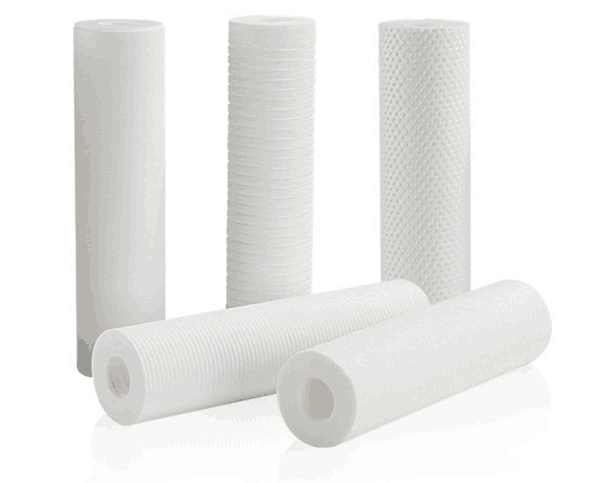
Melt blown filter cartridges use thermally bonded polypropylene microfibers to form a porous filtration matrix for particulate removal in industrial water treatment, RO pretreatment, food and beverage, chemical and wastewater filtration.
Gradient Density Structure
← Outer surface Inner core →
| Filtration mechanism | Depth filtration |
| Media material | Polypropylene |
| Bonding method | Thermal (no binders) |
| Micron rating | Confirm for application |
| Connections | DOE · 222 · 226 families |
Product Overview
PP depth filtration for sediment reduction, equipment protection and prefiltration
Melt blown filter cartridges are polypropylene depth filtration cartridges designed for particulate removal in industrial liquid filtration. The cartridge body is formed from thermally bonded polypropylene microfibers, which produce a porous filtration matrix without binders, adhesives or added chemicals.
ECOFILTRONE supplies melt blown cartridges for sediment reduction, equipment protection, RO pretreatment filtration, and general industrial water treatment filtration. The polypropylene construction provides broad chemical compatibility and low extractables for many process applications, but chemical concentration, temperature, exposure time and the selected seals and hardware must all be reviewed before use.
Melt blown cartridges are not suitable for sterile filtration or validated microbial retention. Where those requirements apply, a membrane pleated cartridge should be evaluated instead.
Stable filtration
Particulate capture for inlet protection, pre-filter duties and general water prefiltration.
Equipment protection
Upstream of pumps, membranes, heat exchangers and other process equipment sensitive to suspended solids.
RO pretreatment
Melt blown cartridges are a cost-effective option for RO pretreatment filtration where membrane-grade retention is not required.
Low extractables
Thermally bonded polypropylene without binders or adhesives — suited to food, beverage and chemical applications subject to compatibility review.
Filtration Technology and Construction
Depth filtration through the full thickness of the fiber structure
Melt blown cartridges use depth filtration technology to capture particles throughout the porous polypropylene fiber structure.
The gradient density structure concentrates finer fibers toward the inner core and coarser fibers toward the outer surface. This arrangement supports progressive particle loading through the cartridge wall and helps distribute contaminant capture across the media thickness rather than concentrating it at the surface.
Cartridge construction typically includes a PP media body, inner support core depending on the design, end caps and sealing components. Construction details should be confirmed by series, especially for replacement applications or housings with specific end-connection requirements.
Construction components
| Media body | Polypropylene microfibers, thermally bonded |
| Bonding method | Thermal — no binders, adhesives or surfactants |
| Inner core | Included or open-core depending on series and design |
| End caps | PP; construction confirmed by series |
| Sealing | Series and housing dependent — confirm before selection |
What depth filtration means for selection — Because particles are captured through the media thickness, dirt-holding capacity depends on contaminant loading, particle size distribution, flow rate and the selected pore rating. Differential pressure monitoring helps determine cartridge replacement timing. For a detailed treatment of depth filtration behavior, see the filter cartridge differential pressure technical guide.
Technical Specifications
Specifications are series-dependent and require confirmation for selection
The table below reflects general product-family direction. Lengths, micron ratings and operating limits must be verified against the selected series before ordering.
| ITEM | DOCUMENTED OPTIONS OR GUIDANCE |
|---|---|
| Filter media | Polypropylene (PP) — thermally bonded microfibers |
| Micron ratings | Multiple micron ratings are available depending on series; confirm the required rating and removal grade for the application before selection. Ratings are not confirmed as a universal product range. |
| Cartridge length | Standard industry lengths are available; confirm the required length against the existing housing or specified dimensions. Published length references from other product families should not be assumed to apply. |
| Typical outside diameter | Confirm against housing specification — not confirmed as a universal product dimension |
| Filtration area | Series-dependent; confirm for the selected cartridge length and design |
| Maximum operating temperature | Configuration-dependent; confirm for selected series and seal material |
| Maximum operating differential pressure | Configuration-dependent; confirm for selected series and operating temperature |
| Sterilization capability | Not confirmed for standard melt blown PP series — confirm by series if required |
| End connections | DOE, 222 and 226 connection families; additional configurations available — confirm interface before selection |
| Seal materials | Silicone, EPDM, FKM / Viton and others — availability depends on series; ↗ chemical compatibility must be reviewed for the complete cartridge |
⚠ Do not use length and diameter alone to confirm fit. End connection, terminal style, seal position and housing interface must also be verified. See the replacement cartridge evaluation section for the complete verification checklist.
Typical Industrial Applications
Five process positions where melt blown cartridges are commonly used
01 / Membrane Systems
RO Pretreatment
Operating challenge
RO systems are sensitive to suspended solids. Inadequate prefiltration can increase membrane fouling and cleaning frequency. The cartridge type and micron rating should be selected to match the actual feed-water condition and the downstream RO membrane requirement.
Filtration requirement
Reliable sediment and particle removal without excessive pressure drop or short operating cycles. Feed quality, turbidity, total flow and cartridge quantity should be reviewed together.
Product direction
Melt blown PP cartridges are a cost-effective option for RO pretreatment filtration where membrane-grade microbial retention is not required. Confirm micron rating and housing compatibility before selection.
02 / Water Treatment
Industrial Water Treatment
Operating challenge
Industrial water systems require consistent particulate control upstream of pumps, heat exchangers, membranes and other sensitive equipment. Feed-water quality and contaminant type can vary with source water conditions and seasonal changes.
Filtration requirement
Reliable sediment removal matched to the particle distribution and equipment protection requirement. Filter cartridge micron rating selection should account for contaminant size and the sensitivity of downstream equipment.
Product direction
Melt blown cartridges are widely used for general industrial water treatment filtration prefiltration where depth filtration behavior and low cost-per-cartridge are primary selection factors.
03 / Food & Beverage
Food and Beverage Filtration
Operating challenge
Food and beverage processes require consistent particle removal, low extractables and compatibility with the process fluid and cleaning procedures. The cartridge must also be appropriate for the sanitation conditions of the specific process.
Filtration requirement
Particle polishing, prefiltration before fine filtration stages, or equipment protection. Media and seal chemical compatibility must be reviewed for the specific fluid, cleaning chemistry and temperature.
Product direction
Thermally bonded PP melt blown cartridges without binders or adhesives are a common direction for food and beverage prefiltration. Micron rating, seal material and housing compatibility must be confirmed for the application.
04 / Chemical Processing
Chemical Process Filtration
Operating challenge
Chemical processes may involve acids, alkalis, solvents or mixed fluids. These can affect the membrane, support layers, hardware and seal materials differently. PP has broad chemical-resistance direction, but chemical compatibility must still be evaluated for each specific fluid.
Filtration requirement
Particle removal from the process filtration stream while maintaining chemical compatibility across the complete cartridge including end caps, seals and any insert components.
Product direction
Melt blown PP cartridges may be evaluated for chemical prefiltration and particle removal duties. Chemical concentration, temperature and exposure duration must be reviewed before selection, and seal material must be confirmed separately.
05 / Wastewater Treatment
Wastewater Reuse Filtration
Operating challenge
Reuse water can contain variable concentrations of suspended solids, organic particles, biological material and residual chemicals. Changes in feed quality can produce unpredictable cartridge life and rapid differential pressure growth.
Filtration requirement
Consistent particle removal upstream of RO, UF or other downstream reuse processes. TSS concentration, contaminant type and operating cycle should be reviewed when selecting micron rating and cartridge quantity.
Product direction
Melt blown cartridges with depth filtration structure may be considered where the primary duty is particulate reduction ahead of downstream treatment. Confirm micron rating, cartridge quantity and filter cartridge differential pressure limits for the actual feed condition.
Other applications
Power plant condensate, amine filtration and process filtration
These higher-value applications have dedicated selection requirements. Send process fluid, flow rate, contaminant type and operating conditions for an application-specific review.
End Connections and Seal Options
Connection family and terminal style must match the installed housing
Documented connection families include DOE, 222 and 226. Terminal style, insert configuration and sealing arrangement should all be confirmed against the existing housing before replacement or new installation.
| CONNECTION FAMILY | COMMON CONFIGURATIONS |
|---|---|
| DOE | Double open end |
| 222 | 222 / Flat, 222 / Fin, 222 Extended / Flat, 222 Extended / Fin — confirm terminal style for the housing |
| 226 | 226 / Flat, 226 / Fin — confirm terminal style and insert configuration for the housing |
| Additional | Other connection configurations may be available — confirm against existing cartridge or housing drawing |
Seal materials
Documented seal materials include Silicone, EPDM and FKM / Viton. PTFE is available in selected configurations. Seal availability depends on the cartridge series and construction. chemical compatibility should be evaluated for the membrane, hardware and sealing materials together before final selection.
Terminal styles are not interchangeable. Flat and Fin terminals engage differently with housing knife-edge or bayonet seating. Confirm the installed housing type before specifying a replacement connection configuration.
Chemical Compatibility
Compatibility applies to the complete cartridge, not only the PP media
Polypropylene media provides broad chemical compatibility direction for many process fluids. However, compatibility must be evaluated for the complete cartridge: the media, support structure, end caps, seals and any insert components may respond differently to the same fluid.
Actual suitability depends on chemical concentration, temperature, exposure duration, pressure, mixture composition and cleaning cycle. A chemically resistant media does not automatically make the complete cartridge compatible if the selected seal or hardware material is unsuitable for the process fluid.
⚠ Mixed chemicals, CIP fluids and elevated temperatures — For mixed chemicals, proprietary formulations, CIP cleaning fluids or high-temperature exposure, provide full process conditions for material review before cartridge selection.
Selection Guide
Eight steps to a verified melt blown cartridge specification
1⃣️
Define the process fluid: water, industrial liquid, food or beverage, chemical solution, acid, alkali or other fluid. Confirm whether the PP media and all hardware materials are compatible.
2⃣️
Define the filtration objective: sediment removal, equipment protection, RO pretreatment filtration, general prefiltration, or upstream particle reduction before a finer filter stage.
3⃣️
Identify the contaminant type: suspended solids, sand, rust and corrosion products, sediment, organic particles or other materials. Contaminant size, concentration and loading rate affect micron rating selection and service life.
4⃣️
Select the required filter cartridge micron rating. A lower micron rating does not automatically improve results — selecting a finer rating than the contaminant requires can increase pressure drop and reduce cartridge life without improving system performance.
5⃣️
Review chemical compatibility for the PP media, end caps, seal material and any insert components. Confirm compatibility for the specific fluid concentration, temperature and exposure duration.
6⃣️
Confirm operating temperature, maximum differential pressure, flow rate and fluid viscosity. These determine whether the selected series is suitable and whether internal support is required.
7⃣️
Confirm cartridge length and outside diameter against the housing specification. Do not assume that a nominal length designation is interchangeable between manufacturers without dimensional verification.
8⃣️
Confirm end connection family, terminal style and seal material against the installed housing. See the replacement cartridge evaluation section for the complete interface checklist.
Replacement and Compatibility Considerations
Length and diameter alone do not confirm a compatible replacement
Two cartridges with the same nominal length and micron rating may still have different end connections, terminal geometry, seal positions, insert materials or housing sealing interfaces. These differences can prevent correct installation or allow bypass in service.
For replacement cartridge evaluation, provide available information including: existing manufacturer and model number, cartridge length and outside diameter, filter media, micron rating, end connection family, terminal style, O-ring quantity and position, seal material, housing model, process fluid, operating temperature and pressure.
Photographs accelerate verification. Photographs of the full cartridge, top end, bottom end, O-ring area and any model markings help confirm the housing interface when the existing model code is unclear or the manufacturer is unavailable.
Dimensional check
Overall length, outside diameter, seal diameter and position, end geometry, support interface, installation clearance and housing seating dimensions.
Connection and terminal check
End connection family (DOE, 222, 226), terminal style (Flat, Fin), insert configuration and O-ring arrangement confirmed against the installed housing.
Operating condition check
Normal and peak flow, operating and change-out differential pressure, process temperature, fluid chemistry and contaminant loading — confirm before supply.
ECOFILTRONE Engineering Support
Selection, replacement evaluation and custom configuration
ECOFILTRONE supports melt blown filter cartridge selection for new installations, replacement projects and customized configuration requirements. Engineering review may include micron rating selection, chemical compatibility review, end connection confirmation, seal material selection and replacement cartridge evaluation.
For quotation or technical recommendation, send available project information:
| INFORMATION TYPE | USEFUL DETAILS |
|---|---|
| Application | Industry, process position and filtration objective |
| Process fluid | Fluid name, concentration, pH, temperature and mixture composition |
| Contaminant | Particle type, suspended solids, sediment or other removal target |
| Filtration requirement | Required micron rating, removal grade and any downstream equipment sensitivity |
| Operating conditions | Flow rate, operating pressure, differential pressure, current cartridge life and cleaning chemistry |
| Existing cartridge | Manufacturer, model number, length, outside diameter, micron rating and photos |
| Housing interface | Housing model, end connection, terminal style, O-ring arrangement and seal material |
| Documentation | Drawings, photos, operating data or replacement samples when available |
Frequently Asked Questions
Melt blown filter cartridge — technical questions
What is a melt blown filter cartridge?
A melt blown filter cartridge is a polypropylene depth filtration cartridge formed from thermally bonded microfibers. It is used for sediment removal, particle prefiltration, equipment protection and general industrial liquid filtration. It does not use binders or adhesives in the documented construction direction.
How do I select the right micron rating?
Start with the contaminant size distribution and the protection requirement of downstream equipment. A lower rating does not automatically improve performance — selecting a finer rating than required can increase pressure drop and shorten cartridge life without improving system protection. See the filter cartridge micron rating selection guide for details.
How does differential pressure indicate when to replace the cartridge?
Differential pressure monitoring helps determine cartridge replacement timing. As contaminants accumulate in the depth structure, resistance increases and differential pressure rises. A pre-set change-out differential pressure is typically used as the replacement trigger. For a full explanation of pressure behavior, see the filter cartridge differential pressure guide.
Can melt blown cartridges be used for RO pretreatment?
Yes, where the duty is sediment and particle removal ahead of RO membranes and membrane-grade microbial retention is not required. Melt blown PP cartridges are a cost-effective option for RO pretreatment filtration. Micron rating, cartridge quantity and differential pressure limits should be confirmed for the actual feed-water condition.
What is the difference between melt blown and membrane pleated cartridges?
Melt blown cartridges use depth filtration through the PP fiber structure for particulate removal. Membrane pleated cartridges use a defined-pore membrane layer for finer particle retention or microbial load reduction. Melt blown cartridges are not suitable where sterile filtration or validated microbial retention is required.
Are melt blown cartridges chemically compatible with my process fluid?
Polypropylene media provides broad chemical-resistance direction, but chemical compatibility must be evaluated for the complete cartridge including end caps, seals and any insert components. Provide fluid name, concentration, pH, temperature and exposure duration for a compatibility review.
What information is needed for a replacement evaluation?
Provide the existing manufacturer, model number, cartridge dimensions, micron rating, end connection, terminal style, O-ring arrangement, seal material, housing model, process fluid and operating conditions. Cartridge photographs help confirm the interface when the model code is unclear. See the replacement cartridge evaluation checklist for the complete list.
Are melt blown cartridges suitable for sterile or pharmaceutical filtration?
No. Melt blown PP cartridges are not suitable for sterile filtration or validated microbial retention. Where those requirements apply, a membrane pleated cartridge with appropriate validation data should be evaluated instead.
Request a Selection Review
Send your process conditions — we return a cartridge selection assessment
Include application, process fluid, chemical concentration, pH, temperature, contaminant type, required micron rating, flow rate, operating pressure, differential pressure, current cartridge life, manufacturer, model number, dimensions, end connection, terminal style, seal material, housing model, photographs, drawings and cleaning chemistry where available.