Content showData grading: (rated) = manufacturer specification · (typical) = commonly observed industry range · (cited) = published standard or reference · (illustrative) = approximate reference value
Introduction
Amine gas treating — also known as amine scrubbing, gas sweetening or acid gas removal — uses aqueous solutions of alkanolamines (MEA, DEA, MDEA, DGA and specialty formulations) to remove hydrogen sulfide (H₂S) and carbon dioxide (CO₂) from natural gas, refinery streams, synthesis gas and other hydrocarbon vapors (cited, Wikipedia amine gas treating). The amine circulates continuously through an absorber (where it contacts the sour gas and absorbs H₂S and CO₂) and a regenerator (where heat strips the acid gases back out, regenerating the lean amine for reuse).
The problem every amine system operator knows: the circulating amine becomes contaminated. Iron sulfide (FeS) particulates form from corrosion and reaction with H₂S. Activated carbon fines carry over from the carbon bed that protects the amine from hydrocarbon contamination. Amine degradation products accumulate from thermal breakdown in the regenerator and oxidative degradation in the absorber. Hydrocarbons enter the system through liquid carryover in the feed gas. These contaminants cause foaming, fouling, reduced acid gas pickup, corrosion, pump seal failures, reboiler tube failures and exchanger plugging (cited, Pall sour gas treating amine units brochure).
Filtration is the primary method for removing particulate contamination from circulating amine, but amine service is uniquely challenging: high temperature (60–90 °C in the rich amine return, up to 115–130 °C in the lean amine after the reboiler), chemically aggressive environment (amine solutions are mildly alkaline and corrosive to some materials), fine particulate (iron sulfide is predominantly sub-10 µm), and the consequence of filter failure includes not only fouling but also foaming that can shut down the entire gas treating unit.
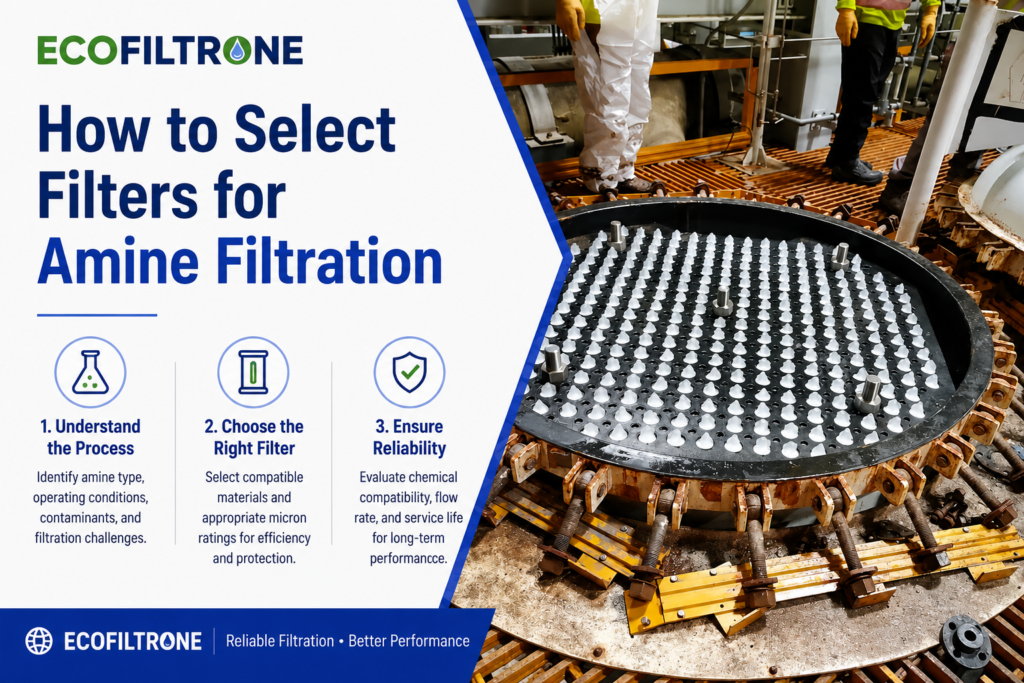
This guide explains the contaminants found in amine systems, where filters should be located, how to select micron rating and media type for amine service, which materials are compatible with MEA, DEA, MDEA and DGA, and how to size filtration for iron sulfide, carbon fines and hydrocarbon removal.
Key Takeaways
- Iron sulfide (FeS) is the dominant particulate contaminant in amine systems, formed from corrosion and reaction with H₂S. FeS is predominantly less than 10 µm in size (cited, Pall amine units brochure), requiring fine filtration (5–10 µm) to protect exchangers, pumps and the regenerator.
- Activated carbon fines carry over from the carbon bed used to remove hydrocarbons from the amine. These fines blind filters rapidly and are typically removed by a dedicated prefilter (25–50 µm) upstream of the main amine filter.
- Temperature is the filter selection constraint. Polypropylene, the most common filter material, is limited to approximately 80 °C (176 °F). Hot lean amine returning from the regenerator can exceed 100–130 °C, requiring PVDF, PES or stainless steel filter elements.
- Foaming is triggered by hydrocarbons, not by particulate. A liquid/gas coalescer on the feed gas upstream of the absorber prevents hydrocarbon liquid carryover from entering the amine, eliminating the primary cause of foaming.
- Amine chemistry (MEA, DEA, MDEA) determines filter material compatibility. MEA is the most aggressive; MDEA is the least. Polypropylene is generally compatible with all amines at moderate temperature; PVDF and PTFE are preferred for hot or high-concentration service.
- Filtration alone does not restore degraded amine. Amine reclaiming (vacuum distillation or ion exchange) is required to remove heat-stable salts, degradation products and dissolved contaminants. Filtration removes only particulates.
Quick Answer
For iron sulfide and carbon fines removal from circulating amine:
- Prefilter upstream of carbon bed: 25–50 µm melt-blown polypropylene or pleated cartridge, rated to amine operating temperature (typically 60–80 °C in rich amine service).
- Final filter downstream of carbon bed: 5–10 µm polypropylene depth or pleated cartridge, or 5–10 µm PVDF/PES if temperature exceeds 80 °C. This filter protects lean/rich exchangers, pumps and the regenerator internals.
- Hot lean amine filter (after reboiler, 100–130 °C): 10–25 µm PVDF, PES or stainless steel sintered cartridge. Polypropylene is not suitable for this duty due to temperature.
- Feed gas liquid knockout upstream of absorber: Liquid/gas coalescer to remove entrained hydrocarbons and prevent foaming. This is not an amine filter — it is on the gas side, before gas contacts the amine.
1. Amine Treating Process Overview
A typical amine treating unit consists of:
Sour gas (with H₂S, CO₂)
        ↓
Feed gas knockout drum (removes liquids)
        ↓
Absorber (contactor) ← Lean amine in
        ↓
Sweet gas out (H₂S, CO₂ removed)

Rich amine out (with absorbed H₂S, CO₂)
        ↓
Rich amine filter (removes FeS, carbon fines)
        ↓
Lean/rich heat exchanger
        ↓
Regenerator (stripper)
        ↓  heat
Acid gas out (H₂S, CO₂ stripped)

Lean amine (regenerated)
        ↓
Reboiler
        ↓
Lean amine cooler
        ↓  optional: hot lean amine filter
Activated carbon bed (removes hydrocarbons)
        ↓  optional: post-carbon filter
Lean amine back to absorber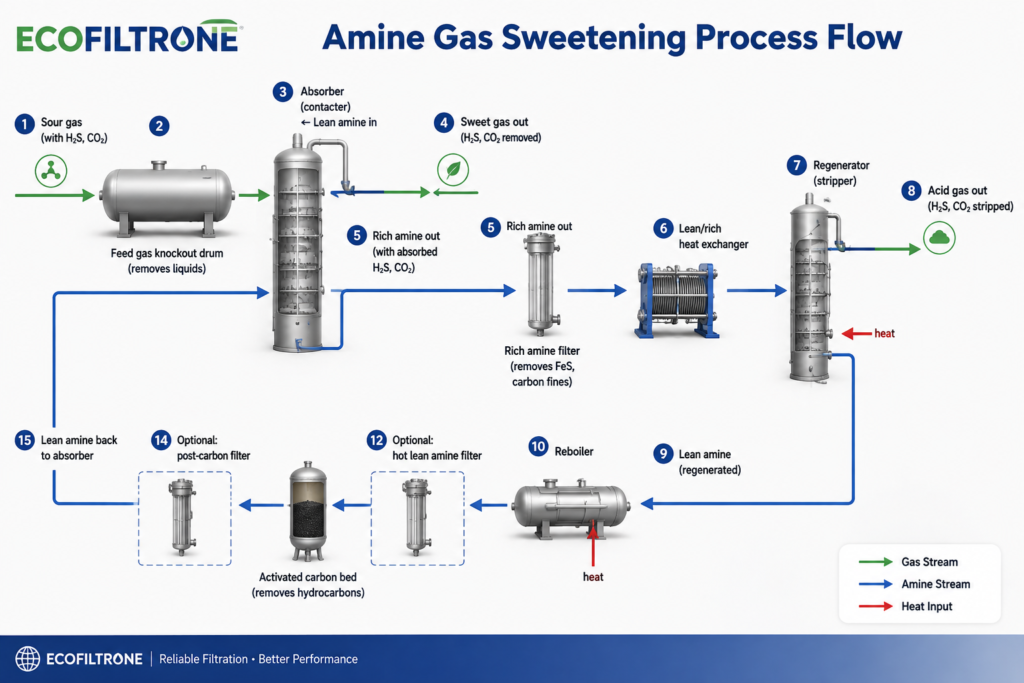
Filters are installed at multiple points:
- Feed gas liquid knockout / coalescer — upstream of the absorber, on the gas side. Removes entrained liquids (water, condensate, hydrocarbons) from the feed gas before it contacts the amine. Prevents foaming.
- Rich amine filter — after the absorber, before the lean/rich exchanger. Removes iron sulfide and particulate picked up from the contactor and circulating system. Temperature: 60–80 °C (typical).
- Post-carbon filter — after the activated carbon bed. Removes carbon fines that elute from the carbon. Protects the lean amine pump and contactor internals. Temperature: 50–70 °C (typical).
- Hot lean amine filter (optional, not always installed) — after the reboiler, before the carbon bed or before returning to the absorber. Removes degradation products and particulate at high temperature (100–130 °C). Requires high-temperature-rated elements.
2. Contaminants in Amine Systems
2.1 Iron Sulfide (FeS)
Source: Corrosion of carbon steel piping, vessels and internals in the presence of H₂S. FeS forms as a black, fine particulate.
Particle size: Predominantly less than 10 µm (cited, Pall amine units brochure), with a fraction below 5 µm. Very fine and difficult to settle or separate.
Problems caused:
- Fouling of heat exchangers (lean/rich exchanger, reboiler tubes)
- Tray plugging in both the absorber and regenerator
- Pump seal failures from abrasive particulate
- Erosion of piping and fittings at high velocity
- Increased pressure drop across contactor trays and packing
Filtration requirement: 5–10 µm filtration is required to remove the bulk of FeS. Finer filtration (1–3 µm) is sometimes specified for high-purity or critical service, but increases filter change-out frequency significantly.
2.2 Activated Carbon Fines
Source: Elution from the activated carbon bed used to remove hydrocarbons from the amine. Carbon fines (fine carbon dust) are released continuously but increase significantly after fresh carbon is loaded or when the bed is backwashed.
Particle size: 1–100 µm, broad distribution. Fine carbon dust is predominantly 5–20 µm.
Problems caused:
- Rapid filter blinding — carbon fines have high surface area and low density, producing steep differential pressure rise
- Carryover to absorber — carbon fines in the lean amine can be carried over into the sweet gas, fouling downstream compressors or burners
- Black color in amine — aesthetic problem, also an indicator of carbon bed deterioration
Filtration requirement: A prefilter upstream of the carbon bed (25–50 µm) removes coarse particulate and protects the carbon from FeS fouling. A post-carbon filter (5–10 µm) downstream of the carbon bed removes carbon fines before they reach the absorber.
2.3 Amine Degradation Products
Source: Thermal degradation in the regenerator reboiler (above 120 °C) and oxidative degradation in the absorber (oxygen ingress from feed gas or leaks). MEA degrades faster than DEA or MDEA (cited, ResearchGate degradation studies).
Nature: Heat-stable salts (HSS), organic acids, polymeric compounds. These are dissolved or colloidal, not particulate.
Problems caused:
- Reduced acid gas pickup — degradation products consume amine capacity
- Increased corrosion — some degradation products are corrosive to steel
- Foaming — certain degradation products reduce surface tension
- Viscosity increase — polymerized degradation products thicken the amine
Filtration limitation: Standard particulate filters do not remove dissolved degradation products. Amine reclaiming (vacuum distillation or ion exchange) is required to restore the amine. Filtration only removes particulate contaminants.
2.4 Hydrocarbons
Source: Liquid hydrocarbons (condensate, natural gas liquids, oil) enter the absorber with the feed gas as entrained droplets or mist.
Problems caused:
- Foaming — hydrocarbons mix with amine, reducing surface tension and causing severe foaming in the absorber. Foam carryover contaminates the sweet gas and can shut down the unit (cited, Pall amine units brochure).
- Amine losses — foaming carries amine out of the absorber, resulting in high amine makeup cost and environmental discharge
- Off-spec product — foamed amine in the sweet gas causes downstream equipment fouling
Filtration solution: Install a liquid/gas coalescer on the feed gas line upstream of the absorber. This coalescer removes virtually all entrained liquids from the feed gas before it contacts the amine, eliminating hydrocarbon-induced foaming at the source. The coalescer is on the gas side, not in the amine loop.
After hydrocarbons enter the amine, they are removed by the activated carbon bed in the lean amine loop. The carbon adsorbs dissolved and emulsified hydrocarbons, preventing them from returning to the absorber.
2.5 Other Contaminants
- Weld slag, mill scale, pipe scale — introduced during construction or turnaround. Removed by startup flushing and filtration.
- Elemental sulfur — can form in the presence of oxygen and H₂S. Appears as fine yellow particulate.
- Corrosion inhibitor residues — some corrosion inhibitors form insoluble precipitates. Removed by filtration.
3. Filter Location and Function
3.1 Feed Gas Liquid Knockout / Coalescer (Gas Side)
Location: Feed gas line, upstream of the absorber inlet.
Function: Remove entrained liquid droplets (water, hydrocarbons, condensate) from the feed gas before it contacts the amine.
Filter type: Liquid/gas coalescer — a two-stage element that coalesces fine mist into larger droplets, which then drain by gravity to a knockout sump.
Micron rating: Not applicable — coalescers work by droplet coalescence, not by sieving a specific particle size.
Materials: Typically polypropylene, glass fiber or specialty coalescing media. Temperature depends on feed gas conditions — usually ambient to 60 °C.
Critical note: This is the single most effective intervention to prevent foaming in amine systems. Removing hydrocarbons before they contact the amine is far more effective than trying to remove them after contamination.
3.2 Rich Amine Filter (Amine Side, Post-Absorber)
Location: Rich amine line, after the absorber bottom, before the lean/rich heat exchanger.
Function: Remove iron sulfide, carbon fines and particulate picked up in the absorber and circulating system. Protect the lean/rich exchanger, regenerator internals and downstream equipment.
Filter type: Cartridge filter — melt-blown polypropylene depth or pleated polypropylene/PES.
Micron rating: 5–10 µm nominal (typical). 5 µm provides good FeS removal; 10 µm extends service life if FeS loading is moderate. Some operators use 25 µm as a prefilter and 5 µm as a final filter in a two-stage configuration.
Materials: Polypropylene at this location is acceptable if rich amine temperature is below 80 °C. If temperature exceeds 80 °C, use PES or PVDF.
Flow rate: Size for the full rich amine circulation rate. In a 100 MMscfd (million standard cubic feet per day) gas plant, rich amine circulation is typically 200–500 gpm (45–115 m³/h) (typical, varies by amine concentration and acid gas loading).
3.3 Post-Carbon Filter (Amine Side, After Carbon Bed)
Location: Lean amine line, after the activated carbon bed, before the lean amine pump or before returning to the absorber.
Function: Remove activated carbon fines eluted from the carbon bed. Protect lean amine pump seals and absorber internals from carbon carryover.
Filter type: Cartridge filter — depth or pleated.
Micron rating: 5–10 µm nominal (typical). Must be fine enough to capture carbon dust, which is predominantly 5–20 µm.
Materials: Polypropylene is suitable if lean amine temperature at this point is below 80 °C (which it typically is, after cooling). PES or PVDF if temperature is elevated.
Note: Some plants install a prefilter upstream of the carbon bed (25–50 µm) to remove coarse FeS and protect the carbon from fouling. This extends carbon bed life and reduces the fines load on the post-carbon filter.
3.4 Hot Lean Amine Filter (Optional, High-Temperature Location)
Location: Lean amine line, immediately after the regenerator reboiler (before the lean amine cooler), or after the cooler if the cooler does not reduce temperature below 90 °C.
Function: Remove particulate and degradation products at high temperature, protecting the carbon bed and downstream equipment. Not always installed — many plants rely on the rich amine filter alone.
Filter type: Cartridge filter — must be rated for high temperature.
Micron rating: 10–25 µm nominal (typical). Finer than necessary for this location increases DP and shortens life without significant benefit.
Materials: PVDF, PES or stainless steel sintered elements. Polypropylene is not suitable — hot lean amine after the reboiler is typically 100–130 °C (typical), well above polypropylene’s 80 °C limit.
Temperature: Confirm the actual lean amine temperature at this location from plant data. If above 90 °C, polypropylene and standard PES are unsuitable. PVDF (rated to 100 °C) or stainless steel (rated to 400+ °C) are required.
4. Filter Material Compatibility with Amines
4.1 Amine Chemistry Background
The most common amines used in gas treating:
| Amine | Full name | Typical concentration | Operating temperature | Aggressiveness |
|---|---|---|---|---|
| MEA | Monoethanolamine | 15–20 wt% | 100–120 °C | Most aggressive; fast CO₂ reaction, high corrosion rate |
| DEA | Diethanolamine | 20–30 wt% | 100–120 °C | Moderate; slower than MEA, less corrosive |
| MDEA | Methyldiethanolamine | 40–50 wt% | 100–130 °C | Least aggressive; selective for H₂S over CO₂ |
| DGA | Diglycolamine | 50–60 wt% | 100–120 °C | High concentration, low corrosion |
All amines are mildly alkaline (pH 10–12 in aqueous solution) and can degrade certain polymers over time, especially at elevated temperature (cited, 3M amine gas treating filtration guide).
4.2 Material Compatibility Table
| Material | MEA compatibility | DEA compatibility | MDEA compatibility | Max temperature in amine | Notes |
|---|---|---|---|---|---|
| Polypropylene | Good at < 70 °C; caution at 70–80 °C | Good at < 80 °C | Good at < 80 °C | 80 °C | Most common material for rich amine and post-carbon filters. Avoid in hot lean amine service. |
| PES (polyethersulfone) | Good | Good | Good | 80 °C | Hydrophilic, low protein binding. Suitable for amine service at moderate temperature. |
| PVDF | Excellent | Excellent | Excellent | 90–100 °C | Preferred for hot lean amine (100–130 °C after reboiler). Excellent chemical resistance to amines. |
| PTFE | Excellent | Excellent | Excellent | 200 °C | Suitable for all amine service including high-temperature. Cost premium over PVDF. |
| Stainless steel 316L | Excellent | Excellent | Excellent | 400+ °C | Reusable, suitable for hot lean amine. Initial cost is high but lifecycle cost can be favorable. |
| Nylon | Poor | Poor | Poor | Not recommended | Nylon degrades in alkaline solutions. Do not use in amine service. |
| Cellulose | Poor | Poor | Poor | Not recommended | Cellulose degrades in alkaline solutions and elevated temperature. Do not use. |
4.3 Seal Material Compatibility
| Seal material | Amine compatibility | Max temperature in amine service |
|---|---|---|
| EPDM | Good | 120 °C |
| Nitrile (NBR) | Fair — acceptable for MEA/DEA; some swelling in MDEA with hydrocarbon contamination | 100 °C |
| Fluoroelastomer (FKM/Viton) | Excellent | 150 °C (limited by hydrolysis in hot water/amine above 150 °C) |
| PTFE | Excellent | 200 °C |
For most amine filtration applications, EPDM seals are the standard choice — good amine compatibility, suitable for temperatures to 120 °C, and lower cost than fluoroelastomer.
5. Micron Rating Selection
5.1 Iron Sulfide Removal
Iron sulfide particulate in amine systems is predominantly sub-10 µm (cited, Pall amine units brochure). To remove the bulk of FeS and protect heat exchangers and pumps, 5–10 µm nominal filtration is required.
5 µm nominal: Removes the majority of FeS (typically 85–95% by mass) and provides good protection for exchangers and regenerator internals. Change-out frequency is higher than 10 µm due to finer rating.
10 µm nominal: Removes coarse FeS and reduces filter change-out frequency. Fine FeS below 5 µm passes through, but the bulk of the mass load is captured. Adequate for many amine systems where exchanger fouling is moderate.
25 µm nominal: Used as a prefilter upstream of a 5–10 µm final filter, or as the sole filter in systems with low FeS loading. Does not remove fine FeS effectively.
1–3 µm nominal or absolute: Provides very fine FeS removal but at the cost of high DP and frequent change-outs. Rarely justified unless downstream equipment is extremely fouling-sensitive (e.g., high-efficiency plate-and-frame exchangers or high-speed centrifugal pumps).
5.2 Activated Carbon Fines Removal
Activated carbon fines range from 1–100 µm, with the bulk of eluted fines in the 5–20 µm range. 5–10 µm filtration downstream of the carbon bed is required to prevent carbon carryover to the absorber.
A 25–50 µm prefilter upstream of the carbon bed is often installed to protect the carbon from FeS fouling. This prefilter does not remove carbon fines (they form downstream of it) but extends carbon bed life by reducing FeS loading.
5.3 Depth vs Pleated Media
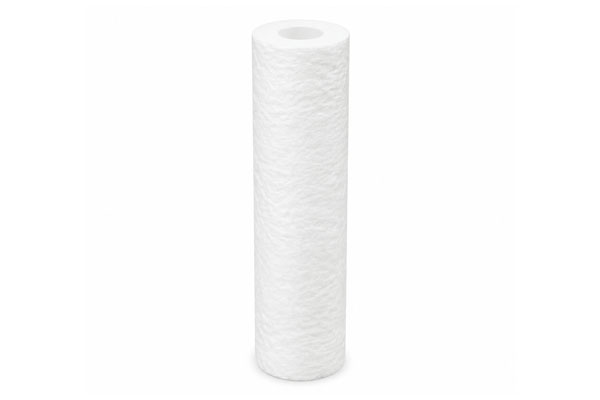
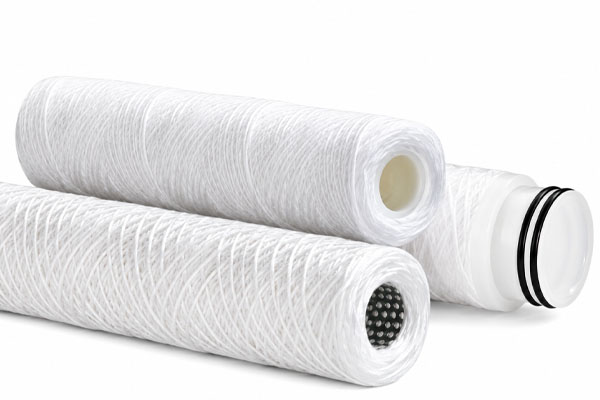
Melt-blown polypropylene depth cartridges are the industry standard for amine filtration. They offer high dirt holding capacity for FeS and carbon fines, gradient density structure for progressive loading, and thermal bonding (no adhesives or binders to leach into the amine).
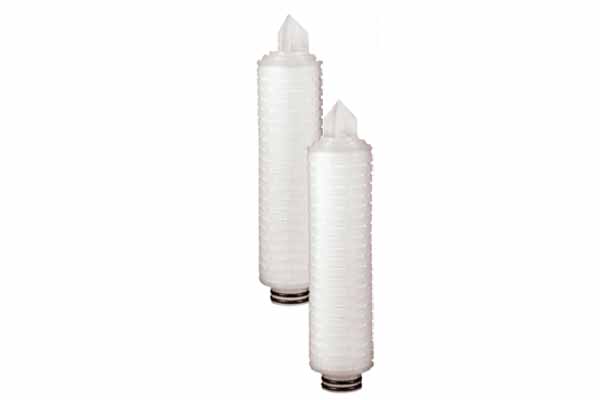
Pleated polypropylene or PES cartridges offer higher surface area and lower initial DP than depth cartridges at the same nominal micron rating. They are suitable for clean amine service (post-carbon filter, for example) but blind faster than depth cartridges when FeS loading is high. Pleated is preferred for absolute-rated applications (rare in amine treating) or when element count must be minimized.
For FeS-laden rich amine: use melt-blown depth cartridges (5–10 µm nominal) for maximum dirt holding capacity.
For post-carbon fine filtration: pleated cartridges (5–10 µm) are acceptable and offer lower DP.
6. Sizing and Flow Rate Considerations
Amine circulation rates depend on gas throughput, amine concentration and acid gas loading. A typical rule of thumb for natural gas treating is 2–5 gallons of amine circulation per thousand standard cubic feet of gas treated (typical).
Example sizing:
- Gas plant capacity: 100 MMscfd (million standard cubic feet per day)
- Amine circulation: 300 gpm (68 m³/h) (typical, MDEA at 45 wt%)
- Filter location: Rich amine, post-absorber
Conventional 2.5 in OD cartridge sizing:
A 40 in × 2.5 in melt-blown polypropylene cartridge at 5 µm nominal handles approximately 1.5–2 m³/h (6–9 gpm) at acceptable clean DP (typical).
For 68 m³/h (300 gpm), element count = 68 / 1.7 ≈ 40 elements in a multi-round housing.
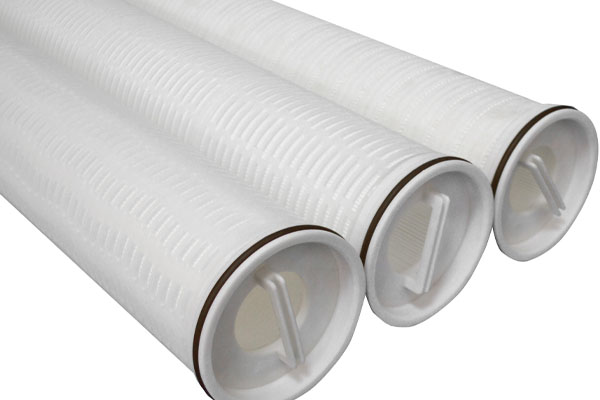
High flow 6 in OD cartridge sizing:
A 60 in × 6 in high flow cartridge at 5 µm nominal handles approximately 60–80 m³/h (265–350 gpm) (typical, depending on media structure and DP allowance).
For 68 m³/h, element count = 68 / 70 ≈ 1 element (or 2 elements for redundancy and margin).
High flow format reduces element count, housing footprint and maintenance labor. It is cost-effective for amine circulation rates above 100–150 gpm (23–34 m³/h).
DP budget: Amine system pumps typically operate at 5–15 bar discharge pressure. Filter DP should be sized to 0.5–1.0 bar (7–15 psi) clean DP, 2.0–2.5 bar (29–36 psi) change-out DP (typical). Confirm the available DP budget from the pump curve and system hydraulics before sizing.
7. High-Temperature Amine Filtration (Hot Lean Amine)
Hot lean amine after the regenerator reboiler can reach 100–130 °C (typical). Standard polypropylene cartridges (rated to 80 °C) are unsuitable for this duty. Three material options are available:
7.1 PVDF Membrane Cartridges
Temperature rating: 90–100 °C continuous (rated), 135 °C short-term.
Micron rating: Typically 10–20 µm nominal or absolute, depending on construction.
Advantages: Excellent chemical resistance to all amines, suitable for temperatures to 100 °C, lower cost than PTFE or stainless steel.
Limitations: PVDF cartridges are predominantly pleated, not depth. For applications with high FeS or particulate loading, they may blind faster than depth cartridges. PVDF is also more expensive than polypropylene (typically 2–4× cost per element).
Best for: Hot lean amine filtration at 100–115 °C where disposable elements are preferred and particulate loading is moderate.
7.2 PTFE Membrane Cartridges
Temperature rating: 200 °C continuous (rated).
Advantages: Universal chemical compatibility, highest temperature capability, suitable for all amine types and temperatures.
Limitations: High cost (5–10× polypropylene cost per element). Hydrophobic (requires pre-wetting or surfactant treatment for aqueous amine). Higher DP than polypropylene depth media at the same nominal rating.
Best for: High-temperature amine service above 120 °C, or when chemical compatibility with specialty amine formulations or additives is uncertain.
7.3 Stainless Steel Sintered Elements
Temperature rating: 400+ °C continuous (rated).
Advantages: Reusable — elements are backwashed or chemically cleaned and reinstalled. No thermal degradation. Suitable for all amine types and temperatures. Lifecycle cost per cubic meter filtered can be lower than disposable cartridges in continuous high-temperature duty.
Limitations: High initial cost (10–50× a disposable cartridge). Heavier than polymer elements. Requires housing designed for backwash or removal for offline cleaning. Not suitable for hydrochloric or hydrofluoric acid cleaning agents (corrosion risk).
Best for: Continuous hot lean amine duty at 110–130 °C in large gas plants where lifecycle cost and waste reduction are priorities.
8. Common Amine Filtration Problems and Solutions
Problem 1: Rapid filter blinding and short element life
Symptoms: Filter DP rises to change-out within days or weeks. High element consumption.
Causes:
- FeS loading is higher than the filter was sized for
- Carbon fines breakthrough from carbon bed
- No prefilter upstream — all particulate is hitting the final filter
- Micron rating too fine for the duty (1–3 µm where 5–10 µm would suffice)
Solutions:
- Add a prefilter (25–50 µm) upstream of the main filter to capture coarse particulate
- Confirm carbon bed is not channeling or degrading (source of excessive fines)
- Check for corrosion upsets — sudden increase in FeS indicates accelerated corrosion somewhere in the loop
- Re-evaluate micron rating — moving from 5 µm to 10 µm can double or triple service life if exchanger fouling remains acceptable
Problem 2: Foaming in the absorber
Symptoms: Amine foam carries over into sweet gas. Amine losses. Off-spec product.
Causes:
- Hydrocarbons in the feed gas — the primary cause. Liquid hydrocarbons entering the absorber mix with amine and reduce surface tension.
- Amine degradation products (surfactants formed from thermal or oxidative degradation)
- Contamination with surfactants, corrosion inhibitors or other surface-active chemicals
Solutions:
- Install a liquid/gas coalescer on the feed gas line upstream of the absorber. This removes entrained liquids before they contact the amine.
- Confirm the activated carbon bed is functioning — hydrocarbons dissolved in the amine are removed by the carbon. Spent or bypassed carbon allows hydrocarbons to accumulate.
- Reclaim the amine if degradation products are causing foaming. Filtration does not remove dissolved surfactants — vacuum distillation or ion exchange is required.
- Add antifoam agent (as a short-term mitigation, not a solution)
Problem 3: Exchanger fouling (lean/rich exchanger, reboiler tubes)
Symptoms: Rising DP across exchangers. Reduced heat transfer. Tube plugging.
Causes:
- FeS particulate passing through the filter (filter micron rating too coarse, or bypass around filter)
- Filter bypass due to wrong end cap, damaged seal, or loose element installation
- No filter installed, or filter bypassed
Solutions:
- Confirm 5–10 µm filtration is in place on the rich amine before the lean/rich exchanger
- Check for filter bypass — measure turbidity or particulate count upstream and downstream of the filter. If downstream turbidity is not significantly lower, bypass is occurring.
- Inspect filter end caps and seals — confirm SOE spigot is fully engaged, DOE gaskets are not worn
- If fouling persists despite filtration, confirm the particulate is FeS and not a dissolved or colloidal contaminant that filtration cannot remove
Problem 4: Black amine and carbon carryover
Symptoms: Lean amine is dark black or grey. Carbon fines visible in amine samples. Sweet gas contamination.
Causes:
- Activated carbon bed is degrading or eluting excessive fines
- No post-carbon filter installed, or post-carbon filter micron rating is too coarse
- Carbon bed is bypassing (channeling, short-circuiting)
Solutions:
- Install a 5–10 µm post-carbon filter if not already in place
- Inspect carbon bed — check for channeling, subsidence, or carbon degradation. Replace carbon if necessary.
- Consider a prefilter upstream of the carbon bed (25–50 µm) to prevent FeS from fouling the carbon, which accelerates carbon breakdown
9. ECOFILTRONE Amine Filtration Products
ECOFILTRONE Polypropylene Filter Cartridge for Amine Service
Gradient density melt-blown polypropylene depth media, thermally bonded (no adhesives). Rated to 80 °C continuous. Available in 5, 10, 25 and 50 µm nominal, 20–60 inch lengths, DOE and SOE end caps, EPDM seals. For rich amine filtration, post-carbon filtration and general amine service below 80 °C.
→ View specificationsECOFILTRONE PVDF Filter Cartridge for Hot Amine Service
Pleated PVDF membrane, rated to 90–100 °C continuous. Available in 5, 10, 20 µm nominal and absolute, 20–40 inch lengths. EPDM or fluoroelastomer seals. For hot lean amine filtration after the regenerator reboiler, and for high-temperature amine service where polypropylene thermal limits are exceeded.
→ View specifications
ECOFILTRONE confirms amine type (MEA, DEA, MDEA, DGA), operating temperature and particulate character (FeS, carbon fines, or other) before recommending media type, micron rating and materials. Filter selection is validated for the complete assembly — media, end cap, core and seal — not just the nominal micron number.
10. Frequently Asked Questions
What micron rating should I use for amine filtration?
For iron sulfide removal in rich amine: 5–10 µm nominal. 5 µm provides better protection for heat exchangers; 10 µm extends filter life. For post-carbon filtration (carbon fines removal): 5–10 µm nominal. For prefilter upstream of carbon bed: 25–50 µm nominal.
Can I use polypropylene filters in hot amine service?
Polypropylene is suitable for amine service up to 80 °C (176 °F) continuous. Above this, use PVDF (90–100 °C), PTFE (200 °C) or stainless steel (400+ °C). Hot lean amine after the reboiler (100–130 °C) requires PVDF, PTFE or stainless steel — polypropylene will soften and degrade.
How do I prevent foaming in my amine system?
Install a liquid/gas coalescer on the feed gas line upstream of the absorber to remove entrained hydrocarbons before they contact the amine. This is the primary intervention. Ensure the activated carbon bed is functioning to remove dissolved hydrocarbons from the circulating amine. If foaming persists, reclaim the amine to remove degradation products (filtration alone does not remove dissolved surfactants).
What is the difference between a rich amine filter and a lean amine filter?
Rich amine filter (after the absorber, before the lean/rich exchanger) removes iron sulfide and particulate picked up in the contactor. Temperature is moderate (60–80 °C). Lean amine filter (after the reboiler or after the carbon bed) operates at higher temperature (100–130 °C after reboiler, or 50–70 °C after carbon bed and cooling). The hot lean amine filter requires high-temperature materials (PVDF, PTFE, stainless steel); the post-carbon lean amine filter can use polypropylene.
Why is my amine filter blinding so quickly?
Common causes: (1) FeS loading is higher than expected — check for corrosion upsets; (2) No prefilter — all particulate hits the final filter; (3) Carbon bed is eluting excessive fines — inspect carbon; (4) Micron rating too fine — 1–3 µm where 5–10 µm would suffice; (5) Filter bypassing — check end cap seals and gaskets.
Can amine filtration remove degradation products and heat-stable salts?
No. Standard particulate filters remove only particulates (FeS, carbon fines, pipe scale). They do not remove dissolved contaminants such as heat-stable salts, organic acids, or amine degradation products. Amine reclaiming (vacuum distillation or ion exchange) is required to restore degraded amine.
What materials are compatible with MEA, DEA and MDEA?
Polypropylene, PVDF, PTFE and stainless steel are all compatible with MEA, DEA, MDEA and DGA at their respective temperature ratings. Nylon and cellulose are not compatible (alkaline degradation). EPDM seals are the standard for amine service. Confirm temperature rating — polypropylene is limited to 80 °C; PVDF to 100 °C; PTFE and stainless to far higher.
Should I use depth or pleated cartridges for amine filtration?
Melt-blown polypropylene depth cartridges are the industry standard for rich amine filtration (high FeS loading). They offer high dirt holding capacity and progressive loading. Pleated cartridges (polypropylene or PES) are suitable for post-carbon filtration or lean amine service where particulate loading is lower and you want lower initial DP or higher surface area.
11. Conclusion
Amine filtration is essential for reliable operation of gas treating and acid gas removal systems. Iron sulfide — the dominant contaminant — is predominantly sub-10 µm and requires 5–10 µm filtration to protect heat exchangers, pumps and regenerator internals. Activated carbon fines require dedicated post-carbon filtration at the same micron rating. Foaming, the most disruptive operational problem in amine systems, is prevented not by amine-side filtration but by installing a liquid/gas coalescer on the feed gas to remove entrained hydrocarbons before they contact the amine.
Temperature is the primary material selection constraint. Polypropylene — the standard material for most industrial filtration — is limited to 80 °C and unsuitable for hot lean amine service after the reboiler. PVDF (90–100 °C), PTFE (200 °C) or stainless steel (400+ °C) are required for high-temperature locations. Confirm the operating temperature at each filter location and select materials accordingly.
Size filters for the full amine circulation rate, allowing 0.5–1.0 bar clean DP and 2.0–2.5 bar change-out DP. For large systems (>150 gpm / 34 m³/h amine circulation), high flow 6 in cartridges reduce element count, housing footprint and maintenance labor compared to conventional 2.5 in multi-round housings.
Filtration removes particulates only. Amine reclaiming (vacuum distillation or ion exchange) is required to remove dissolved degradation products, heat-stable salts and restore amine performance. Filtration and reclaiming are complementary — both are necessary for long-term amine system health.
Need Help Selecting Amine Filtration?
If you are specifying filters for MEA, DEA, MDEA or DGA amine treating, share your amine type, circulation rate, operating temperature at each filter location, and primary contaminants (FeS, carbon fines, or other).
ECOFILTRONE will recommend the appropriate micron rating, media type, materials and element count for your specific amine system configuration.
WhatsApp: +86 131 8896 2285
Email:[email protected]
Sources: 3M amine gas treating filtration guide · Pall sour gas treating amine units brochure · Wikipedia amine gas treating · ResearchGate degradation studies of amines · Digital Refining FeS contamination resolution