Data grading: (rated) = manufacturer specification · (typical) = commonly observed industry range · (cited) = published standard or reference · (illustrative) = approximate reference value
Introduction
Filter cartridge failure in high-temperature service rarely announces itself with a sudden collapse. Instead, it progresses silently: the polypropylene media softens at 85 °C (185 °F), the end cap bond relaxes, and fibers begin releasing into the downstream system. Differential pressure stays low — because the element is no longer filtering effectively — and the first indication of failure is often particulate or fiber contamination detected weeks later at a downstream process step or on an RO membrane autopsy.
Temperature is the most commonly underspecified parameter in cartridge filter selection. Engineers specify micron rating, length, end cap type and flow rate, but assume "standard polypropylene" will handle the duty. For applications below 60 °C (140 °F), this assumption holds. Above 80 °C (176 °F), polypropylene approaches its practical service limit and element integrity becomes time- and temperature-dependent. Above 100 °C (212 °F), polypropylene is inappropriate and alternative materials — PTFE, PVDF, PES, stainless steel — must be specified.
This guide explains the temperature limits of common filter cartridge materials, how thermal degradation manifests in each material type, how to select seal compounds for high-temperature service, and which cartridge formats are suitable for hot water (80–100 °C), steam-in-place (121–135 °C) and high-temperature process liquids (up to 200 °C).
Key Takeaways
- Polypropylene practical limit is approximately 80 °C (176 °F) continuous, 82 °C (180 °F) short-term sanitization (rated, typical PP cartridge specification). Above this, end cap bonds degrade, media softens and fiber release risk increases significantly.
- PTFE is the highest-temperature cartridge material, rated to 200 °C (392 °F) continuous and suitable for steam-in-place at 121–135 °C (250–275 °F) (rated). Used in pharmaceutical steam sterilization and high-temperature chemical processing.
- PVDF offers intermediate temperature capability — 90–100 °C (194–212 °F) continuous (rated) — and excellent chemical resistance. Common in hot caustic, acid and solvent service where PTFE cost is prohibitive.
- PES (polyethersulfone) membrane is rated to 80 °C (176 °F), the same practical limit as polypropylene, but with better hydrophilicity and lower protein binding for pharmaceutical hot water sanitization.
- Seal material is as critical as cartridge media. EPDM seals rated to 120 °C (248 °F) degrade in hydrocarbon service; fluoroelastomer seals rated to 200 °C (392 °F) harden below 0 °C. Match seal compound to both temperature AND chemical environment.
- Short-term hot water sanitization (82 °C for 1 hour) is not the same as continuous hot water service (80 °C, 24/7). Polypropylene cartridges tolerate intermittent sanitization but degrade under continuous hot water exposure.
- Steam-in-place requires elements designed for steam, not just "high-temperature" elements. The rapid thermal cycling and condensate shock in SIP service exceed the capability of elements rated only for static hot liquid.
Quick Reference: Temperature Limits by Material
| Material | Continuous service max | Short-term max | Steam-in-place | Typical applications |
|---|---|---|---|---|
| Polypropylene (melt-blown) | 80 °C (176 °F) | 82 °C (180 °F), 1 hour | No | General industrial, RO pretreatment, ambient to warm water |
| Polypropylene (pleated) | 65–80 °C (150–176 °F) | 82 °C (180 °F), 1 hour | No | Fine filtration, ambient to warm water |
| PES (polyethersulfone) membrane | 80 °C (176 °F) | 90 °C (194 °F), 30 min | No (some SIP-rated variants exist) | Pharmaceutical hot water, biotech |
| Nylon 6,6 membrane | 60–80 °C (140–176 °F) | 85 °C (185 °F), short | No | Aqueous solutions, moderate temperature |
| PVDF (polyvinylidene fluoride) | 90–100 °C (194–212 °F) | 135 °C (275 °F), short | Some variants | Hot caustic, acids, solvents, high-temp water |
| PTFE (polytetrafluoroethylene) | 200 °C (392 °F) | 260 °C (500 °F), short | Yes, 121–135 °C (250–275 °F) | Steam sterilization, high-temp chemicals, gases |
| Stainless steel (sintered) | 400+ °C (750+ °F) | 800+ °C (1470+ °F), short | Yes | Ultra-high temperature, catalysts, molten polymers |
| Glass fiber (borosilicate) | 500 °C (932 °F) | 550 °C (1022 °F), short | Yes | High-temp gases, air filtration in furnaces |
All values (rated, typical manufacturer specifications). Actual limits depend on media construction, end cap bonding method, seal material and fluid chemistry. Always confirm against the specific manufacturer’s datasheet.
1. Polypropylene: The Standard Material and Its Limits
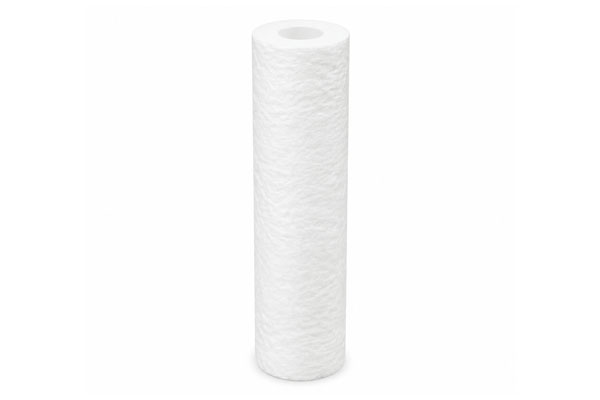
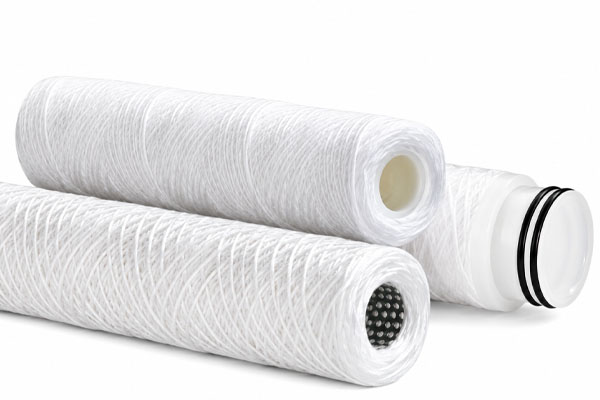
Polypropylene (PP) is the dominant material for industrial water treatment cartridges — melt-blown depth, string-wound and pleated formats. It is thermally bonded (no adhesives), chemically resistant to most aqueous solutions, and inexpensive. Its weakness is temperature.
1.1 Continuous service limit: 80 °C (176 °F)
Polypropylene softens as temperature approaches its glass transition range. The practical upper limit for continuous service is approximately 80 °C (176 °F) (rated, typical for melt-blown PP depth cartridges). At this temperature, the material retains structural integrity but is approaching the point where:
- End cap bonds (thermally welded) begin to weaken
- The media pack loses rigidity and becomes susceptible to deformation under differential pressure
- Fiber release risk increases as the fiber-to-fiber thermal bond softens
1.2 Short-term sanitization: 82 °C (180 °F) for 1 hour
Most polypropylene cartridges are rated for hot water sanitization at 82 °C (180 °F) for up to 1 hour (cited, Pall Poly-Fine II datasheet). This is a common sanitization protocol for pharmaceutical and food/beverage water systems.
"Rated for" means the element survives the exposure without structural failure. It does not mean the element is unaffected. Each hot water sanitization cycle:
- Causes thermal expansion and contraction, stressing the end cap bond
- Softens the media temporarily, allowing slight compression or deformation
- Accelerates aging — an element sanitized weekly at 82 °C will have a shorter total service life than one operated continuously at 60 °C
Practical guideline: Polypropylene cartridges tolerate hot water sanitization in intermittent service (e.g., sanitized once per week, operated at 40–60 °C the rest of the time). They are not suitable for continuous 24/7 service at 75–80 °C, even though that temperature is within the rated limit. Long-term continuous exposure at the upper temperature limit leads to gradual degradation.
1.3 Failure modes above 80 °C
End cap bond failure: The thermal weld between the polypropylene end cap and the media pack softens. The end cap can separate, or a gap can open allowing bypass. This failure is invisible in DP data — DP may actually drop because unfiltered flow is bypassing.
Media softening and telescoping: Under differential pressure, the softened media pack compresses axially ("telescopes"), reducing effective length and opening a gap at one end. Flow bypasses through the gap.
Fiber release: The fiber-to-fiber bonds in melt-blown media weaken, and fibers shed into the filtrate. For RO pretreatment, these fibers can reach and foul the membrane. For pharmaceutical service, fiber contamination fails sterility or particulate specifications.
Dimensional change: The element swells slightly or loses dimensional stability. In a multi-element housing, this can cause uneven loading — some elements compressed too tightly, others loose.
1.4 When polypropylene is appropriate
Use polypropylene cartridges for:
- Continuous service below 70 °C (158 °F) — a safe margin below the 80 °C limit
- Intermittent service to 80 °C (176 °F) — normal operation below 70 °C, occasional excursions or sanitization cycles to 80–82 °C
- Cost-sensitive applications where hot water is not continuous
- General RO pretreatment, process water and industrial duties at ambient to warm temperature
1.5 When polypropylene is not appropriate
Avoid polypropylene for:
- Continuous service above 80 °C (176 °F)
- Steam-in-place (SIP) service at 121–135 °C (250–275 °F)
- Power plant condensate polishing where water temperature routinely exceeds 85 °C
- Hot caustic or solvent service above 70 °C, even if PP is chemically compatible at ambient temperature — the combination of heat and chemical stress accelerates degradation
2. PTFE: The High-Temperature Standard
Polytetrafluoroethylene (PTFE, trademarked as Teflon by Chemours) is the benchmark high-temperature filter material. It is chemically inert to nearly all industrial fluids, thermally stable to 260 °C (500 °F) short-term, and the material of choice for steam-in-place and pharmaceutical sterile applications.
2.1 Temperature rating
- Continuous service: 200 °C (392 °F) (rated)
- Short-term / excursions: 260 °C (500 °F) (rated)
- Steam-in-place: 121–135 °C (250–275 °F), multiple cycles (rated, typical pharmaceutical SIP protocol)
PTFE maintains mechanical integrity, chemical inertness and filtration performance across this entire range. It does not soften, release fibers, or degrade structurally under thermal cycling.
2.2 Construction
PTFE filter cartridges are typically:
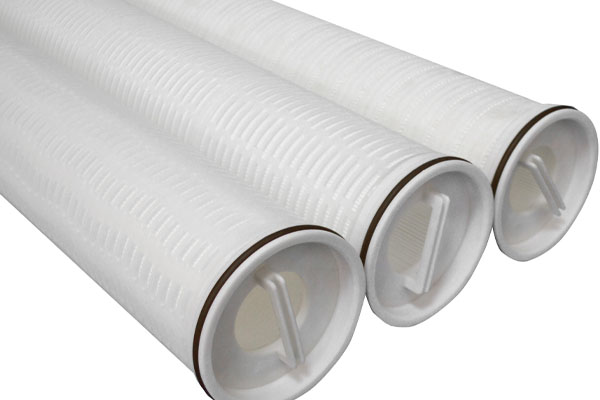
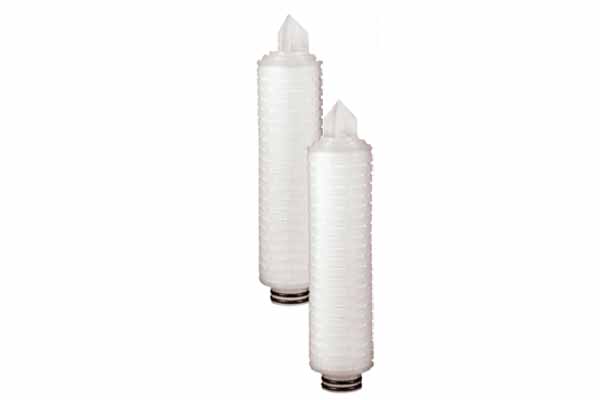
- Expanded PTFE (ePTFE) membrane, pleated and supported by a polypropylene or PTFE core and cage
- Hydrophobic — PTFE does not wet with water. For aqueous service, the membrane is often treated or laminated to make it hydrophilic, or a small amount of surfactant or alcohol is used to pre-wet.
- Absolute-rated — ePTFE membranes are available in 0.1, 0.2, 0.45, 1 µm and coarser, with beta ratios ≥ 5000 (rated, typical pharmaceutical-grade ePTFE).
2.3 End cap and seal considerations
PTFE membrane cartridges for high-temperature service use:
- PTFE or stainless steel end caps — not polypropylene, which would limit the assembly to 80 °C
- Fluoroelastomer (FKM/Viton) or PTFE O-rings — rated to 200 °C (392 °F) or higher
- Thermally stable adhesives or mechanical retention — no adhesives that degrade above 100 °C
A "PTFE cartridge" with polypropylene end caps is only rated to the end cap’s limit (80 °C), not to PTFE’s capability (200 °C). Always confirm the entire assembly rating, not just the membrane material.
2.4 Typical applications
- Pharmaceutical steam-in-place (SIP) sterilization — air/gas filters, vent filters, and final liquid filters sterilized at 121–135 °C for 30–60 minutes (cited, Critical Process Filtration SIP protocols)
- High-temperature chemical processing — hot acids, caustics, solvents, above 100 °C
- Compressed air and gas filtration at elevated temperature
- Semiconductor and electronics ultrapure water hot loops (70–90 °C continuous)
- Power plant condensate polishing at 90–120 °C (though stainless steel sintered elements are more common in this duty)
2.5 Limitations
Cost: PTFE cartridges are typically 3–10× the cost of equivalent polypropylene elements. Use them only where the temperature or chemical requirement justifies the premium.
Hydrophobicity: Untreated PTFE is hydrophobic. For aqueous service, confirm the cartridge is surfactant-treated or hydrophilic-laminated, or plan to pre-wet with isopropanol or ethanol before introducing water.
Differential pressure: Pleated PTFE membranes have higher clean DP than melt-blown polypropylene depth media at the same nominal micron rating, due to the surface-filtration mechanism of the membrane.
3. PVDF: The Intermediate Option
Polyvinylidene fluoride (PVDF) bridges the gap between polypropylene and PTFE. It offers better temperature and chemical resistance than PP, at a lower cost than PTFE.
3.1 Temperature rating
- Continuous service: 90–100 °C (194–212 °F) (rated, typical PVDF membrane cartridge)
- Short-term: 135 °C (275 °F), brief exposure (rated)
- Steam-in-place: Some PVDF cartridges are rated for SIP; others are not. Confirm with the manufacturer.
PVDF maintains mechanical strength and chemical resistance across its rated range. It is more rigid than polypropylene at elevated temperature and does not soften or release fibers.
3.2 Chemical resistance
PVDF is highly resistant to:
- Strong acids (HCl, H₂SO₄, HNO₃) at elevated temperature
- Strong alkalis (NaOH, KOH) hot
- Chlorinated and oxidizing chemicals (sodium hypochlorite, hydrogen peroxide) hot
- Most organic solvents
This makes PVDF the material of choice for hot caustic, hot acid, and hot chemical service where PTFE’s cost is prohibitive.
3.3 Typical applications
- Hot caustic / hot acid filtration in chemical plants (80–100 °C)
- Hot deionized or ultrapure water (85–95 °C continuous)
- Pharmaceutical hot water loops where SIP is not required but continuous 90 °C operation is
- Food and beverage hot CIP solutions (80–90 °C)
- Hot solvent filtration in pharmaceutical API manufacturing
3.4 Limitations
PVDF is more expensive than polypropylene (typically 2–4× for equivalent formats) but less expensive than PTFE (typically 50–70% of PTFE cost).
PVDF membranes are predominantly pleated, not melt-blown depth. For applications requiring high dirt holding capacity with compressible foulants, a PVDF pleated cartridge may blind faster than a PP depth cartridge. Match the media type to the foulant character, not just the temperature requirement.
4. PES and Nylon Membranes
Polyethersulfone (PES) and nylon 6,6 are hydrophilic membrane materials common in pharmaceutical and biotech applications. Both have temperature limits similar to polypropylene but offer advantages in protein binding, extractables and absolute filtration.
4.1 PES (Polyethersulfone)
Temperature rating:
- Continuous: 80 °C (176 °F) (rated)
- Short-term hot water sanitization: 90 °C (194 °F), 30 minutes (typical)
- Steam-in-place: Generally not rated, but some pharmaceutical-grade PES cartridges are validated for limited SIP cycles at 121 °C
Applications: Pharmaceutical process water, biotech cell culture media, final sterile filtration (0.2 µm absolute), high-purity chemical filtration.
Advantages over PP: Hydrophilic (no pre-wetting required), low protein binding, low extractables, absolute ratings with full validation data.
Limitation: Temperature ceiling is the same as polypropylene (80 °C continuous). If the application exceeds 80 °C, PES does not help — move to PVDF or PTFE.
4.2 Nylon 6,6 Membrane
Temperature rating:
- Continuous: 60–80 °C (140–176 °F) (rated, depending on construction)
- Short-term: 85 °C (185 °F) (typical)
Applications: Aqueous solutions, some solvent filtration, general pharmaceutical and laboratory filtration.
Limitation: Nylon has poor resistance to strong acids, strong alkalis, and oxidizing agents. It is not suitable for hot caustic, hot acid, or chlorinated water at elevated temperature, even within its thermal rating.
5. Stainless Steel Sintered Elements
Sintered stainless steel (typically 316L) is the ultimate high-temperature cartridge material, used in extreme-duty applications where polymers are inadequate.
5.1 Temperature rating
- Continuous service: 400+ °C (750+ °F) (rated)
- Short-term: 800+ °C (1470+ °F) (rated)
- Steam: Suitable for steam-in-place and direct steam filtration at any pressure/temperature combination within the housing’s rating
5.2 Construction
Sintered stainless steel elements are made by compressing and sintering stainless steel powder or fibers into a porous structure. Micron ratings (typically 0.5–200 µm) are controlled by particle size and sintering conditions. The structure is rigid, cleanable, and reusable.
5.3 Typical applications
- Power plant condensate polishing at 90–150 °C, protecting ion exchange resins from iron oxide and corrosion products
- High-temperature catalyst recovery in chemical reactors
- Molten polymer filtration (above 200 °C)
- High-temperature compressed air and gas filtration in furnaces, ovens and kilns
- Steam filtration for sterile steam supply in pharmaceutical plants
5.4 Advantages
- Reusable — sintered stainless elements are backwashed, ultrasonically cleaned, and reused for years. Initial cost is high (10–50× a disposable polymer cartridge), but lifecycle cost per cubic meter filtered is often lower in continuous high-temperature duty.
- No thermal degradation — stainless steel does not soften, creep, or degrade under thermal cycling.
- Cleanable — removes accumulated foulant through backwash, chemical cleaning or ultrasonic cleaning.
5.5 Limitations
- High initial cost
- Heavier than polymer cartridges — housing design must account for the weight
- Limited to stainless-compatible fluids — not suitable for hydrochloric acid, hydrofluoric acid, or chloride-containing solutions above certain concentrations (pitting corrosion risk)
6. Seal Material Selection for High-Temperature Service
The cartridge seal — O-ring or gasket at the end cap — is as critical as the media material. A PTFE cartridge rated to 200 °C with an EPDM seal rated to 120 °C is limited to 120 °C by the seal.
6.1 Seal material temperature and chemical compatibility
| Seal material | Continuous temp max | Short-term max | Compatible with | Avoid |
|---|---|---|---|---|
| EPDM (ethylene propylene) | 120 °C (248 °F) | 150 °C (302 °F), brief | Hot water, steam, alkalis, polar solvents | Hydrocarbons, oils, fuels |
| Nitrile (NBR / Buna-N) | 100 °C (212 °F) | 120 °C (248 °F), brief | Oils, fuels, hydrocarbons, water | Ozone, strong oxidizers, aromatic solvents |
| Fluoroelastomer (FKM / Viton) | 200 °C (392 °F) | 230 °C (446 °F), brief | Hydrocarbons, fuels, oils, acids, high temp | Hot water above 150 °C, steam, amines, ketones |
| PTFE (solid or encapsulated) | 260 °C (500 °F) | 300 °C (572 °F), brief | Nearly universal chemical compatibility | Molten alkali metals, fluorine gas |
| Silicone (VMQ) | 200 °C (392 °F) | 230 °C (446 °F), brief | Hot water, steam, food contact | Fuels, oils, concentrated acids |
| Kalrez / FFKM (perfluoroelastomer) | 260 °C (500 °F) | 300 °C (572 °F), brief | Universal chemical and thermal compatibility | None (extremely expensive) |
Compatibility data (cited, Eclipse Seal temperature ranges reference).
6.2 Common seal selection mistakes
Mistake 1: EPDM in hydrocarbon service
EPDM swells in hydrocarbons and petroleum fluids. For hot hydrocarbon service, use fluoroelastomer (FKM) or nitrile (NBR if temperature is below 100 °C).
Mistake 2: Fluoroelastomer in hot water / steam above 150 °C
Fluoroelastomer is rated to 200 °C, but this rating applies to oils, fuels and dry heat. In continuous hot water or steam above 150 °C, fluoroelastomer degrades through hydrolysis. For steam-in-place at 121–135 °C, fluoroelastomer is acceptable. For continuous steam service above 150 °C, use EPDM, silicone or PTFE.
Mistake 3: Silicone in fuel or oil
Silicone seals swell and degrade in hydrocarbon service. Silicone is excellent for hot water, steam and food contact, but incompatible with fuels and oils.
6.3 Recommended seal by application
| Application | Recommended seal |
|---|---|
| Hot water 80–120 °C, continuous | EPDM |
| Steam-in-place 121–135 °C, intermittent | EPDM or fluoroelastomer |
| Hot process water 90–150 °C, no hydrocarbons | Silicone or EPDM |
| Hot hydrocarbons, fuels, oils 80–150 °C | Fluoroelastomer (FKM/Viton) |
| High-temperature chemicals 150–200 °C | Fluoroelastomer or PTFE |
| Universal high-temperature (cost no object) | Kalrez / FFKM or solid PTFE |
7. Application-Specific Selection Guide
7.1 Power Plant Condensate Polishing (90–120 °C)
Challenge: Continuous high-temperature service, corrosion products (iron oxide, copper), resin fines, low tolerance for fiber release (protects downstream ion exchange beds and boiler feed pumps).
Material recommendation:
- Sintered stainless steel — industry standard. Reusable, no fiber release, rated to 400+ °C. Initial cost is high but lifecycle cost is favorable in continuous duty.
- PTFE pleated — disposable alternative if reusable elements are not preferred. Rated to 200 °C, no fiber release.
Seal: EPDM or fluoroelastomer, depending on whether the system uses steam or hot water for backwash/regeneration.
Avoid: Polypropylene (softens above 80 °C, releases fibers), PES or nylon (temperature limit too low).
7.2 Pharmaceutical Hot Water Loop (80–90 °C continuous)
Challenge: Continuous hot water circulation at 80–90 °C to inhibit biofilm, with weekly or daily hot water sanitization at 82 °C for 1 hour. Must meet USP/EP extractables and particulate requirements.
Material recommendation:
- PES (polyethersulfone) membrane, 0.2 µm absolute — rated to 80 °C continuous, 90 °C short-term. Hydrophilic, low extractables, validated for pharmaceutical service. This is the pharmaceutical industry standard.
- PTFE membrane — if temperature approaches or exceeds 90 °C regularly, or if steam-in-place is used.
Seal: EPDM (for water compatibility) or silicone (for food/pharma compliance).
Avoid: Standard polypropylene (extractables not validated for pharma unless specifically rated USP Class VI), nylon (poor hot water stability).
7.3 Hot Caustic Filtration (80–100 °C)
Challenge: Sodium hydroxide (NaOH) or potassium hydroxide (KOH) solutions at 80–100 °C, used in chemical processing, pulp and paper, or CIP cleaning. Requires chemical resistance to strong alkali at elevated temperature.
Material recommendation:
- PVDF membrane — excellent caustic resistance, rated to 90–100 °C continuous.
- PTFE membrane — if temperature exceeds 100 °C or if cost is justified.
Seal: EPDM (excellent alkali resistance, rated to 120 °C).
Avoid: Polypropylene (acceptable for ambient caustic but degrades faster at elevated temperature), PES or nylon (poor caustic resistance).
7.4 Steam-in-Place (SIP) Sterilization (121–135 °C)
Challenge: Pharmaceutical or biotech filters sterilized with saturated steam at 121 °C (250 °F) or 135 °C (275 °F) for 30–60 minutes, with rapid thermal cycling (ambient → 135 °C → ambient in under 2 hours). Must survive multiple SIP cycles without structural degradation.
Material recommendation:
- PTFE membrane — industry standard for SIP-rated cartridges. Rated to 135 °C steam, validated for pharmaceutical sterile service.
- Some PVDF or PES cartridges are rated for limited SIP cycles. Confirm with manufacturer’s validation data — not all PVDF or PES elements are SIP-capable.
Seal: Fluoroelastomer or EPDM. Silicone is also acceptable for steam.
Avoid: Polypropylene (completely unsuitable for steam above 100 °C), standard nylon (thermal limit too low).
7.5 General Hot Water Service (70–80 °C continuous)
Challenge: Municipal or industrial hot water at 70–80 °C, 24/7 continuous service. Not pharmaceutical, not sterile. Cost is a consideration.
Material recommendation:
- Polypropylene melt-blown or pleated — acceptable at the lower end of this range (70–75 °C continuous). Use with caution at 80 °C continuous — expect shorter service life than at ambient temperature.
- PES or PVDF — if budget allows and temperature is consistently at or above 75 °C.
Seal: EPDM (rated to 120 °C, water-compatible).
Practical note: Many plants operate polypropylene cartridges at 75–80 °C and accept shorter life as a trade-off for lower element cost. Monitor for fiber release and end cap integrity. If elements are failing prematurely (end cap separation, dimensional change), upgrade to PVDF or PTFE.
8. How to Verify Temperature Compatibility
Before ordering a cartridge for high-temperature service, confirm the following from the manufacturer’s datasheet or specification sheet:
| Parameter | What to confirm | Why it matters |
|---|---|---|
| Media material | PP, PES, PVDF, PTFE, stainless steel | Sets the baseline temperature limit |
| Continuous service temperature rating | °C / °F, continuous | The safe operating temperature for 24/7 service |
| Short-term / sanitization rating | °C / °F, duration | Confirms whether intermittent hot water sanitization is acceptable |
| Steam-in-place rating | Yes/No, temperature and duration | Required for pharmaceutical SIP service |
| End cap material and construction | PP, PVDF, PTFE, stainless; thermal weld, adhesive, mechanical | End cap limits the assembly even if media is high-temp rated |
| Seal / O-ring material | EPDM, FKM, silicone, PTFE | Seal must be compatible with both temperature and fluid |
| Core material | PP, PVDF, PTFE, stainless | PP core limits a PTFE cartridge to 80 °C |
| Differential pressure rating at temperature | bar / psi at stated temperature | DP rating typically decreases at elevated temperature |
If any component is rated lower than your operating temperature, the assembly is limited to that lower rating. A PTFE membrane cartridge with a polypropylene core and EPDM seal is limited to 80 °C by the core, not to 200 °C by the PTFE.
9. Thermal Degradation Warning Signs
If you are operating cartridges at or near their temperature limit, monitor for these failure indicators:
End cap separation or looseness: The bond between end cap and media has weakened. The element may still filter, but bypass risk is high. Replace immediately.
Dimensional change: Element is shorter, wider, or visibly deformed compared to a new element. This indicates media softening or creep under DP and temperature.
Fiber release or particulate in filtrate: White fibers, flakes or increased turbidity downstream of the cartridge stage. Indicates media breakdown.
Odor or discoloration: Darkening or yellowing of polypropylene media, or a burnt plastic odor, indicates thermal degradation or oxidation.
Shortened service life without increased foulant load: If DP rises to change-out faster than expected, and feed water quality has not changed, the element may be losing dirt holding capacity due to thermal compression or media densification.
Seal damage: O-ring is hardened, cracked, swollen or permanently compressed. Indicates seal compound degradation — replace element and confirm seal material is correct for the temperature and fluid.
10. ECOFILTRONE High-Temperature Filter Cartridges
ECOFILTRONE Polypropylene Filter Cartridge
Thermally bonded melt-blown polypropylene depth media, rated to 80 °C (176 °F) continuous service, 82 °C (180 °F) hot water sanitization for 1 hour. Available in 1–100 µm nominal, 10–60 inch lengths, DOE and SOE end caps, EPDM or fluoroelastomer seals. For general industrial hot water, RO pretreatment and process water to 80 °C.
→ View specificationsECOFILTRONE PVDF Filter Cartridge
Pleated PVDF membrane, rated to 90–100 °C (194–212 °F) continuous service. Available in 0.2–50 µm nominal and absolute, 10–40 inch lengths. For hot caustic, hot acid, hot ultrapure water and pharmaceutical hot water loops where temperature exceeds polypropylene’s capability.
→ View specifications
ECOFILTRONE confirms media, end cap, core and seal materials for high-temperature applications before supply — not assumed from a general product catalogue. Temperature rating is validated for the complete assembly, not just the membrane.
11. Frequently Asked Questions
What is the maximum temperature for a polypropylene filter cartridge?
Polypropylene cartridges are rated to approximately 80 °C (176 °F) continuous service and 82 °C (180 °F) short-term hot water sanitization for 1 hour (rated, typical). Above 80 °C, end cap bonds weaken, media softens and fiber release risk increases. For continuous service above 80 °C, use PVDF, PTFE or stainless steel.
Can polypropylene cartridges be used for steam-in-place?
No. Steam-in-place operates at 121–135 °C (250–275 °F), far above polypropylene’s 80 °C limit. Use PTFE or validated SIP-rated PVDF cartridges for steam sterilization.
What is the best filter cartridge material for hot water?
For hot water 70–80 °C continuous: polypropylene (with caution at the upper end). For 80–100 °C: PES, PVDF. For above 100 °C or steam: PTFE. Match the material to the specific temperature and confirm the entire assembly (media, end cap, core, seal) is rated for the duty.
Why do polypropylene cartridges fail faster in hot water?
Heat accelerates all degradation mechanisms: end cap bond relaxation, media softening, fiber release, oxidation, and thermal stress from expansion/contraction. A polypropylene cartridge at 75 °C may last half as long as the same element at 40 °C, even if feed water quality is identical.
Can I use an EPDM O-ring seal for hot oil filtration?
No. EPDM swells in hydrocarbons and oils. For hot oil, use fluoroelastomer (FKM/Viton) seals if temperature is below 200 °C, or nitrile (NBR) if temperature is below 100 °C. EPDM is excellent for hot water and steam but incompatible with oils.
What is the difference between short-term and continuous temperature ratings?
Short-term (or sanitization) ratings apply to intermittent exposures — typically 1 hour per day or per week, with the element operating at lower temperature the rest of the time. Continuous ratings apply to 24/7 operation at the stated temperature. A polypropylene element rated "82 °C for 1 hour" can tolerate weekly sanitization at that temperature but cannot operate continuously at 82 °C without degrading.
Are PTFE cartridges worth the cost for hot water at 85 °C?
Usually not. PVDF or even polypropylene (if temperature is intermittent) are more cost-effective for 85 °C hot water. PTFE’s premium is justified for steam-in-place, temperatures above 100 °C, or when chemical compatibility requires PTFE’s universal resistance. For hot water alone at 85–95 °C, PVDF offers equivalent performance at 50% of PTFE’s cost.
How do I know if my cartridge seal is failing due to temperature?
Signs of thermal seal degradation: O-ring is hardened, cracked, permanently compressed, or has lost elasticity. For elastomers, high temperature causes hardening and compression set; low temperature causes stiffening. If the seal does not spring back when compressed, or if it shows cracks or surface cracking, it has exceeded its thermal capability and the cartridge should be replaced.
12. Conclusion
Temperature is the most commonly underspecified parameter in filter cartridge selection, and the consequences of exceeding a material’s thermal limit are often invisible until contamination appears downstream weeks or months later. Polypropylene — the industry workhorse — is appropriate for the majority of ambient and warm water applications, but approaches its practical limit at 80 °C and is unsuitable for continuous hot water above that temperature or for any steam service.
PVDF extends the range to 90–100 °C and offers excellent chemical resistance for hot caustic and acid. PTFE is the gold standard for steam-in-place and high-temperature chemical processing above 100 °C, with a cost premium that is justified only where the duty requires it. Stainless steel sintered elements serve ultra-high-temperature applications where polymers cannot.
Seal material is as critical as cartridge media — confirm that end cap, core and O-ring are all rated to the operating temperature, not just the membrane. Calculate total assembly rating, not media rating alone. For high-temperature applications, request validation data from the manufacturer and monitor installed elements for signs of thermal degradation.
Select the material to match the duty — not to the highest available rating, and not to the lowest cost. The optimal cartridge for 75 °C hot water is not the same as for 120 °C steam, and installing the wrong material costs far more in downtime and contamination than the incremental element price.
Need Help Selecting a High-Temperature Filter Cartridge?
If you are specifying cartridges for hot water, steam-in-place, condensate polishing or high-temperature process liquids, share your operating temperature (continuous and peak), fluid type, chemical environment and whether steam sterilization is required.
ECOFILTRONE will confirm the appropriate media material, end cap construction and seal compound for your specific duty and provide validation data for temperature and chemical compatibility.
WhatsApp: +86 131 8896 2285
Sources: Pall Poly-Fine II datasheet · Critical Process Filtration filter devices reference · Eclipse Seal temperature ranges for seal materials · NEWater high temperature resistant filter cartridges