Data grading: (rated) = manufacturer / standard specification · (typical) = commonly observed industry range · (cited) = published standard or industry reference · (illustrative) = approximate reference value
Introduction
Ordering the wrong cartridge size is one of the most common — and most avoidable — maintenance problems in industrial and commercial water treatment. The element arrives, the housing opens, and it either will not seat, sits loose, or seals but leaks at the face because the nominal length is right but the end cap profile is wrong.
The confusion has a straightforward cause: filter cartridge sizes are stated in nominal inches, not actual measured dimensions. A "10 inch cartridge" does not measure 10.00 inches. A "2.5 inch diameter" element does not have a 2.5-inch media pack. And two cartridges with the same nominal size from different manufacturers can have end caps that are geometrically incompatible with the same housing.
This guide explains how the three standard size systems — conventional (2.5 in OD), Big Blue (4.5 in OD) and high flow (6 in OD) — are dimensioned, gives nominal and typical actual dimensions for every standard length, explains end cap types and what to measure before ordering a replacement, and shows how to match cartridge format to flow rate and application.
## Key Takeaways
- Nominal length ≠ actual length. A 10 inch cartridge measures approximately 9.75 inches (248 mm); a 40 inch element measures approximately 39.5 inches (1003 mm). Always confirm actual length against the housing’s internal dimension before ordering.
- Three format families exist and are not interchangeable. Standard (2.5 in OD), Big Blue (4.5 in OD) and High Flow (6 in OD) each require a different housing. Mixing them is not possible without changing the housing.
- End cap type is as important as length. A DOE and an SOE element of the same nominal length will not interchange in the same housing without an adapter. SOE cartridges also come in multiple bayonet profiles that are not mutually compatible.
- High flow elements are not just "big standard cartridges." A single 60 inch high flow element handles the flow of 15–30 conventional 40 inch elements (typical). The format choice is a system design decision, not a sizing detail.
- Measure the installed element, not the housing label. Housing labels state nominal size. The element you pull out gives you the actual seating length and OD your replacement must match.
- 30 inch and 50 inch lengths exist but are not widely stocked. In most industrial supply chains, 10, 20, 40 and 60 inch are the four practical choices.
1. How Filter Cartridge Size Is Described
Every filter cartridge size specification has three components:
Length × OD × end cap type
For example: 20 inch × 2.5 in OD × DOE or 40 inch × 6 in OD × SOE 226 double O-ring.
All three must match the housing. Getting two of the three right still produces a cartridge that will not seal or will not fit.
1.1 Nominal vs Actual Dimensions
Cartridge lengths are stated as nominal — rounded commercial names that do not correspond to measured dimensions. The convention is industry-wide and applies to all three format families.
The reason is practical: housing manufacturers build to the nominal standard, and element manufacturers build their actual dimensions to ensure the element seats and seals correctly within that housing. A slightly shorter actual length prevents the element from jamming before it seats; the end cap gasket or O-ring makes up the small gap.
Rule of thumb: actual length is approximately 6–10 mm (¼ inch) shorter than the nominal length (typical). Exact actual dimensions vary by manufacturer — see the tables in section 2.
1.2 Outer Diameter (OD) and Inner Diameter (ID)
The outer diameter (OD) of the media pack is what must fit inside the housing vessel bore. The OD stated on a cartridge datasheet refers to the media pack — not the flange or end cap, which is wider.
The inner diameter (ID) is the bore of the element core. On DOE elements, the housing centre rod passes through this bore to retain the element stack. The ID must be compatible with the rod diameter of the installed housing.
For conventional 2.5 in OD elements, the core ID is typically 28–30 mm (approximately 1.1 in) (typical). For high flow 6 in OD elements the ID is larger — typically 40–50 mm (typical) — depending on the manufacturer.
2. Standard Cartridge Size Chart
2.1 Conventional Format — 2.5 in OD
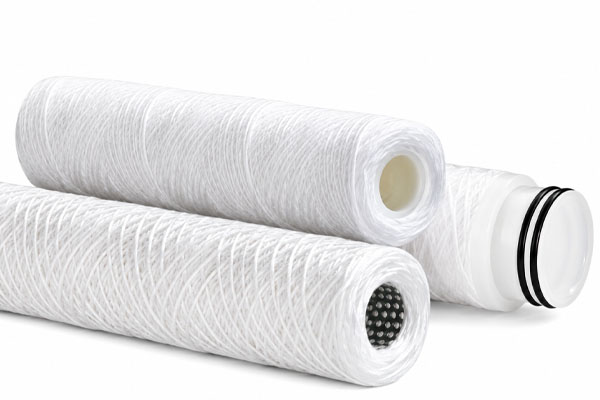
The most widely installed format globally. Used in under-sink, point-of-entry, industrial guard filtration, RO pretreatment and general process water applications.
| Nominal length | Typical actual length | Nominal OD | Typical actual OD | Common housing thread |
|---|---|---|---|---|
| 5 in (127 mm) | ~123–125 mm (~4.9 in) | 2.5 in | ~63 mm (2.48 in) | ¾ in BSP / NPT |
| 10 in (254 mm) | ~248–251 mm (~9.75 in) | 2.5 in | ~63 mm (2.48 in) | ¾ in or 1 in BSP / NPT |
| 20 in (508 mm) | ~503–505 mm (~19.8 in) | 2.5 in | ~63 mm (2.48 in) | 1 in BSP / NPT |
| 30 in (762 mm) | ~756–758 mm (~29.8 in) | 2.5 in | ~63 mm (2.48 in) | 1 in BSP / NPT |
| 40 in (1016 mm) | ~1003–1010 mm (~39.5 in) | 2.5 in | ~63 mm (2.48 in) | 1 in or 1½ in BSP / NPT |
| 50 in (1270 mm) | ~1260–1265 mm (~49.7 in) | 2.5 in | ~63 mm (2.48 in) | 1½ in BSP / NPT |
All dimensions (typical). Confirm actual dimensions from the manufacturer’s published datasheet before ordering.
2.2 Big Blue Format — 4.5 in OD
Larger-diameter housing system for higher flow rates than the 2.5 in format can deliver at acceptable DP. Common in whole-building point-of-entry systems, light industrial water treatment, and well water applications.
| Nominal length | Typical actual length | Nominal OD | Typical actual OD |
|---|---|---|---|
| 10 in (254 mm) | ~248–251 mm (~9.75 in) | 4.5 in | ~114 mm (4.49 in) |
| 20 in (508 mm) | ~503–505 mm (~19.8 in) | 4.5 in | ~114 mm (4.49 in) |
"Big Blue" is an industry nickname for this format, originally from a widely installed housing brand. The 4.5 in element is not the same as the 2.5 in element in a 4.5 in housing — the media pack OD and the end cap geometry are both different. They are not interchangeable.
2.3 High Flow Format — 6 in OD
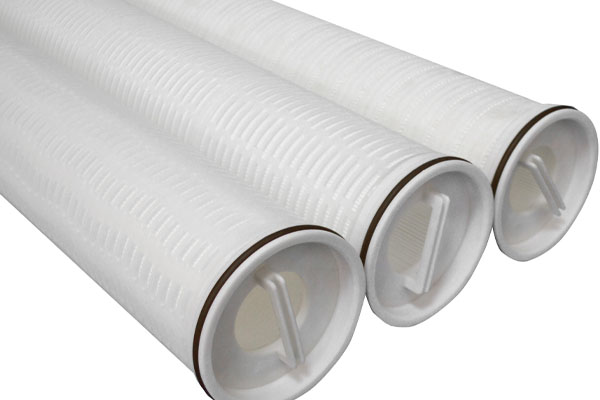
Large-diameter elements designed for high-volume industrial applications. A single 60 in high flow element handles the flow of 15–30 conventional 40 in elements (typical, duty dependent). Dominant in SWRO pretreatment, power plant water treatment, oil and gas produced water, and large-scale industrial process water.
| Nominal length | Typical actual length | Nominal OD | Typical flange OD | Typical core ID |
|---|---|---|---|---|
| 20 in (508 mm) | ~505–508 mm | 6 in (152 mm) | ~179 mm (7.06 in) | ~40–50 mm |
| 40 in (1016 mm) | ~1010–1016 mm | 6 in (152 mm) | ~179 mm (7.06 in) | ~40–50 mm |
| 60 in (1524 mm) | ~1518–1524 mm | 6 in (152 mm) | ~179 mm (7.06 in) | ~40–50 mm |
Flange OD and core ID data (typical, based on published industry datasheets including Pall Ultipleat HFU and Global Filter high flow). Confirm against the specific manufacturer’s datasheet — dimensions vary between brands and series.
3. Each Standard Length Explained
3.1 — 10 Inch Filter Cartridge
The most common length for point-of-use and small point-of-entry systems. Under-sink reverse osmosis pre- and post-filters, countertop systems, and light commercial applications all use 10 in × 2.5 in OD as the baseline format.
In industrial applications, 10 in elements are typically found only in low-flow sampling or analytical lines, or as a compact guard filter where the flow rate is very low. For most industrial duties they are impractical: a single 10 in × 2.5 in element has a recommended flow of approximately 0.5–1 m³/h (2–4 gpm) (typical), so a 10 m³/h duty requires 10–20 elements in parallel, which is better served by a 20 in or 40 in format.
A 10 in × 4.5 in Big Blue element handles approximately 2–4 m³/h (9–18 gpm) (typical).
3.2 — 20 Inch Filter Cartridge
The standard length for medium residential and light commercial applications. Also the shortest practical length for industrial multi-round housings.
A 20 in × 2.5 in element has approximately twice the surface area and dirt holding capacity of a 10 in × 2.5 in at the same OD, with roughly double the recommended flow (approximately 1–2 m³/h / 4–9 gpm) (typical).
In high flow format, 20 in × 6 in is the shortest available length. It handles up to approximately 100–170 m³/h (440–750 gpm) per element (rated, Pall HFU 20 in data) at rated conditions, which is already far beyond the capacity of any conventional housing system.
3.3 — 30 Inch Filter Cartridge
Less common than 10, 20 or 40 in. Occasionally found in older housing systems designed for this specific length. If your installed housing uses 30 in elements, check stock availability before committing to a long-term change-out programme — supply of 30 in elements is thinner than the four main lengths.
3.4 — 40 Inch Filter Cartridge
The workhorse length for industrial conventional-format systems. Multi-round housings holding 7, 12, 20 or more elements of 40 in × 2.5 in are standard throughout water treatment plant engineering.
A 40 in × 2.5 in element at 5 µm nominal has a typical recommended flow of 1.4–1.8 m³/h (6–8 gpm) per element (typical). A 12-element housing therefore handles approximately 17–22 m³/h (75–97 gpm).
In high flow format, 40 in is the mid-length. Pall publishes a maximum suggested flow of 333 gpm (1,260 lpm / ~76 m³/h) per 40 in high flow element (rated, Pall Marksman PFT datasheet) as a general guideline. Actual duty depends on the specific medium, micron rating and foulant load.
3.5 — 60 Inch Filter Cartridge
The maximum standard length for high flow systems. Offers the highest dirt holding capacity per element and the lowest element count for a given duty. In SWRO pretreatment, condensate polishing and large industrial water treatment, the 60 in × 6 in element is the standard choice where high flow housings are installed.
Maximum suggested flow: up to 500 gpm (1,892 lpm / ~115 m³/h) per 60 in high flow element (rated, Pall Marksman PFT datasheet) as a general guideline. These figures are for orientation — actual sizing must account for micron rating, media structure, feed quality and target service life.
No conventional 2.5 in OD element is manufactured in 60 in length as a standard item. The length/diameter ratio would produce an element with inadequate mechanical rigidity.
4. Format Comparison: Standard vs Big Blue vs High Flow
| Standard (2.5 in OD) | Big Blue (4.5 in OD) | High Flow (6 in OD) | |
|---|---|---|---|
| Standard lengths | 10, 20, 30, 40, 50 in | 10, 20 in | 20, 40, 60 in |
| Flow per element (typical) | 0.5–2 m³/h | 2–6 m³/h | 60–115 m³/h |
| Housing connection size | ¾–1½ in BSP/NPT | 1–1½ in BSP/NPT | Flanged / custom |
| Typical application scale | Point-of-use to small industrial | Light to medium industrial | Medium to large industrial |
| Multi-element housing | Yes — 5 to 36 elements | Yes — 1 to 4 elements | Yes — 1 to 12+ elements |
| End cap types | DOE, SOE 222, SOE 226 | DOE, SOE | DOE, SOE with large-format adapters |
| Replacement stock availability | Very wide | Wide | Industrial supply; less retail |
| Relative consumable cost per element | Low | Medium | Higher per element, but fewer elements |
All flow figures (typical) at clean DP with standard polypropylene depth media. Actual recommended flow depends on the specific element series, micron rating and manufacturer.
5. End Cap Types and Sealing
The end cap is the component that seals the element into the housing. A dimensionally correct element with the wrong end cap profile will either bypass or not seat — neither failure is visible until downstream water quality degrades.
5.1 DOE — Double Open End
Both ends of the element are open. The element sits between two flat support plates or gaskets inside the housing. The element stack is held in compression by a spring or a threaded retainer, and the flat gasket faces create the seal.
Advantages: simple, tolerant of minor dimensional variation, works with any element in the stack that compresses flat.
Limitations: less positive seal than a knife-edge or spigot O-ring arrangement. Susceptible to bypass if the plate gasket is worn, the element face is not flat, or the retaining pressure is insufficient.
Most suitable for: low to medium pressure applications, non-critical processes, housings not subject to frequent disassembly.
5.2 SOE — Single Open End
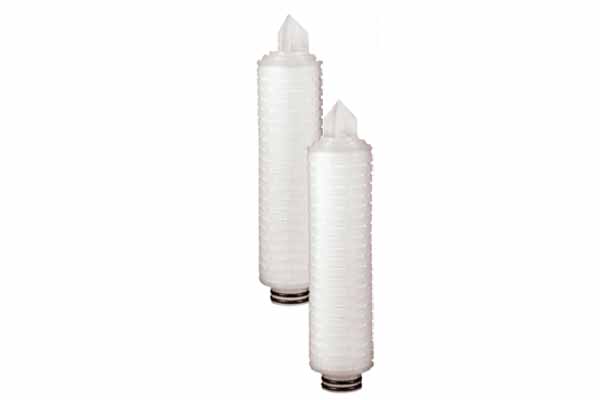
One end of the element has a moulded closed cap. The open end has a spigot or bayonet fitting with one or two O-rings that insert into a corresponding socket in the housing sump.
Advantages: more positive seal at the open end than DOE flat gasket. The closed end prevents any axial leakage path. Correct spigot engagement is visible and tactile.
Limitations: multiple SOE profiles exist and are not mutually compatible even at the same nominal length:
| SOE profile | O-ring arrangement | Common applications |
|---|---|---|
| 222 fin / single O-ring | One O-ring, fin orientation | Standard pharmaceutical and food/beverage housings |
| 222 double O-ring | Two O-rings, bayonet or fin | Higher-integrity pharmaceutical and sterile service |
| 226 single O-ring | Single, larger cross-section O-ring | Industrial housings |
| 226 double O-ring | Two O-rings, larger cross-section | High-pressure or critical-seal industrial |
| Flat-cap closed bottom + spigot top | Varies by housing brand | Specific OEM housings |
A 222-profile element will not seal correctly in a 226-profile housing socket, even if the nominal length and OD are identical. The O-ring sizes and groove geometry are different.
For high flow elements: end cap profiles vary significantly between brands. Pall HFU, 3M High Flow, Pentair High Flow and Parker ParMax all use proprietary or semi-proprietary end cap and seal arrangements. Always confirm against the installed housing drawing, not just the element datasheet.
6. How to Measure Your Installed Cartridge
If you are reordering a replacement and do not have the original documentation, measure the pulled element directly. Do not rely on the housing label alone — it states nominal size.
Step 1 — Overall length. Measure from the outer face of one end cap to the outer face of the other. This is the seating length your replacement must match.
Step 2 — Media pack OD. Measure the outside diameter of the cylindrical media body, not the end cap flange (which is wider). Use callipers.
Step 3 — Core ID. Measure the bore of the centre core at one open end. This determines housing rod compatibility for DOE elements.
Step 4 — End cap type. Identify whether each end is open or closed. If open, identify the seal type: flat gasket face (DOE) or spigot with O-ring groove (SOE). For SOE, measure the O-ring groove ID and cross-section.
Step 5 — Flow direction marking. Check whether the element has an arrow or text indicating flow direction (typically outside-in for depth media). Note it — a replacement installed in the reverse direction can unload captured material toward the downstream equipment.
Step 6 — Photograph. Take photographs of both end caps before discarding the used element. The visual record resolves most ambiguity.
7. Housing Compatibility: What the Size Must Match
A replacement cartridge must match the housing on all of the following — not just length:
| Housing parameter | What it determines | How to check |
|---|---|---|
| Internal working length | Maximum element seating length | Housing manufacturer’s datasheet or measured with a rod |
| Vessel bore ID | Maximum element OD | Datasheet or measured |
| Centre rod diameter (DOE housings) | Minimum element core ID | Datasheet |
| Sump socket profile (SOE housings) | End cap spigot and O-ring profile | Housing manufacturer’s part number |
| Inlet/outlet connection | Not directly related to element size, but confirms the housing model | Nameplate |
| Number of element positions | Determines total element count and flow per element | Vessel nameplate or drawing |
| Max operating pressure and temperature | Determines whether the element’s DP and temperature rating is adequate | Housing nameplate |
For multi-round housings (industrial systems with 7–36 or more elements), also check the hold-down plate configuration — some housings use a single plate that applies equal load to all elements, others use individual caps. An element that is 5–10 mm shorter than its neighbours in the same vessel will not be held in compression and will bypass.
8. Size Selection by Application
| Application | Recommended format | Typical length | Notes |
|---|---|---|---|
| Under-sink / point-of-use | Standard 2.5 in OD | 10 in | Single or two-stage housing |
| Whole-building domestic | Big Blue 4.5 in OD | 10 or 20 in | Sized to house flow capacity |
| Small commercial / light industrial | Standard 2.5 in OD | 20 or 40 in | Multi-round housing for flows > 3 m³/h |
| Medium industrial process water | Standard 2.5 in OD | 40 in | Multi-round 7–20 element housing |
| SWRO / BWRO pretreatment guard | High flow 6 in OD | 40 or 60 in | See high flow filter cartridge for sizing |
| Power plant condensate polishing | High flow 6 in OD | 40 or 60 in | Temperature and pressure rating critical |
| Oil and gas produced water | High flow 6 in OD | 40 or 60 in | Chemical compatibility check required |
| Irrigation / coarse sediment | Standard or Big Blue | 20 in | 50–100 µm rating, possibly washable |
| Pharmaceutical process water | Standard 2.5 in OD | 10 or 20 in | SOE 222 profile, absolute-rated element |
| Sampling / analytical lines | Standard 2.5 in OD | 5 or 10 in | Very low flow, tight micron rating |
9. Conventional vs High Flow: When to Switch Format
The question of whether to use conventional (2.5 in OD) or high flow (6 in OD) elements is a system economics question, not a filtration performance question. Both formats can achieve the same micron rating and removal efficiency.
The decision criteria are:
Use conventional 2.5 in OD when:
- Flow rate is below approximately 20 m³/h (88 gpm) (typical threshold)
- An existing conventional housing is already installed and operating satisfactorily
- The application is intermittent or low-criticality
- Local supply of replacement elements is the primary procurement constraint
Use high flow 6 in OD when:
- Flow rate exceeds approximately 50–100 m³/h (220–440 gpm) (typical threshold)
- Change-out labour and downtime are a significant cost factor
- Housing footprint is constrained
- The seal-point count of a large conventional element bank is a bypass risk concern
- The application is continuous-duty industrial (SWRO, power, oil and gas)
For detailed flow rate sizing and element count calculation in high flow applications, see our high flow filter cartridge sizing and selection guide.
10. Frequently Asked Questions
What is a standard filter cartridge size?
The most common standard in global industrial water treatment is 40 inch length × 2.5 inch OD with a DOE or SOE end cap. For high-volume industrial applications (SWRO, power, oil and gas), the standard shifts to 60 inch × 6 inch high flow format. "Standard" depends on the application scale.
What does "10 inch filter cartridge" mean?
Ten inches is the nominal length — the commercial name for the size class. The actual measured length is approximately 9.75 inches (248 mm) (typical). The diameter must be stated separately: 2.5 in OD is the most common, but 4.5 in (Big Blue) is also available in 10 inch length.
What is the actual dimension of a 20 inch filter cartridge?
For a standard 2.5 in OD element, actual length is typically 503–505 mm (approximately 19.8 inches) (typical). Confirm against the specific manufacturer’s published datasheet — actual dimensions vary by brand.
Can I use a 20 inch cartridge in a 20 inch housing from a different manufacturer?
Usually yes for the same format (2.5 in OD, same end cap type), but confirm actual length, OD and end cap profile. Different housing manufacturers use slightly different internal working lengths and retainer geometry. When in doubt, use the housing manufacturer’s recommended element series.
What is a Big Blue filter cartridge?
Big Blue is the industry nickname for the 4.5 inch OD filter cartridge format, available in 10 and 20 inch nominal lengths. The larger diameter allows higher flow rates than a 2.5 in OD element of the same length. The Big Blue housing is a different vessel from a standard 2.5 in housing — the two element formats are not interchangeable.
What is a 6 inch high flow filter cartridge?
A large-format industrial element with 6 inch (152 mm) OD, available in 20, 40 and 60 inch nominal lengths. One 60 inch high flow element replaces 15–30 conventional 40 inch elements at the same duty (typical). Used in SWRO, power plant water treatment, oil and gas, and large industrial process water applications. Requires a dedicated high flow housing.
How do I know if my replacement cartridge will fit?
Measure the installed element: overall length, media OD, core ID, end cap type and O-ring or gasket profile. Do not rely on the housing nameplate alone — it shows nominal size. Confirm all dimensions against the replacement element’s published datasheet before ordering.
Can I use a 30 inch cartridge in a housing designed for 40 inch elements?
No — a 30 inch element in a 40 inch housing will not be held in compression and will bypass around the end cap seal. Element length must match the housing’s designed working length within a few millimetres.
What is the difference between DOE and SOE filter cartridges?
DOE (double open end) has two open ends and seals against flat support plates. SOE (single open end) has one closed end and one spigot end that seals via O-rings into a housing socket. The two types are not interchangeable in the same housing. SOE cartridges also come in multiple bayonet profiles (222 single O-ring, 222 double O-ring, 226 double O-ring) that are not mutually compatible.
What information do I need to order the correct replacement cartridge?
Element nominal length (or measured actual length), nominal OD (or measured actual OD), end cap type (DOE or SOE profile), seal material, flow direction, micron rating and efficiency basis (nominal or absolute), and the housing make and model if available.
11. Discuss Your Application
If you are specifying a cartridge size for a new housing system, replacing elements in an existing installation, or cross-referencing a high flow element to a compatible replacement, share your element dimensions, end cap details and housing information — including photographs of the installed element if available.
ECOFILTRONE will confirm dimensional compatibility and evaluate whether the proposed configuration meets your flow rate, service life and downstream protection requirements.
WhatsApp: +86 131 8896 2285
Sources consulted: Pall Ultipleat High Flow datasheet · Pall Marksman PFT High Flow datasheet · Global Filter high flow cartridges · Industry nominal/actual dimension conventions (typical, multiple manufacturer datasheets).