Data grading: (rated) = manufacturer/standard rating · (typical) = commonly observed industry range · (cited) = published standard or literature · (illustrative) = approximate reference, not a measured value
Introduction
Micron rating is the most frequently specified — and most frequently misunderstood — parameter on a filter cartridge datasheet. Procurement teams routinely replace a "5 micron" element with another "5 micron" element from a different supplier and find that performance either degrades or that the replacement fails faster. Engineers specify 1 µm where 10 µm would work, then wonder why differential pressure climbs in days. Plants running 100 µm strainer elements ahead of 5 µm cartridges blame the cartridges when the problem is sizing.
The root cause in almost all of these situations is the same: micron rating is not a single number. It is a shorthand for a removal efficiency at a stated particle size, measured under a defined test method. Two cartridges with identical printed micron ratings can have very different real-world performance if one is rated nominally and the other absolutely, if the test conditions differ, or if the underlying filtration mechanism is different.
This guide explains what micron ratings actually mean, how to read a particle size reference chart, how to convert between micron and mesh, and how to select the right rating for nine common applications — including the specific ratings 0.2, 1, 3, 5, 10, 20, 25, 50 and 100 µm and what each is actually for.
## Key Takeaways
- Nominal and absolute ratings are not comparable. A 5 µm nominal element and a 5 µm absolute element perform very differently. Never substitute one for the other without confirming the efficiency basis.
- Finer is not better. A tighter micron rating reduces dirt holding capacity and shortens cartridge life. Use the coarsest rating that still meets your downstream protection requirement.
- The micron rating is set by the downstream equipment, not by the feed water. RO membranes define what they need protected. Work backwards from that requirement, not forward from what the feed water contains.
- Mesh and micron are not the same scale. A 200-mesh screen passes particles approximately 74 µm in size (cited, Tyler/US mesh standard). Use the conversion table in section 3 to cross-reference between the two systems.
- Micron rating alone does not determine performance. Flow rate, media structure, housing design, chemical compatibility and temperature rating all affect whether the cartridge delivers its rated efficiency in your specific installation.
- 0.2 and 1 µm are for sterilization and bacteria/fine colloid removal. Using them as general prefilters wastes dirt holding capacity and cost.
- 5 µm is the most common RO guard filter rating downstream of media filtration (typical). Use 1 µm downstream of UF, and 10–20 µm as a coarse prefiltration stage upstream of a fine cartridge.
- Comparing quotations on micron rating alone is meaningless unless both suppliers state the same efficiency basis and test method.
1. What Is a Micron Rating?
A micron (µm, micrometre) is one millionth of a metre. A filter cartridge micron rating states the size of particle that the element will retain to a defined removal efficiency.
That last clause — "to a defined removal efficiency" — is where most confusion begins.
1.1 Nominal vs Absolute Rating
Nominal rating is an approximate indication. Industry convention quotes nominal efficiency at 85–90% removal of particles at the stated size, but there is no standardized test method behind this number and different suppliers test differently (cited, general industry practice; no ISO standard governs nominal rating). A "5 µm nominal" element from supplier A and a "5 µm nominal" element from supplier B may have actual removal efficiencies anywhere from 70% to 95% of 5 µm particles under the same test conditions.
Absolute rating is a defined, verifiable number. It states the particle size at which the filter achieves a specific beta (β) ratio or percentage removal under a standardized multi-pass test (cited, ISO 16889). Common absolute rating thresholds:
| Efficiency | Beta ratio | What it means |
|---|---|---|
| 99.9% | β ≥ 1000 | 1 in 1,000 particles at the rated size passes |
| 99.98% | β ≥ 5000 | 1 in 5,000 passes |
| 99.99% | β ≥ 10,000 | 1 in 10,000 passes |
| ≥ 99.99% | β > 10,000 | Effectively zero passage at rated size |
An absolute rating is always higher efficiency than a nominal rating at the same stated micron size. A "5 µm absolute, β ≥ 5000" element removes 99.98% of all 5 µm particles, whereas a "5 µm nominal" element may remove 85% of them.
Practical consequence: specifying "5 micron" without the efficiency basis means you may receive a nominal element when you intended absolute performance. For sterile or pharmaceutical applications this is critical. For RO guard filtration it matters less — but it still means two quotations are not directly comparable.
1.2 Test Standards
The primary test standard for absolute liquid filter ratings is ISO 16889 (multi-pass test with AC fine test dust). Some cartridge suppliers also reference ASTM F795 for pleated elements. Bacterial challenge tests for 0.2 µm sterilizing-grade filters follow ASTM F838.
Always ask the supplier which standard their stated rating is based on. A nominal rating with no standard cited is an unverified marketing figure.
1.3 Filter Media Mechanisms
Micron rating also interacts with how the medium actually captures particles:
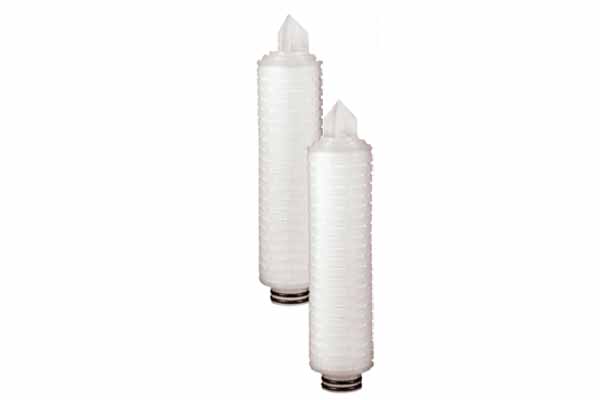
- Mechanical sieving — particles larger than the pore opening are physically excluded. Most pleated membrane filters work this way.
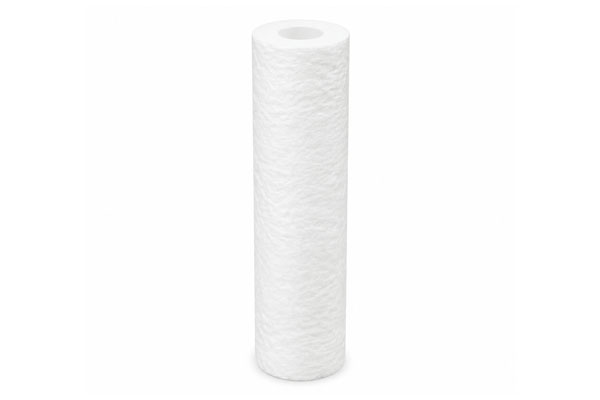
- Depth loading / adsorption — particles are captured inside the media structure by interception, inertial impaction and adsorption. Melt-blown polypropylene depth filters work this way. They can retain particles smaller than the nominal pore size, but also release captured particles if differential pressure exceeds the design limit (unloading).
This distinction matters when you move from nominal to absolute specification: you may need to switch from a depth medium to a membrane or tight pleated medium, with different flow resistance, life, and DP characteristics.
2. Particle Size Reference Chart
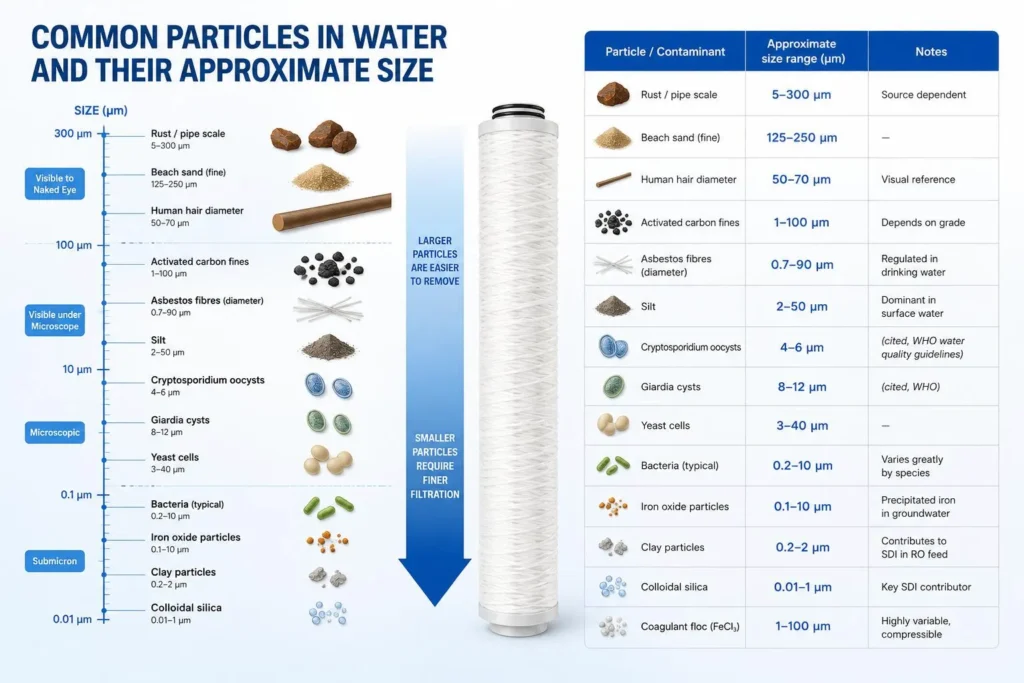
A micron number only becomes meaningful when you know what particle sizes you are actually dealing with. Reference values below are (illustrative) — real-world particle sizes vary widely by source.
| Particle / Contaminant | Approximate size range (µm) | Notes |
|---|---|---|
| Human hair diameter | 50–70 µm | Visual reference |
| Beach sand (fine) | 125–250 µm | — |
| Silt | 2–50 µm | Dominant in surface water |
| Clay particles | 0.2–2 µm | Contributes to SDI in RO feed |
| Bacteria (typical) | 0.2–10 µm | Varies greatly by species |
| Cryptosporidium oocysts | 4–6 µm | (cited, WHO water quality guidelines) |
| Giardia cysts | 8–12 µm | (cited, WHO) |
| Asbestos fibres | 0.7–90 µm (diameter) | Regulated in drinking water |
| Activated carbon fines | 1–100 µm | Depends on grade |
| Iron oxide particles | 0.1–10 µm | Precipitated iron in groundwater |
| Colloidal silica | 0.01–1 µm | Key SDI contributor |
| Coagulant floc (FeCl₃) | 1–100 µm | Highly variable, compressible |
| Rust / pipe scale | 5–300 µm | Source dependent |
| Yeast cells | 3–40 µm | — |
| Viruses | 0.02–0.3 µm | Not removed by 0.2 µm membrane filters (cited) |
Key reading: a 5 µm cartridge will remove most Cryptosporidium and Giardia cysts, most iron oxide precipitates and most coagulant floc (at the upper end of its size range), but will not remove clay particles, colloidal silica, or bacteria reliably. A 0.2 µm filter will remove bacteria but not viruses.
3. Micron to Mesh Conversion Chart
Mesh size refers to the number of openings per linear inch in a woven screen. A higher mesh number means a finer screen. The two scales run in opposite directions — as mesh number goes up, the micron opening goes down.
The conversion below is based on the Tyler mesh series (cited, Tyler Mesh standard) and is (illustrative) for woven wire screens. Injection-moulded or sintered mesh screens may differ.
| Mesh (Tyler) | Approx. opening (µm) | Mesh (US/ASTM) | Approx. opening (µm) |
|---|---|---|---|
| 10 | 1,680 | 10 | 2,000 |
| 20 | 840 | 20 | 840 |
| 40 | 420 | 40 | 420 |
| 60 | 250 | 50 | 300 |
| 80 | 177 | 80 | 180 |
| 100 | 149 | 100 | 150 |
| 150 | 105 | 120 | 125 |
| 200 | 74 | 200 | 74 |
| 270 | 53 | 270 | 53 |
| 325 | 44 | 325 | 44 |
| 400 | 37 | 400 | 37 |
Practical note: mesh-to-micron conversion is straightforward for screens and strainers, but most cartridge filters use fibrous or membrane media, not woven wire. A "50 mesh strainer" upstream of a "50 µm cartridge filter" are approximately equivalent in opening size, but the cartridge has far higher surface area and dirt holding capacity. Do not treat mesh-rated strainer baskets as interchangeable with micron-rated cartridge filters even when the numbers align.
4. Common Problems When Selecting a Micron Rating
Problem 1 — Specifying tighter than necessary
Symptom: Cartridges clog far sooner than expected. Frequent replacement. High DP even on relatively clean feed.
Cause: A 1 µm cartridge specified where a 5 µm would protect the downstream equipment equally well. The tighter rating reduces effective pore size and dramatically cuts dirt holding capacity — the element fills up before the bulk of its volume is used.
Direction: Work backwards from the downstream requirement. An RO membrane manufacturer’s feed specification typically requires SDI₁₅ ≤ 5 and particles larger than 5–10 µm removed. That requirement does not need a 1 µm cartridge downstream of a properly operating media filter.
Problem 2 — Specifying too coarse for the downstream risk
Symptom: Downstream equipment fouling — RO membrane particulate fouling, pump wear, heat exchanger plugging.
Cause: A 20 or 25 µm cartridge used as a final guard where a 5 µm is needed; or a 100 µm strainer type element upstream of a delicate membrane.
Direction: Define the consequence of failure first. A fouled RO membrane element costs several times the annual cartridge budget to replace. Size the cartridge to the risk, not to the cartridge budget.
Problem 3 — Substituting nominal for absolute
Symptom: Replacement "same micron" element from a new supplier shows worse downstream water quality or different service life with no obvious cause.
Cause: One element was nominal-rated, the other absolute-rated, or they used different test standards. Performance is genuinely different even though the printed number is the same.
Direction: Specify efficiency basis and test standard, not just micron size.
Problem 4 — Misreading a mesh-rated upstream strainer
Symptom: A 100-mesh basket strainer is upstream of the cartridge housing. Engineer specifies "100 micron cartridges" assuming they match.
Cause: 100 mesh ≈ 149 µm opening (Tyler), not 100 µm. The cartridge is actually finer than the upstream strainer, which may be correct (guard filtration) or may indicate a selection error.
Direction: Always convert mesh to micron before comparing the two stages.
5. How to Select the Right Micron Rating
5.1 Work from downstream to upstream
The selection sequence:
- Identify the downstream requirement. What does the protected equipment need? RO membrane: typically particles > 5–10 µm removed, SDI₁₅ ≤ 5 (cited, typical membrane manufacturer specification). Sterile filling: 0.2 µm absolute bacteria-retentive. Potable water: application-specific regulatory standard.
- Characterise the feed water. What is the SDI, turbidity, TSS, and nature of the dominant foulant (crystalline, biological, gelatinous)?
- Check the upstream treatment. A UF permeate with SDI ≤ 1 can tolerate a tighter cartridge for longer than a media filter effluent with SDI 2–4.
- Apply the table below.
- Confirm with a service life target. If the target is 3-month change-out intervals and the proposed rating gives 3 weeks in practice, the rating is too tight or the upstream process needs improvement — not both.
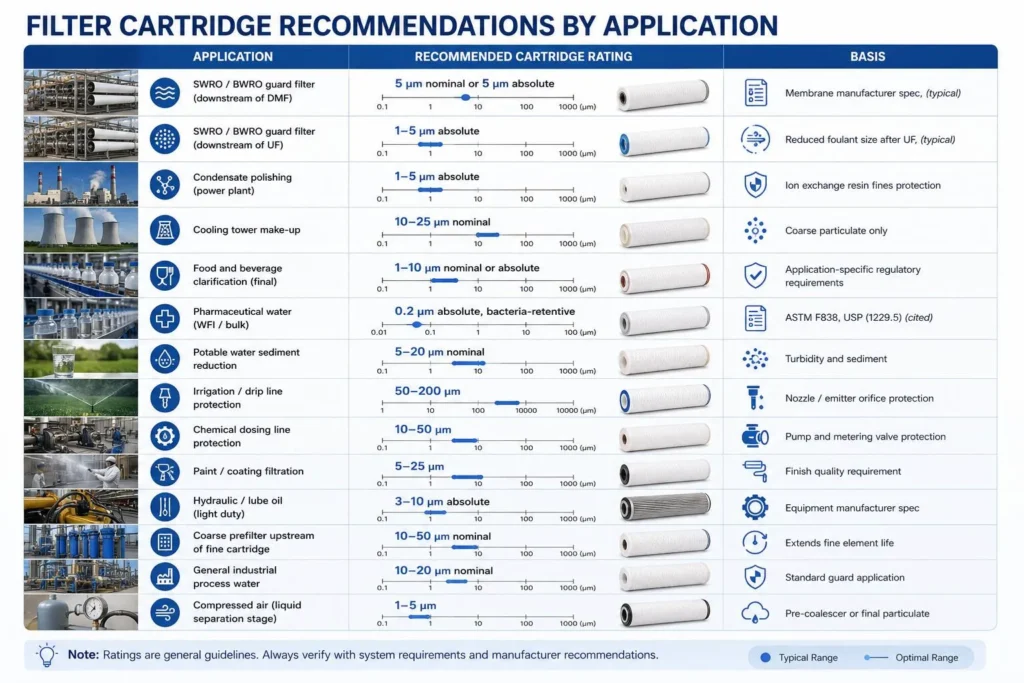
5.2 Application selection table
| Application | Recommended cartridge rating | Basis |
|---|---|---|
| SWRO / BWRO guard filter (downstream of DMF) | 5 µm nominal or 5 µm absolute | Membrane manufacturer spec, (typical) |
| SWRO / BWRO guard filter (downstream of UF) | 1–5 µm absolute | Reduced foulant size after UF, (typical) |
| Condensate polishing (power plant) | 1–5 µm absolute | Ion exchange resin fines protection |
| Cooling tower make-up | 10–25 µm nominal | Coarse particulate only |
| Food and beverage clarification (final) | 1–10 µm nominal or absolute | Application-specific regulatory requirements |
| Pharmaceutical water (WFI / bulk) | 0.2 µm absolute, bacteria-retentive | ASTM F838, USP ⟨1229.5⟩ (cited) |
| Potable water sediment reduction | 5–20 µm nominal | Turbidity and sediment |
| Irrigation / drip line protection | 50–200 µm | Nozzle / emitter orifice protection |
| Chemical dosing line protection | 10–50 µm | Pump and metering valve protection |
| Paint / coating filtration | 5–25 µm | Finish quality requirement |
| Hydraulic / lube oil (light duty) | 3–10 µm absolute | Equipment manufacturer spec |
| Coarse prefilter upstream of fine cartridge | 10–50 µm nominal | Extends fine element life |
| General industrial process water | 10–20 µm nominal | Standard guard application |
| Compressed air (liquid separation stage) | 1–5 µm | Pre-coalescer or final particulate |
6. Each Micron Rating Explained
The nine ratings below cover the most commonly specified sizes. Where a "cartridge filter 5 micron 40 inch" or similar product is the intended result of a keyword search, this section gives the context behind the number.
6.1 — 0.2 µm
What it removes: bacteria, yeast cells, and particles at or above 0.2 µm. Does not remove viruses reliably (cited).
Media type: typically membrane (PTFE, PVDF, cellulose acetate, nylon) or tight asymmetric polypropylene. Must be absolute-rated and tested to ASTM F838 (bacterial challenge, Brevundimonas diminuta) to be called "sterilizing-grade."
Typical flow resistance: high. Expect a higher clean DP than any larger-rated element at the same flow. Requires careful hydraulic sizing.
Applications: pharmaceutical water systems (WFI, CIP return), biological process fluids, laboratory water, sterile food and beverage filtration.
Common mistake: using 0.2 µm as a guard filter in an industrial water system. Clean DP will be high, life will be short, and the application does not need it.
6.2 — 1 µm
What it removes: fine bacteria, iron oxide colloids, clay fines, activated carbon fines, fine silt.
Media type: depth or membrane. Depth 1 µm nominal is common in RO pretreatment; membrane 1 µm absolute is used in food, beverage and pharmaceutical service.
Applications: RO guard filter downstream of UF (SDI ≤ 1 feed), condensate polishing protecting ion exchange resin beds, fine chemical clarification.
Important context for RO use: a 1 µm cartridge downstream of properly operating UF will have a very long life because UF permeate is already low in particulate above 0.03 µm. A 1 µm cartridge downstream of media filtration will foul rapidly in the presence of colloidal iron or gelatinous foulants — not because 1 µm is wrong, but because those foulants pass media filters and blind the cartridge surface regardless of rating.
6.3 — 3 µm
What it removes: fine particulate, Cryptosporidium and Giardia with margin, fine iron precipitates.
Media type: depth or pleated. Less common than 1 or 5 µm; most used in food and beverage applications where 5 µm is slightly too coarse and 1 µm is over-specified.
Applications: pre-RO when feed is between UF-quality and media-filter-quality, food and beverage process water, light pharmaceutical make-up water.
6.4 — 5 µm
What it removes: coarse particulate, Cryptosporidium oocysts and Giardia cysts (≥ 99% at absolute rating (cited, NSF P231 data) ), most coagulant floc at process size, coarse silt.
Media type: depth (melt-blown PP) or pleated (polypropylene or glass fibre). The most common rating for RO guard filtration.
Applications: SWRO and BWRO guard filter downstream of media filtration, potable water final sediment reduction, general industrial process water final guard.
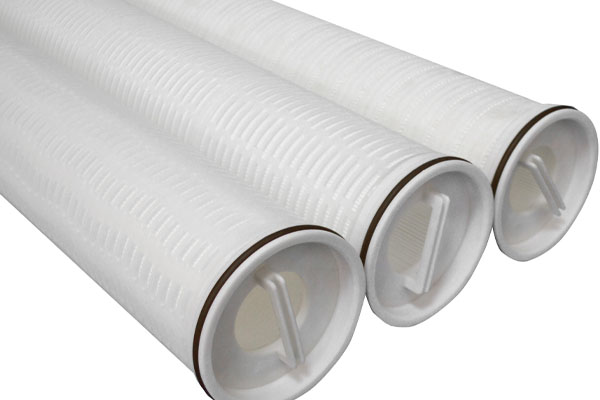
Note on "cartridge filter 5 micron 40 inch": the 40-inch length is a standard dimension for conventional housing systems. A 2.5 in OD × 40 in element at 5 µm nominal is the single most widely installed configuration in water treatment plants worldwide. High flow elements (6 in diameter, 20/40/60 inch) are sized differently; see our high flow filter cartridge page for selection in those applications.
6.5 — 10 µm
What it removes: coarse silt, sand fines, pipe scale, coarse iron precipitates, large biological particles.
Applications: coarse prefilter upstream of a 5 µm final stage (to extend 5 µm life), cooling tower make-up, general protection of pumps and heat exchangers where 5 µm is over-specified, irrigation and process water where coarse TSS is the only concern.
Practical note: a two-stage system — 10 µm prefilter followed by 5 µm guard — often has a longer total consumable cost per cubic metre than a single correctly sized 5 µm stage, but dramatically extends the 5 µm element life when feed quality is poor or variable.
6.6 — 20 µm
What it removes: visible particulate, sand fines at the upper end of the silt range, coarse pipe scale.
Applications: first-stage coarse sediment reduction, irrigation supply protection, general cooling water, upstream of media filters as a coarse strainer alternative.
Not suitable for: RO pretreatment as the final guard element. A 20 µm element will not protect RO membranes from the colloidal and fine particulate load that causes membrane fouling.
6.7 — 25 µm
Functionally similar to 20 µm. Common in process water applications and as a coarse prefilter. Also used in oil field water injection systems where the injection well specification allows larger particulate.
6.8 — 50 µm
What it removes: coarse sand, large scale, visible debris. Equivalent to approximately 270 mesh (Tyler).
Applications: upstream of cartridge filter housings as a coarse protection element, large-volume irrigation systems, coarse industrial process protection. In some oil and gas injection applications, 50 µm is the final specification where formation damage tolerance is high.
Practical note: at 50 µm you are approaching the range where a wedge-wire or woven stainless screen strainer may be more cost-effective than a disposable depth cartridge, particularly at high flow rates.
6.9 — 100 µm
What it removes: large visible particulate, coarse sand, debris. Approximately 150 mesh (Tyler).
Applications: wellhead water protection, very coarse first-stage filtration, upstream of everything else. In industrial water treatment, a 100 µm cartridge is almost always a prefilter, not a final guard.
Reusable option: at 100 µm, washable pleated polyester or stainless mesh cartridges are available and often preferable to disposable depth elements, since the dirt is large enough to backwash off without blinding the medium.
7. Filter Cartridge Selection Criteria Beyond Micron Rating
Micron rating addresses removal efficiency. It does not address whether the cartridge will physically fit, survive the service environment, or run at an acceptable cost. The following parameters must also be confirmed.
7.1 Flow rate and differential pressure
Cartridge DP is set by flow per unit, media structure and rating. A correctly sized element at rated flow should show a clean DP in the range 0.05–0.3 bar (0.7–4.4 psi) (typical). Exceeding the recommended flow per element:
- Raises clean DP roughly with the square of velocity
- Reduces contact time and therefore effective removal efficiency
- Shortens service life by accelerating surface loading
Always check the manufacturer’s recommended flow rate per element, and size the element count to stay within it at your peak flow condition.
7.2 Element length and diameter
Standard lengths for conventional cartridge systems: 10, 20, 30, 40, 50 and 60 inches (254, 508, 762, 1016, 1270, 1524 mm). Standard OD: 2.5 in (63 mm) for most cartridge housings. High flow elements: typically 6 in (152 mm) OD, available in 20/40/60 in lengths.
An element that is dimensionally incorrect will not seal regardless of how correct the micron rating is.
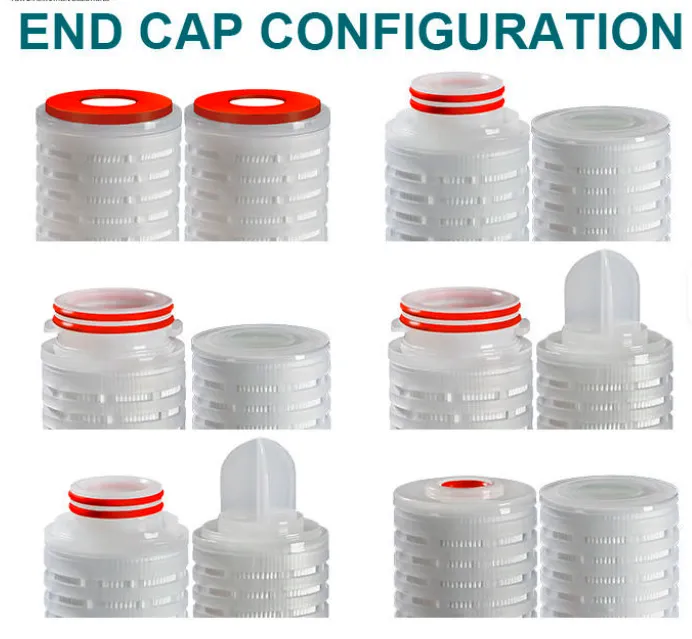
7.3 End connection and seal geometry
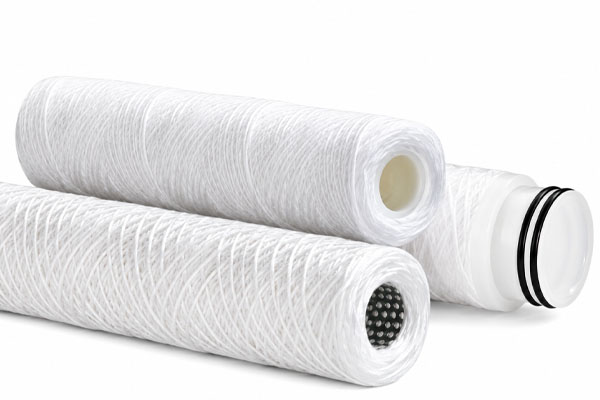
DOE (double open end): both ends open, element sits between two flat plate gaskets or O-rings. Simple and tolerant of dimensional variation, but less positive seal than knife-edge.
SOE (single open end): one closed moulded end, one open end with a spigot and O-ring that locates into the housing sump. More positive seal. Different housing types use different spigot profiles — 222 or 226 bayonet, flat or fin, single or double O-ring.
Bypass caused by a wrong seal geometry is invisible in DP data. It is one of the most common causes of poor downstream water quality that is incorrectly attributed to cartridge performance.
7.4 Media material and chemical compatibility
Standard melt-blown polypropylene is compatible with most water applications, dilute acids, alkalis, and common process streams. It is not compatible with aromatic solvents, strong oxidisers above certain concentrations, or temperatures above approximately 80 °C (176 °F) (rated, typical PP media).
For chemical service: confirm compatibility of media fibre, core, end cap and seal compound against your specific fluid, concentration, and temperature.
7.5 Seal material
| Compound | Compatible with | Avoid |
|---|---|---|
| EPDM | Hot water, steam, alkalis, dilute acids, many water treatment chemicals | Hydrocarbons, petroleum fluids, mineral oils |
| Fluoroelastomer (FKM / Viton) | Hydrocarbons, fuel, oils, many solvents, high temperature | Steam, hot water above ~150°C, amines |
| Silicone | Hot water, steam, food contact applications | Fuels, oils, strong solvents |
| Nitrile (NBR) | Oils, fuels, mild acids | Ozone, strong oxidisers, aromatic solvents |
7.6 Operating temperature
Polypropylene media and hardware: practical upper limit approximately 80 °C (176 °F) (rated). Above this, element integrity and end cap bond strength degrade.
For hot water or steam service: use elements constructed from compatible materials (PTFE, glass fibre, stainless core) with appropriate end cap compounds.
7.7 Maximum differential pressure rating
All cartridge elements have a collapse DP — the point at which the element core or structure fails mechanically, releasing all captured material into the downstream system. This is typically 3–5 bar (44–72 psi) for a standard polypropylene melt-blown element (rated, typical), but can be higher for reinforced elements.
Set change-out at a DP with margin below the collapse rating, not at the collapse rating itself.
8. Selection Mistakes to Avoid
Specifying the finest available rating as a default. A 1 µm element is not "safer" than a 5 µm element in most industrial water applications — it is shorter-lived, more expensive, and creates higher DP at the same flow. Use the coarsest rating that meets the downstream requirement.
Not logging clean DP. A change-out decision made only on calendar ignores the actual condition of the element. Without a clean DP baseline at a known flow, you cannot distinguish a fouling problem from a bypass problem.
Changing micron rating to solve an upstream problem. If coagulant overdose is blinding your cartridges in three days, going to 10 µm instead of 5 µm only slightly delays the problem. Fix the upstream chemistry.
Ignoring the test standard behind the rating. Nominal ratings from different suppliers are not comparable. Ask for the efficiency basis and the test standard.
Treating the cartridge as the primary SDI reduction stage. Cartridge filters are guard filters. If the cartridge stage is producing a large SDI reduction, the upstream clarification is deficient and cartridge life will be unpredictable regardless of rating.
Ordering by catalogue name without confirming dimensions. Even within the same supplier’s range, a product revision can change end cap geometry. Confirm dimensional details before ordering a first-time replacement.
9. How ECOFILTRONE Configures Micron Selection
When ECOFILTRONE specifies a cartridge for a new application or replacement, the process is:
- Review the downstream requirement — membrane manufacturer specification, process specification, or regulatory standard.
- Review the feed water analysis — SDI₁₅, turbidity, TSS, iron, TOC, and dominant foulant type.
- Review the upstream treatment — DMF, UF, softener, or none, and its current performance.
- Confirm the housing and existing element dimensions — length, OD, end cap, seal.
- Select rating basis — nominal for most industrial guard applications; absolute where downstream risk is high or a standard requires it.
- Calculate flow per element — confirm the proposed element count keeps each unit within its recommended flow band.
- Set a service life expectation — not a fixed interval, but a DP growth rate target under normal conditions so the first cycle generates data to refine the second.
This sequence is set out in detail in our cartridge filter sizing and selection guide, which also covers housing selection for high flow applications.
10. Frequently Asked Questions
What micron rating do I need for an RO system?
5 µm nominal is the standard starting point downstream of media filtration (typical). Use 1–5 µm absolute downstream of UF. Confirm against your membrane manufacturer’s feed water specification — different manufacturers state different requirements.
What is the difference between nominal and absolute micron ratings?
Nominal rating is an approximate statement (typically 85–90% removal) with no standardized test behind it. Absolute rating is a verified removal efficiency at a defined beta ratio, tested to ISO 16889 or an equivalent standard. The two ratings are not interchangeable. See section 1.1 for detail.
How do I convert micron to mesh?
Divide using the relationship: 200 mesh (Tyler) ≈ 74 µm; 100 mesh ≈ 149 µm; 40 mesh ≈ 420 µm. See the full table in section 3. Note that mesh sizes apply to woven screens, not to fibrous filter media.
What does a 5 micron filter remove?
A 5 µm filter removes particles at or above 5 µm, including most Giardia cysts, Cryptosporidium oocysts, coarse silt, coagulant floc and visible turbidity. It does not remove bacteria, viruses, dissolved compounds, colloidal silica, or fine clay particles.
What does a 1 micron filter remove?
A 1 µm filter removes particles at or above 1 µm, including most bacteria at the larger end of the size range, fine iron colloids, fine clay and silt. It does not remove viruses or dissolved compounds. For guaranteed bacteria removal, use a 0.2 µm absolute membrane element tested to ASTM F838.
Is a 0.2 micron filter enough to remove viruses?
No. Most viruses are 0.02–0.3 µm; many fall below the 0.2 µm barrier. Virus removal from drinking water requires UV treatment, membrane systems with a specific virus log-reduction validation, or chemical disinfection.
My 5 micron cartridge is clogging in days. Should I switch to 10 micron?
Probably not. Short cartridge life is almost always an upstream problem. Check coagulant dose, media filter backwash performance, and whether there is an upstream upset event (algae bloom, pipe disturbance). A 10 µm element will extend life slightly but the root cause will persist. Identify the foulant first.
What is a 40 inch cartridge filter?
The 40-inch specification refers to the element length — approximately 1016 mm — which is the standard length for conventional housing systems designed for this size. The length must match the housing internal height. Longer elements (40 or 60 in) offer more surface area and higher dirt holding capacity than shorter elements of the same diameter and rating.
Can I use a higher micron rating to reduce my operating cost?
Sometimes, with caveats. Moving from 5 µm to 10 µm reduces filtration efficiency and may not protect the downstream equipment adequately. The correct way to reduce operating cost is to fix the upstream process so the cartridge stage receives cleaner feed, to switch from surface-loading to depth-loading media to increase dirt holding capacity, or to size the element count correctly so each element operates within its recommended flow range.
What information do I need to select a filter cartridge?
Application type, design flow (m³/h or gpm), feed water analysis (SDI, turbidity, TSS, temperature), upstream treatment type, housing details (element length, OD, end cap type, flow direction), operating temperature, target change-out interval, and whether the downstream requirement calls for nominal or absolute rating.
11. Discuss Your Application
If you are selecting a filter cartridge for a new installation, troubleshooting short cartridge life, or looking for a replacement that matches your current element’s rated performance, share your application details — feed water analysis, housing dimensions, upstream treatment, and downstream requirement — and ECOFILTRONE will evaluate a suitable configuration.
WhatsApp: +86 131 8896 2285