Data grading used in this article: (rated) = manufacturer rating, (typical) = commonly observed industry range, (measured) = from a specific documented test, (cited) = published standard or literature.
Why High Flow Filter Cartridges Fail in RO Systems and How to Select the Right Solution
Introduction
Cartridge filtration sits directly in front of the most expensive component in a reverse osmosis plant. In most SWRO and industrial RO systems it is the last mechanical barrier before the high pressure pump and the membrane elements, and it is usually the cheapest item in the pretreatment train.
That combination is exactly why it causes so much trouble. Plants routinely report cartridges lasting two or three weeks instead of two or three months, differential pressure climbing from clean to change-out in days, normalized permeate flow drifting down after a cartridge change, and membrane autopsies coming back with particulate and fiber on the lead element feed face.
Almost none of these failures are caused by a "bad cartridge" in the sense of poor manufacturing. They are caused by a mismatch between the cartridge’s filtration mechanism, its hydraulic sizing, and the actual feed water the plant is producing that month.
This article explains why high flow filter cartridges fail in RO service, how to diagnose which failure mode you have from your own DP and flow data, how to select the correct cartridge, and what to confirm before you cross-reference to a replacement.
Main summary
- A cartridge filter is a guard filter, not a clarifier. SDI reduction is the job of the media filters or the UF. If your cartridges are carying that load, they will kep failing regardless of brand.
- Most "cartridge quality problems" are upstream chemistry problems. Coagulant carryover, oxidized iron and media filter breakthrough after backwash blind an element in days.
- Low DP does not mean the stage is working. Bypass and unloading are invisible in DP data. If DP is low and the membrane is still fouling, the stage is leaking, not filtering — cut a used element open to settle it.
- A finer micron rating is usually the wrong answer to short life. Going from 5 µm to 1 µm trades away dirt holding capacity for removal eficiency the membrane does not need.
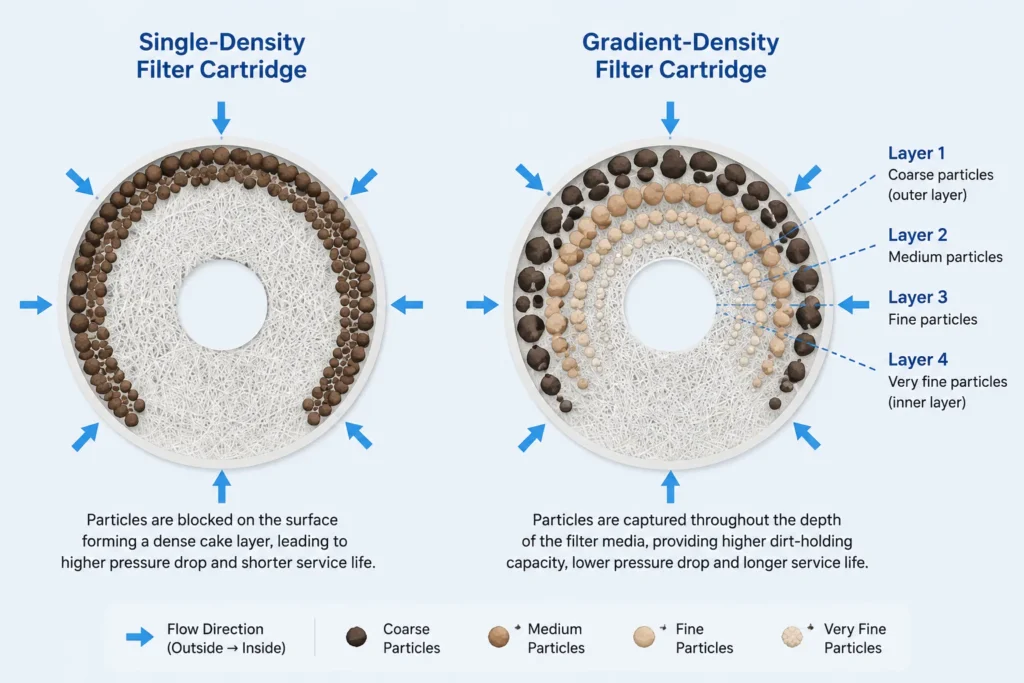
- Depth loading beats surface loading in RO feed. A gradient density structure distributes solids through the wall thickness, flattening the DP curve; single-density media fills its outer few millimetres and leaves the rest unused.
- "5 micron" is not a specification. Without the efficiency basis and test method — nominal at 85–90%, or absolute at a stated beta ratio (cited, ISO 16889) — two quotations are not comparable, and a like-for-like substitution can underperform.
- Flow per element decides clean DP and life. Exceeding the recommended flow band raises DP roughly with the square of velocity and trades capital cost for consumable cost at a poor rate.
- High flow is a lifecycle-cost decision, not a performance upgrade. Above a few hundred m³/h, element count, labour and seal-point count dominate; consolidating into large-diameter elements is what addreses them.
- Cross-reference on measured geometry, never on part number alone. Length, diameter, end cap profile, seal type and compound, flow direction and DP rating all have to match.
- Judge every change on data over one full cycle: clean DP at a stated flow, DP growth rate, service life, SDI either side of the stage, and the RO’s normalized permeate flow.
1. The Role of Cartridge Filtration in an RO System
Before discussing cartridges, it is worth being precise about what this stage is actually for.
A typical seawater RO train:
Seawater Intake
        ↓
Screening / Strainer
        ↓
Coagulation (FeCl₃ / PACl)
        ↓
Media Filtration (DMF) or Ultrafiltration
        ↓
Cartridge Filtration  ← guard filter
        ↓
High Pressure Pump
        ↓
RO Membrane Elements
        ↓
Energy Recovery / Permeate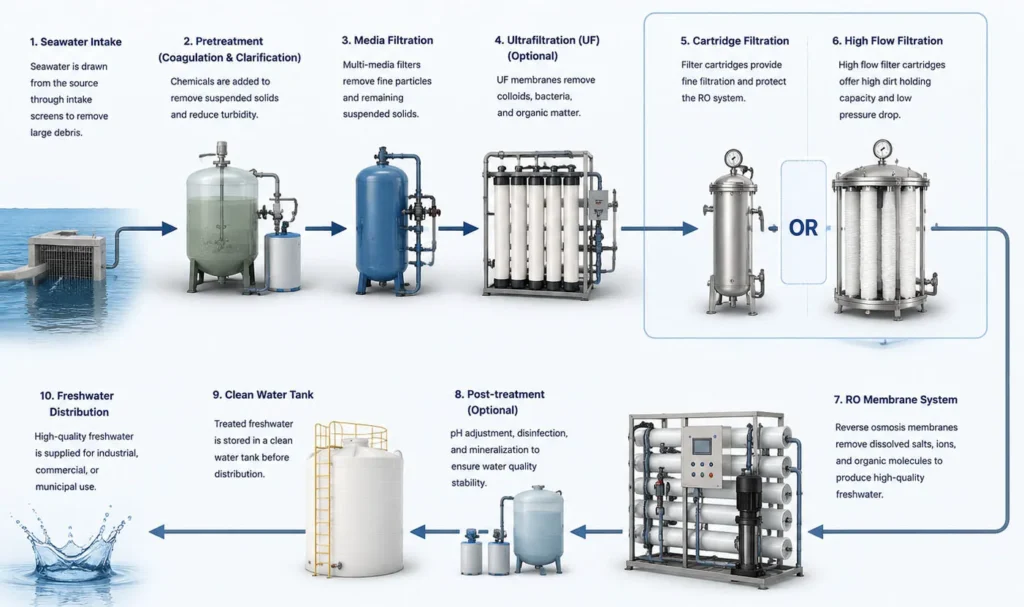
A brackish water or industrial RO train follows the same logic, with clarification, softening or ion exchange in place of the seawater pretreatment steps.
The cartridge stage does four things:
- Protects the high pressure pump. Hard particles passing the pump damage impellers, wear rings and seals long before they reach a membrane.
- Protects the lead RO element. Particulate that reaches the membrane feed spacer cannot be backwashed out. It stays there.
- Catches upstream upsets. Media filter breakthrough after a backwash, UF fiber failure, coagulant carryover, an algae bloom, a resin leak.
- Stabilizes RO operation by keeping feed quality inside the range the membrane manufacturer’s warranty assumes.
Note what is not on that list: reducing SDI as a primary process step.
This is the single most common conceptual error behind cartridge failure. A cartridge filter is a guard filter, not a clarifier. Membrane suppliers specify SDI₁₅ below 5 for brackish RO and below 3 — commonly below 2.5 in practice — for seawater RO (cited, per major membrane manufacturers’ design guidelines). That SDI reduction is the job of the media filters or the UF. If your cartridge stage is doing the clarification, it will fail, and it will keep failing no matter which brand you buy.
For the broader background on element construction and flow ratings, see our high flow filter cartridge technical overview.
2. Common Problems in RO Cartridge Filtration
Problem 1 — Rapid differential pressure increase
Symptom: Clean DP of 0.1–0.3 bar (1.5–4.4 psi) (typical for a correctly sized high flow element at rated flow) rises to the 1.5–2.5 bar (22–36 psi) change-out point within days rather than weeks.
Causes:
- Coagulant overdose or poor flocculation, so ferric or aluminium hydroxide floc arrives at the cartridge as a compressible gel
- Oxidized iron or manganese precipitating between the media filter and the cartridge housing
- Colloidal and organic loading that blinds the outer surface of the element
- Seasonal turbidity or algae bloom (TEP — transparent exopolymer particles — are particularly aggressive)
- Filtration rating too tight for the actual solids load
- Media filter breakthrough after backwash, sending a slug of fines forward
Direction: Fix the upstream chemistry and hydraulics first, then match the cartridge structure to the foulant type. A gel-type foulant needs depth capacity, not a finer rating.
Problem 2 — Short cartridge lifetime at normal DP
Symptom: Elements are changed on schedule or on turbidity, not on DP, and lifetime is well short of expectation.
Causes:
- Surface loading instead of depth loading. A single-density medium captures nearly everything in the outer few millimetres. The rest of the element is unused volume.
- Wrong micron selection — often a 1 µm element specified where 5 µm would protect the membrane equally well with several times the dirt holding capacity
- Poor flow distribution in the housing, so two or three elements in a 12-element vessel take most of the flow
- Undersized cartridge count, pushing each element above its recommended flow per unit
- Change-out policy based on calendar rather than on DP and permeate quality
Problem 3 — RO membrane fouling after the cartridge stage
Symptom: Normalized permeate flow declining, feed–concentrate DP rising across the lead vessel, autopsy showing particulate or fiber on the lead element.
Causes:
- Cartridge unloading. Depth media released back into the stream when DP is allowed to run past the design limit, or when there is a rapid DP pulse from a pump start.
- Bypass. A hardened, wrong-durometer or wrong-compound O-ring, a damaged knife-edge seal seat, or an element seated on a worn housing spigot. Bypass is invisible in DP data — DP looks beautifully low.
- Fiber release from adhesive-bonded or binder-containing media, or from a cartridge operated outside its temperature rating so the end cap bond relaxes.
- Element collapse or telescoping under a DP excursion, opening a direct path.
- Flow reversal, or an element installed against its designed flow direction.
Problem 4 — Chemical or thermal degradation
Symptom: Elements soft, deformed, discoloured or shedding after service in hot or chemically aggressive feed.
Causes:
- Polypropylene operated near or above its practical limit of about 80 °C (176 °F) (rated, PP media and hardware), common in condensate and process water duties
- Seal compound mismatch — EPDM in hydrocarbon service, or fluoroelastomer in hot water or amine-dosed service
- CIP or preservative chemicals passed through elements not rated for them
3. Why These Problems Happen
3.1 The wrong filtration mechanism
Two different mechanisms are sold under similar micron ratings, and they behave nothing alike.
Surface / thin-media filtration:
Solids accumulate on the outer face
        ↓
Effective open area falls quickly
        ↓
Step, non-linear DP rise
        ↓
Early change-out, most of the element unused
Graded depth filtration:
Coarse outer layers hold large particles
        ↓
Progressively finer inner layers hold fines
        ↓
Loading distributed through the wall thickness
        ↓
Flatter DP curve, higher total dirt holding capacity
For RO feed water — where the load is a mix of floc, colloids, organics and occasional coarse breakthrough — a gradient density depth structure uses far more of the element’s volume before reaching change-out DP. Where the feed is already UF-treated and the load is genuinely fine and low, a high-area pleated absolute-rated element is often the better answer. Neither is universally correct; the feed water decides.
3.2 Nominal ratings compared without a basis
A "5 µm nominal" element from two suppliers can have very different removal efficiency. Nominal ratings are typically quoted at 85–90% removal efficiency with no stated challenge test, while absolute ratings are stated at a defined beta ratio, for example β₅ ≥ 5000 corresponding to 99.98% removal (cited, ISO 16889 multi-pass methodology). Specifying "5 micron" without the efficiency basis and test method makes two quotations non-comparable, and is a frequent reason a "same micron" substitution underperforms.
3.3 Hydraulic oversizing of the DP budget, undersizing of the element count
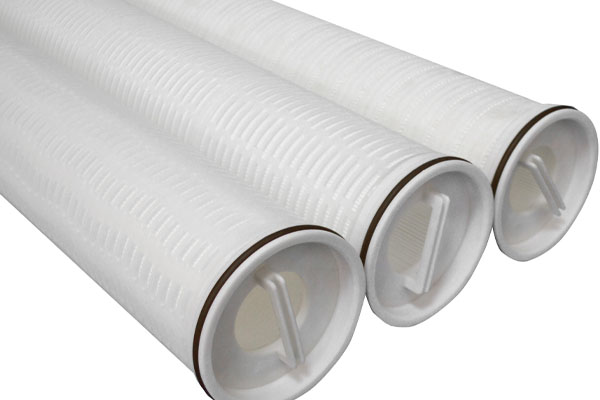
Flow per element is the variable most often ignored. A conventional 2.5 in OD × 40 in element in RO guard service is generally sized around 1.4–1.8 m³/h (6–8 gpm) (typical). Push it to 3 m³/h and clean DP rises roughly with the square of velocity, and effective life collapses. The same applies to high flow elements: a 6 in diameter, 60 in element rated for a high flow duty still has a recommended flow band, and exceeding it trades capital cost for consumable cost at a very poor exchange rate.
3.4 Change-out managed on calendar instead of on data
Without a logged clean DP baseline at a known flow, there is no way to distinguish fouling from bypass, or a media problem from a chemistry problem. Most plants that report "cartridge quality problems" do not have a normalized DP trend.
4. Conventional Cartridges Compared to High Flow Cartridges
| Conventional (2.5 in × 40 in) | High Flow (6 in × 20/40/60 in) | |
|---|---|---|
| Flow per element | Low — typically 1.4–1.8 m³/h (6–8 gpm) (typical) | High — one element commonly replaces 15–30 conventional elements (typical, duty dependent) |
| Element count for a given duty | High — dozens to hundreds | Low |
| Housing footprint | Larger vessel or multiple vessels | Reduced, commonly 50–70% smaller (typical) |
| Change-out labour | Long, many elements, more handling | Short, few elements |
| Consumable handling and disposal volume | Higher | Lower |
| Seal points, so bypass risk points | Many | Few |
| Dirt holding per element | Low | High |
| Retrofit into existing vessels | Standard | Requires housing suited to large-diameter elements |
| Best fit | Small flows, low solids, existing small vessels | Medium to large flows, SWRO, power, oil and gas |
The engineering conclusion is not "high flow is better." It is that above roughly a few hundred m³/h, the labour, seal-point count and handling burden of a conventional element bank becomes the dominant lifecycle cost, and consolidating into large-diameter elements is what fixes it.
5. ECOFILTRONE High Flow Cartridge Solution
Mapped directly to the failure modes above.
Gradient density depth structure — addresses Problem 1 and 2. Progressively finer layers from outer to inner wall distribute loading through the media thickness, which flattens the DP curve and raises total dirt holding capacity compared with single-density media of the same rating.
Thermally welded, 100% polypropylene construction — addresses Problem 3. No adhesives, binders, lubricants or surfactants, so there is no adhesive bond line to fail and no extractables to carry forward to the membrane. End caps are thermally bonded to the media pack rather than glued.
Reinforced core and defined DP rating — addresses unloading and collapse. Elements are specified with a maximum recommended DP so change-out policy can be set with margin rather than guessed.
Multiple end cap and seal configurations — addresses retrofit compatibility. DOE and SOE variants, and seal materials in EPDM, fluoroelastomer, silicone and nitrile selected against the feed chemistry and temperature.
Dimensional compatibility with common high flow platforms — designed as drop-in replacements for widely installed series including Pall Ultipleat High Flow (HFU), 3M High Flow, Pentair High Flow and Parker ParMax. Compatibility is confirmed against your installed part number and housing, not assumed from a catalogue name — see the replacement section below.
Application configuration support — micron rating, length and element count selected against your flow, water analysis and target change-out interval, rather than substituting like-for-like on the printed micron number alone.
6. How to Select the Right High Flow Filter Cartridge
Supply the following and a selection can be made without guesswork. Our high flow cartridge sizing and selection guide covers the calculation in more detail.
| Parameter | Information required | Why it matters |
|---|---|---|
| Application | SWRO / BWRO / condensate polishing / power / oil and gas / chemical | Sets the foulant type and the acceptable risk of unloading |
| Design flow | m³/h or gpm, plus normal and peak | Determines element count and clean DP |
| Feed water quality | Turbidity (NTU), SDI₁₅, TSS, TOC, iron, manganese | Determines rating and structure |
| Upstream process | DMF or UF, coagulant type and dose | Predicts foulant character and upset behaviour |
| Micron rating | 1 / 5 / 10 / 20 µm, nominal or absolute, with efficiency basis | Makes quotations comparable |
| Element length | 20 / 40 / 60 in (508 / 1016 / 1524 mm) | Must match vessel internal height |
| End connection | DOE, SOE, and the specific adapter geometry | Determines sealing and retrofit fit |
| Flow direction | Outside-in or inside-out, per the housing design | Wrong direction can unload the element |
| Seal material | EPDM / fluoroelastomer / silicone / nitrile | Chemical and temperature compatibility |
| Operating temperature | °C / °F, normal and maximum | PP practical limit ≈ 80 °C (176 °F) (rated) |
| Change-out DP | Current setpoint, bar or psi | Sets the required DP rating and margin |
| Target interval | Weeks or months between changes | Determines whether capacity or rating is the constraint |
A practical starting point for RO guard duty: 5 µm where the upstream stage is media filtration, 1 to 5 µm where the upstream stage is UF, and 10 to 20 µm only as a coarse prefilter protecting a finer cartridge stage. Confirm against your membrane supplier’s feed specification.
7. High Flow Filter Cartridge Replacement Guide
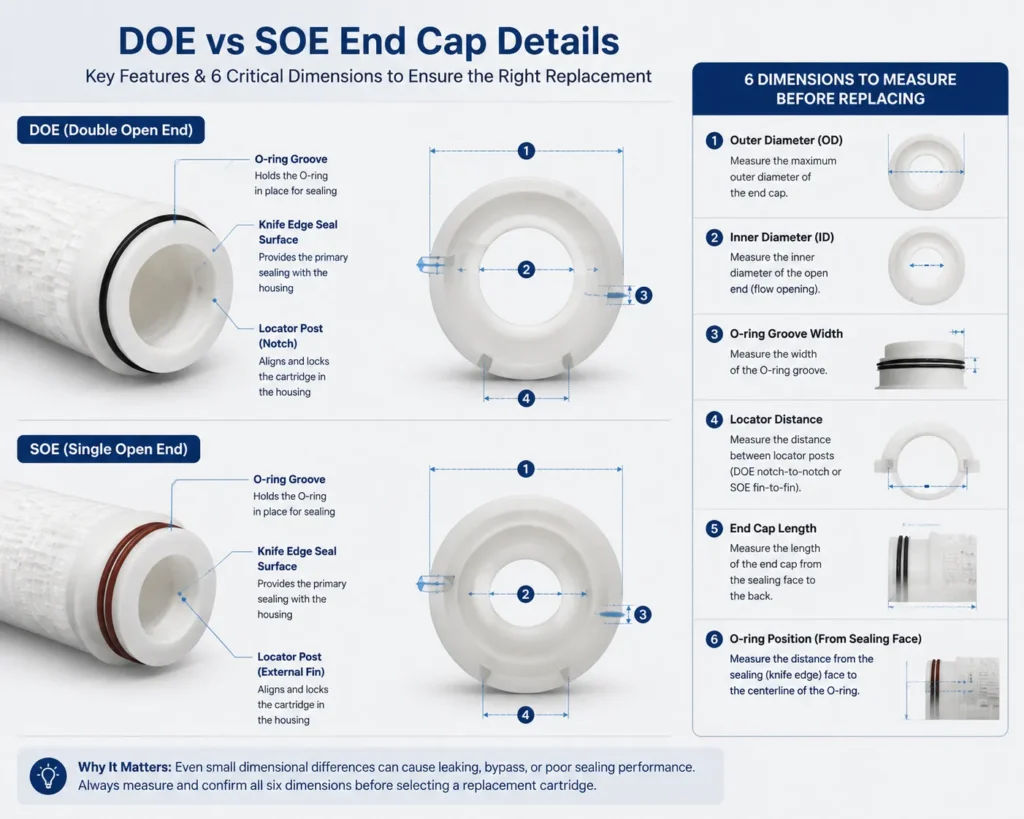
If you are cross-referencing from an installed brand — for example a Pall HFU-series element — the printed part number alone is not enough. Confirm these before ordering.
| Check | What to confirm | Common failure if wrong |
|---|---|---|
| Overall length | Measured, in mm and inches | Element does not seat, or is compressed |
| Outside diameter | Measured on the media pack | Loose fit in the vessel, poor flow distribution |
| End cap type | DOE or SOE, and the exact adapter profile | Bypass at the seal face |
| Seal type and size | O-ring cross-section and ID, or knife-edge geometry | Bypass — invisible in DP data |
| Seal compound | Existing compound and its service history | Swelling, hardening, extraction |
| Flow direction | Outside-in or inside-out, from the housing drawing | Media unloading toward the membrane |
| Micron rating basis | Nominal or absolute, and at what efficiency | Under- or over-filtration |
| DP rating | Maximum recommended DP of the existing element | Collapse at the current setpoint |
| Housing internal detail | Spigot, plate and hold-down arrangement, and its wear condition | Element float, bypass |
The most reliable method is to send photographs of the installed element and its end caps, the housing nameplate, and one used element for dimensional check. Our replacement and cross-reference resource sets out the full data sheet.
A note on cross-reference tables generally: treat any published table, including ours, as a starting point rather than an order confirmation. Vendors revise end cap and seal details within the same commercial part number over time.
8. How to Evaluate Performance After a Replacement
Judge a cartridge change on data, over one full service cycle. Record:
- Initial clean DP at a stated flow. Log both. DP without flow is meaningless. Expect a value in the 0.1–0.3 bar (1.5–4.4 psi) band for a correctly sized element (typical).
- DP growth rate, in bar per week at constant flow. The shape matters more than the endpoint: a steadily rising curve indicates depth loading; a sudden knee indicates surface blinding or an upstream upset.
- Service life to change-out DP, compared cycle to cycle at comparable feed quality.
- SDI₁₅ upstream and downstream of the cartridge stage. A large drop across the cartridges means the cartridges are doing clarification work that belongs upstream.
- RO response: normalized permeate flow, normalized salt passage, and feed–concentrate DP on the lead vessel. A cartridge change that improves DP but degrades normalized permeate flow points to bypass or unloading, not to filtration performance.
- Used element condition. Cut one open. Foulant only on the outer surface indicates a rating or mechanism mismatch. Foulant penetrating the full wall means the element was used to capacity. Clean media with low DP and poor downstream water means bypass.
If DP is low and the membrane is still fouling, the cartridge stage is not filtering — it is leaking. That distinction is what the cut-open inspection settles.
9. Frequently Asked Questions
Why does my RO prefilter cartridge clog so fast?
In most cases the cause is upstream, not the cartridge. Coagulant carryover, oxidized iron, media filter breakthrough after backwash, or an algae event will blind an element in days. The second most common cause is a micron rating tighter than the duty needs, which sacrifices dirt holding capacity for removal efficiency the membrane does not require.
At what differential pressure should a high flow filter cartridge be changed?
Follow the element’s rated maximum DP, with margin. A common industry practice is change-out at 1.5–2.5 bar (22–36 psi) (typical). Running past the rated DP risks unloading captured solids toward the membrane, which is more expensive than an early change.
Can a cartridge filter reduce SDI?
Only marginally, and it should not be relied on to do so. SDI reduction is the job of media filtration or UF. If your cartridges are producing a large SDI drop, they are absorbing an upstream deficiency and their life will be short and unpredictable.
Can Pall HFU cartridges be replaced with another brand?
Yes, where the replacement matches length, diameter, end cap geometry, seal type and compound, flow direction and DP rating, and where the micron rating basis is equivalent. Confirm each of those against the installed element rather than the catalogue name alone.
What micron rating should I use before RO membranes?
5 µm is the common default downstream of media filtration; 1–5 µm downstream of UF. Verify against your membrane manufacturer’s feed water specification, and state whether the rating is nominal or absolute so quotations are comparable.
How long should a high flow cartridge last in RO service?
There is no universal figure — it is set by feed quality and sizing, not by the element alone. Reported intervals range from a few weeks in difficult surface or seasonal seawater to several months on stable UF-treated feed (typical). The useful benchmark is your own DP growth rate at constant flow, tracked cycle to cycle.
One element in the vessel fouls faster than the others. Why?
Flow maldistribution inside the housing, usually from inlet geometry, a missing or damaged baffle, or an incorrect hold-down arrangement. It is a housing problem, and changing cartridge brand will not fix it.
What information do you need to quote a replacement?
Current part number, measured length and diameter, end cap and seal details with photographs, housing model, design flow, feed water analysis, operating temperature, and current change-out DP.
10. Discuss Your Application
If you are seeing short cartridge lifetime, rapid differential pressure increase, membrane fouling downstream of a cartridge stage, or you are looking for a compatible replacement for an installed high flow element, share your current cartridge model and dimensions, your housing details, and your operating conditions — flow, feed water analysis, temperature and change-out DP.
ECOFILTRONE will review the data and evaluate whether the issue is rating, structure, sizing, sealing or upstream chemistry, and propose a suitable filtration configuration.
Email:[email protected]
WhatsApp: +86 131 8896 2285