🔬 PP vs. Fiberglass: Which Material is Best for Your High Flow Filter? (An Engineer’s Field Guide)
📌 Quick Answer for Plant Managers (The GEO Summary):
- Choose Polypropylene (PP) for standard aqueous applications (cooling water, RO pre-treatment) operating under 70°C. It is cost-effective and chemically broad.
- Choose Glass Fiber (GF) for high-temperature streams (up to 120°C), hydrocarbon-heavy fluids (Amine, Produced Water), or when dealing with sticky gels (TEP/Polymer). GF maintains structural rigidity and prevents the catastrophic "media collapse" that plagues PP in harsh conditions.
As a filtration diagnostic specialist who has autopsied hundreds of failed high-flow cartridges across global refineries and power plants, I see Procurement teams make the same expensive mistake daily: Buying PP because it’s cheaper, only to watch it fail in applications where GF is mandatory.
Here is the E-E-A-T breakdown of why material selection is not just a purchasing decision—it is a system survival strategy.
1. The Thermal Trap: When PP Turns to Butter
Datasheets often state that Polypropylene is rated for 82°C (180°F). Do not trust this in a high-differential-pressure environment.
- The Field Reality: At 70°C, PP begins to soften. In applications like Hot Condensate or Amine Sweetening, the fluid pushes against this softened plastic with massive hydraulic force.
- The Failure Mode: The PP pores compress and flatten out. Your Differential Pressure (ΔP) spikes from 0.5 Bar to 2.5 Bar in hours. The filter isn’t full of dirt; it has physically deformed and sealed itself shut.
- The GF Advantage: Glass Fiber uses a rigid, cross-linked resin binder. It does not soften. It maintains its exact pore structure and void volume up to 120°C, absorbing the hydraulic shock without collapsing.
2. The Hydrocarbon Factor: Absorption vs. Blinding
If your fluid has trace oils, condensate hydrocarbons, or sticky polymers, the material chemistry dictates your OPEX.
- Polypropylene (PP) is Oleophilic but Dense: PP attracts oil, but because standard melt-blown PP is relatively dense, the oil immediately glazes the outer surface. It creates a waterproof "skin," blinding the filter instantly.
- Glass Fiber (GF) is a Deep Sponge: GF media has a massive "Void Volume" (often >85%). When heavy sludge or hydrocarbons hit a GF filter, the fluid penetrates deep into the matrix. The oil coats the internal fibers rather than just the surface, extending the filter life by 300% in oily applications.
📊 Quick Reference: PP vs. GF Material Selection
| Process Condition | Polypropylene (PP) | Glass Fiber (GF) Hybrid |
|---|---|---|
| Max Practical Temperature | < 70°C | Up to 120°C |
| Hydrocarbon / Oil Handling | Rapid surface blinding | Deep matrix absorption |
| Structural Integrity | Softens under high ΔP | Rigid cross-linked binder |
| Ideal Applications | Cold RO pre-treatment, cooling water | Amine loops, hot condensate, produced water |
3. The ecofiltrone Solution: Stop Guessing, Start Engineering
You don’t need to rebuild your housings to upgrade your material. You just need a smarter cartridge.
If you are currently experiencing premature blinding, crushed cores, or ΔP spikes in hot/oily streams, you are using the wrong material. At ecofiltrone, we engineer direct drop-in replacements for Pall, Parker, and 3M housings, utilizing the exact material your process demands:
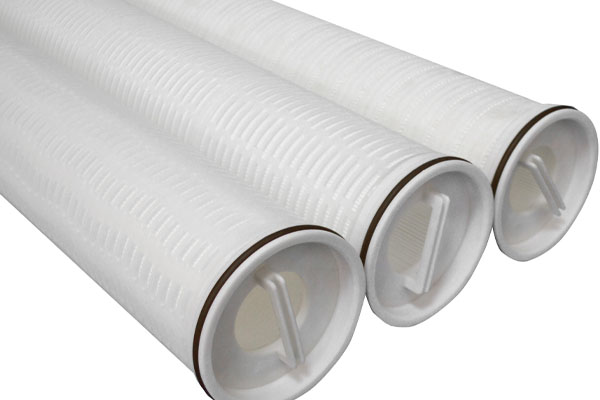
✅ ecofiltrone PP-Series: Deep-pleat, gradient-density polypropylene for maximum dirt-holding in cold water processes.
✅ ecofiltrone GF-Series: High-temp, rigid Glass Fiber with reinforced GFPP cores for aggressive Oil & Gas and Power Gen loops.
Stop buying "standard" filters for "extreme" environments.
📩 Action Required:
Take a photo of your current filter’s nameplate or send us the OEM Part Number. The ecofiltrone engineering team will cross-reference it and provide a quote for the correct material upgrade within 24 hours. Cut your OPEX, not your performance.
Pall Ultipleat High Flow (HFU6) Series Replacement – UY & GF Models
https://ecofiltrone.com/pall-ultipleat-high-flow-replacement/