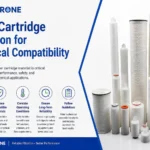
Why Does HFU640 ΔP Rise Too Fast in RO Systems?
Rapid ΔP Increase Is Usually Related to Pretreatment Instability
A rapid pressure drop (ΔP) increase across HFU640 high flow filters is often caused by unstable upstream pretreatment conditions rather than the filter cartridge itself.
In many RO systems, the security filter becomes the first component reacting to UF instability, colloidal fouling, coagulant carryover, or seasonal organic loading. When contaminants accumulate faster than the filter’s depth-loading capacity, surface blinding occurs rapidly, resulting in unstable ΔP growth and shortened cartridge life.
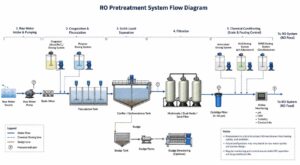
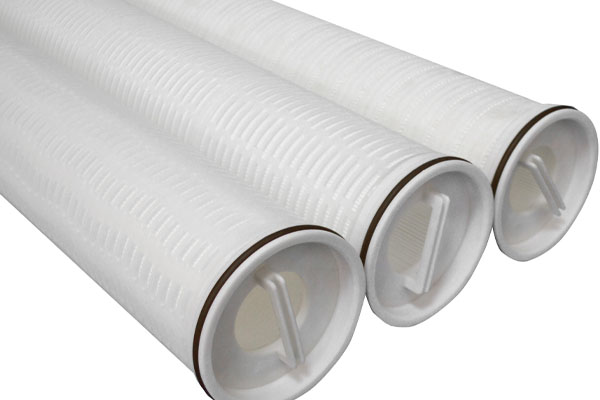
HFU640 high flow filter position in RO pretreatment system including media filter UF security filter and RO membrane
Main Causes of Rapid HFU640 ΔP Increase
1. UF Permeate Instability
One of the most common causes of rapid ΔP increase is unstable ultrafiltration (UF) performance upstream.
When UF integrity weakens or backwash efficiency declines, more colloidal particles and suspended solids pass downstream into the security filter.
Typical symptoms include:
- sudden ΔP spikes
- uneven cartridge fouling
- shorter replacement cycles
- unstable flow behavior
In many desalination plants, operators first detect pretreatment instability through abnormal security filter ΔP trends.
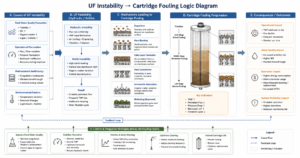
UF Instability → Cartridge Fouling Logic Diagram
2. Surface Blinding Instead of Depth Loading
HFU640 cartridges are designed for depth-loading filtration. However, when contaminants accumulate mainly on the outer media layer, surface blinding occurs rapidly.
This is commonly caused by:
- sticky organic contamination
- fine colloidal particles
- coagulant residue
- biological fouling
Once the outer layer becomes blocked, pressure drop rises sharply even though the inner filtration media remains underutilized.
3. Excess Coagulant or Flocculant Carryover
Improper chemical dosing upstream can accelerate filter fouling significantly.
Residual coagulants may form sticky contaminant layers that quickly block the filter surface and reduce effective filtration area.
This issue is especially common in:
- seawater desalination
- surface water treatment
- wastewater reuse systems
- algae bloom seasons
Operators often notice slimy fouling behavior and unstable cartridge lifetime under these conditions.
4. Incorrect Micron Rating Selection
Using a tighter micron rating does not always improve system performance.
For example, a 1 μm filter may experience much faster pressure rise than a 5 μm structure when upstream pretreatment is unstable.
In many RO systems, micron rating selection should consider:
- SDI fluctuations
- turbidity trends
- solids loading
- fouling characteristics
rather than relying only on nominal filtration precision.
Recommended Comparison Table
| Micron Rating | Typical Performance | Risk |
|---|---|---|
| 1 μm | Higher particle retention | Faster ΔP rise |
| 5 μm | More stable operation | Lower fouling risk |
Why the Security Filter Reacts First
In many RO pretreatment systems, the security filter acts as an early warning indicator for upstream instability.
Unlike media filters or UF systems, high flow cartridges respond immediately to contaminant loading changes.
When pretreatment performance fluctuates, operators often observe:
- rapid ΔP increase
- localized fouling
- unstable replacement intervals
- uneven contaminant loading
This is why rapid HFU640 ΔP rise is often a system stability issue rather than simply a cartridge quality issue.
Surface Fouling vs Depth Loading
Surface Fouling
Characteristics:
- contaminants accumulate mainly on the outer media surface
- rapid ΔP increase
- short cartridge lifespan
- low media utilization
Typical causes include colloidal fouling and sticky organics.
Depth Loading
Characteristics:
- contaminants distribute gradually through the media depth
- slower ΔP growth
- higher dirt-holding capacity
- more stable filtration performance
Depth-loading behavior is generally preferred in RO pretreatment applications.
Improve UF Stability
Recommended actions include:
- optimizing UF backwash performance
- monitoring SDI fluctuations
- reducing turbidity spikes
- improving pretreatment consistency
Stable UF permeate quality often has the greatest impact on cartridge lifetime.
Reduce Sticky Fouling
Operators should evaluate:
- coagulant dosage
- flocculation efficiency
- chemical carryover
- seasonal organic loading
Reducing sticky contaminants helps prevent premature surface blinding.
Optimize Filter Structure Instead of Only Tightening Micron Rating
In many systems, stable depth-loading performance is more important than simply using tighter filtration ratings.
Gradient-density media structures may help:
- distribute contaminants more evenly
- reduce localized fouling
- stabilize ΔP growth
- improve dirt-holding utilization
Monitor ΔP Trends Continuously
Instead of relying only on fixed replacement schedules, trend monitoring helps operators identify:
- pretreatment drift
- seasonal fouling changes
- UF instability
- abnormal contaminant loading
ΔP behavior often provides earlier warning signals than laboratory water analysis alone.
How Optimized High Flow Filter Structures Help
High flow cartridges designed with gradient-density media and stable pleat geometry can help improve contaminant distribution throughout the filtration depth.
Compared with conventional surface-loading structures, optimized depth-loading designs may help:
- reduce premature blinding
- stabilize ΔP increase
- extend replacement intervals
- improve filtration consistency
For RO pretreatment systems, structural stability and flow distribution are often more important than nominal micron rating alone.
Recommended Comparison Table
| Root Cause | Typical Symptoms | ΔP Behavior | Recommended Action |
|---|---|---|---|
| UF instability | Uneven fouling | Sudden ΔP rise | Improve UF stability |
| Coagulant carryover | Sticky fouling | Rapid pressure increase | Optimize chemical dosing |
| Surface blinding | Short filter life | Sharp ΔP growth | Improve depth loading |
| Incorrect micron selection | Frequent replacement | High initial ΔP | Reevaluate filtration strategy |
FAQ
Why do HFU640 filters clog too quickly?
Rapid clogging is often caused by unstable pretreatment conditions, colloidal fouling, or surface blinding rather than cartridge failure aloneRapid clogging is often caused by unstable pretreatment conditions, colloidal fouling, or surface blinding rather than cartridge failure alone
Can UF instability increase cartridge pressure drop?
Yes. Poor UF performance may allow more fine particles to enter the security filter, causing faster fouling and unstable ΔP increase.
Is rapid ΔP increase always caused by poor filter quality?
Not necessarily. In many cases, rapid ΔP growth reflects upstream system instability rather than cartridge structure alone.Not necessarily. In many cases, rapid ΔP growth reflects upstream system instability rather than cartridge structure alone.
Why do filters foul faster during algae bloom seasons?
Higher biological and organic loading during warm seasons may accelerate fouling and reduce effective filtration area.
Engineering Support for RO Pretreatment Optimization
If your RO system is experiencing unstable HFU640 ΔP increase or shortened replacement cycles, system-level analysis should evaluate:
- pretreatment stability
- fouling behavior
- UF permeate quality
- depth-loading performance
- micron rating selection
- fouling behavior
A stable pretreatment system is often the key to extending filter life and reducing total operating cost.