🔄 Pall HFU640 Replacement: How to Reduce Filtration Cost by 40% in RO Systems
1. The Application Scenario (The Frontline)
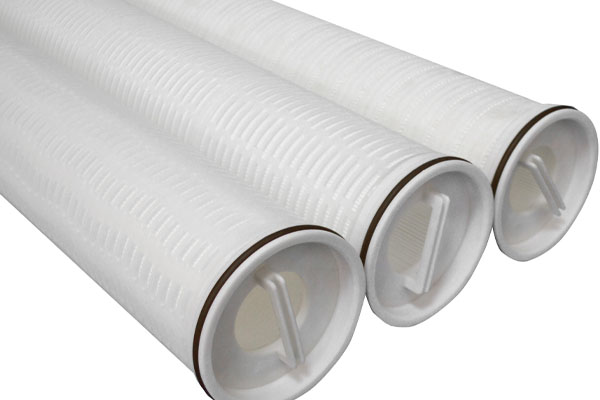
In Reverse Osmosis (RO) pretreatment, the HFU640 is typically installed in high-flow housings (6–19 cartridges per vessel) handling:
- Flow rate: 20–80 m³/h per vessel
- Feed water: SDI < 5 (often heavily fluctuating)
- Typical contaminants: Colloids, suspended solids, and biofouling
At this stage, filtration performance directly determines your RO membrane fouling rate, your CIP (Clean-In-Place) frequency, and your system downtime costs.
👉 The Reality: This is not just a "filter"—it is a critical system protection component.
2. The Problem (The Customer Pain Point)
Most users don’t actually have a “filter problem”—they have a Cost-per-m³ problem.
Typical data seen in field projects:
- OEM HFU640 lifespan: 2–4 weeks
- Differential pressure (ΔP) rise: Spikes rapidly from 0.5 to 2.5 bar
- Annual replacement frequency: 20–30 cycles
- Filtration cost share: Consumes up to 15–25% of total pretreatment OPEX
👉 The Core Pain Point: The issue isn’t the unit price of the filter; it is that the unit cost of produced water keeps rising, and it has become impossible to stably control.
3. The Root Cause (Engineering Logic)
In most cases, premature failure is driven by a mismatch in filtration physics, not brand quality. There are three critical engineering failures at play:
① Dirt Loading Distribution Failure (Surface Blinding)
Many standard HFU structures load particles exclusively on the outer layer. The inner media remains entirely unused, meaning the effective filtration area is wasted.
② Flow Direction Mismatch
The choice between Inside-Out vs. Outside-In flow is often selected by default, rather than engineered for the specific system conditions.
- Example: High-colloid water should strongly favor an Outside-In configuration. However, many systems still utilize Inside-Out, leading to rapid surface clogging and premature failure.
③ Media Density Not Matched to SDI Fluctuation
Uniform-density media cannot handle variable particulate loads:
- Low SDI: The media is under-utilized.
- High SDI: The media blocks rapidly.
👉 The Result: The ΔP curve becomes exponential instead of linear, forcing a shutdown long before the filter is actually "full."
4. The Solution (The Replacement Strategy)
A true HFU640 replacement is not about offering the "same size at a lower price." It is about re-engineering the filtration behavior.
An optimized drop-in design must deliver:
- ✔ Gradient Density Media (Not Uniform): The outer layer provides coarse capture, while the inner layer provides fine polishing. This ensures full-depth utilization of the media, preventing surface blinding.
- ✔ Controlled Flow Direction Selection: We match the geometry to the fluid. High fouling water demands Outside-In; stable low SDI utilizes Inside-Out. This adjustment alone can extend filter life by 20–30%.
- ✔ Pleat Geometry Optimization: By increasing the effective filtration area and reducing the local flow velocity (flux density), we drastically lower the ΔP growth rate.
- ✔ Rigid Inner Core: A high collapse-strength core prevents physical deformation under high flow and severe ΔP spikes, maintaining consistent and safe flow channels into the RO.
💡 Stop bleeding OPEX on standard OEM consumables. Are your current high-flow filters blinding in under 4 weeks? Send me your flow rate and SDI data via DM. Our engineering team will provide a re-engineered, high-capacity replacement quote designed to cut your OPEX by up to 40%.
- CTA (Call to Action)
If you are currently using HFU640 and facing:
Rapid pressure increase
Unstable lifespan
High replacement frequency
👉 Then your issue is likely design mismatch, not supplier price
We provide engineered HFU640 replacements, including:
Flow direction selection support
Media structure optimization
Full compatibility with Pall housings
📩 Send your system parameters (flow rate, SDI, housing type), and we will give you a matched configuration — not just a quote**
email:[email protected]
www.ecofiltrone.com