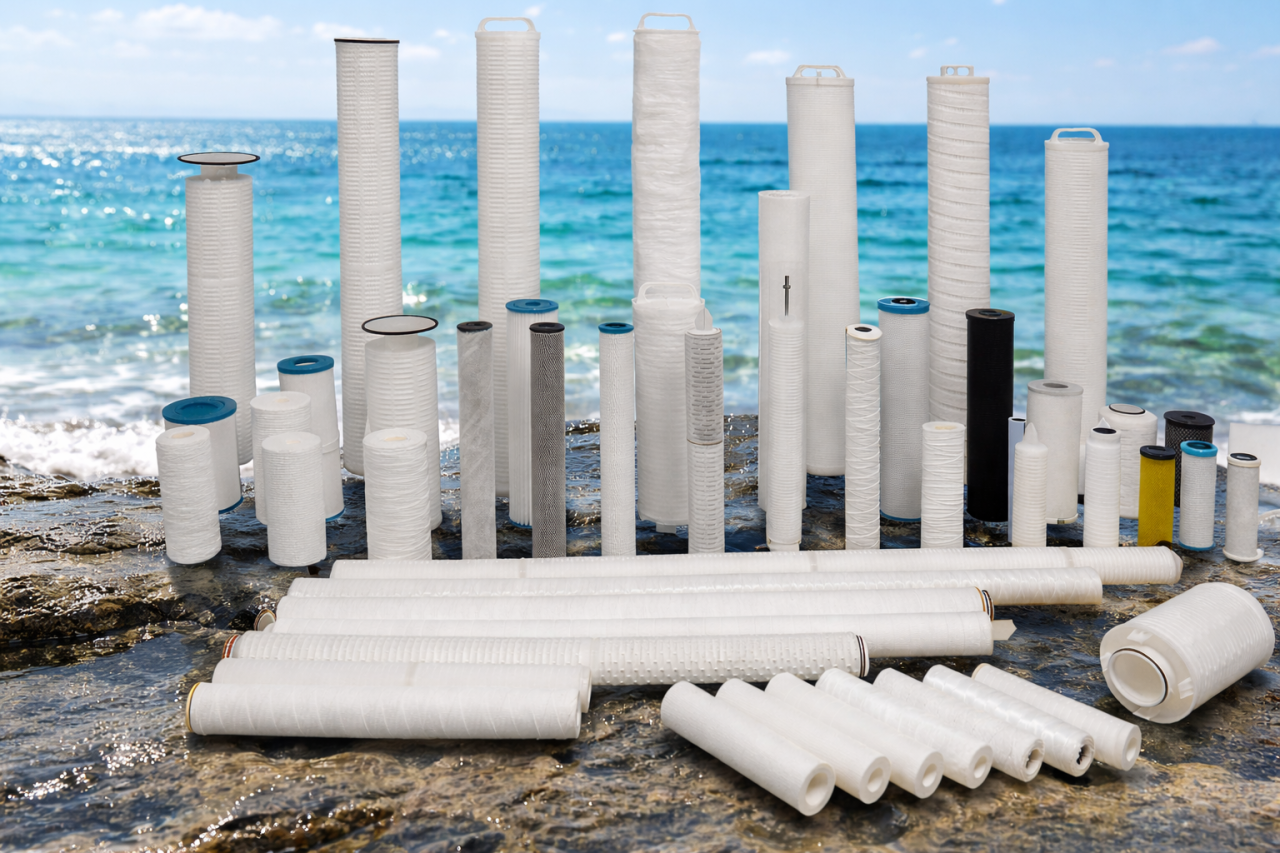
💥 Core Collapse: The Catastrophic Risk in Condensate Polishing Pre-Filtration
In Power Plants, the "Condensate Polishing" stage is the final defense for the boiler.
The Pre-filter’s job is to catch Iron Oxides (Magnetite/Hematite) before they foul the Ion Exchange Resin.
But Condensate creates a "Perfect Storm" for mechanical failure:
- High Temperature: $60^\circ\text{C} – 90^\circ\text{C}$.
- High Surge Flow: During startup.
- Dense Contaminant: Heavy iron sludge.
I have seen it happen: An operator ignores the high $\Delta P$ alarm for just 10 minutes during startup. Suddenly, the pressure drops to zero. They think, "Oh good, it cleared itself."
No. It didn’t clear. The core collapsed.
The filter imploded, releasing pounds of iron sludge and plastic shards directly into the expensive Resin Bed.
Here is the engineering reality of why "Standard" High Flow filters fail in Condensate, and how to prevent it.
1. The Physics of Collapse (Heat + Pressure)
Standard Polypropylene (PP) cores lose 50% of their mechanical strength at $80^\circ\text{C}$.
- The Scenario: You install a filter rated for 3 Bar $\Delta P$.
- The Reality: At $85^\circ\text{C}$, that rating drops to maybe 1.5 Bar.
- The Failure: When the "Iron Burst" hits during startup, the filter blinds instantly. The pressure spikes to 2.0 Bar. The softened PP core buckles, twists, and eventually shatters.
2. The Solution: Glass-Filled Polypropylene (GFPP)
For Condensate applications, you cannot use virgin Polypropylene cores.
You must specify Glass-Filled Polypropylene (GFPP) or Reinforced Cores.
- The Material: By adding 20-30% glass fiber to the core resin, we increase the flexural modulus (stiffness) by 300%.
- The Result: The core remains rigid even at $90^\circ\text{C}$ and 4 Bar $\Delta P$. It will not buckle.
3. The "Inside-Out" Design Advantage
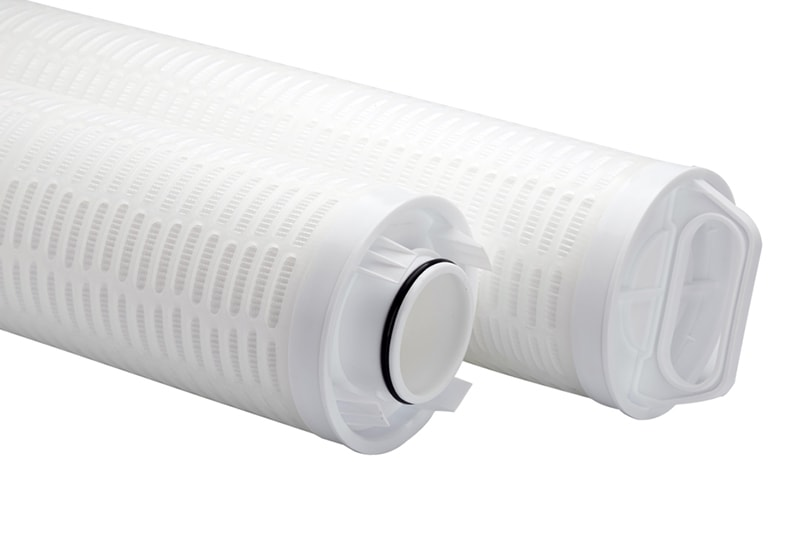
Most modern Power Plants use "Inside-Out" flow (like Pall Ultipleat or Parker ParMax).
This design is safer for Condensate for one reason: Containment.
If the filter fails, the dirt is trapped inside the cartridge.
However, if the Core fails in an Inside-Out filter, the failure is catastrophic because the core is the pressure vessel. Once it breaches, everything goes downstream.
4. Operational Discipline: The "Startup" Rule
Engineering controls (better cores) are essential, but Operational controls are critical.
- The Rule: During cold startup, man the gauges.
- Condensate crud loading is not linear. It comes in a massive wave. $\Delta P$ can go from 0.1 Bar to 3.0 Bar in minutes.
- Never wait for the DCS alarm. If you see the curve go vertical, bypass or change filters immediately.
Conclusion
A collapsed filter is not just a $200 loss.
It involves downtime, cleaning the resin bed of plastic shards, and potential boiler chemistry upsets.
Spec your Condensate filters correctly:
✅ Glass-Filled Core.
✅ High-Temp Gaskets.
✅ Inside-Out Flow.
Don’t ask a plastic straw to hold back a flood.
👇 Discussion: Have you ever experienced a sudden "Pressure Drop to Zero" event? Did it damage your resin?