High Flow vs Pleated Filter Cartridge Guide
Which Filtration Solution Should You Choose?
Selecting the right filter cartridge is not simply about choosing a micron rating or replacing an existing filter element.
The cartridge design directly affects:
- Flow capacity
- Pressure drop
- Dirt holding capacity
- Replacement frequency
- Maintenance requirements
- Total operating cost
High flow and pleated filter cartridges are two widely used filtration technologies in industrial applications.
Although both remove suspended solids and protect downstream equipment, they are designed for different operating requirements.
High flow cartridges are optimized for large-volume industrial filtration systems where high capacity, low maintenance frequency, and reduced operating costs are critical.
Pleated filter cartridges are designed for flexible filtration applications where high filtration area, various media options, and precise particle removal are required.
This engineering guide explains the differences between high flow and pleated filter cartridges and helps engineers select the most suitable solution based on actual operating conditions.
Quick Answer
High flow and pleated filter cartridges are not direct replacements for each other.
A high flow filter cartridge is designed for large industrial systems requiring high throughput, such as:
- Seawater desalination
- RO pretreatment
- Municipal water treatment
- Power plants
Its larger diameter and filtration area allow fewer cartridges to handle higher flow rates while reducing maintenance requirements.
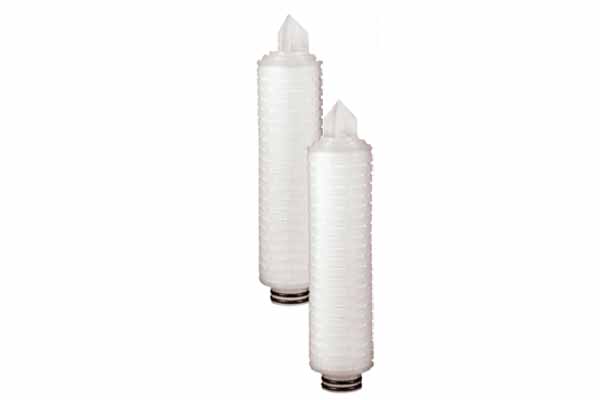
A pleated filter cartridge uses folded filter media to increase surface area within a compact cartridge design.
It provides:
- Excellent filtration efficiency
- Wide range of filtration materials
- Flexible application options
Pleated cartridges are widely used in:
- Industrial process water
- Food & beverage
- Pharmaceutical water
- Final filtration applications
The correct choice depends on:
- Required flow rate
- Contaminant loading
- Filtration accuracy
- Existing housing design
- Maintenance strategy
- Total cost of ownership
Key Takeaways
- High flow cartridges are designed for large-flow industrial systems.
- Pleated cartridges provide high filtration area and flexible media options.
- High flow cartridges reduce cartridge quantity and maintenance operations.
- Pleated cartridges are preferred for fine filtration and specialized applications.
- The best filtration solution depends on the complete system design, not cartridge price alone.
Quick Comparison: High Flow vs Pleated Filter Cartridge
| Feature | High Flow Filter Cartridge | Pleated Filter Cartridge |
|---|---|---|
| Primary Design Goal | Maximum flow capacity | High filtration area |
| Typical Diameter | 6 inch | 2.5 inch |
| Flow Capacity | Very High | Moderate |
| Filtration Mechanism | Depth filtration | Surface + depth filtration |
| Cartridge Quantity | Few | More |
| Pressure Drop | Very Low | Low–Moderate |
| Dirt Holding Capacity | High | Medium–High |
| Media Options | Mainly PP depth media | PP, PES, PTFE, Nylon, PVDF |
| Maintenance Frequency | Lower | Higher |
| Housing Requirement | High flow housing | Standard cartridge housing |
| Best Application | Large industrial systems | General and fine filtration |
What Is a High Flow Filter Cartridge?
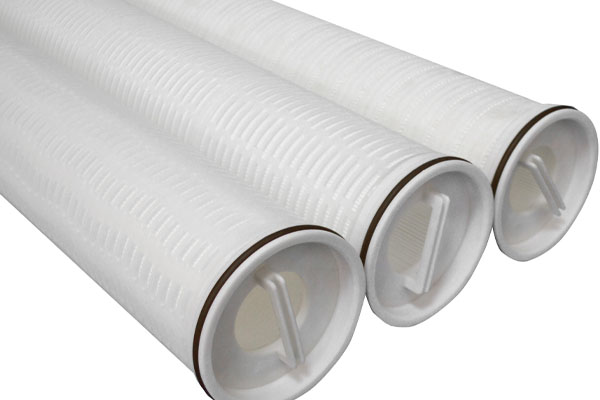
A high flow filter cartridge is a large-diameter filtration element designed to process high volumes of liquid with fewer cartridges.
Unlike traditional 2.5-inch cartridges, high flow cartridges typically have a diameter of approximately 6 inches, providing significantly larger filtration area and higher dirt holding capacity.
The main design objective of high flow filtration is not simply increasing cartridge size, but improving the overall efficiency of the filtration system.
By reducing the number of cartridges required, high flow systems can provide:
- Higher flow capacity
- Lower pressure drop
- Reduced housing footprint
- Less frequent replacement
- Lower maintenance labor
High flow cartridges are commonly manufactured with polypropylene depth filtration media using gradient density structures.
The outer layer captures larger particles, while inner layers retain finer contaminants.
This structure helps distribute contaminant loading throughout the filter media instead of concentrating particles only on the surface.
Typical Applications of High Flow Cartridges
High flow cartridges are commonly used in:
- Seawater desalination (SWRO)
- RO membrane protection
- Municipal water treatment
- Power plant water systems
- Cooling water filtration
- Petrochemical process water
- Industrial wastewater reuse
Engineering Note:
High flow cartridges provide the greatest value when maintenance efficiency becomes a limiting factor. In large continuous systems, reducing cartridge quantity can significantly reduce labor requirements and operational interruptions.
What Is a Pleated Filter Cartridge?
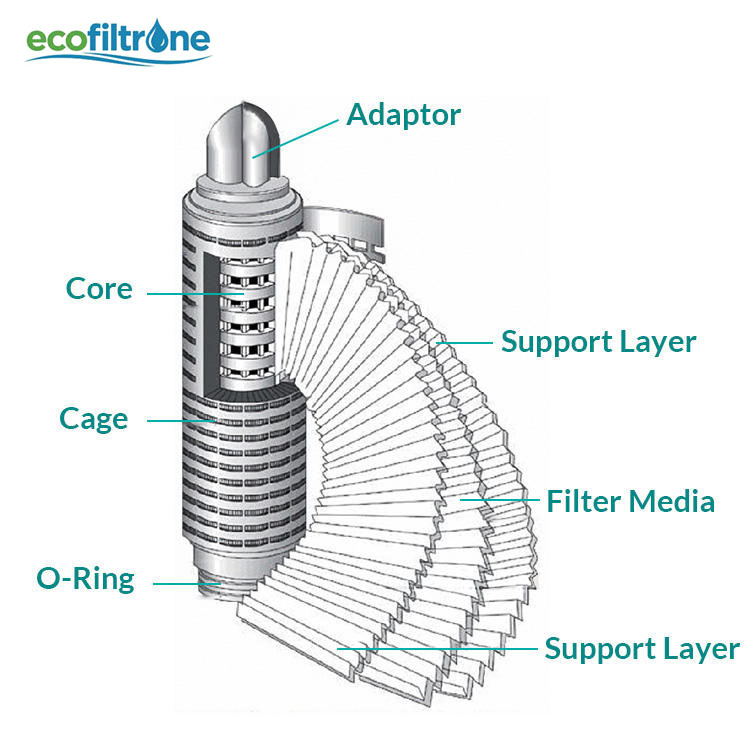
A pleated filter cartridge uses folded filter media to increase the effective filtration surface area inside a compact cartridge structure.
By creating multiple folds in the filter media, pleated cartridges provide much greater filtration area compared with simple depth cartridges of the same size.
Pleated cartridges are available in various materials, including:
- Polypropylene (PP)
- Polyester (PES)
- PTFE
- Nylon
- PVDF
This allows pleated cartridges to meet different requirements for:
- Chemical compatibility
- Temperature resistance
- Filtration accuracy
- Sanitary applications
Unlike high flow cartridges, pleated cartridges are commonly installed in standard cartridge housings using:
- 10 inch
- 20 inch
- 30 inch
- 40 inch
elements.
Typical Applications of Pleated Cartridges
Pleated cartridges are commonly used in:
- Food & beverage processing
- Pharmaceutical water systems
- Laboratory filtration
- Chemical processing
- Electronics water treatment
- Final process filtration
- Pre-filtration before membrane systems
Engineering Note:
Pleated cartridges are not simply a lower-capacity alternative to high flow cartridges. Their greatest advantage is flexibility. Different membrane materials and pore structures allow pleated cartridges to solve applications where high flow cartridges may not be suitable.
Engineering Comparison
1. Flow Capacity
The most significant difference between high flow and pleated cartridges is flow capacity.
High flow cartridges are specifically designed for applications where large volumes of water must be processed continuously.
A single high flow cartridge can often replace multiple standard pleated cartridges.
| Parameter | High Flow | Pleated |
|---|---|---|
| Individual Flow Capacity | Very High | Moderate |
| Large System Suitability | Excellent | Limited |
| Number of Elements Required | Low | Higher |
For example:
A large RO pretreatment system may require dozens of standard pleated cartridges to achieve the required flow rate, while a high flow system may achieve similar capacity with only a few elements.
2. Filtration Area
Both technologies increase filtration area compared with basic cartridge designs, but the method is different.
High Flow Cartridge
Uses:
- Large diameter
- Deep filtration structure
- High media volume
Main advantage:
High contaminant holding capacity
Pleated Cartridge
Uses:
- Folded membrane or polymer media
- Increased surface area
- Compact structure
Main advantage:
High filtration efficiency with flexible materials
| Feature | High Flow | Pleated |
|---|---|---|
| Media Volume | High | Moderate |
| Surface Area | Very High | High |
| Depth Loading | Excellent | Depends on media |
| Fine Filtration Options | Limited | Excellent |
3. Pressure Drop Performance
Pressure drop is one of the most important parameters in industrial filtration.
A lower pressure drop means:
- Lower pump energy consumption
- Longer cartridge service life
- More stable operation
High flow cartridges usually achieve lower pressure drop because flow is distributed across a larger filtration area.
Pleated cartridges can also provide low pressure drop, especially with optimized pleat geometry and high-quality media.
However, in very high flow applications, multiple pleated cartridges may create higher system resistance.
| Parameter | High Flow | Pleated |
|---|---|---|
| Initial ΔP | Very Low | Low |
| High Flow Operation | Excellent | Moderate |
| Pressure Stability | Excellent | Good |
4. Dirt Holding Capacity
Service life depends not only on filtration rating but also on how contaminants are captured.
High flow cartridges generally provide greater dirt holding capacity because of:
- Larger media volume
- Gradient density structure
- Deeper contaminant loading
Pleated cartridge performance depends more on:
- Media type
- Pleat design
- Filtration mechanism
| Feature | High Flow | Pleated |
|---|---|---|
| Dirt Capacity | Very High | Medium–High |
| Heavy Contamination Applications | Excellent | Moderate |
| Fine Particle Removal | Good | Excellent |
5. Maintenance Requirements
For large industrial plants, maintenance efficiency is often more important than cartridge purchase price.
High flow cartridges reduce:
- Cartridge quantity
- Housing openings
- Replacement time
- Spare inventory
Pleated cartridges remain easier to source and replace, especially for smaller systems.
| Maintenance Factor | High Flow | Pleated |
|---|---|---|
| Replacement Frequency | Lower | Higher |
| Labor Requirement | Lower | Higher |
| Inventory Management | Easier | More Items |
When Should You Choose High Flow Filter Cartridge?
Choose high flow cartridges when:
✓ Flow rate is high
✓ System operates continuously
✓ Maintenance downtime is expensive
✓ Large RO or desalination systems are involved
✓ Suspended solids loading is significant
✓ Reducing housing footprint is important
Typical applications:
- SWRO plants
- Power stations
- Municipal water plants
- Industrial RO systems
When Should You Choose Pleated Filter Cartridge?
Choose pleated cartridges when:
✓ Flow rate is moderate
✓ Fine filtration is required
✓ Specialized membrane materials are needed
✓ Existing standard housings are installed
✓ Sanitary requirements are important
Typical applications:
- Beverage filtration
- Pharmaceutical water
- Final polishing filtration
- Chemical filtration
Engineering Decision Tree
Start
 |
 |
Is system flow rate above 100 m³/h?
 |
 ├── Yes
 |     |
 |     Is reducing maintenance important?
 |           |
 |           ├── Yes → High Flow Cartridge
 |           |
 |           └── No → Evaluate existing housing
 |
 └── No
       |
       Is fine filtration or special media required?
             |
             ├── Yes → Pleated Cartridge
             |
             └── No → Compare lifecycle cost
Recommended Products
High Flow Filter Cartridge
Recommended For
- SWRO pretreatment
- RO protection
- Power plants
- Municipal water
- Industrial process water
Key Benefits
- High flow capacity
- Low pressure drop
- Large dirt holding capacity
- Reduced maintenance
Learn More → High Flow Filter Cartridge
PP Pleated Filter Cartridge
Recommended For
- Process water
- Food & beverage
- General industrial filtration
- Fine particle removal
Key Benefits
- Wide micron range
- Multiple media options
- Excellent filtration accuracy
Learn More → PP Pleated Filter Cartridge
Related Engineering Guides
Continue exploring:
- High Flow vs Standard Filter Cartridge
- Depth Filter vs Pleated Filter
- Nominal vs Absolute Filter Rating
- Melt Blown vs String Wound Filter Cartridge
- How to Select the Right Filter Cartridge
Total Cost of Ownership: Initial Cost vs Operating Cost
When comparing high flow and pleated filter cartridges, many purchasing decisions focus only on the cartridge purchase price.
However, for industrial filtration systems, the cartridge itself is only one component of the total operating cost.
A complete filtration cost analysis should consider:
- Cartridge purchase cost
- Filter housing investment
- Installation labor
- Replacement labor
- Production downtime
- Spare inventory
- Disposal cost
- Energy consumption caused by pressure drop (ΔP)
A lower-cost cartridge does not always create a lower-cost filtration system.
The correct evaluation method is based on Total Cost of Ownership (TCO) rather than initial purchase price alone.
Initial Investment Comparison
| Cost Factor | High Flow Cartridge | Pleated Cartridge |
|---|---|---|
| Individual Cartridge Price | Higher | Lower |
| Number of Cartridges Required | Fewer | More |
| Housing Quantity | Lower | Higher |
| Installation Complexity | Lower | Higher |
| Initial Equipment Cost | Medium–High | Low–Medium |
At the beginning of a project, pleated cartridges may appear more economical because each cartridge has a lower purchase price.
However, as system flow requirements increase, the number of cartridges and housings required can significantly increase the overall filtration system cost.
Lifecycle Cost Comparison
For continuous industrial applications, operating cost often becomes the dominant factor.
A high flow filtration system may provide economic advantages through:
- Fewer cartridge replacements
- Reduced maintenance labor
- Shorter shutdown periods
- Lower inventory requirements
- More stable pressure drop performance
| Operating Factor | High Flow | Pleated |
|---|---|---|
| Cartridge Replacement Frequency | Lower | Higher |
| Maintenance Labor | Lower | Higher |
| Downtime Risk | Lower | Higher |
| Spare Stock Requirement | Lower | Higher |
| Long-Term Cost | Often Lower | Depends on Application |
Example: Large RO Pretreatment System
Consider an industrial RO pretreatment system requiring continuous operation.
A conventional pleated cartridge solution may require:
- Multiple filter housings
- Dozens of cartridges
- Frequent replacement operations
- Larger spare inventory
A high flow cartridge solution can reduce system complexity by using fewer filtration elements.
Although the initial cartridge cost may be higher, the reduction in maintenance activities can significantly improve the overall economics of the filtration system.
Engineering Note:
In large-scale water treatment systems, the lowest cartridge price is rarely the lowest filtration cost. Labor, downtime, energy consumption, and system reliability often represent a larger portion of the total lifecycle expense.
Application Selection Guide
The correct cartridge selection depends heavily on the application.
Different industries have different filtration priorities:
- Some require maximum flow capacity.
- Some require extremely fine filtration.
- Some require chemical compatibility.
- Some require sanitary filtration.
The following guide provides a practical selection reference.
Seawater Desalination (SWRO)
Recommended Solution
Seawater desalination plants process large volumes of water continuously.
Cartridge filtration is typically installed before RO membranes to remove remaining suspended solids and protect membrane performance.
High flow cartridges are preferred because they provide:
- High flow capacity
- Lower pressure drop
- Reduced replacement frequency
- Smaller filtration footprint
Typical Applications
- UF downstream protection
- RO security filtration
- Seawater intake polishing
RO Pretreatment
Recommended Solution
RO membranes require stable feed water quality.
Rapid cartridge fouling can increase differential pressure (ΔP) and reduce system reliability.
High flow cartridges help maintain stable operation by providing:
- Larger filtration area
- Higher dirt holding capacity
- Lower flow velocity through media
- Longer service intervals
Power Plant Water Treatment
Recommended Solution
Power plants operate under strict reliability requirements.
Unexpected filtration downtime can affect the entire production process.
High flow cartridges are suitable for:
- Condensate filtration
- Cooling water filtration
- Boiler feedwater pretreatment
Advantages
- Less frequent replacement
- Reduced maintenance work
- Improved operational continuity
Food & Beverage Processing
Recommended Solution
Food and beverage applications often require:
- Fine filtration
- Sanitary design
- Specific material compatibility
- Easy validation
Pleated cartridges provide advantages through:
- Wide range of filter media
- Various micron ratings
- Compatibility with sanitary systems
Typical Applications
- Process water
- Beverage clarification
- Ingredient filtration
- Final polishing filtration
Pharmaceutical Applications
Recommended Solution
Pharmaceutical filtration requires more specialized requirements.
Applications may require:
- Sterile filtration
- Bacterial retention
- Validation documentation
- High-purity materials
Common choices include:
- PES membrane cartridges
- PTFE membrane cartridges
- Nylon membrane cartridges
Chemical Processing
Recommended Solution
Depends on Process Conditions
Chemical filtration requires careful evaluation of:
- Chemical compatibility
- Temperature
- Viscosity
- Particle characteristics
Possible solutions include:
- High Flow Cartridge
- PP Pleated Cartridge
- PTFE Cartridge
- String Wound Cartridge
Engineering Selection Matrix
| Application | Preferred Solution | Main Reason |
|---|---|---|
| SWRO | High Flow | High capacity and lower maintenance |
| RO Pretreatment | High Flow | Protect RO membranes |
| Power Plant | High Flow | Reliability and reduced downtime |
| Municipal Water | High Flow | Large processing volume |
| Food & Beverage | Pleated | Flexible media options |
| Pharmaceutical | Membrane Pleated | Fine and sterile filtration |
| Chemical | Depends on fluid | Compatibility requirements |
| Laboratory | Pleated | Lower flow demand |
Common Selection Mistakes
Choosing a filter cartridge based on only one parameter can lead to poor filtration performance.
The following mistakes are common in industrial filtration design.
Mistake 1: Selecting Only by Micron Rating
A 5 μm cartridge is not automatically equal to another 5 μm cartridge.
Filtration performance also depends on:
- Filter media structure
- Filtration mechanism
- Dirt holding capacity
- Pressure drop characteristics
Two cartridges with the same micron rating may have completely different service lives.
Mistake 2: Choosing High Flow for Every Application
High flow cartridges provide excellent performance in large systems, but they are not always the correct solution.
For example:
A pharmaceutical final filtration process may require a membrane pleated cartridge rather than a high flow depth cartridge.
The correct choice depends on the filtration objective.
Mistake 3: Ignoring Existing Housing Design
A cartridge must match the filtration system.
Before replacing a standard cartridge with a high flow cartridge, engineers should evaluate:
- Housing compatibility
- Connection type
- Sealing design
- Installation space
A cartridge upgrade may require a housing modification.
Engineering Notes
Engineering Note 1: High Flow vs Pleated Is Not a Quality Comparison
High flow cartridges are not simply "better" than pleated cartridges.
They solve different engineering problems.
High Flow Cartridges Optimize:
- Capacity
- Flow rate
- Maintenance efficiency
- System footprint
Pleated Cartridges Optimize:
- Filtration flexibility
- Accuracy
- Media selection
- Specialized applications
The correct selection depends on the system objective.
Engineering Note 2: Filtration Area Is Important, But Filtration Structure Matters More
A larger filtration area does not automatically guarantee better performance.
Engineers should evaluate:
- How contaminants are captured
- Where particles accumulate
- How pressure develops over time
- How the cartridge handles changing water quality
A well-designed filtration system balances:
Filtration Efficiency + Flow Capacity + Operating Cost
Final Selection Recommendation
Use a High Flow Filter Cartridge When:
✓ Your system requires high flow capacity
✓ Cartridge replacement is frequent
✓ Maintenance downtime is expensive
✓ Large RO, SWRO, or industrial water systems are involved
✓ Suspended solids loading is significant
Use a Pleated Filter Cartridge When:
✓ Fine filtration is required
✓ Specialized filter media is needed
✓ Existing standard housings are installed
✓ The application requires sanitary or validated filtration
Conclusion
The best filtration solution is not determined by cartridge size or purchase price alone.
A successful filtration design considers the complete system:
- Process requirements
- Water quality
- Flow conditions
- Maintenance strategy
- Lifecycle cost
By selecting the right cartridge technology for the application, engineers can achieve:
- More reliable operation
- Lower maintenance requirements
- Reduced downtime
- Improved long-term filtration performance
Frequently Asked Questions (FAQ)
Can a High Flow Filter Cartridge Replace a Pleated Filter Cartridge?
Not always.
Although high flow cartridges and pleated cartridges can sometimes achieve similar filtration objectives, they are designed for different operating conditions.
A high flow cartridge is optimized for:
- High flow capacity
- Large industrial systems
- Lower maintenance frequency
- Reduced operating costs
A pleated cartridge is optimized for:
- Flexible filtration requirements
- Fine particle removal
- Specialized filter media
- Compact standard housings
Replacing a pleated cartridge with a high flow cartridge may require evaluating:
- Housing compatibility
- Connection type
- Flow direction
- Installation space
- Required filtration performance
The correct choice depends on the complete filtration system rather than cartridge dimensions alone.
Is a High Flow Cartridge Better Than a Pleated Filter Cartridge?
Neither technology is universally better.
High flow and pleated cartridges solve different engineering challenges.
High Flow Cartridges Are Generally Better For:
- Very high flow rates
- Continuous operation
- Reduced maintenance requirements
- Lower lifecycle costs
Pleated Cartridges Are Generally Better For:
- Fine filtration
- Specific membrane materials
- Sanitary requirements
- Existing standard cartridge housings
The best cartridge is the one that matches the process requirements.
Which Cartridge Has a Lower Pressure Drop?
In large flow applications, high flow cartridges typically provide lower pressure drop because they have:
- Larger filtration area
- Lower filtration velocity
- Higher media volume
Pleated cartridges can also provide low pressure drop, especially when properly sized.
However, when many pleated cartridges are installed in parallel to handle high flow rates, the overall system resistance and maintenance requirements may increase.
| Factor | High Flow Cartridge | Pleated Cartridge |
|---|---|---|
| Filtration Area | Very Large | High |
| Initial ΔP | Very Low | Low |
| High Flow Performance | Excellent | Moderate |
| Hydraulic Stability | Excellent | Good |
Which Cartridge Has a Longer Service Life?
Service life depends on operating conditions rather than cartridge type alone.
Important factors include:
- Suspended solids concentration
- Particle size distribution
- Water quality variation
- Flow rate
- Allowable pressure drop
- Filter media structure
High flow cartridges often provide longer service intervals in large industrial systems because of their higher dirt holding capacity.
However, pleated cartridges may provide longer life in applications where specialized media or fine filtration is required.
The correct selection depends on the filtration objective.
Are High Flow Cartridges Suitable for RO Pretreatment?
Yes.
High flow cartridges are widely used in RO pretreatment systems because they can handle large feed water volumes while protecting RO membranes from suspended solids and particulate contamination.
Common applications include:
- Seawater RO
- Brackish water RO
- Industrial RO plants
- Municipal water reuse systems
The final cartridge selection should consider:
- Feed water quality
- SDI level
- Turbidity
- Flow rate
- Existing filtration stages
Are Pleated Cartridges Suitable Before RO Membranes?
Yes.
Pleated cartridges are commonly used before RO membranes, especially in:
- Small and medium RO systems
- Industrial process water
- Pilot plants
- Systems requiring specific filtration media
For large RO plants with high flow requirements, high flow cartridges are often preferred because they reduce:
- Cartridge quantity
- Housing requirements
- Maintenance frequency
Which Cartridge Is Better for Seawater Desalination?
For large-scale seawater desalination plants, high flow cartridges are usually the preferred choice.
Reasons include:
- High seawater processing volume
- Continuous operation
- Reduced cartridge replacement frequency
- Lower maintenance requirements
However, smaller desalination systems may still use pleated cartridges due to:
- Lower flow requirements
- Existing equipment design
- Flexible filtration requirements
Do High Flow Cartridges Reduce Operating Costs?
In many industrial applications, yes.
Although high flow cartridges usually have a higher initial purchase cost, they can reduce total operating expenses through:
- Fewer replacement cartridges
- Less maintenance labor
- Reduced downtime
- Smaller housing requirements
- Lower spare inventory
The correct evaluation should focus on Total Cost of Ownership (TCO) rather than cartridge unit price.
What Information Is Needed to Select Between High Flow and Pleated Cartridges?
Before selecting a cartridge, engineers should evaluate the complete operating conditions.
System Information
- Flow rate (m³/h)
- Operating pressure
- Temperature
- Fluid type
Filtration Requirements
- Required micron rating
- Contaminant type
- Suspended solids concentration
- Target service life
Equipment Information
- Existing housing model
- Cartridge dimensions
- Connection type
- Current cartridge brand
Providing these details allows a more accurate filtration recommendation.
Can the Same Micron Rating Perform Differently Between High Flow and Pleated Cartridges?
Yes.
Micron rating alone does not determine cartridge performance.
A 5 μm high flow cartridge and a 5 μm pleated cartridge may have different:
- Dirt holding capacity
- Pressure drop behavior
- Service life
- Particle retention efficiency
Filtration structure, media quality, and operating conditions also significantly affect performance.
Why We Wrote This Guide
Industrial filtration decisions are rarely straightforward.
At Ecofiltrone, we work with engineers, system integrators, EPC companies, and industrial operators who need reliable filtration solutions for demanding applications.
One question appears frequently:
Should we choose a high flow cartridge or continue using traditional pleated cartridges?
The answer depends on much more than cartridge price.
A successful filtration system requires balancing:
- Flow capacity
- Filtration performance
- Pressure drop
- Maintenance requirements
- Equipment configuration
- Long-term operating cost
We created this engineering guide to help filtration professionals compare high flow and pleated cartridge technologies based on real operating conditions.
The purpose is not to promote one technology for every application, but to help engineers select the most suitable filtration solution according to their process requirements.
Engineering References
The technical principles discussed in this guide are based on commonly used filtration engineering practices and industry references, including:
ISO 16889
Hydraulic Fluid Power — Multi-pass Method for Evaluating Filtration PerformanceASTM D4189
Standard Test Method for Silt Density Index (SDI) of WaterAWWA Manual M46
Reverse Osmosis and NanofiltrationASTM F795
Standard Practice for Evaluation of Water Filtration MediaEPA Membrane Filtration Guidance Documents
Pall Corporation Industrial Filtration Technical Documentation
3M Purification High Flow Filtration Technical Literature
Parker Industrial Filtration Product Information
Pentair Industrial Filtration Solutions Documentation
Engineering Note:
Actual cartridge performance depends on filter design, media structure, operating conditions, and contaminant characteristics. Product selection should always be verified against specific application requirements.
Need Help Selecting the Right Filter Cartridge?
Choosing between a high flow cartridge and a pleated cartridge requires understanding the complete filtration system.
Our engineering team can help evaluate your application based on:
✓ Flow rate
✓ Required micron rating
✓ Current cartridge model
✓ Filter housing information
✓ Operating conditions
✓ Water quality or process fluid
✓ Current filtration challenges
Based on your requirements, we can recommend a filtration solution that balances:
- Performance
- Reliability
- Maintenance efficiency
- Total operating cost
Related Products
High Flow Filter Cartridge
Designed For:
- RO pretreatment
- Seawater desalination
- Power plants
- Municipal water treatment
- Large industrial filtration systems
Key Benefits:
- High flow capacity
- Low pressure drop
- Large dirt holding capacity
- Reduced maintenance frequency
Learn More → High Flow Filter Cartridge
PP Pleated Filter Cartridge
Designed For:
- Process water
- Food & beverage
- General industrial filtration
- Fine particle removal
Key Benefits:
- Wide micron range
- Large filtration area
- Flexible media options
Learn More → PP Pleated Filter Cartridge
PES Membrane Filter Cartridge
Designed For:
- Final filtration
- Pharmaceutical applications
- High purity water
Key Benefits:
- Fine filtration accuracy
- Membrane filtration performance
- High purity applications
Learn More → PES Filter Cartridge
Related Engineering Guides
Continue exploring industrial filtration technologies.
Selection Guides
- High Flow vs Standard Filter Cartridge
- Depth Filter vs Pleated Filter
- Nominal vs Absolute Filter Rating
- Melt Blown vs String Wound Filter Cartridge
- How to Select the Right Cartridge Filter
Troubleshooting Guides
- Why Does Filter Cartridge Pressure Drop Increase Quickly?
- Why Do Filter Cartridges Clog Quickly?
- Why Is Cartridge Service Life Short?
Solution Guides
- RO Pretreatment Filtration
- Seawater Desalination Filtration
- Industrial Water Treatment Filtration
- Food & Beverage Filtration
Final Conclusion
High flow and pleated filter cartridges are both effective filtration technologies, but they are designed for different engineering requirements.
Choose High Flow Filter Cartridges When Your Priority Is:
- High flow capacity
- Lower maintenance frequency
- Reduced downtime
- Large-scale industrial operation
Choose Pleated Filter Cartridges When Your Priority Is:
- Filtration flexibility
- Fine particle removal
- Specialized media selection
- Existing standard cartridge systems
The best filtration solution is not the largest or most expensive option.
It is the solution that provides the right balance between:
Filtration Performance + System Reliability + Total Operating Cost