🛡️ Why RO Security Filters Fail During Upstream Upsets | ecofiltrone
Every Reverse Osmosis (RO) system is built to achieve three ultimate goals: System Stability, RO Membrane Protection, and TCO (Total Cost of Ownership) Reduction.
To achieve this, we design pre-treatment as a layered "Defense in Depth" strategy. Water travels through a highly orchestrated chain of command:
- Coarse/Fine Screens: To catch the macro-debris.
- Coagulation/Flocculation & DAF: To clump and float off suspended solids and oils.
- Multi-Media Filtration (MMF) or Ultrafiltration (UF): To remove the micro-particles and colloids.
In a perfect world, the water exiting the UF or MMF is pristine.
But plant operators know: The real world is never perfect.
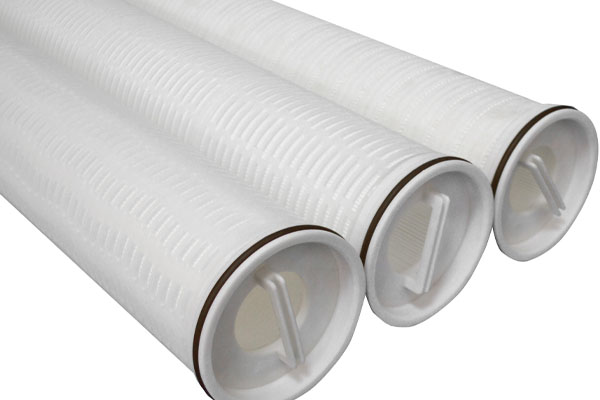
This is where the High-Flow Security Cartridge comes in. It is the final step before the High-Pressure Pump and the $1M RO membranes.
Many engineers treat this filter as an afterthought—a mere formality. But as a veteran in fluid dynamics and filtration, I am telling you: The security filter is not there for when things go right; it is engineered for when things go wrong.
Here is how understanding the entire system dictates the design of the ultimate gatekeeper, and why standard OEM filters often fail when you need them most.
1. The Reality of Upstream Vulnerability
Upstream processes are dynamic and active. They rely on moving parts, chemical dosing, and pressure balances. And they fail.
- The UF Fiber Breakage: Ultrafiltration is excellent, but fibers break (pinholes). When a UF membrane breaches, a sudden spike of silt and bacteria shoots downstream.
- The MMF Channeling: During a pressure surge, sand filters can "channel," allowing raw, unfiltered water to bypass the media bed instantly.
- The Flocculant Overdose: A malfunctioning dosing pump sends unreacted polymer (sticky gel) straight through the system.
When any of these "active" defenses fail, a lethal wave of contamination heads straight for your RO membranes.
2. The True Role of the High-Flow "Gatekeeper"
The High-Flow Security Filter is a Passive, Absolute Barrier. It has no moving parts. It cannot be "out of tune."
Its entire existence is to be the ultimate shock absorber. When the UF breaks or the MMF channels, the High-Flow filter must catch the "Crud Burst" without letting a single particle over 5 microns pass, and without collapsing under the sudden differential pressure (ΔP) spike.
3. How System Knowledge Drives ecofiltrone’s Design
Because we at ecofiltrone understand the volatile nature of upstream DAF and UF systems, we do not design our High-Flow cartridges to simply filter "clean" water. We engineer them to survive the worst-case scenarios.
If you are using a standard, cheap surface-pleated OEM filter, an upstream MMF channeling event will blind the filter in 10 minutes, forcing an emergency plant shutdown.
Here is how the ecofiltrone design responds to system failures:
- Absorbing the "Crud Burst" (Gradient Density Media): To handle sudden silt spikes from UF/MMF failures, our High-Flow cartridges utilize a highly engineered Deep-Pleat, Gradient-Density Matrix. The outer layers are loose to catch the bulk wave of dirt, while the inner layers tighten to guarantee Absolute (Beta 5000) retention. This prevents instantaneous surface blinding and buys the operator time to fix the upstream issue without shutting down the RO.
- Surviving the Hydraulic Shock (Reinforced GFPP Cores): UF systems utilize frequent pneumatic valve switching (backwashing), sending hydraulic shockwaves down the pipe. Standard polypropylene filter cores flex and fatigue. ecofiltrone utilizes heavy-duty Glass-Filled Polypropylene (GFPP) cores that remain rigid, ensuring the filter matrix never distorts and releases trapped dirt into the RO.
- Combating Polymer Carryover (Advanced Media Chemistry): To fight the sticky gels from DAF chemical overdosing, we offer specialized Glass-Fiber/PP hybrid media that resists immediate glazing, maintaining flux far longer than standard melt-blown plastics.
4. Stop Gambling with Your RO Assets
Your screens, DAF, and UF are the hard workers. But your High-Flow Security Filter is the Ultimate Gatekeeper.
If you are buying standard, over-priced OEM filters just to check a box, you are leaving your RO membranes exposed to inevitable upstream upsets.
Audit your last line of defense.
Does your current high-flow filter have the depth to handle a UF breakthrough? Does it have the core strength to survive a hydraulic shock?
The Gatekeeper Comparison: Standard OEM vs. ecofiltrone Engineered Barrier
| Upstream Failure Scenario | Standard OEM (Single Layer / Surface Pleated) | ecofiltrone Engineered Barrier (Gradient Depth Matrix) | Impact on TCO |
|---|---|---|---|
| UF Fiber Breakage / MMF Channeling (Sudden Particle Surge) | Rapid Surface Blinding: Differential Pressure (ΔP) spikes within minutes, leading to unplanned system downtime. | Gradient Dirt-Holding: Outer layers capture coarse particles, while inner layers provide absolute retention, offering a much longer buffer time. | Reduces emergency downtime frequency and lowers manual replacement labor costs. |
| Chemical Overdose (Colloid / Flocculant Adhesion) | Immediate "Glazing": An impermeable film instantly forms on the media surface, causing complete filter failure. | Composite Media Technology: Glass Fiber/PP hybrid material resists adhesion, effectively maintaining flux balance. | Protects the high-pressure pump from tripping due to low feed pressure. |
| Hydraulic Shock / Frequent Backwashing (Pressure Transients) | Core Deformation: Standard PP support cores fatigue and deform, causing the "unloading" of trapped contaminants into the RO feed. | Glass-Filled PP (GFPP) Core: High-rigidity core strongly resists instantaneous shocks, ensuring complete structural integrity. | Completely prevents particles from entering the RO membrane, multiplying the time between CIP cycles. |
| Operational Stability Summary | Only effective under absolutely "ideal" operating conditions. | Active Defense Design: Engineered specifically to handle severe upstream process fluctuations. | Maximizes protection of core assets and significantly reduces RO membrane replacement frequency. |
📩 Don’t wait for an upstream failure to find out.
Send your current OEM High-Flow Part Number (Pall, Parker, 3M) to the ecofiltrone engineering team today. We will provide a direct drop-in replacement quote for a cartridge that is actually engineered to protect your entire system’s TCO.