Why RO Security Filters Clog Faster After UF Instability
Rapid Answer
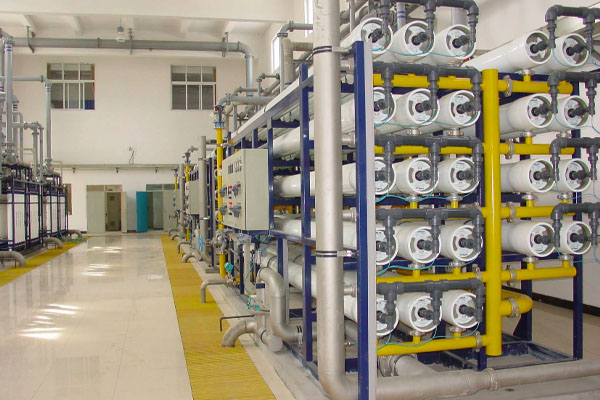
In a Reverse Osmosis (RO) pre-treatment system, Ultrafiltration (UF) is designed to operate in a steady-state, providing an absolute barrier with an SDI (Silt Density Index) below 3. However, when a UF system becomes unstable—experiencing fluctuating Transmembrane Pressure (TMP), erratic backwash cycles, or chemical dosing imbalances—it fundamentally changes the nature of the water reaching the downstream RO security filters.
UF instability does not just mean "dirtier" water; it creates highly concentrated, transient "crud bursts" and chemical carryovers. The RO security filter, engineered to handle a low, steady baseline of sub-micron particles, is suddenly hit with waves of unreacted polymers, sheared biofilms (EPS), or agglomerated colloids. These concentrated bursts do not form a porous filter cake; instead, they cause instantaneous internal pore blinding, causing the security filter’s differential pressure (Delta P) to skyrocket and clog days or weeks faster than its designed lifespan.
The Physics of Instability: Steady-State vs. Transient Loads
To understand why security filters fail so rapidly after a UF upset, process engineers must differentiate between a steady-state load and a transient shock.
Standard meltblown or pleated security filters rely on predictable fluid dynamics to capture particles deeply within their matrix. If a UF system is slightly underperforming but stable (e.g., constantly outputting 0.2 NTU water), the security filter will plug faster than normal, but the Delta P will rise in a predictable, linear fashion.
Instability is different. When a UF system experiences hydraulic shocks, air-scour failures, or erratic Chemically Enhanced Backwash (CEB) recoveries, it releases foulants in massive, concentrated waves. When a high-velocity transient wave of dirt hits a clean security filter, the sheer kinetic energy drives the contaminants so deeply into the pleat roots that they physically compact, immediately eliminating the filter’s porosity and triggering the exponential "hockey-stick" pressure spike.
The 3 Mechanisms of Post-UF Fouling
When diagnosing rapid security filter clogging following a UF upset, field engineers typically find one of three specific failure mechanisms during the filter autopsy.
1. Chemical Carryover (The Coagulant Trap)
When UF TMP begins to rise (indicating fouling), operators or automated systems often respond by increasing the dose of in-line coagulant (like PAC or Ferric) to force better flocculation.
- The Failure: If the system is unstable and mixing is poor, the excess, unreacted liquid coagulant passes straight through the UF hollow fibers.
- The Filter Impact: When this unreacted chemical hits the high-pressure environment of the RO security filter, it acts as a liquid glue. It coats the filter media in an invisible, highly viscous film, sealing the pores shut. The filter looks completely clean to the naked eye, but it is hydraulically blocked.
2. Biological Sloughing (EPS Shearing)
UF systems are highly prone to biofouling. If the UF backwash sequence becomes unstable or if chlorine/biocide dosing fluctuates, bacterial colonies will establish themselves in the permeate headers.
- The Failure: A sudden hydraulic shock or pressure fluctuation in the UF can physically shear off these established biofilms.
- The Filter Impact: The sheared biofilm releases Extracellular Polymeric Substances (EPS)—a thick, sticky, snot-like matrix. When a wave of EPS hits the security filter, it creates a total liquid block that cannot be removed by standard flushing.
3. Sub-Micron Agglomeration (The Colloidal Squeeze)
During periods of UF instability, specifically when hollow fibers undergo excessive physical stretching (pore dilation) under high TMP, fine colloidal matter can bypass the barrier.
- The Failure: These colloids (often silica or ultra-fine clay) are smaller than the nominal 5-micron rating of the security filter.
- The Filter Impact: Because they arrive in concentrated bursts rather than a steady trickle, the high fluid velocity inside the security housing forces these sub-micron particles to violently collide and agglomerate within the filter matrix, effectively blinding the cartridge from the inside out.
Diagnostic Cross-Validation Matrix
Field engineers must link the physical state of the exhausted security filter directly to the specific UF instability event.
| Surface Signal (Security Filter Autopsy) | Cross-Validation Signal (UF System Data) | Real Engineering Root Cause |
|---|---|---|
| Filter looks clean but Delta P is maxed out; media feels slick. | UF TMP was erratic; Coagulant dosing was recently increased manually or by PID loop. | Coagulant Overdose / Chemical Blinding: Unreacted polymer has bypassed the UF and plasticized on the security filter. |
| Filter is covered in a thick, light-brown, slimy gel. | UF CEB (Chemically Enhanced Backwash) cycles were skipped or aborted; High organic load in raw water. | Bio-Sloughing (EPS): Unstable UF operation allowed biofilms to build and shear off into the permeate header. |
| Filter has a hard, grey crust and pleats are physically deformed. | Sudden, severe spikes in UF permeate turbidity; History of water hammer during UF backwash transitions. | Transient Crud Burst / Hydraulic Shock: A massive wave of solid dirt bypassed the UF due to fiber fatigue or O-ring failure during a pressure spike. |
The Cascading O&M Consequences
If the plant treats this rapid clogging merely as a "filter problem" rather than a symptom of upstream instability, the operational consequences multiply:
- OPEX Hemorrhage: Replacing 5-micron security filters every 48 hours rapidly destroys the plant’s consumable budget and wastes hundreds of man-hours in hazardous or confined-space maintenance.
- Pump Cavitation Risk: As the security filters blind rapidly, the high-pressure RO feed pumps are starved of water. If the low-suction pressure switches fail to trip in time, the pumps will cavitate, leading to catastrophic impeller and seal damage.
- RO Membrane Risk: Standard depth filters will physically stretch and bypass under rapid pressure spikes. If the security filter yields, the concentrated wave of EPS or coagulant will hit the RO membranes, causing irreversible fouling that standard CIP (Clean-In-Place) procedures cannot remove.
The ecofiltrone Engineering Solution: Building a Resilient Buffer
You cannot always prevent upstream UF instability, but you can engineer your RO pre-treatment system to survive it without shutting down production.
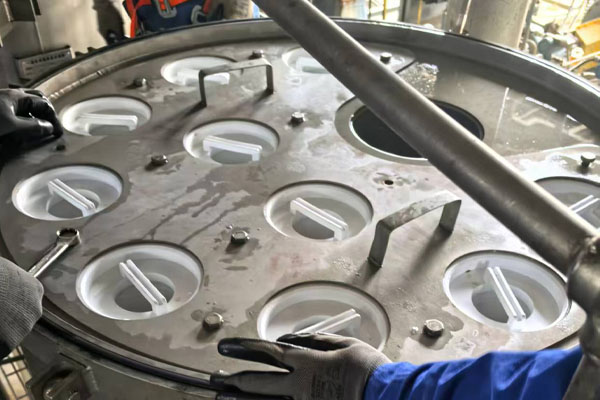
Standard 2.5-inch nominal depth filters lack the surface area to absorb transient crud bursts. When hit with a concentrated wave of foulants, they fail instantly.
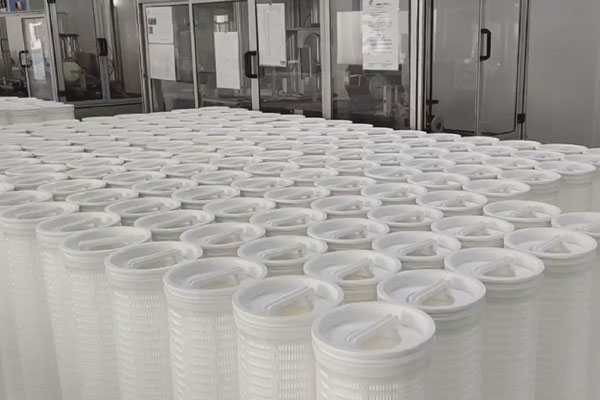
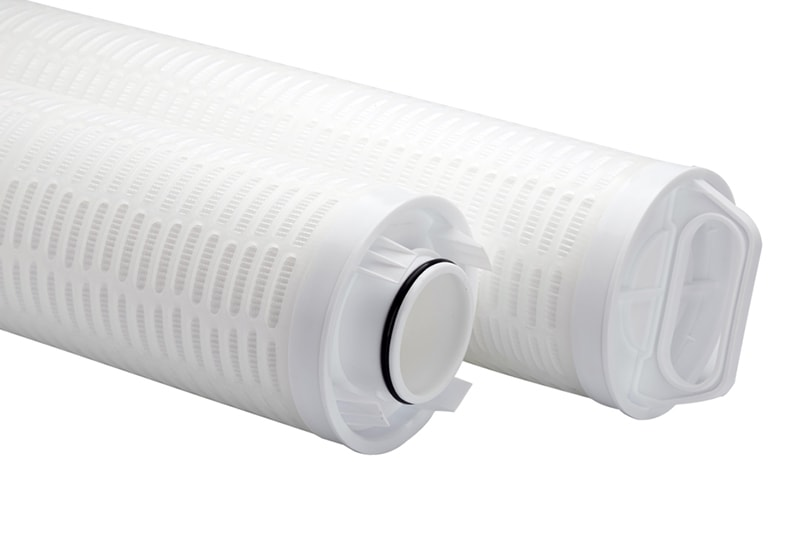
To protect your RO high-pressure pumps and membranes during UF instability, the system must be upgraded to ecofiltrone High-Flow Pleated Cartridges.
- Maximum Dirt Holding Capacity (DHC): By utilizing deep-pleated micro-glass or advanced polypropylene, our high-flow geometry provides exponentially more surface area. This massive area acts as a hydraulic shock absorber, capturing transient bursts of EPS and coagulant without causing an immediate, vertical pressure spike.
- Reduced Flux Velocity: Because the total surface area is drastically increased, the velocity of the water hitting the media (the flux rate) is inherently lowered. A gentle flux allows the filter to intercept sticky gels and colloids without driving them so violently into the pores that they cause immediate blinding.
- Rigid Structural Integrity: Engineered with heavy-duty inner cores and outer support cages, ecofiltrone cartridges will not deform, bypass, or collapse under the sudden Delta P spikes caused by UF upsets. They guarantee an absolute mechanical barrier, ensuring your expensive RO membranes remain pristine while your team works to stabilize the upstream UF process.