Why is it often said in high-flow filter cartridges that "the denser the pleats, the longer the lifespan"?
Your high-flow filters are clogging too quickly, forcing costly and frequent change-outs. You thought you bought a good filter, but the downtime is killing your budget.
Denser pleats mean more surface area packed into the same space. This distributes the incoming dirt over a larger area, slowing down the pressure increase and directly extending the filter’s service life before it needs replacement.
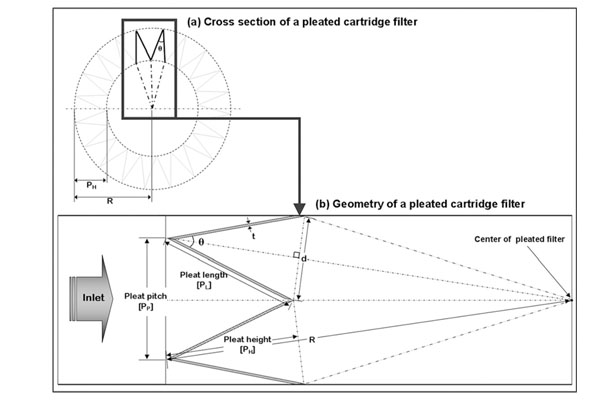
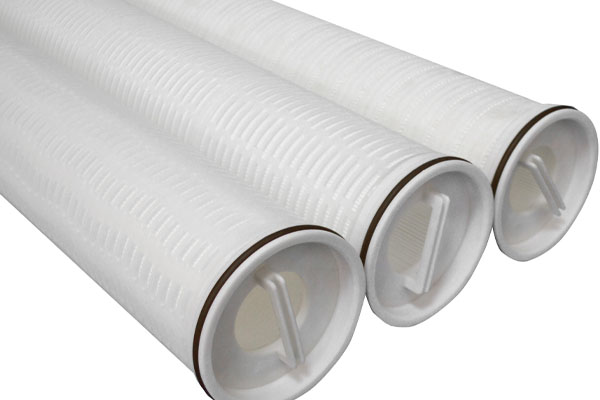
I once worked with a client at a large power generation plant who was frustrated with his RO pre-filters. He was changing them every three weeks, and the labor costs were adding up. He showed me the filter he was using. It looked fine from the outside. Then, I showed him one of our Ecofiltrone cartridges. I told him, "Just look at the end." The difference was immediately obvious. Our filter had almost double the number of pleats. He installed our filters for a trial, and his change-out interval went from three weeks to over two months. He saw that day that what’s inside the filter matters far more than the label on the outside.
Isn’t a denser pleat pack more likely to clog?
You look at a densely pleated filter and think the tight spaces will get blocked faster. It seems like less room for water would mean a quicker path to clogging.
It’s the opposite. Densely packed pleats create thousands of individual flow paths. This spreads the contamination load very thin, so no single area is overwhelmed. The overall filter clogs much slower.
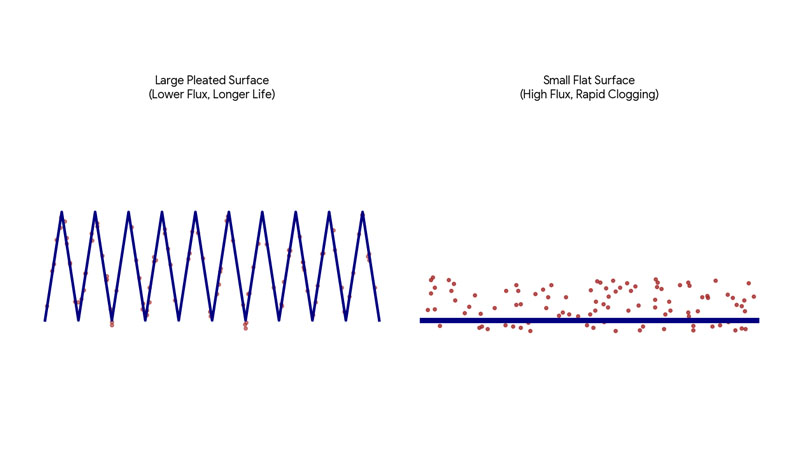
This is a common misconception, but the physics works in our favor. Think of it like cashiers at a busy supermarket. If you only have three cashiers open (low pleat density), their lines will get very long, very fast. If you open twenty cashiers (high pleat density), even with the same number of shoppers, each line is much shorter, and no single cashier gets overwhelmed. It’s the same with a filter. Each pleat acts like a separate flow channel. By having more pleats, you lower the amount of water and dirt each individual part of the filter has to handle. This concept is known as "flux," or the flow rate per unit of surface area.
| Pleat Density | Effective Surface Area | Flux (Flow per Area) | Rate of Clogging |
|---|---|---|---|
| Low | Small | High | Fast |
| High | Large | Low | Slow |
A lower flux means contaminants arrive at the filter surface more gently, forming a more permeable cake layer instead of plastering the media shut. This is the key to a long and predictable filter life.
How does more surface area directly translate to a longer lifespan?
You hear the term "more surface area" constantly. But what is the direct connection between that specification and the filter’s actual time in service before it clogs?
More surface area directly increases the filter’s Dirt Holding Capacity (DHC). A filter with a higher DHC can physically trap more contaminants before its pressure drop reaches the change-out limit, resulting in a longer operational life.
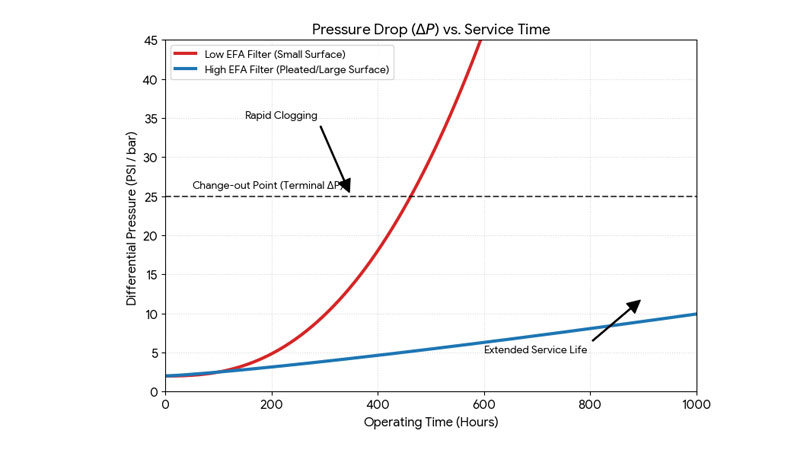
This is the most important financial reason to choose a filter with a high pleat density. Every filter has a terminal pressure drop, a point where it is considered "full" and must be replaced (e.g., 15-25 psid). A filter’s lifespan is simply the time it takes to reach that point. The Dirt Holding Capacity is the total weight of dirt the filter can capture to get there. Imagine Filter A has a low surface area and can hold 100 grams of sand before it’s full. If your water has a certain amount of sand, Filter A might last one month. Now, consider Filter B, which has dense pleats and double the surface area. It might be able to hold 200 grams of sand before it’s full. With the same water, Filter B will last two months. For an engineer like Jacky, this means half the number of filter purchases, half the labor for change-outs, and half the production downtime over a year.
Is there a point where pleats can be too dense?
You’re now convinced that denser is better. So, you start searching for the filter with the absolute highest pleat count, thinking it must be the best available.
Yes. If pleats are packed too tightly, they can touch each other, a problem called "pleat crowding." This blocks flow channels, reduces the usable surface area, and can cause the filter to clog prematurely, defeating the purpose.
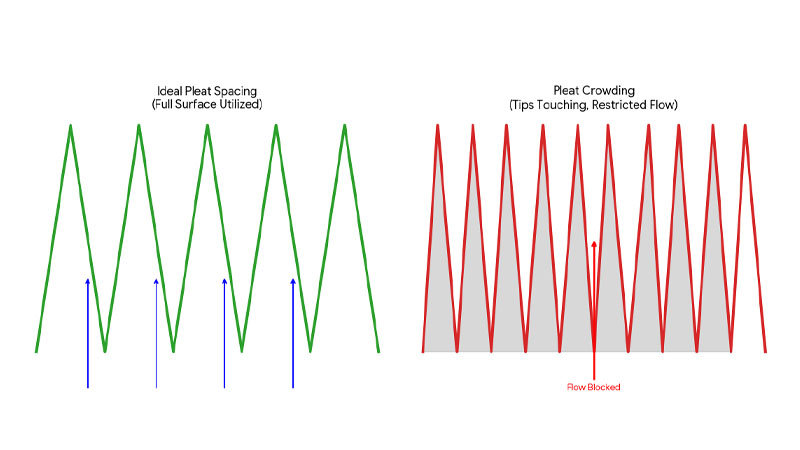
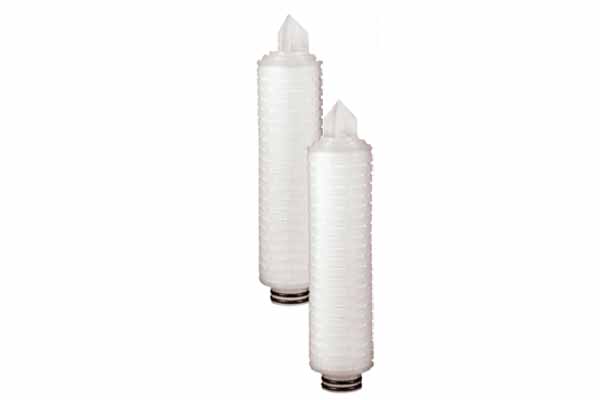
This is where true manufacturing quality shows. Simply cramming as many pleats as possible into a cartridge isn’t good engineering. There is an optimal balance. The valleys between the pleats are just as important as the pleats themselves, because they are the channels the water flows through to reach the media surface. If these valleys are too narrow or collapse under pressure, that part of the filter becomes useless. A well-designed high-flow filter balances pleat count, pleat depth, and proper spacing. Quality manufacturers use specialized support layers upstream and downstream of the filter media. These layers act as spacers, holding the pleats open and ensuring that the entire surface area is available for filtration, even under high flow and pressure. When you see a filter with perfectly uniform, well-supported pleats, you’re looking at a product designed not just for high area, but for high performance.
Conclusion
Denser pleats mean more surface area, which translates directly to a higher dirt holding capacity and longer filter life. However, quality design is key to prevent pleat crowding for maximum performance.