Why Do Filters Foul Faster During Summer?
Seasonal Water Quality Changes Often Accelerate Filter Fouling
In many RO pretreatment systems, operators notice that cartridge lifetime becomes significantly shorter during summer months.
Although system flow and operating conditions may remain unchanged, higher biological activity, algae growth, organic loading, and unstable pretreatment performance often cause filters to foul much faster during warm seasons.
【Onsite Evidence Suggestion】
Comparison of cartridge lifespan in summer and winter: Winter cartridge life: 25–30 days
Summer cartridge life: 7–10 days
During algae bloom: 3–5 days
- ΔP Change in growth rate :Winter ΔP increase rate: 0.02 bar/day
Summer ΔP increase rate: 0.08 bar/day
During algae bloom: 0.15–0.20 bar/day- SDIchange :Winter SDI15: 2.5–3.0
Summer SDI15: 3.8–4.5
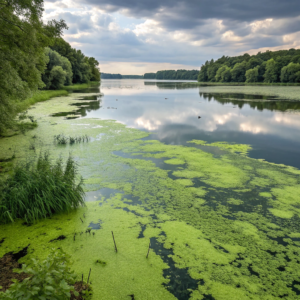
Algae bloom period: 4.8–5.5- algae bloom time :The ΔP acceleration appeared 10 days after the algae bloom was observed, suggesting a link between seasonal biological activity and cartridge surface fouling.
Example:
“During summer operation, cartridge lifetime dropped from 10 days to less than 3 days while ΔP increased much faster than during winter conditions.”
![Summer algae bloom and biological fouling causing rapid filter fouling in RO pretreatment system]
What Operators Usually Observe
Operators commonly notice:
- rapid ΔP increase
- slimy fouling deposits
- unstable cartridge replacement intervals
- increased SDI fluctuation
- biological or organic contamination
- stronger fouling odor during cartridge removal
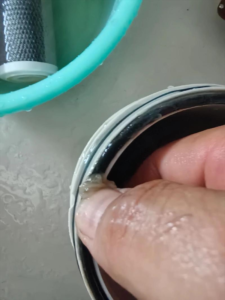
In many systems, cartridges removed during summer show more sticky and gelatinous fouling compared with dry particulate fouling during colder seasons.
Example:
“Removed cartridges showed heavy slimy fouling concentrated on the outer pleat surface during summer algae bloom conditions.”
—
What Usually Causes It
Increased Biological Activity
Higher water temperatures significantly increase biological growth inside raw water systems.
This often results in:
- algae growth
- bacterial activity
- organic contamination
- biofilm formation
These contaminants may rapidly overload the security filter surface.
Seasonal Algae Bloom
Algae bloom events may increase organic solids and colloidal contaminants entering pretreatment systems.
These particles are often sticky and difficult to distribute evenly through the filtration depth.
Example:
“Rapid fouling started shortly after seasonal algae bloom conditions appeared at the seawater intake.”
Unstable UF or Pretreatment Performance
During summer, higher contaminant loading may overload UF or media filtration systems.
This can allow more colloidal and biological contaminants to pass downstream into the security filter.
Operators often observe:
- unstable UF recovery
- increased backwash frequency
- SDI fluctuation
- higher turbidity spikes
Surface Blinding from Sticky Organic Fouling
Biological and organic contaminants often accumulate mainly on the outer filter surface instead of distributing gradually through the media depth.
Once sticky fouling blocks the surface pores, rapid ΔP increase occurs even when the inner filtration layers remain partially unused.
What Should Be Checked Onsite
Inspect Removed Cartridges
Check:
- slime or gelatinous deposits
- fouling color
- biological odor
- contaminant penetration depth
- uneven fouling patterns
Review Seasonal Operating Data
Review:
- ΔP trend
- SDI fluctuation
- turbidity changes
- UF recovery trend
- backwash frequency
- seasonal intake conditions
Rapid summer fouling often reflects unstable organic loading rather than simply higher solids concentration.
Example:
“SDI increased from below 3 during winter to above 5 during peak summer operation.”
Engineering Insight
Filters often foul faster during summer not because the total contaminant load increases dramatically, but because biological and organic contaminants are more likely to cause sticky surface fouling instead of stable depth loading.
Once contaminants concentrate mainly on the outer filtration layer, premature surface blinding and unstable ΔP growth occur rapidly.
| Onsite Symptom | Possible Cause | What to Check |
|---|---|---|
| Rapid ΔP increase | Organic surface fouling | Inspect outer pleat slime |
| Short cartridge life | Algae bloom | Review intake condition |
| Slimy fouling | Biological loading | Check biological activity |
| Unstable SDI | Pretreatment overload | Review UF performance |
FAQ
Why do filters clog faster during summer?
Higher biological activity and algae growth often increase sticky organic fouling inside the filtration system.
What does slimy fouling usually indicate?
It often suggests biological or organic contamination rather than dry particulate loading.
Can algae bloom affect cartridge lifetime?
Yes. Algae bloom conditions may significantly increase organic loading and accelerate surface fouling.
Engineering Perspective
In many RO pretreatment systems, rapid summer fouling is primarily a contaminant behavior problem rather than simply a filtration precision problem.
Stable pretreatment operation and controlled organic loading are often critical for maintaining stable ΔP behavior and longer cartridge lifetime during warm seasonal conditions.