Why do filter cartridges with the same precision have such different flow rates depending on their structural design?
You have two 1-micron filters, but one slows to a trickle while the other handles hundreds of gallons per minute. This makes system design feel like guesswork.
Flow rate is determined by a filter’s effective surface area and media structure, not just its micron rating. A pleated High Flow filter has an enormous surface area compared to a standard depth filter, allowing it to process much more fluid.
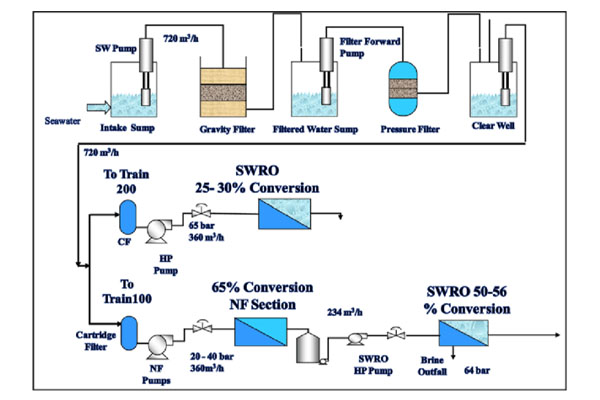
I remember working with a new engineer on a desalination project. He specified 1-micron filters for the RO pre-treatment stage, but he chose standard melt-blown cartridges because they were cheaper per unit. When they started the system, the pressure drop was so high they couldn’t reach their target flow. He was completely baffled. "They’re 1-micron, what’s wrong?" he asked. The problem wasn’t the precision; it was the structure. He had specified a filter with the surface area of a napkin when he needed one with the surface area of a bedsheet.
Isn’t a micron rating a universal standard for performance?
You assume a 5-micron rating is a guarantee of performance. But when you install a new filter brand with the same rating, your system’s flow rate drops dramatically.
A micron rating is a standard for particle size removal, not flow capacity. Flow is governed by the filter’s surface area and media design. Two 5-micron filters can have vastly different structures, leading to completely different flow rates.
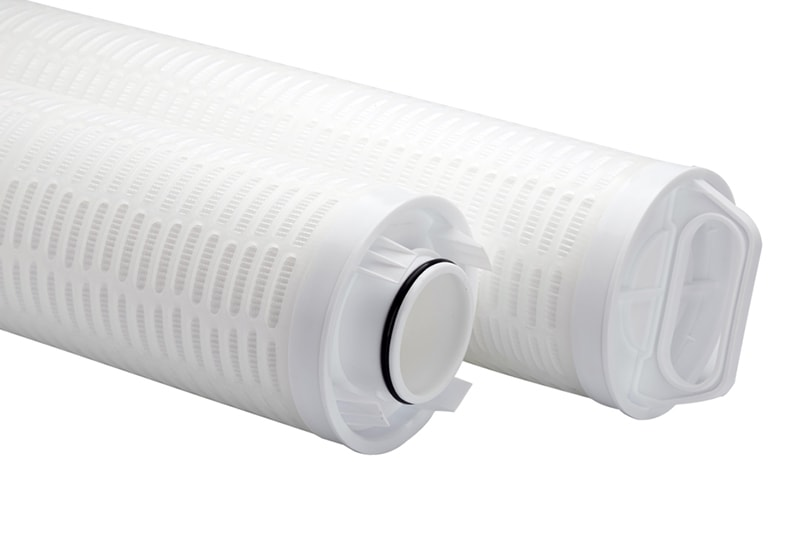
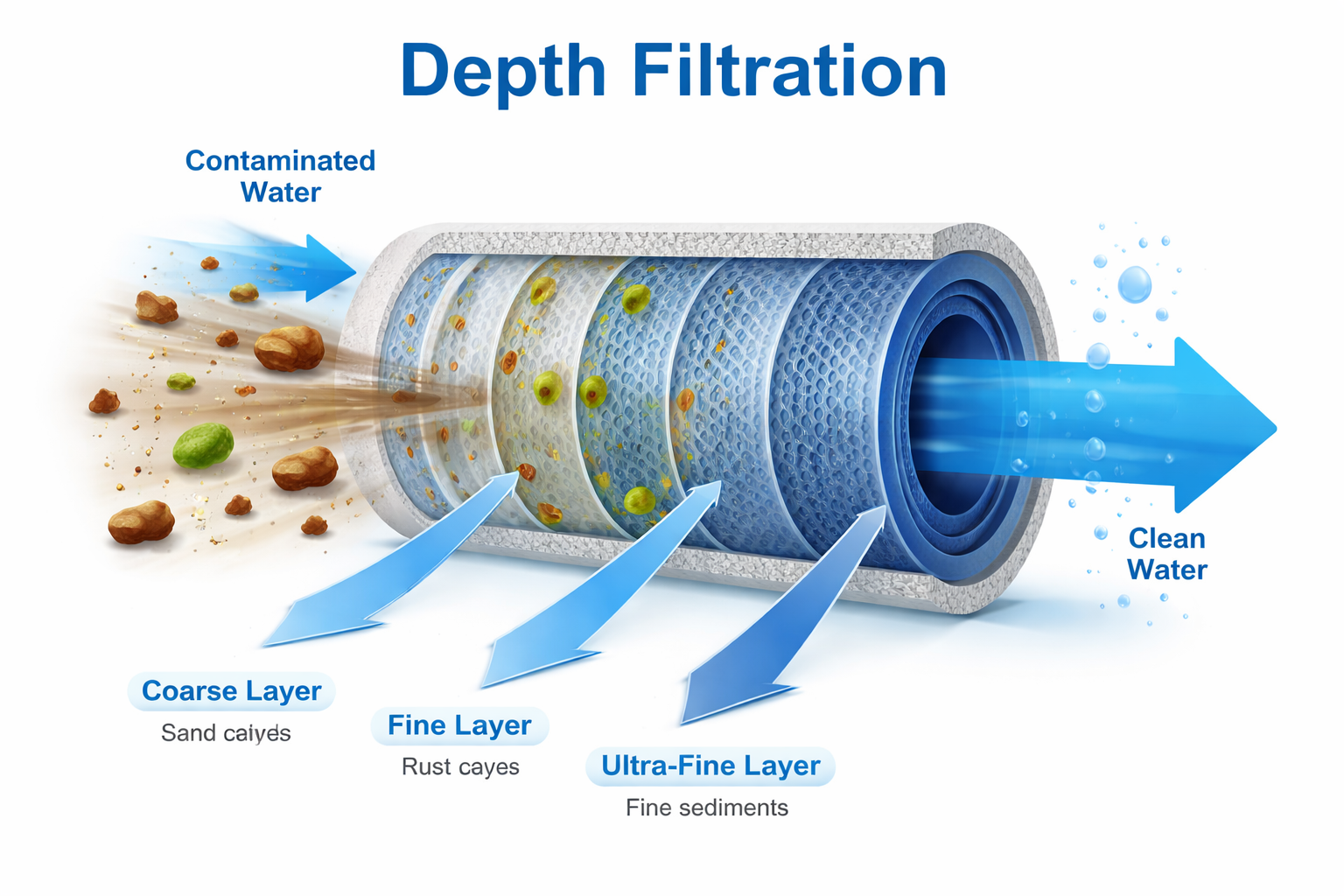
The micron rating only tells you half the story. It tells you the size of the holes in the screen, but it doesn’t tell you the size of the screen itself. The most critical factor for flow rate is the Effective Filtration Area (EFA). This is the total usable surface of the filter media. A filter with more surface area has more pathways for water to flow through, resulting in a higher overall flow rate and a lower pressure drop. Another key factor is media permeability. A dense, thick media, like that found in a depth filter, will naturally have more resistance to flow than a thin, engineered surface media. This is why just looking at the micron rating on a data sheet can be so misleading. An engineer like Jacky needs to consider the entire structural design to predict how a filter will perform in a real-world system.
| Parameter | 1-Micron Melt-Blown | 1-Micron High Flow Pleated |
|---|---|---|
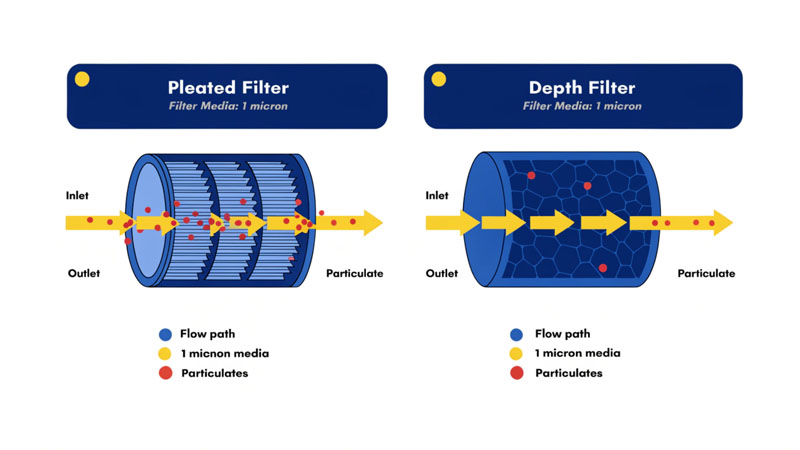
| Filter Type | Depth Filtration | Surface Filtration |
| Structure | Dense fiber matrix | Thin pleated media |
| Surface Area | Low (e.g., ~2 sq. ft.) | Very High (e.g., ~50+ sq. ft.) |
| Typical Flow | Low (e.g., 5-10 GPM) | Very High (e.g., 350 GPM) |
How does pleating dramatically increase the flow rate?
You see the pleats on a filter but might not fully appreciate their purpose. You may think it’s just for strength, underestimating its massive impact on performance.
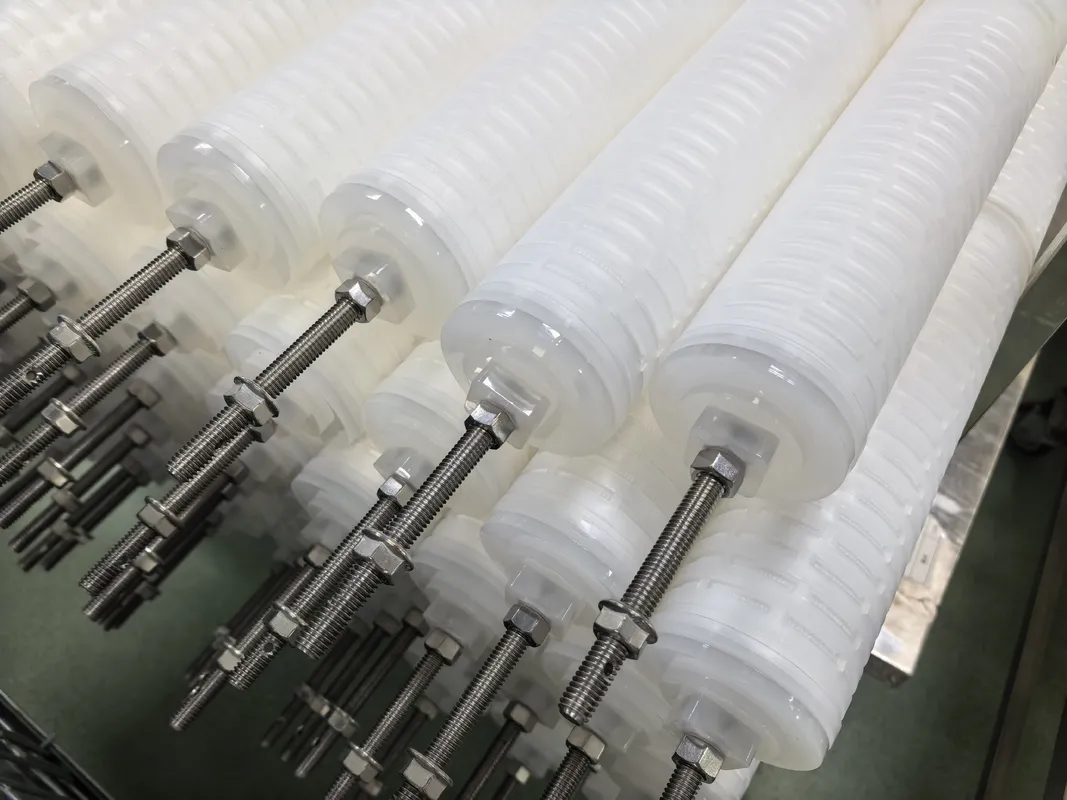
Pleating folds a very large, flat sheet of filter media into a compact cylinder. This simple technique can increase the effective surface area by 10 to 50 times compared to a non-pleated cartridge, directly boosting its flow capacity.
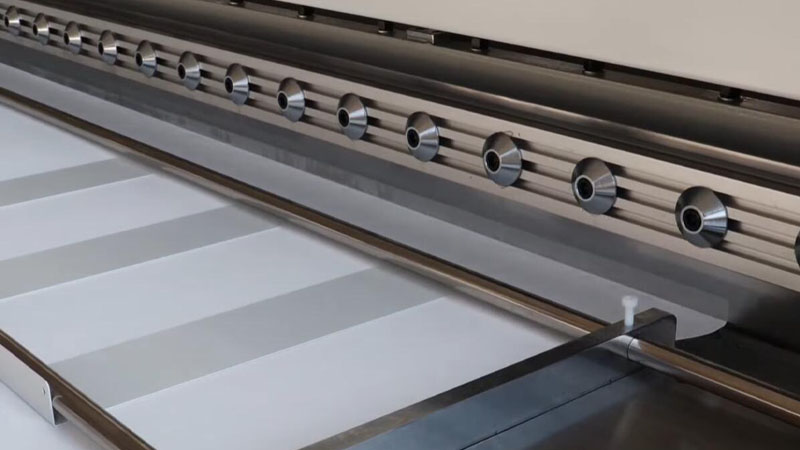
Pleating is one of the most brilliant and effective engineering tricks in filtration. Imagine trying to fit a 20-foot-long tablecloth into a small jar. If you just stuff it in, it will be a dense, useless lump. But if you fold it very neatly, like an accordion, it fits perfectly. That’s exactly what pleating does for a filter cartridge. It takes a huge sheet of thin filter media and packs it into the standard cylindrical shape of a filter. This massive increase in surface area has a direct and powerful effect on performance. For example, a standard 40-inch non-pleated depth filter might have about 2 or 3 square feet of media. A 40-inch High Flow pleated filter, in contrast, can have over 50 square feet of media. All that extra area means more water can pass through with less effort, which is why a single High Flow cartridge can replace 10 or 20 standard cartridges.
Does the cartridge’s diameter also affect flow rate?
You’re comparing a standard 2.5-inch filter to a 6-inch High Flow filter. You know the High Flow one is better, but you don’t realize how much the diameter multiplies its performance.
Yes, the diameter has an enormous impact. A larger diameter allows for a greater number of deeper pleats, which exponentially increases the available surface area. It also optimizes the flow path, reducing restriction and maximizing capacity.
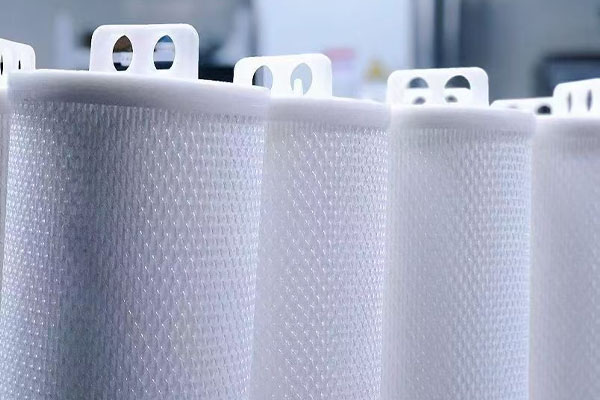
The large 6-inch diameter of a High Flow filter works in perfect synergy with its pleated design. A bigger diameter means you can fit a much longer piece of media into the cartridge, and you can make the pleats themselves much deeper. This geometry alone creates an exponential increase in the total surface area packed into the filter. Furthermore, the design of a High Flow filter optimizes the water’s path. Most use an "inside-out" flow, where water enters the open core and flows outward through the pleats. This allows the entire surface area to be used evenly. The large, open core and large housing connections also act like a big pipe instead of a small one, dramatically reducing flow restriction. It’s not just about the filter media; it’s about the hydraulic design of the entire cartridge. This combination of large diameter, extensive pleating, and optimized flow dynamics is what gives a High Flow filter its incredible capacity.
Conclusion
Precision and performance are not the same. Flow rate depends on structural design, where pleated media and large diameters create a massive surface area, delivering superior capacity unmatched by standard filters.