🛢️ When Standard Filters Fail: The Solution for Oil, Gels, and Extreme Dirt Loads
Standard Pleated High Flow cartridges are fantastic for hard particles (sand, rust).
But have you ever put one in a stream containing Oil, Amine, or Organic Gels, only to see the pressure drop spike in 2 hours?
The filter looks clean inside, but the surface is covered in a thin, shiny film.
This is called "Glazing" or "Surface Blinding."
When you are facing Extreme Dirt Holding Capacity (DHC) requirements or need to remove Oil/Hydrocarbons, you need to stop using a "Screen" and start using a "Sponge."
Here is why Glass Fiber (GF) and Deep-Depth Polypropylene are the only materials that survive these harsh conditions.
1. The "Surface Blinding" Trap
Standard Polypropylene (PP) pleated filters are surface-dominant.
- The Scenario: You have a fluid with trace oil or deformable gels.
- The Failure: These soft contaminants hit the tight surface pores and spread out like butter on toast. They seal the surface instantly.
- The Result: You waste 90% of the filter media depth. You pay for a whole filter but only use the outer skin.
2. The Solution: Glass Fiber (The "Oil Magnet")
For oil removal and high-temperature applications, Glass Fiber (GF) media is the heavyweight champion.
- Oleophilic Nature: Glass fiber naturally attracts and adsorbs oil droplets into its matrix.
- High Void Volume: Unlike the tight structure of melt-blown PP, GF media has a massive void volume (up to 90%). It acts like a 3D trap, absorbing oil and sludge deep into the media without blocking the flow channels.
- Rigidity: GF fibers are rigid. They don’t compress or collapse under the weight of heavy sludge, maintaining their flow path even when fully loaded.
3. The Structure: "Deep Pleated" Technology
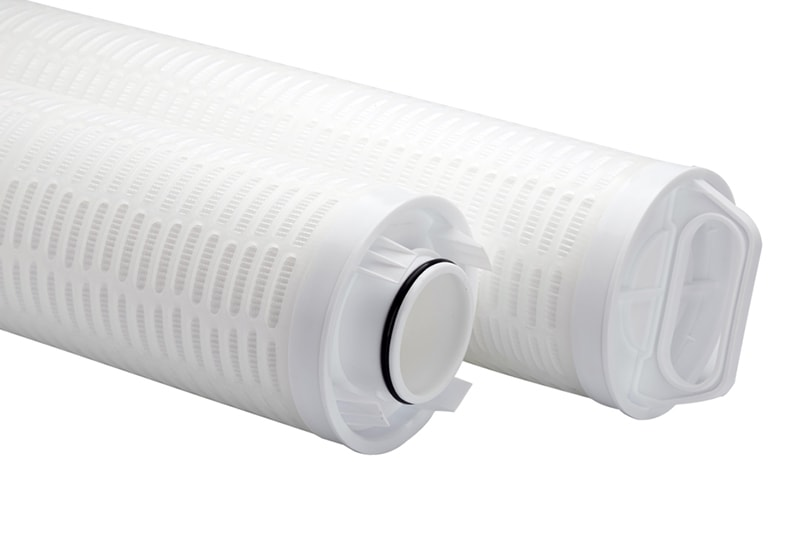
Material alone isn’t enough; you need the right geometry. For high DHC, we use Deep Pleated (or Lofted) Media.
- Thickness: Instead of a thin sheet of paper, imagine folding a thick blanket. The media is much thicker (often 2mm – 5mm thick).
- Gradient Density: The outer layers are loose (to catch big globs of oil/gel), and the inner layers are tight (to polish the fluid).
- The Result: The contaminant is distributed throughout the volume of the filter, not just the surface. This can increase service life by 3x to 5x compared to standard pleated filters in oily applications.
4. Ideal Applications
Where should you switch from Standard PP to Glass Fiber/Depth High Flow?
- Amine Loops (Gas Sweetening): Removing anti-foam agents and hydrocarbon sludge.
- Produced Water: Removing residual oil droplets before reinjection.
- Paints & Coatings: Filtering viscous resins and gels.
- Cooling Water: High biological slime loads.
Conclusion
If your filters are failing due to pressure drop, but they don’t look "full" of dirt, you have a Surface Blinding problem.
Switch to Glass Fiber or Deep Depth Media. Stop filtering on the edge; start filtering in the depth.
👇 Discussion: Do you struggle with "Glazing" in your Amine or Glycol systems?