What is the physical process of filter cartridge "breakdown" (unloading phenomenon)?
Your process fluid is suddenly contaminated, but your filters are in place. This unexpected failure can ruin your product, forcing you to question the reliability of your entire system.
Filter unloading is when a cartridge releases previously captured contaminants back into the fluid. This happens when physical stress, like a pressure spike, forces the filter’s pores to expand, dislodging the trapped particles and sending them downstream.
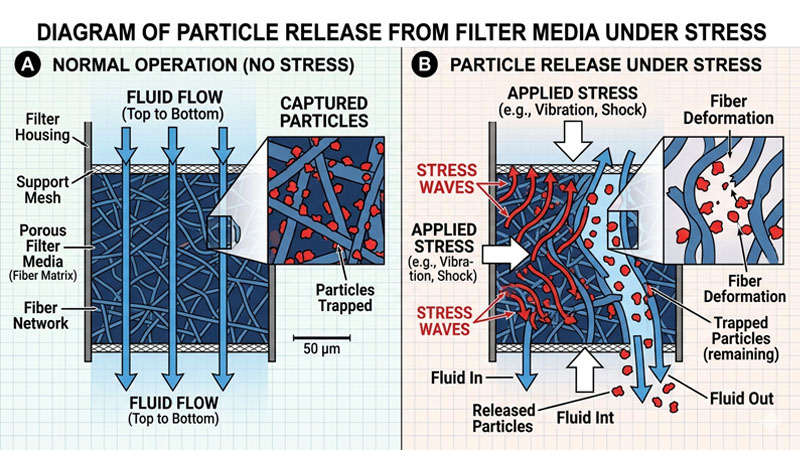
I’ll never forget a crisis at a beverage plant I consulted for. An entire batch of a sports drink failed its final quality check due to particle contamination. The team was convinced their water source was the problem, but I suspected the filters. We pulled the final filter cartridge, and it looked fine on the outside. But when we learned that a large pump had kicked on just before the batch was run, I knew what happened. The resulting pressure surge forced the filter to "unload" a burst of old particles, contaminating the final product. That experience taught me a filter isn’t just a barrier; under the wrong conditions, it can become a source of contamination itself.
How does a change in pressure cause unloading?
Your system seems stable, but even a pump starting up can create pressure surges. You don’t realize that these small, quick events might be destroying your filter’s ability to hold onto dirt.
Pressure spikes dramatically increase the force pushing on the filter media. This force flexes the filter’s fiber structure, temporarily stretching the pores open and allowing trapped particles to escape and flow downstream with the clean fluid.
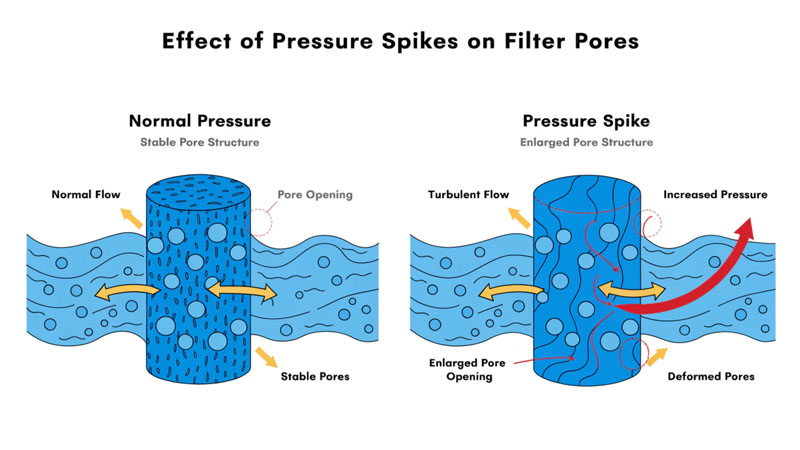
A filter’s media is not a rigid, solid object. It is a complex web of fibers with a certain amount of flexibility. Under normal, steady operating pressure, particles get trapped in the twists and turns of this web. When a sudden pressure spike happens—from a valve closing quickly or a large pump starting—the force across the filter media skyrockets. This force physically stretches and distorts the fiber matrix. A pore that was small enough to hold a 10-micron particle might momentarily expand, allowing that same particle to break free. The force of the fluid rushing through the newly opened path is often enough to break the weak bonds holding the dirt in place. The filter essentially "coughs up" a cloud of previously captured contaminants. This is why stable system pressure is so critical for reliable filtration. Even a filter with a high dirt-holding capacity can fail if it’s subjected to constant pressure shocks.
Can a fully loaded filter start to unload without any pressure spikes?
Your filter is nearing the end of its life, and the pressure drop is high. It seems like it’s just doing its job, but it may have already started to contaminate your process fluid.
Yes. As a filter becomes heavily loaded with dirt, the fluid is forced through fewer and fewer open channels at a much higher speed. This high-velocity flow can act like a sandblaster, eroding and releasing trapped particles.
This type of unloading happens gradually as a filter reaches its maximum dirt-holding capacity. In the beginning, fluid flows evenly through the entire filter media. As particles are captured, they begin to block off sections of the media. The system pump is still pushing the same amount of fluid, so that fluid has to find a new path. It starts to create channels through the areas that are still open. Because the same volume of fluid is now going through a much smaller area, its speed increases dramatically. This high-velocity fluid has a powerful scouring effect. It can physically tear away chunks of the caked-on dirt and carry them downstream. This process is less dramatic than a big release from a pressure spike, but it can cause a slow, steady increase in downstream contamination as the filter gets older. This is a key reason why it is crucial to change out filters when they reach their recommended change-out pressure, not just when the flow rate becomes too low.
What is the difference between unloading and media migration?
You’ve found unwanted particles in your clean fluid. You are not sure if they are old contaminants or pieces of the filter itself. Knowing the difference is critical for fixing the right problem.
Unloading is the release of previously captured process contaminants. Media migration is when the filter itself falls apart, releasing its own fibers or materials downstream. They are two different failure modes with very different causes.
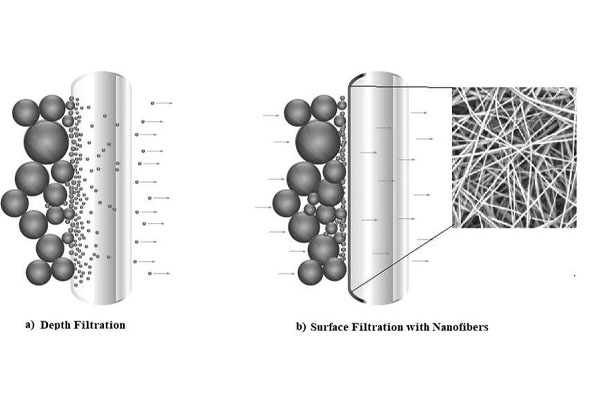
This is one of the most important distinctions to make when troubleshooting a filtration problem. Unloading means the filter is releasing the dirt it was supposed to hold. Media migration means the filter itself is becoming the contaminant. The best way to tell the difference is to analyze the downstream particles. If you find particles that are the same as what you are trying to filter out, you have an unloading problem. This is usually solved by controlling system pressures and having a proper filter change-out schedule. If you find uniform, synthetic fibers, bits of plastic, or adhesives, you have a media migration problem. This points to a much more serious issue, like a poorly manufactured filter, a chemical incompatibility that is dissolving the filter material, or operating conditions that far exceed the filter’s temperature or pressure limits.
| Failure Mode | Released Material | Root Cause | Solution |
|---|---|---|---|
| Unloading | Process Contaminants (dirt, rust) | Operational Stress (pressure spikes, high ΔP) | Control system pressure; change filters on time. |
| Media Migration | Filter Materials (fibers, glues) | Defective filter; chemical/temp incompatibility | Choose a better quality or more compatible filter. |
Diagnosing the correct failure mode saves you from fixing the wrong thing. You don’t want to redesign your system’s pressure controls when the real problem is that you just need a different filter.
Conclusion
Filter unloading is the physical release of trapped dirt caused by operational stress. Preventing it requires using quality filters, maintaining stable system pressures, and following a disciplined filter replacement schedule.