Struggling to choose the right filters for your desalination plant? The wrong choice leads to high costs and system failure. Understanding your water source is the first step to success.
The main difference is the contaminant load. Open-intake seawater is exposed to surface elements, containing more suspended solids, biological matter, and pollutants. Deep-well water is naturally filtered through geological layers, resulting in much cleaner, more consistent water that requires less intensive pre-treatment.

I’ve spent over a decade helping project managers optimize their filtration systems, and the most common mistake I see is treating all seawater the same. The source of your water, whether it’s an open-intake pipe stretching into the ocean or a deep beach well, completely changes the game. Getting this wrong doesn’t just affect performance; it directly hits your operational budget. Let’s break down why these two sources are worlds apart and what it means for your filter selection.
Why does open-intake seawater demand more frequent cartridge replacement than deep-well sources?
Are your filter change-out costs for an open-intake system spiraling out of control? This constant replacement means more downtime, higher labor costs, and a bigger hit to your budget.
Open-intake seawater has a much higher and more variable load of contaminants like silt, sand, and organic debris. This heavy load clogs filter cartridges much faster than the cleaner water from deep wells, forcing more frequent replacements to maintain water flow and pressure.
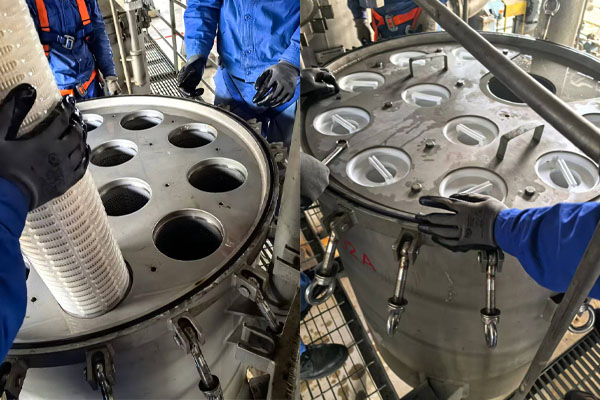
In my experience, this is one of the biggest operational headaches for plants using surface water. Deep wells, also known as beach wells or subsurface intakes, use the sand and soil as a massive, natural pre-filter. The water that reaches the pump is already quite clean. Open-intake systems, on the other hand, pull water directly from the sea. This water is filled with everything the ocean contains: suspended solids, sediment stirred up by currents, and all sorts of biological life. This heavy and inconsistent challenge is what we call a high Total Suspended Solids (TSS) and Silt Density Index (SDI) level. A cheap, low-quality filter simply can’t handle this. I’ve seen many cases where clients try to save money on the cartridge’s unit price, only to find the filters clog in a matter of days, not weeks. Even worse, under the high pressure of the system, these inferior filters can experience "unloading," where they release the very particles they just captured. These particles then rush downstream and slam into your expensive RO membranes.
Contaminant Load Comparison
| Parameter | Typical Open-Intake | Typical Deep Well | Impact on Filtration |
|---|---|---|---|
| TSS (mg/L) | 10 – 100+ | < 1 | Clogs filters faster. |
| SDI₁₅ | > 5 | < 2 | High fouling potential for RO membranes. |
| Variability | High (Tides, Storms) | Low (Stable) | Requires a robust and adaptable filter. |
Can biological fouling in surface intake bypass traditional filtration and damage your RO membranes?
You trust your pre-filters to protect your RO system. But what if microscopic organisms are slipping through and slowly destroying your most expensive assets from within? This hidden threat can cause irreversible damage.
Yes, absolutely. Small microorganisms, algae, and organic nutrients present in surface water can pass through initial filters. They then attach to and multiply on RO membrane surfaces, creating a biofilm that restricts flow, increases energy consumption, and requires aggressive, costly chemical cleanings (CIP).

Biofouling is a silent killer for RO membranes. It doesn’t happen overnight. It starts with tiny living things from the open-intake source that are small enough to get past the initial media filters. Once they reach the calm, protected environment of the RO pressure vessels, they begin to thrive. They form a slimy layer, or biofilm, across the membrane surface. I remember a client working on a large municipal project who couldn’t figure out why their energy costs were climbing and their water output was dropping. An autopsy of their membranes revealed severe biofouling. The problem wasn’t just the cost of a CIP cycle; the biofilm had permanently damaged the membrane material. This is where the quality of your final security filter is critical. A high-efficiency, absolute-rated cartridge acts as the last line of defense, capturing these tiny biological precursors before they can colonize and destroy your RO investment.
Stages of Biofouling
- Attachment: Microorganisms and organic molecules from the intake water adhere to the membrane surface.
- Colonization: The attached organisms multiply, feeding on nutrients in the water.
- Biofilm Formation: The colony grows into a complex, slimy matrix that covers the membrane, blocking water passage and trapping more particles.
Is the "natural filtration" of beach wells enough to eliminate the need for high-end security filters?
Your water from a beach well looks crystal clear. You might think you can save money by using a basic, cheap filter or even skipping the security filtration step altogether. This is a risky assumption.
No, it is not enough. While beach wells provide excellent pre-filtration, they aren’t foolproof. Fine particles, dissolved minerals, and occasional microbial breakthroughs can still threaten your RO membranes. A high-quality security filter is an essential insurance policy to protect your system’s most valuable components.
I often speak with project managers who are impressed by the low SDI of their beach well water. It’s true, the sand bed does a fantastic job, removing the vast majority of suspended solids. However, it’s a mistake to become complacent. The geology of the ground can change, or heavy rains could alter groundwater flow, introducing fine silts that weren’t there before. More importantly, the anaerobic (low-oxygen) environment in some deep wells can encourage the growth of specific types of bacteria that are difficult to detect. Relying solely on the "natural filter" is like driving a very expensive car without insurance. The risk might seem low, but the cost of a single incident—like replacing a full rack of RO membranes—is catastrophic. A top-tier security filter from a manufacturer like us at ecofiltrone costs a fraction of a percent of that potential damage. It’s the smartest investment you can make for long-term operational stability.
Risk Profile: Intake Source
| Risk Factor | Open-Intake System | Deep Well System | Mitigation Strategy |
|---|---|---|---|
| Macrofouling | High (Fish, seaweed) | Very Low | Coarse screens at intake |
| Microfouling | High (Algae, bacteria) | Low but possible | High-efficiency security filters |
| Inorganic Fouling | High (Silt, clay) | Low (Fine particles) | High-efficiency security filters |
| Variability | Very High | Very Low | Robust, absolute-rated filters |
How do seasonal algal blooms affect the micron-rating selection for high-flow filter cartridges?
Your filtration system runs smoothly for months, then suddenly, your filters clog in hours. This unexpected crisis can halt production and cause chaos as your team scrambles to replace cartridges.
Algal blooms flood the intake water with millions of tiny, often gelatinous particles. This sudden, massive load requires you to switch to a finer micron-rated filter, often from a standard 5-micron down to a 1-micron absolute-rated cartridge, to effectively capture the algae and protect downstream systems.
Seasonal changes have a huge impact on open-intake systems. An algal bloom is one of the toughest challenges. I worked with a power plant in Southeast Asia that faced this every year. During the bloom, their standard 5-micron nominal filters were overwhelmed. The algae are not only small, but they are also soft and can be pushed through a low-quality filter material under pressure—that "unloading" phenomenon again. This coats the RO membranes in a thick slime. The solution we developed was a two-step approach. First, we helped them monitor key water quality indicators to predict the start of a bloom. Second, they kept a stock of our 1-micron absolute-rated high-flow cartridges ready. When the bloom hit, they would swap out the cartridges. Yes, the 1-micron filters would clog faster than the 5-micron ones during normal operation, but during a bloom, they were the only thing that could effectively stop the algae and save the RO membranes. This strategy prevented costly shutdowns and emergency CIPs.
Recommended Micron Rating Strategy
| Water Condition | Key Contaminant | Recommended Filter | Rationale |
|---|---|---|---|
| Normal Seawater | Silt, Sand | 5 µm Absolute | Balances filter life and protection. |
| Post-Storm / High Turbidity | Silt, Clay | 5 µm Absolute | Robust structure prevents particle unloading. |
| Seasonal Algal Bloom | Algae, Organic Gels | 1 µm Absolute | Captures small, deformable biological matter. |
Conclusion
The source of your seawater dictates your filtration strategy. Investing in high-quality, correctly specified cartridges isn’t an expense; it’s the best way to lower operational costs and protect your RO membranes.