What Are the Challenges in Membrane Security Filtration for Petrochemical ZLD Systems?
Rapid Answer
Security filtration (pre-filtration) in petrochemical Zero Liquid Discharge (ZLD) systems is uniquely brutal. The challenge is not merely intercepting inert sand or rust; it requires managing a highly concentrated, chemically aggressive cocktail of sticky organic complexes, emulsified hydrocarbons, colloidal silica, and biological slime.
In a ZLD framework, water is pushed to its maximum recovery limit. Standard commodity filters (like basic meltblown polypropylene) fail rapidly in this environment—either blinding prematurely from organic gels or swelling from hydrocarbon exposure, which causes them to extrude contaminants directly into the vulnerable Reverse Osmosis (RO) membranes. Consequently, the security filter must be engineered as a structurally rigid, chemically resilient barrier to prevent catastrophic downstream membrane fouling and unplanned evaporative train shutdowns.
The Physico-Chemical Threats in Petrochemical ZLD
To understand why security filters plug so quickly in petrochemical ZLD RO systems, operators must examine the complex chemistry of the wastewater. As the ZLD process concentrates the effluent, trace impurities multiply into severe operational threats.
1. Emulsified Hydrocarbons and Polymer Swelling
Even after extensive upstream treatment (API separators, DAF, Ultrafiltration), petrochemical wastewater retains trace free oils and emulsified hydrocarbons.
When standard polypropylene (PP) filters are exposed to these hydrocarbons, the non-polar fluids diffuse into the plastic matrix. The PP media swells, loses its yield strength, and the precise micron pores dilate. This allows oil droplets and particulate matter to bypass the filter entirely, permanently blinding the downstream RO membranes (oil-fouling).
2. Extracellular Polymeric Substances (EPS) and Biofouling
ZLD systems often run warm (30°C–40°C) and contain high levels of Chemical Oxygen Demand (COD). This creates an ideal incubator for biological growth. Bacteria secrete extracellular polymeric substances (EPS)—a sticky, glue-like slime. This biomass does not behave like solid dirt; it behaves like a gel. Under pressure, this gel instantly coats and blinds standard depth filters, driving differential pressure (△P) up exponentially.
3. Colloidal Silica Polymerization
In high-recovery ZLD systems, silica concentration often approaches supersaturation. Before it fully crystallizes into a hard scale, silica exists as a microscopic colloid that can polymerize into a highly viscous gel. When combined with trace metals (like aluminum or iron), this colloidal silica forms an impenetrable crust on the security filter, rendering backwashing or chemical cleaning impossible.
Operational Diagnostics: Cross-Referencing ZLD Upset Signals
When a ZLD membrane security filter exhausts prematurely (e.g., in 3 days instead of 30 days), field engineers must diagnose the specific contaminant matrix. The physical appearance of the exhausted filter is the primary diagnostic tool.
ZLD Security Filtration Diagnostic Matrix
| Correlated Operational Signals | Diagnostic Inference (Root Cause) | Typical Operator Action |
|---|---|---|
| Filter media coated in a clear/brown slick gel + Rapid $\Delta P$ spike | Biofouling / EPS Blinding: High biological activity upstream is generating massive amounts of bacterial slime. | Initiate a shock chlorination or non-oxidizing biocide treatment upstream; review DAF performance. |
| Media appears clean but swollen + RO differential pressure rising | Hydrocarbon Swelling / Bypass: Trace aromatics or oils have plasticized the filter media, allowing solids to bypass into the RO train. | Check upstream oil-water separators. Upgrade filter media to oleophobic (oil-resistant) or rigid inorganic structures. |
| Hard, grey/white crust on pleats + System pH fluctuations | Silica / Hardness Precipitation: The ZLD concentration has pushed silica or calcium carbonate past the solubility limit. | Adjust upstream antiscalant dosing and ensure strict pH control prior to the security filtration stage. |
| Black/brown dense paste + Slow △P climb | Coagulant/Flocculant Carryover: Upstream clarifiers are overdosing chemicals, carrying unreacted polymer into the filters. | Optimize the upstream jar testing; reduce polymer dosing rates. |
Field Experience: Diagnosing the Emulsion Block
At a major petrochemical complex operating a 90% recovery ZLD RO system, operators faced a severe bottleneck. The 5-micron security filters upstream of the RO train were completely blinding every 48 to 72 hours.
The operations team suspected massive suspended solids carryover from the upstream Ultrafiltration (UF) unit. However, diagnostic sampling proved the UF effluent turbidity was consistently below 0.1 NTU.
An autopsy of the exhausted security cartridges revealed the true mechanism. The filters were coated in a highly tenacious, sticky emulsion. Diagnostic cross-referencing identified the root cause: a synergistic fouling loop involving oil, polymer, and colloidal solids.
The upstream Dissolved Air Flotation (DAF) unit was occasionally experiencing hydraulic surges, allowing trace amounts of unreacted flocculant polymer and emulsified oil to slip through the UF membranes. Once this mixture hit the high-pressure environment of the security filter, the oil and polymer acted as an adhesive, capturing microscopic colloidal silica and forming a dense, water-impermeable emulsion block over the filter pores.
Because the system was using standard nominal depth filters, the high △P was actually extruding this gel through the filter and into the lead RO elements, requiring chemical cleaning of the RO train every two weeks.
The solution required upgrading the security filtration stage to absolute-rated, high-flow pleated micro-glass elements. The rigid, non-deformable nature of the advanced media prevented extrusion, while its high surface area dropped the fluid velocity (flux) significantly, delaying the onset of the emulsion block and extending run times from 3 days to 4 weeks.
The Engineering Logic of ZLD Filtration Design
Because the ZLD contaminant matrix is fundamentally different from standard municipal or raw water, traditional filtration logic is a liability.
Why Conventional Filters Fail:
Standard 2.5-inch meltblown or string-wound filters operate at a high flux (velocity). When presented with deformable gels (biomass, silica, oil), the high velocity physically shears these contaminants and pushes them through the nominal pore structure. Furthermore, their low surface area means they blind almost instantly when hit with an organic upset.
The Operational Justification for Advanced High-Flow Structures:
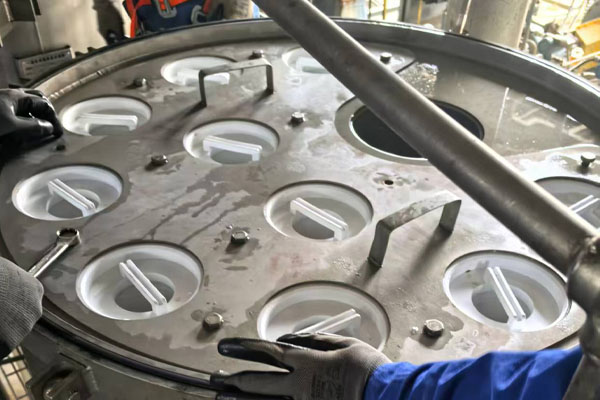
Petrochemical ZLD systems increasingly mandate large-diameter, high-flow pleated structures for security filtration based on three engineering principles:
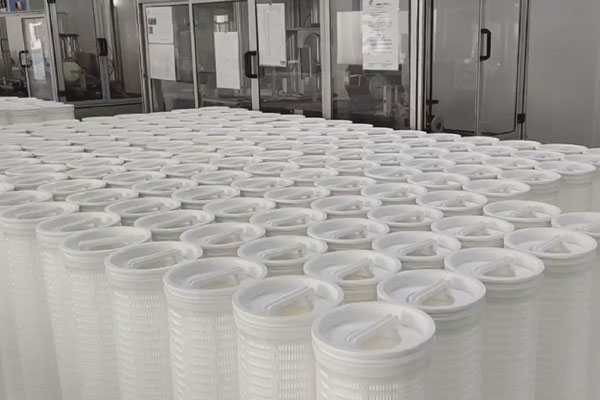
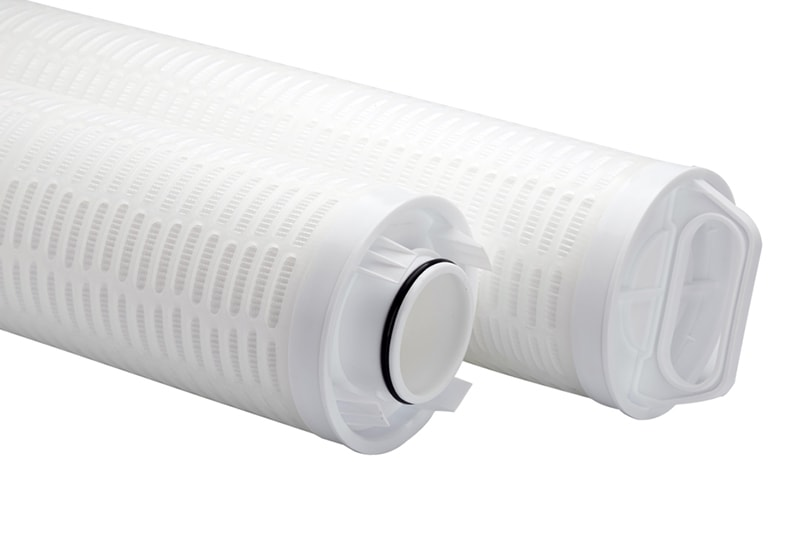
- Ultra-Low Flux Rates: By packing up to $8 \text{ m}^2$ of pleated media into a single high-flow element, the fluid velocity passing through the pores drops dramatically. This gentle flow regime prevents deformable biological gels and colloidal silica from being extruded through the media.
- Structural Rigidity (Bypass Prevention): Using advanced synthetic composites or micro-glass media ensures the filter structure remains completely rigid. It will not swell, stretch, or dilate when exposed to trace hydrocarbons or high differential pressures.
- High Dirt-Holding Capacity for Upsets: ZLD systems are prone to sudden chemistry transients. The deep pleat geometry provides the physical volume necessary to absorb a massive "crud burst" of organic slime or coagulant carryover without triggering an immediate high-△P plant shutdown.
Conclusion
Security filtration in a petrochemical ZLD system is the ultimate mechanical firewall protecting the critical membrane assets. By performing filter autopsies and cross-referencing pressure trends with upstream chemistry, operators can accurately diagnose complex organic and inorganic fouling mechanisms.
Abandoning legacy commodity filters in favor of structurally rigid, high-flow pleated technologies is a fundamental requirement to prevent hydrocarbon extrusion, manage biological slime, and ensure the continuous, reliable operation of the zero liquid discharge cycle.