Solar Panel Cleaning Water Quality: Common Problems & Solutions
Your maintenance team is regularly cleaning your solar panels, but the energy output keeps dropping. You are investing in labor and resources, yet your system’s performance is still declining.
Poor water quality leaves behind mineral deposits that block sunlight and permanently damage panel coatings. The solution is to measure your water’s Total Dissolved Solids (TDS) and use a proper filtration system like Reverse Osmosis to produce pure, spot-free water.
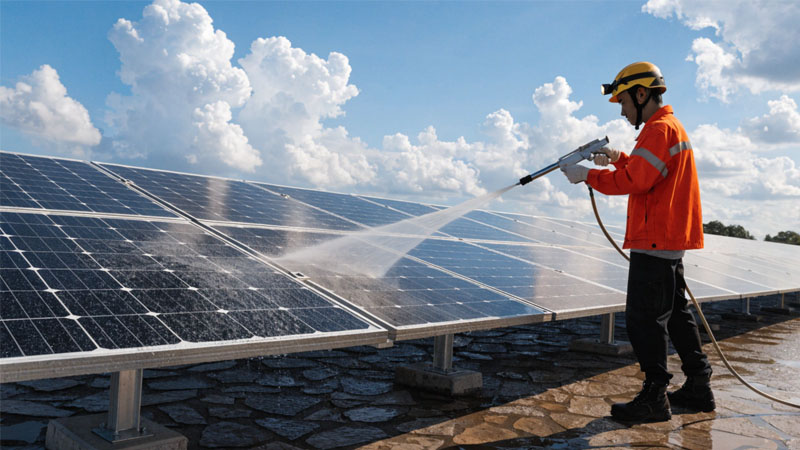
I remember being called out to a commercial building with a new rooftop solar installation. The facility manager was very diligent and had his team washing the panels every month. But he was confused because his power monitoring software showed a steady decline in efficiency, almost as if they weren’t being cleaned at all. I asked to see their water source, which was a standard tap from the building’s utility closet. We took a sample, and the TDS meter immediately read over 300 PPM. He was shocked. His team was doing everything right, but the invisible minerals in the water were undoing all their hard work and actively harming his investment.
What happens when you use poor-quality water to clean solar panels?
You think cleaning your panels is helping, but you might be causing invisible, long-term damage. This gradual degradation can silently rob you of thousands in lost energy production over time.
Poor-quality water leaves behind a layer of mineral scale. This film blocks sunlight, reducing immediate power output, and can chemically etch the anti-reflective coating, causing permanent, irreversible damage to the panel.
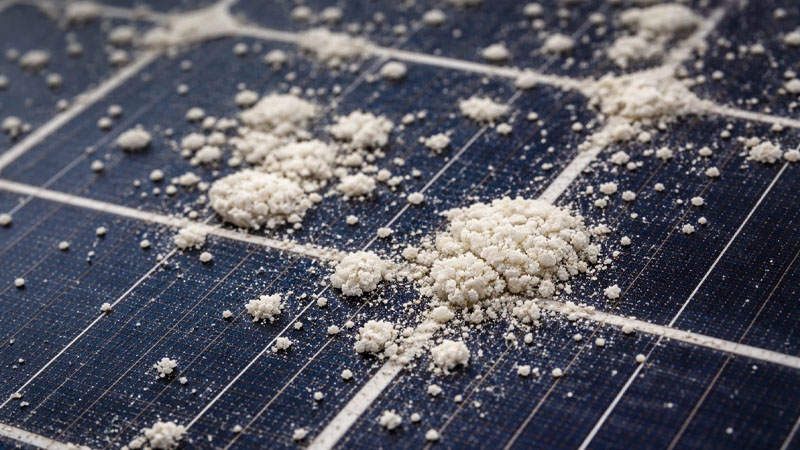
When you use water with high mineral content, you create two separate and serious problems for your solar panels. The first is immediate, and the second is permanent.
Immediate Power Loss from Shading
As the impure water evaporates, it leaves behind a thin, uniform film of minerals like calcium and magnesium. This film, while sometimes hard to see, is not transparent. It scatters and reflects sunlight, preventing it from ever reaching the photovoltaic cells below. This is a form of "soiling loss," but it’s one you are creating yourself. The panel is physically blocked from producing its maximum power.
Permanent Damage to AR Coatings
This is the more dangerous, long-term issue. Solar panel glass has a special Anti-Reflective (AR) coating designed to maximize light absorption. Hard water mineral deposits are alkaline. When left to bake in the sun on the panel’s surface, they create a chemical reaction that can etch and destroy this microscopic coating. Once the AR coating is damaged, it’s gone forever. That part of the panel will permanently reflect more light and produce less power, even after being properly cleaned later.
How do you measure water quality for solar panel cleaning?
You know "bad water" is the problem, but how do you know if your water is bad? Without a clear metric, you are just guessing about the risk to your assets.
Water quality is measured by its Total Dissolved Solids (TDS), expressed in Parts Per Million (PPM). You can easily test your water in seconds using a simple, inexpensive handheld TDS meter. For solar cleaning, the TDS should be as close to zero as possible.
In engineering, we can’t fix what we can’t measure. Luckily, measuring water purity is very simple. A Total Dissolved Solids (TDS) meter is a small, pen-sized device that measures the electrical conductivity of water. Pure water is a poor conductor of electricity, but the dissolved minerals (which are salts) conduct it very well. The meter sends a small electrical current through the water and uses the conductivity to calculate the concentration of dissolved solids in Parts Per Million (PPM). One PPM means there is one milligram of minerals dissolved in every liter of water. Knowing your water’s TDS is the critical first step in creating a safe and effective cleaning procedure. It takes the guesswork out of the equation and gives you hard data to work with.
Water Quality Standards for Solar Cleaning
| TDS Reading (PPM) | Water Quality | Cleaning Result |
|---|---|---|
| 0 – 10 | Ultra-Pure / Ideal | Perfect, spot-free clean. No risk of damage. |
| 11 – 40 | Acceptable | May leave very minor spotting, generally safe. |
| 41 – 100 | Problematic | Will leave noticeable hard water spots and scale. |
| 100+ | Damaging | High risk of significant scaling and AR coating damage. |
What is the best way to produce high-purity water on-site?
Buying tons of bottled distilled water is not practical for large solar arrays. You need a scalable and cost-effective way to generate the right quality water where you need it.
The industry-standard solution is to use a portable or stationary water filtration system. These typically use Reverse Osmosis (RO) as the primary filter, often followed by a Deionization (DI) stage for ultimate purity.

For any professional or large-scale solar installation, producing your own pure water on-site is the only practical solution. This is done using dedicated filtration systems that can take standard tap water and purify it on demand. The two core technologies are Reverse Osmosis and Deionization.
Reverse Osmosis (RO)
An RO system uses a high-pressure pump to push tap water through a tightly wound, semipermeable membrane. This membrane acts as an extremely fine filter, physically blocking about 99% of all dissolved solids, bacteria, and other impurities from passing through. RO is the workhorse of water purification. It is very effective and generally has a lower cost per gallon, making it ideal for removing the bulk of the minerals.
Deionization (DI)
DI is often used as a final "polishing" step after RO. A DI system uses special resin beds with positive and negative charges. These resins attract and trap the remaining mineral ions, exchanging them for pure water ions. DI can bring the TDS level down to a perfect 0 PPM. While the resins are a consumable that needs replacing, DI provides the highest purity for a truly flawless, spot-free finish.
Conclusion
Test your water’s TDS to understand its quality. Use an RO/DI filtration system to produce pure water, ensuring your solar panels are cleaned safely and perform at their peak.