Seawater desalination system filtration process
Turning seawater into fresh water sounds simple, but one small mistake can destroy your multi-million dollar RO system. The invisible enemies in seawater can cause catastrophic failure almost overnight.
Seawater desalination uses a multi-stage filtration process that starts with coarse screening, then multimedia filtration for bulk solids, and finally a fine "security" cartridge filtration step. This ensures the water is clean enough for the final Reverse Osmosis (RO) stage.
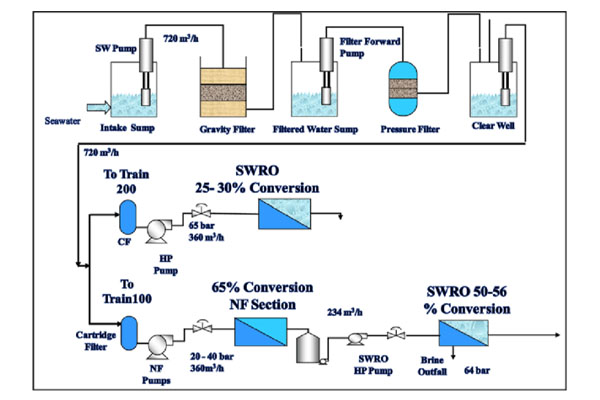
When I first visited a large-scale Seawater Reverse Osmosis (SWRO) plant, I was amazed by how little of the facility was actually dedicated to the RO membranes themselves. The vast majority of the equipment, pipes, and tanks were all part of the pre-treatment system. That is when I truly understood that the secret to successful desalination is not the RO process itself. The secret is perfecting everything that happens before the water ever touches a membrane. It is a systematic process of removing progressively smaller contaminants, and if you get any stage wrong, the entire system fails. Let’s walk through that crucial journey.
Why is Pre-Treatment the Most Critical Stage?
You think the RO membrane is the star player doing all the hard work. But feeding it raw seawater is like feeding sand into a jet engine, leading to immediate and irreversible damage.
Pre-treatment is the most critical stage because it removes the vast majority of suspended solids, silt, algae, and organic matter. Without this step, the expensive and delicate RO membranes would be instantly destroyed by plugging, abrasion, or biofouling.
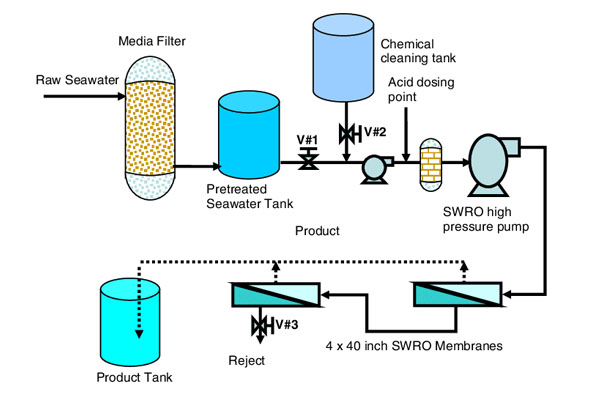
I once consulted on a project where a new SWRO plant was experiencing a rapid pressure increase in their first RO stage. Their pre-filters seemed okay, but something was wrong. We discovered that a seasonal algae bloom was releasing organic compounds that were passing through their media filters. This was creating a thin layer of slime on the lead membranes, a classic case of biofouling. This experience showed me that pre-treatment has to defend against two different enemies at the same time: the physical dirt and the biological life. You have to remove the silt that causes plugging and abrasion, but you also have to control the algae and bacteria that create slime. This is why a robust pre-treatment train is not just a filter; it is the RO system’s shield.
Stages of Conventional Pre-Treatment
The first steps are all about removing the biggest and heaviest contaminants.
| Stage | What It Removes | Typical Technology |
|---|---|---|
| Coarse Screening | Seaweed, trash, fish, large debris | Traveling band screens or bar screens at the intake |
| Media Filtration | Sand, silt, clay, and larger suspended solids | Dual Media Filters (DMFs) with layers of anthracite and sand |
| Dosing & Flocculation | Helps clump tiny colloids together | Chemical injection of coagulants like ferric chloride |
Where Do High-Flow Cartridge Filters Fit In?
Your media filters are working, but your Silt Density Index (SDI) is still too high. These tiny leftover particles are slipping through and silently destroying your expensive RO membranes.
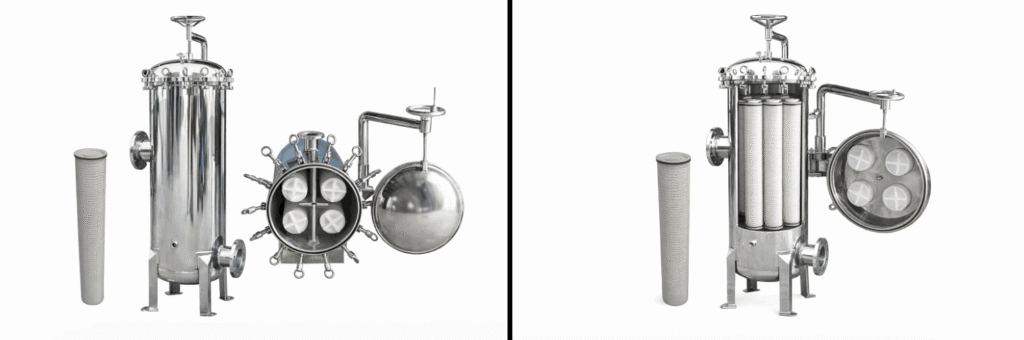
High-Flow cartridge filters serve as the final "security" or "guard" filter right before the high-pressure pump and RO membranes. Their job is to polish the water, catching any fine particles that escape the media filters and ensuring the SDI is safely below 3.
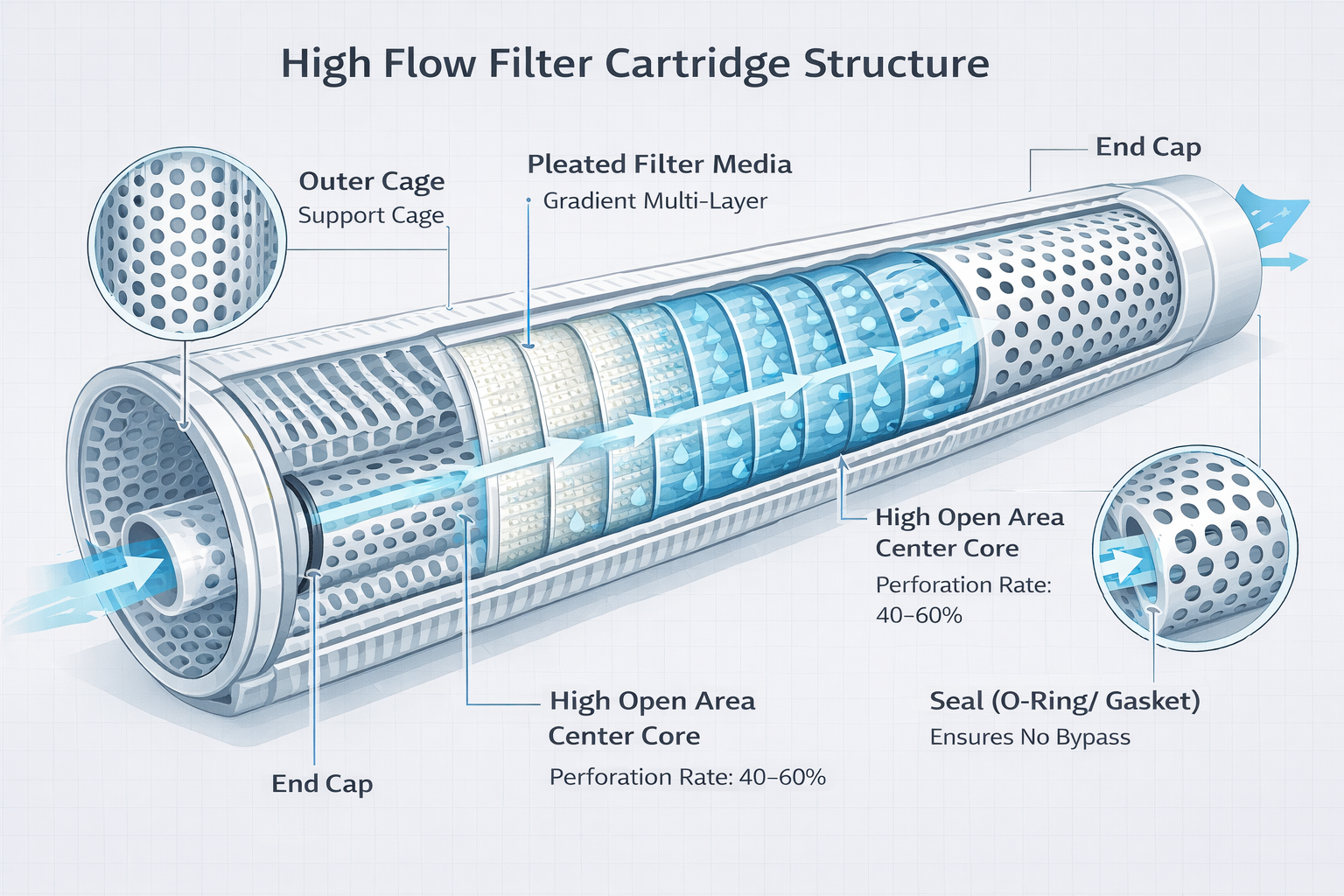
This final cartridge filtration step is the insurance policy for the RO membranes. While the media filters remove the bulk of the solids, they are not perfect. A sudden change in raw water quality or a slight operational issue can cause them to release a small amount of fine particles. This is where the security filter comes in. For large SWRO plants, High-Flow cartridges are the ideal choice for this role. Their large 6-inch diameter design means they can handle huge volumes of water with a much smaller system footprint compared to standard 2.5-inch cartridges. This means fewer filters, smaller housings, and much faster and easier filter change-outs for the maintenance team. In a system where uptime is critical, these operational advantages make a massive difference.
High-Flow vs. Standard Cartridges in Desalination
| Feature | High-Flow Cartridge (6" Diameter) | Standard Cartridge (2.5" Diameter) |
|---|---|---|
| Flow Rate Per Element | Very High (up to 500 GPM) | Low (5-10 GPM) |
| Dirt Holding Capacity | Massive | Limited |
| System Footprint | Small and compact | Large and sprawling |
| Change-out Labor | Fast (fewer elements) | Slow (hundreds of elements) |
Why Can’t You Just Use a Single, Super-Fine Filter?
You want to simplify the process and just use one highly efficient 1-micron filter at the start. But this approach would cause that single filter to clog in minutes, making your operating costs skyrocket.
Using a single, super-fine filter is economically impossible. It would be instantly overwhelmed by the massive load of coarse and fine particles in seawater. This leads to extremely rapid plugging, constant shutdowns for replacement, and an unsustainable operational cost.
The logic of multi-stage filtration is all about cost-effective removal. The goal is to remove the easiest and cheapest dirt first using the most economical technology. Raw seawater has everything from large seaweed to sub-micron silt. You use a coarse screen to get the seaweed because it is the cheapest method. Then you use a media filter to get the bulk of the sand and silt because it can be backwashed and reused, making it cost-effective for heavy loads. Only after these high-load stages do you use the more expensive, disposable cartridge filters to remove the last few fine particles. Each stage is designed to protect the more expensive and more sensitive stage that comes after it. Trying to skip a step is like trying to sift flour with a net designed for catching basketballs, and then trying to catch those basketballs with the flour sifter. It just does not work.
The Cost-Benefit of Each Filtration Stage
| Stage | Particle Size Removed | Relative Cost | Consequence of Skipping This Stage |
|---|---|---|---|
| Coarse Screening | >1 mm | Very Low | Pumps and pipes get clogged with debris. |
| Media Filtration | 10-50 µm | Low to Medium | Cartridge filters clog in hours or minutes. |
| Cartridge Filtration | 1-10 µm | Medium to High | RO membranes foul and fail prematurely. |
| Reverse Osmosis | <0.001 µm | Very High | The most expensive asset; must be protected. |
Conclusion
A successful desalination system uses a smart, multi-stage filtration process. Each step efficiently removes a specific size of contaminant, protecting the more sensitive and expensive equipment downstream.