Is It Surface Blinding or Insufficient Depth Loading?
Rapid ΔP Increase Does Not Always Mean the Filter Is “Too Small”
In many RO pretreatment systems, operators notice rapid ΔP increase and assume the filter micron rating is too fine or the contaminant load is too high.
However, onsite inspections often show the real issue is not total dirt capacity, but how contaminants are distributed inside the filter structure.
The key question is:
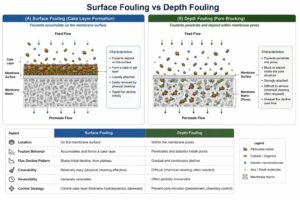
Is the fouling concentrated only on the outer surface, or distributed gradually through the media depth?
—
Typical Onsite Symptoms
Surface Blinding
Operators usually observe:
- rapid ΔP rise
- cartridge surface heavily fouled
- slimy or sticky deposits
- outer pleat blockage
- inner media still relatively clean
In many cases, removed cartridges become blocked mainly within the first few millimeters of the outer layer.
This often indicates:
- colloidal fouling
- organic contamination
- coagulant carryover
- unstable UF permeate quality
Insufficient Depth Loading
Operators may observe:
- uneven contaminant penetration
- localized fouling zones
- unstable cartridge lifetime
- low dirt-holding utilization
Sometimes the cartridge appears partially unused internally while ΔP already increases rapidly.
This usually suggests the filtration structure is not distributing contaminants efficiently through the media depth.
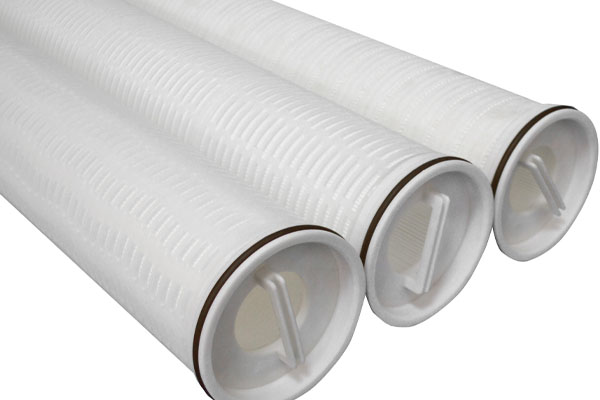
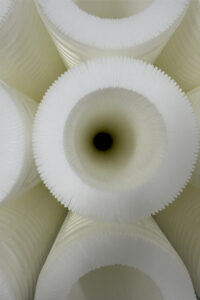
![Depth loading filtration structure inside pleated filter media]
What Should Be Checked Onsite?
Cartridge Removal Inspection
After removing the cartridge, check:
- Is fouling only on the outer surface?
- Is the fouling slimy or dry?
- Are the inner pleats still clean?
- Is fouling evenly distributed?
- Is there pleat deformation?
These observations often provide more useful information than micron rating alone.
Operating Trend Review
Review:
- ΔP trend
- SDI fluctuation
- turbidity changes
- UF recovery trend
- seasonal raw water changes
Rapid and unstable ΔP growth usually indicates unstable contaminant loading rather than normal depth filtration behavior.
Engineering Diagnostic Logic
Surface Blinding Usually Indicates:
- sticky fouling
- colloidal overload
- poor pretreatment stability
- excessive surface capture
Stable Depth Loading Usually Indicates:
- gradual contaminant penetration
- better media utilization
- stable flow distribution
- slower ΔP growth
The difference is often not the amount of contaminants alone, but how the filter structure handles them.
Engineering Recommendations
Reduce Surface Fouling
Focus on:
- UF stability
- coagulant control
- SDI stabilization
- biological fouling reduction
Improve Depth Loading Performance
Evaluate:
- gradient density media
- flow distribution
- pleat geometry
- contaminant penetration behavior
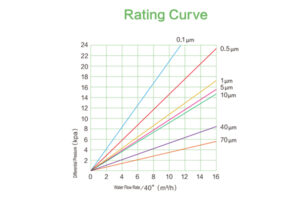
Stable depth loading is often the key to longer cartridge lifetime and slower ΔP increase.
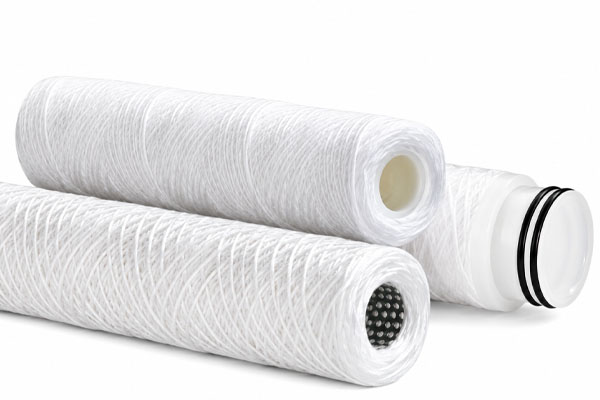
![Gradient density media improving contaminant distribution and pressure stability]
—
FAQ
Why does ΔP rise rapidly even when the cartridge looks partially clean?
This often indicates surface blinding, where contaminants block only the outer media layer while the internal depth remains underutilized.
How can operators identify surface blinding onsite?
Typical signs include slimy outer fouling, rapid ΔP increase, and relatively clean inner pleats after cartridge removal.
What improves depth-loading behavior?
Gradient density structures and stable flow distribution usually help contaminants penetrate more evenly through the media depth.
Engineering Perspective
In many industrial RO systems, rapid fouling is not simply a filtration precision issue.
The real challenge is often:
how contaminants distribute inside the filter structure.
Stable depth loading usually results in:
- slower ΔP growth
- higher dirt-holding utilization
- more stable cartridge lifetime
- improved pretreatment reliability