How to Remove Mineral Deposits from Solar Panels Effectively
Your solar panels have stubborn white spots that regular cleaning just won’t remove. You can see the baked-on residue, and you know it’s costing you energy production.
To remove mineral deposits, use a mild, acid-based solar panel cleaner to dissolve the scale. Gently agitate the area with a non-abrasive pad, and then rinse thoroughly with ultra-pure deionized (DI) water to ensure a perfectly spot-free finish.
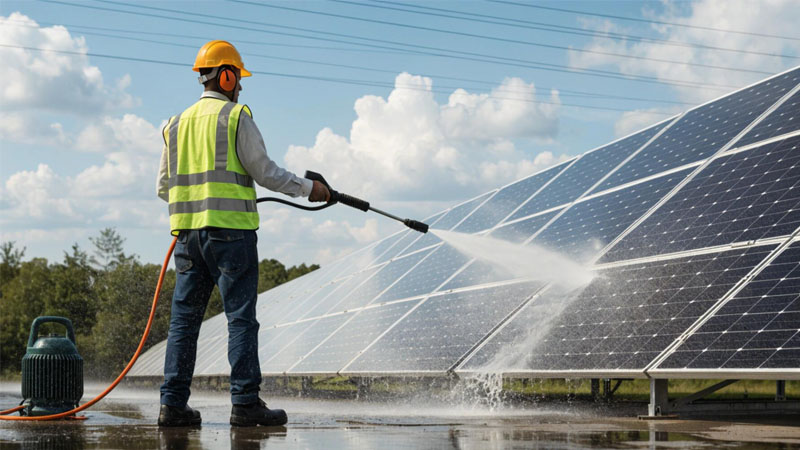
I’ll never forget a call from a farmer in a very dry region. He had installed a large ground-mount solar array and, to keep it clean, he was using water straight from his agricultural well. Within six months, his panels had a thick, white crust on them. His power output had dropped by nearly 30%. He had tried scrubbing them with regular soap and a brush, but it did nothing. The scale was as hard as rock. It took a specialized cleaning process to restore them, and it taught me a valuable lesson: removing heavy mineral scale isn’t just cleaning; it’s a chemical restoration project.
What tools and cleaners are safe for removing mineral scale?
You’re ready to attack the scale, but you’re afraid of using a product that could scratch the glass or damage the panel’s coating. You need tools that are effective but completely safe.
Always use a professional, biodegradable, acid-based cleaner specifically designed for solar panels. Pair it with non-abrasive tools like a soft-bristle brush or a white scrub pad, and have pure deionized water ready for the final rinse.
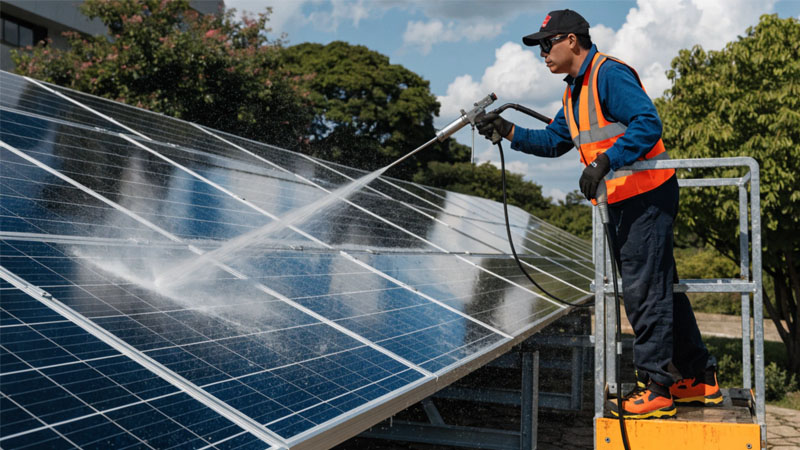
Choosing the right equipment is the most important step in this process. Using the wrong chemical or tool can turn a solvable problem into a permanent one. Your goal is to dissolve the mineral deposits chemically without physically harming the panel surface. The key is to select a cleaner with a mild acidic formula, as acids are what break down alkaline mineral scale like calcium carbonate. Look for products containing ingredients like sulfamic or glycolic acid, which are effective but much safer than harsh industrial acids. It is absolutely critical to avoid any cleaner containing hydrofluoric acid, as it will destroy the glass itself. For tools, the rule is simple: nothing more abrasive than a kitchen sponge’s non-scratch scour side. White, non-abrasive pads are the industry standard.
Safe vs. Unsafe Cleaning Supplies
| Category | Safe to Use | Unsafe – Do Not Use! |
|---|---|---|
| Cleaners | Biodegradable, mild-acid scale removers | Hydrofluoric acid, harsh degreasers, abrasive powders |
| Tools | Soft-bristle water-fed brushes, microfiber cloths, white non-abrasive pads | Stiff-bristle brushes, green kitchen scour pads, razor blades |
| Rinse Water | Purified RO or DI Water (TDS < 20 PPM) | Tap water, well water, softened water |
What is the step-by-step process for safely cleaning the deposits?
You have the right tools, but you need a proven method. A poor technique can lead to scratches, swirl marks, or simply fail to remove the stubborn scale effectively.
Work on a cool, shaded panel. Apply the cleaning solution, allow it to sit for a few minutes without drying, gently scrub in circles, and then rinse completely with pure DI water.
| Step | Action | Description | Key Tip |
|---|---|---|---|
| 1. Apply | Spray Descaler | Use a low-pressure sprayer to evenly apply a diluted, solar-specific descaler to areas affected by hard water stains. | Spray from bottom to top to prevent streaking. |
| 2. Dwell | Dwell / Penetrate | Allow the cleaner to sit on the panel surface for 2-5 minutes to chemically break down calcium and magnesium mineral deposits. | Do not let it dry. If strong sunlight causes rapid drying, mist with water to keep the surface moist. |
| 3. Agitate | Physical Scrubbing | Gently scrub the softened spots in a circular motion using a white non-abrasive cleaning pad or a soft-bristle brush. | Apply even pressure to avoid scratching the glass anti-reflective coating with excessive localized force. |
| 4. Rinse | Pure Water Rinse | Thoroughly rinse from top to bottom using Deionized (DI) Water or Reverse Osmosis (RO) water until no foam remains. | Pure water is strictly required; otherwise, secondary hard water stains will form upon drying. |
A methodical approach is crucial for getting perfect results without causing any damage. You can’t just spray and wipe. You have to let the cleaner do the hard work.
Step 1: Prepare the Surface
Never work on a hot panel in direct sunlight. The heat will cause the water and cleaner to evaporate almost instantly, concentrating the chemicals and making the problem worse. If you can’t wait for a cloudy day, work in the early morning or evening when the panels are cool to the touch. Start with a quick pre-rinse using pure water to remove any loose dirt and dust.
Step 2: Apply the Cleaner
Apply your chosen mild-acid cleaning solution directly to the affected areas. Use a sprayer to get even coverage. Do not let the solution dry on the surface. If you are working on a large area, it’s best to work in smaller, manageable sections.
Step 3: Dwell and Agitate
Let the solution sit on the scale for 3-5 minutes. This "dwell time" is when the chemical reaction happens, and the acid works to break down the mineral bonds. After it has dwelled, use your non-abrasive pad or soft brush to gently agitate the area in small, circular motions. You should feel the deposits starting to break loose. Do not use excessive force; let the cleaner and the pad do the work.
Step 4: Rinse Thoroughly
This is the final and most critical step. Rinse the entire panel completely with ultra-pure (RO or DI) water. This ensures that all the cleaning solution and the dissolved minerals are washed away, leaving nothing behind to create new spots. A final pass with a squeegee can help ensure a perfect, streak-free finish.
How can you prevent mineral deposits from forming again?
You spent hours restoring your panels to perfect condition. Now you want to ensure you never have to do this difficult and time-consuming deep cleaning again.
Prevention is the only real long-term solution. Stop using mineral-rich tap water for routine cleaning and switch exclusively to purified water with a TDS reading below 20 PPM.

After you have successfully removed the mineral scale, your number one priority should be prevention. The deposits only formed for one reason: the water used for cleaning contained minerals. To prevent them from coming back, you must remove the root cause. This means making a permanent switch to using only high-purity water for all future cleanings. Investing in a small, portable deionization (DI) or reverse osmosis (RO) system is the most professional and cost-effective solution in the long run. These systems take your regular tap water and filter out all the damaging minerals, producing the pure water you need for a spot-free rinse. Establishing a regular cleaning schedule—every few months, depending on your environment—using only purified water will keep your panels operating at peak efficiency and will completely eliminate the need for another difficult scale removal job.
Conclusion
Remove existing mineral scale with a safe acid cleaner and gentle scrubbing. Then, prevent future buildup by using only purified, mineral-free water for all routine panel cleanings.