How Inlet and Outlet Pipe Diameters Dictate System Pressure Drop (The "Empty Housing" Trap)
Rapid Answer
When diagnosing a high differential pressure (Delta P) issue, most operators immediately blame the filter cartridge. However, a significant percentage of system pressure drops are actually hardwired into the steel vessel itself due to undersized inlet and outlet nozzles (flanges).
The relationship between pipe diameter, fluid velocity, and pressure drop is mathematically brutal. If the inlet or outlet pipes are too narrow, the fluid velocity skyrockets. Because pressure loss increases exponentially with the square of the fluid velocity, an undersized inlet pipe acts as a built-in bottleneck. It creates massive turbulence and a permanent baseline pressure penalty before the liquid ever touches the filtration media.
In industrial water treatment, if your inlet piping forces the liquid velocity above 2.5 meters per second (m/s), your system is suffering from the "Empty Housing Trap."
The Physics of Nozzle Velocity: Why Diameter Matters
To understand the mechanical impact of pipe diameter, process engineers must look at the physical behavior of liquids as they are forced through a restriction.
1. The Velocity Equation
Fluid velocity is determined by dividing the flow rate by the cross-sectional area of the pipe. Because the area of a circle is proportional to the square of its radius, reducing the pipe diameter even slightly results in a massive loss of cross-sectional area.
- Engineering Reality: If an EPC contractor drops the housing inlet diameter from 6 inches down to 4 inches to save money on valves, the cross-sectional area is reduced by more than half. To push the same volume of water through that smaller hole, the fluid velocity must more than double.
2. The Exponential Pressure Penalty
Why is high velocity a problem? According to the principles of fluid dynamics, pressure drop through a fitting or nozzle is proportional to the square of the velocity.
- The Consequence: If your fluid velocity doubles because the pipe is too narrow, the pressure drop across that inlet nozzle does not double—it quadruples.
3. Jetting and Turbulence (The Mechanical Autopsy)
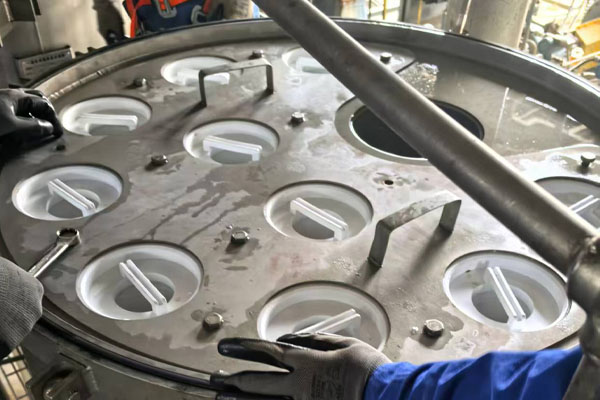
When high-velocity water shoots out of a narrow inlet pipe and enters the large, open chamber of the filter housing, it does not flow smoothly. It creates violent kinetic turbulence and eddy currents. This "jetting" effect wastes pump energy (converting pressure into heat and noise) and can physically buffet the filter cartridges, leading to premature mechanical fatigue or pleat tearing.
The "Empty Housing" Trap
The total differential pressure of a filtration system is not just the resistance of the cartridge. It is the sum of three components:
Total Delta P = (Nozzle/Pipe Delta P) + (Housing Internal Delta P) + (Clean Cartridge Delta P)
The "Empty Housing Trap" occurs when the procurement team buys a filter vessel based purely on matching the existing pipeline size, without calculating the velocity.
For example, a plant might have a 4-inch pipeline carrying 150 cubic meters per hour of water. If they buy a filter housing with 4-inch flanges, the inlet velocity will exceed 4.5 m/s. Even if you remove all the filter cartridges and run water through the completely empty steel vessel, the Delta P gauge will read 0.3 or 0.4 bar simply due to the friction and turbulence of squeezing that much water through 4-inch nozzles.
If your "empty" baseline is already 0.4 bar, adding the filter cartridges will immediately trigger your high-pressure alarms, rendering the system practically useless.
Diagnostic Cross-Validation Matrix: Detecting Piping Bottlenecks
Field engineers must be able to differentiate between a plugged filter cartridge and an undersized housing flange.
| Surface Signal (SCADA) | Cross-Validation Signal (Field Observation) | Real Engineering Root Cause |
|---|---|---|
| New filters installed, but initial Delta P starts at 0.5 bar | Remove all filters. Run system empty. Delta P is still 0.3 bar. | Undersized Nozzles: The pressure loss is entirely hydraulic friction from the inlet/outlet pipes, not the filter media. |
| Delta P fluctuates wildly / Pump sounds like it is pumping gravel | High-frequency vibration felt on the housing inlet flange. | Inlet Cavitation / Jetting: Velocity through the inlet is so high that localized pressure drops below the vapor pressure of the fluid, causing destructive micro-boiling. |
| Filters closest to the inlet tear or deform, while others look fine | Cartridges show physical bending or pleat flutter only on one side of the housing. | Poor Flow Distribution: High-velocity jetting from a narrow inlet is physically slamming into the first row of filters, bypassing the internal baffle plate. |
The Cascading O&M Consequences
Ignoring inlet and outlet pipe diameters leads to severe operational and financial consequences that compound over the life of the plant:
- False Filter Alarms (Wasted Consumables): If the plant’s standard operating procedure dictates a filter change at 2.0 bar, and the housing nozzles are naturally contributing 0.5 bar of permanent resistance, the filters are being robbed of 25% of their usable pressure window. Operators will be forced to throw away perfectly good filters.
- Massive Energy Waste: Every extra 0.1 bar of pressure drop caused by a narrow pipe must be overcome by the main feed pump. Over a 24/7/365 operational cycle, the electrical cost of overcoming that unnecessary hydraulic friction dwarfs the initial savings of buying a smaller flange.
- Flow Limitation (The Bottleneck): Eventually, the plant may want to increase production flow rates. However, the undersized filter housing nozzles will act as a hard hydraulic ceiling, making it physically impossible to push more fluid through the system without destroying the pumps.
The ecofiltrone Engineering Sizing Philosophy
In high-performance industrial filtration, the steel housing is just as critical as the pleated media inside it.
When we design and size a high-flow filtration retrofit, we refuse to fall into the "Empty Housing Trap." Our engineering baseline mandates that inlet and outlet fluid velocities must be kept strictly between 1.5 m/s and 2.5 m/s for liquids. If your required flow rate pushes the velocity past 2.5 m/s on a 4-inch flange, we will structurally redesign the vessel to feature 6-inch or 8-inch inlet/outlet nozzles, even if it requires piping reducers on your end. By engineering the vessel to accommodate the fluid’s kinetic energy properly, we eliminate turbulent jetting, drop the empty housing Delta P to near zero, and ensure that every ounce of pressure drop is utilized exactly where it belongs: capturing dirt inside the high-flow cartridge.