How High-Flow Side-Stream Filtration Reduces Chemical Consumption in Cooling Towers
Rapid Answer
In a cooling tower side-stream filtration system, high-flow filter cartridges reduce chemical reagent usage primarily by eliminating the "oxidant demand" caused by suspended solids.
Cooling towers act as massive air scrubbers, pulling in dust, pollen, and airborne organics. When these solids circulate in the water, oxidizing biocides (like chlorine or bromine) waste their chemical energy attacking this dead, suspended dirt rather than killing actual bacteria. Furthermore, traditional sand filters require massive amounts of water to backwash, literally flushing chemically treated water down the drain.
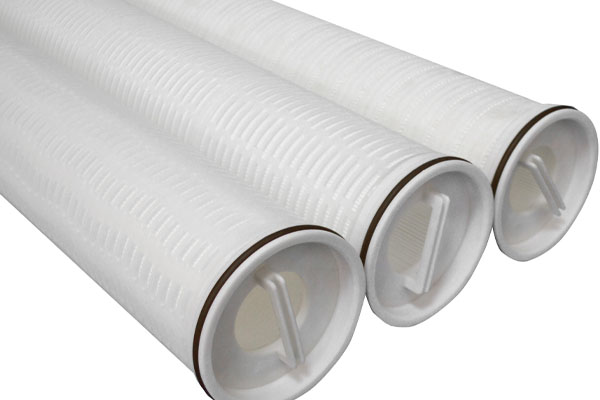
By upgrading to high-flow pleated cartridges, plants remove sub-micron dirt, instantly lowering biocide demand, eliminating the biological safe havens where bacteria hide, and stopping the wasteful backwash cycle that drains expensive chemical inventory.
The Chemical Cost of "Dirty" Cooling Water
To understand the savings, process engineers must look at how water treatment chemicals actually fail in a high-solids environment. When a cooling tower basin is filled with suspended solids (TSS), the chemical treatment program is forced to work overtime.
- The "Chlorine Sponge" Effect: Oxidizing biocides are highly reactive, but they are indiscriminate. They do not know the difference between a live Legionella bacterium and a dead piece of airborne pollen. If the water has high TSS, the biocide reacts with the dirt first. You have to dose twice as much chemical just to achieve a residual free-chlorine level.
- Biological Safe Havens: Bacteria do not like swimming in open water; they prefer to attach to surfaces. Suspended silt provides millions of microscopic nucleation sites for bacteria to attach, form protective biofilms, and multiply.
- Chemical Blocking: Corrosion inhibitors (like orthophosphates or molybdates) work by physically bonding to the clean metal walls of the piping. If suspended dirt settles on the pipes, it forms a barrier. The corrosion inhibitor bonds to the dirt instead of the pipe, requiring massive over-dosing to achieve baseline corrosion protection.
How High-Flow Cartridges Break the Chemical Loop
Deploying a side-stream system utilizing large-diameter, high-flow pleated filter cartridges directly alters the chemistry of the cooling loop.
1. Slashing Biocide Demand
High-flow cartridges typically offer absolute retention ratings of 5 to 10 microns, whereas traditional sand filters struggle to catch anything below 30 microns. By mechanically removing the fine organic silt and pollen from the water loop, the water becomes "chemically cleaner." With the dirt removed, the oxidizing biocide is free to attack the actual biological threats. Plants often see a 20% to 40% reduction in biocide consumption simply by removing the organic load that was acting as a chemical sponge.
2. Eliminating Backwash Waste (The Hidden Chemical Drain)
This is the most critical operational difference between high-flow cartridges and traditional sand or media filters.
- The Sand Filter Penalty: A sand filter must be backwashed regularly. Backwashing uses thousands of gallons of system water, flushing it straight to the sewer. That water has already been treated with expensive biocides, antiscalants, and corrosion inhibitors. When the tower automatically adds fresh makeup water to replace the backwash loss, the dosing pumps must inject a fresh batch of chemicals to treat the new water.
- The High-Flow Cartridge Advantage: Cartridge filters do not backwash. They capture the dirt inside the pleated media. When the filter is exhausted, operators extract the cartridge and the dirt is removed in a solid state. Zero system water is sent to the drain, meaning zero treated chemicals are wasted.
3. Enhancing Corrosion Inhibitor Efficiency
By maintaining ultra-low TSS levels in the bulk water, high-flow side-stream filtration prevents the settling of dirt in the low-velocity areas of the heat exchangers (e.g., the chiller tube bundles). Without a layer of dirt coating the tubes, the corrosion inhibitor can maintain direct contact with the bare metallurgy. The plant can achieve superior corrosion rates (measured in mils-per-year, MPY) while actually turning down the chemical dosing pumps.
4. Reducing Dispersant / Polymer Usage
To keep dirt from settling, chemical vendors often dose high levels of polymeric dispersants. These chemicals keep dirt particles suspended so they flow through the heat exchangers without sticking. If a high-flow side-stream filter is actively pulling the dirt out of the system entirely, the need to chemically "suspend" the dirt drops dramatically, allowing the plant to scale back dispersant usage.
Conclusion
A high-flow side-stream filter is not just a mechanical utility; it is a chemical optimization tool.
While plant managers often focus on the cost of the replacement filter cartridges, the Total Cost of Ownership (TCO) analysis heavily favors the high-flow system. By eliminating backwash water waste, lowering biocide demand, and ensuring corrosion inhibitors reach their target surfaces, the high-flow filter cartridge effectively pays for itself through drastic, measurable reductions in the plant’s monthly chemical reagent spend.