How Does Water Temperature Change Your Filtration Performance?
Your system was designed perfectly on paper, but now its performance is all over the map. Pressures are high in the winter and flow rates change in the summer, making operations totally unpredictable.
Water temperature directly changes the fluid’s viscosity. Colder water is thicker, causing a higher initial pressure drop and lower flow. Warmer water is thinner, resulting in a lower pressure drop and higher flow rate for the same filter.
I learned this lesson the hard way on a project in northern Canada. We installed a large water treatment system in the fall, and it ran beautifully. The initial pressure drop across our new High-Flow cartridges was exactly what we calculated. Then, January hit. I got a frantic call that the pressures were sky-high, even with clean filters. I thought the filters were defective. But when I got to the site, I realized the incoming lake water temperature had dropped from 15°C to nearly 4°C. The water was just thicker. My calculations were right for the design temperature, but I had completely forgotten to account for the coldest possible operating conditions.
Why Does Cold Water Increase Pressure Drop So Much?
Winter is coming, and suddenly your brand-new filters are showing a high pressure drop. You start to question the quality of the filters or wonder if you have an unexpected contamination problem.
Cold water is significantly more viscous, or "thicker," than warm water. It takes much more energy, in the form of pressure, for the pump to force this thicker fluid through the complex pore structure of a filter. This resistance is what you see as a higher initial pressure drop.
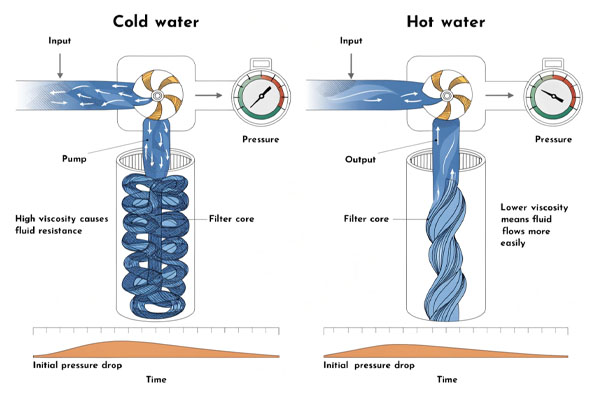
The relationship between temperature and viscosity is the key. Think about pouring honey versus pouring water. The honey is much more viscous, so it flows slowly. Water is the same, just on a much smaller scale. As water gets colder, its molecules move slower and pack together more tightly, increasing its internal friction. This is its viscosity. For an engineer like Jacky, this means when you are sizing a system, you must always use the lowest expected water temperature to calculate your worst-case initial pressure drop. A filter system that looks perfect with 20°C (68°F) water might not even start up properly if the pump cannot overcome the initial resistance from 5°C (41°F) water. It’s a fundamental of fluid dynamics that can easily be overlooked.
Water Viscosity at Different Temperatures
| Temperature | Viscosity (in Centipoise) | Impact on Filtration |
|---|---|---|
| 40°C (104°F) | ~0.65 cP | Very low resistance, easy to filter. |
| 20°C (68°F) | ~1.00 cP | Standard baseline for many calculations. |
| 5°C (41°F) | ~1.52 cP | ~50% higher viscosity than baseline, requires much more pressure. |
Does Hotter Water Have Any Downsides for Filtration?
You see that hot water gives you a wonderfully low pressure drop and high flow rate. It seems like a huge benefit, making you think that hotter is always better for system efficiency.
Yes, hotter water introduces serious risks. It can soften and deform the filter’s plastic components, reduce the structural integrity of the filter media, and accelerate chemical reactions or bacterial growth that can damage the filter or contaminate your process.
While the lower viscosity of hot water is great for flow, it can be a silent killer for your filters. Most standard High-Flow cartridges, for example, are made from polypropylene. This material is fantastic for general use, but it has a temperature limit, usually around 60-80°C (140-176°F). If you push it past that limit, the material can soften. I once saw a whole set of pleated cartridges that had completely collapsed on themselves because the process water got too hot. The pleats fused together, the outer cage deformed, and the filter lost all of its surface area. The low pressure drop they were enjoying was quickly followed by a total system failure. You must always check the manufacturer’s datasheet for the maximum operating temperature and ensure your system has controls to prevent it from ever exceeding that limit.
Three Hidden Dangers of High-Temperature Filtration
| Risk Category | The Problem | The Consequence |
|---|---|---|
| Material Integrity | Plastics like polypropylene and seals like EPDM can soften, swell, or lose strength. | Filter collapse, loss of sealing (bypass), or shedding of filter material downstream. |
| Chemical Compatibility | Higher temperatures speed up chemical reactions. | A fluid that is compatible at room temperature might become corrosive and attack the filter media when hot. |
| Biological Growth | Warm water is the ideal breeding ground for many types of bacteria. | Rapid onset of biofouling, which creates slime that can blind a filter very quickly. |
Conclusion
Water temperature is a critical factor in filtration. It directly impacts your system’s pressure and flow by changing the water’s viscosity, and it can affect the physical limits and life of your filter cartridges.