Your filtration process is stripping away your beverage’s unique flavor. This loss of character can hurt your brand. Let’s find the perfect balance between clarity and taste retention.
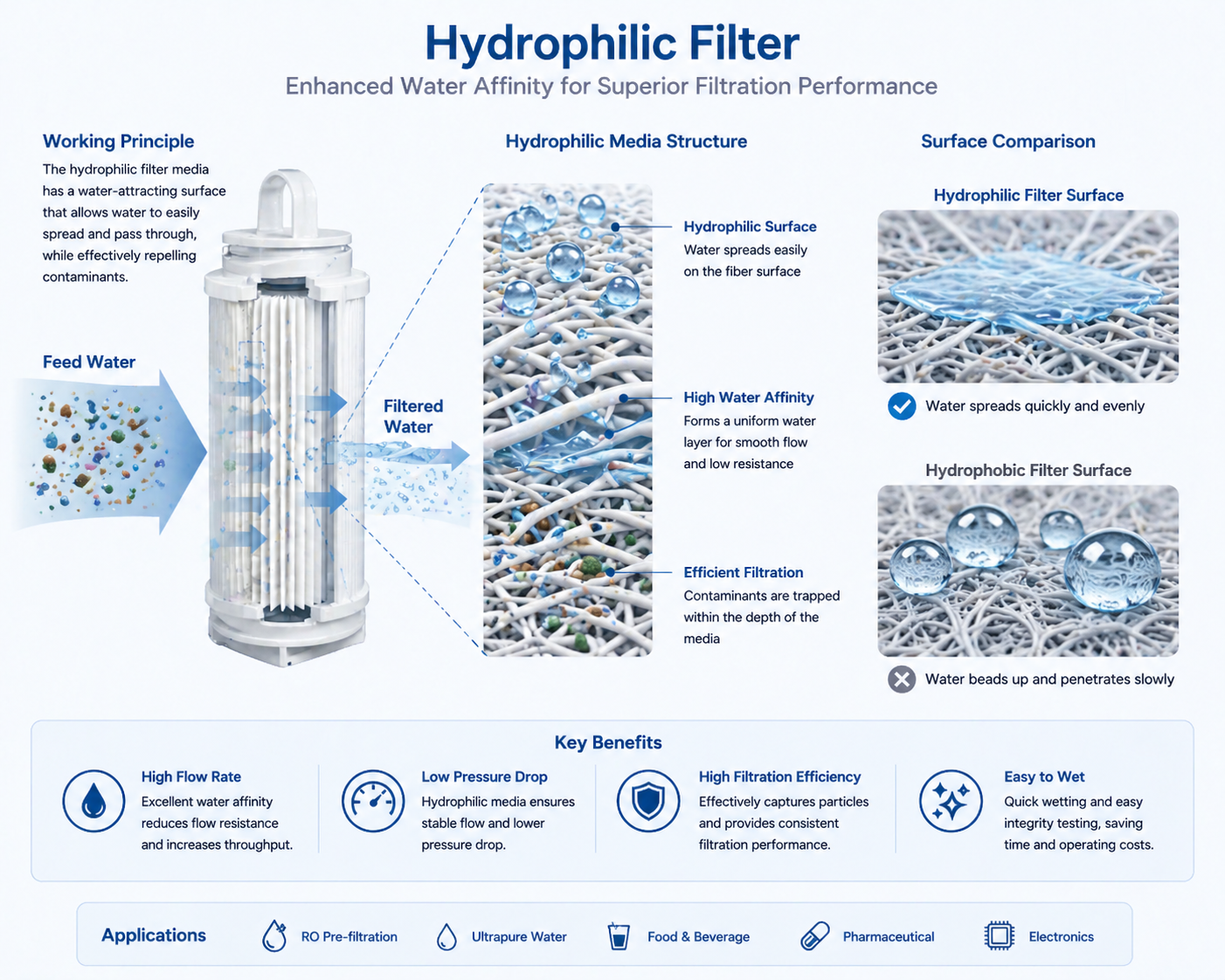
Balancing speed and flavor involves optimizing flow rates and selecting hydrophilic filter media. This approach efficiently removes haze particles while allowing essential flavor colloids to pass through. It’s about smart, selective filtration, not just aggressive speed, to maintain your beverage’s signature taste.
I’ve seen it many times in my 10+ years in industrial filtration. A beverage plant pushes for higher throughput, only to find their premium juice tastes disappointingly thin. The secret isn’t just about speed; it’s about understanding the delicate dance between physics and flavor. Filtration is an art of "selective abandonment," where we carefully choose what to remove and what to keep. Let’s dive into how to master this art. It starts with understanding how the physical force of filtration can impact your product.
Does the shear force generated when a high flow rate passes through a filter cartridge damage the natural fibers in fruit juice?
Worried your high-speed filtration is ruining your juice’s texture? This shear force can degrade natural fibers, making your product thin. Let’s discuss how to protect its natural mouthfeel.
Yes, high flow rates can create shear force that damages delicate fruit fibers. The solution is using a high-flow cartridge with a graded-density structure. This design slows the fluid gently, protecting fibers and preserving the natural mouthfeel and texture of the juice.
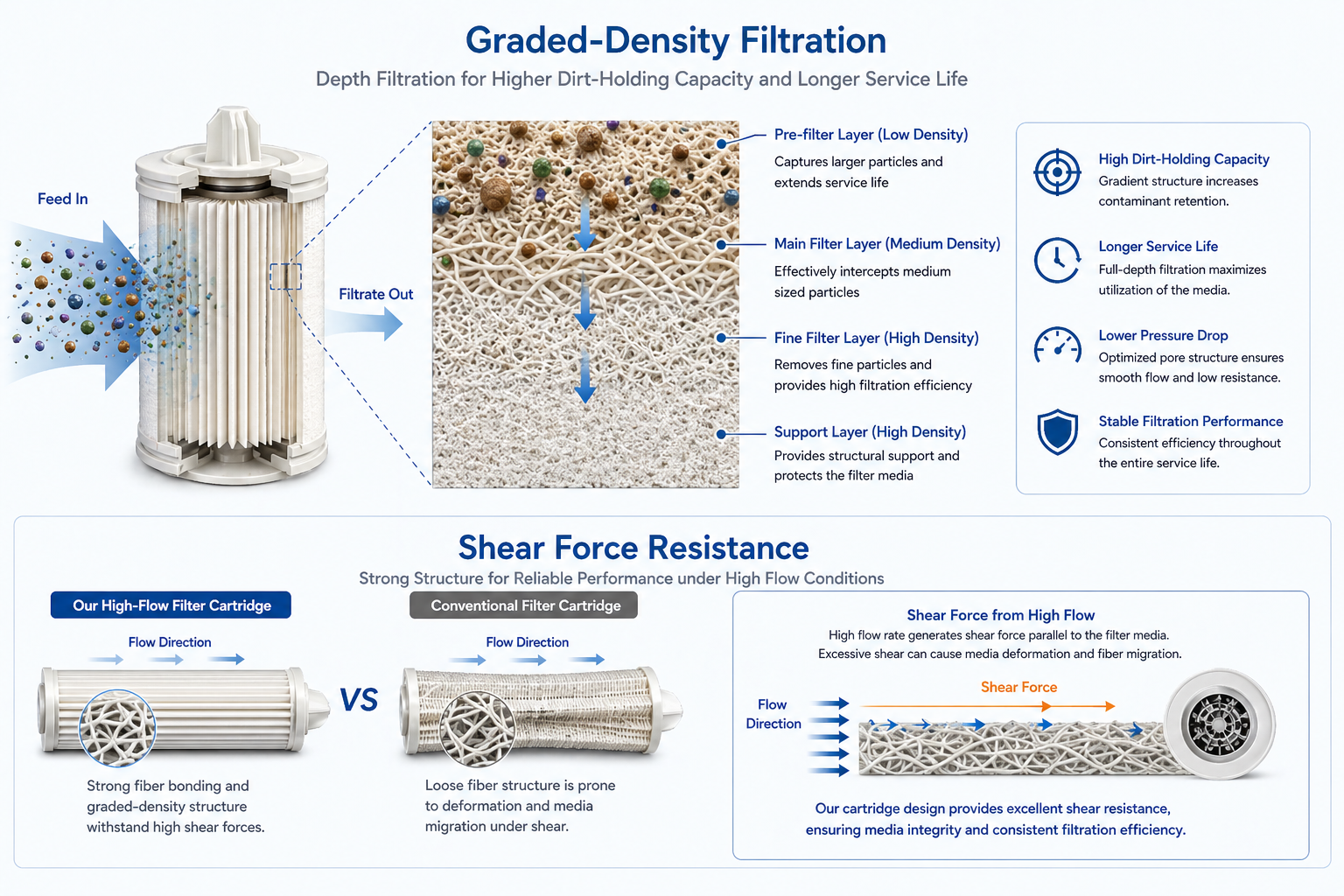
Shear force is essentially the mechanical stress placed on particles as they are forced through the filter media. Imagine water rushing through a narrow pipe—the friction and pressure are immense. For a delicate product like fruit juice, this force can be destructive. I once worked with a juice producer whose product was losing its rich, pulpy texture after filtration. They were using standard filters and pushing the flow rate to meet production targets. The high velocity was literally tearing the natural fruit fibers apart.
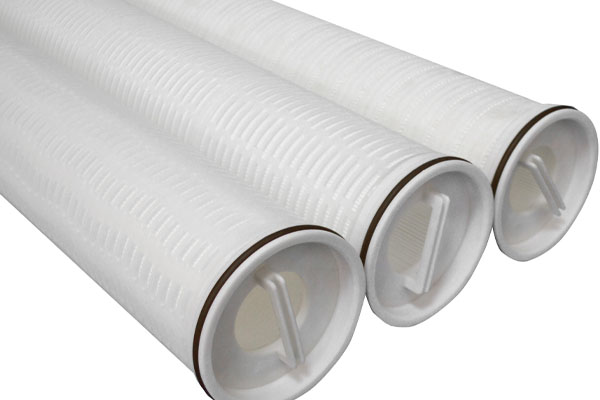
This is where the design of a high-flow filter cartridge becomes critical. Our cartridges at ecofiltrone use two key features to combat this:
- Large Diameter and Pleated Media: This design dramatically increases the available surface area for filtration. More surface area means the fluid velocity at any single point on the filter media (face velocity) is much lower, even at a high overall flow rate. Less velocity means less shear stress.
- Graded-Density Structure: The filter media is not uniform. It’s built in layers, with larger pores on the outside and progressively smaller pores on the inside. This allows the filter to trap particles gradually, preventing a sudden, high-pressure bottleneck at the surface that would damage fibers.
| Feature | Standard Depth Filter | Graded-Density High-Flow Filter |
|---|---|---|
| Structure | Uniform density media | Layered, from coarse to fine |
| Particle Capture | Mostly on the surface | Throughout the depth of the media |
| Shear Force | High at the surface | Low and distributed |
| Impact on Fibers | Potential for damage and tearing | Preservation of natural texture |
By using a filter designed to minimize shear, you can run at efficient speeds without sacrificing the essential mouthfeel that customers expect from a high-quality juice.
How can the trapping of thickeners in beverages be prevented by controlling the pressure drop (ΔP)? Why is the "charge trapping" capability of the filter cartridge more important than pore size in beer point filtration?
Your filters clog with thickeners, causing pressure spikes and slow production. This strips away desirable textures. Let’s see how managing pressure drop and filter charge can prevent this problem.
To prevent trapping thickeners, use a large surface area filter to maintain a low initial pressure drop (ΔP). For beer, a filter’s positive charge is crucial. It attracts negatively charged haze and yeast, removing them more effectively than just relying on pore size, ensuring clarity without clogging.
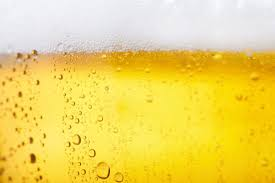
Pressure drop, or ΔP, is the difference in pressure between the inlet and outlet of your filter housing. A rising ΔP tells you the filter is clogging. For beverages with thickeners or stabilizers like pectin or gums, a high initial ΔP can be a disaster. It can physically compress these soft, gel-like substances and force them deep into the filter pores, causing rapid and irreversible blockage. The key is to start with a very low ΔP, which you can achieve by using a high-flow filter cartridge with a massive surface area. This spreads the load and keeps the pressure gentle, allowing the thickeners to remain in suspension while smaller, unwanted particles are removed.
Now, let’s talk about beer. In final or "point" filtration, the goal is to achieve brilliant clarity by removing yeast and protein-polyphenol haze complexes. Here, a filter’s pore size is only part of the story. Many of these haze-forming particles are smaller than the micron rating of the filter. This is where "charge trapping," or adsorptive filtration, becomes more important. In the near-neutral pH of beer, yeast cells and haze particles carry a negative surface charge. By using a filter media with a slight positive charge, such as our specialized glass fiber or modified polypropylene cartridges, we create an electrostatic attraction. The filter acts like a magnet, pulling these negatively charged particles out of the beer and holding them, even if they are small enough to pass through the pores.
| Filtration Mechanism | How It Works | Best For |
|---|---|---|
| Mechanical Sieving | Particles larger than pores are blocked. | Removing well-defined, hard particles. |
| Charge Trapping | Oppositely charged particles are attracted and held. | Removing sub-micron, charged particles like yeast and haze. |
This adsorptive capability is the ultimate form of "selective abandonment." It allows us to use a filter with a relatively open pore structure, which maintains a very high flow rate and low ΔP. We effectively remove the microscopic haze that clouds the beer while allowing the desirable, flavor-giving colloidal substances to pass through untouched. You get a crystal-clear product that retains its full body and flavor profile.
How can engineers set the optimal flow rate to reduce the risk of oxidation?
Is oxidation ruining your beverage’s shelf life and taste? High turbulence during filtration can introduce oxygen, creating stale flavors. Let’s find the optimal flow rate to prevent this.
To reduce oxidation, aim for laminar flow by operating within the filter’s specified design flow rate. This steady, gentle process minimizes turbulence and agitation. This simple step significantly lowers the risk of introducing dissolved oxygen, protecting your beverage’s flavor and extending its shelf life.
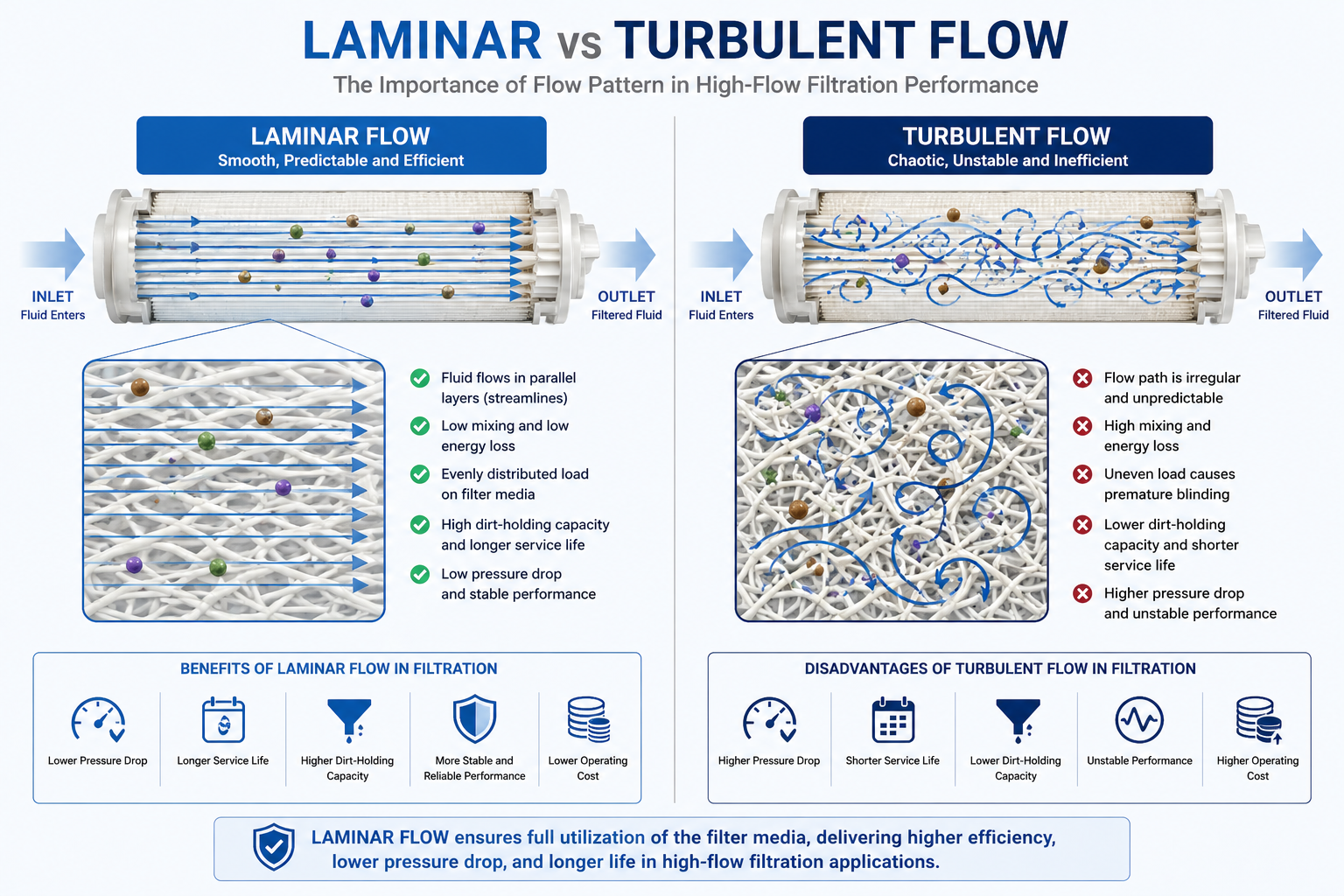
Dissolved oxygen is the enemy of many beverages, especially beer. It leads to stale, papery, or cardboard-like off-flavors and dramatically shortens shelf life. One of the critical points for oxygen pickup is during processing steps like filtration. The danger lies in creating turbulent flow. Think of laminar flow as a river moving smoothly and gently, while turbulent flow is like whitewater rapids—chaotic, churning, and mixing everything together. This churning action dramatically increases the contact between the beverage and any residual air in the piping or filter housing, accelerating the dissolution of oxygen.
So, how do you ensure laminar flow? The answer lies in the filter manufacturer’s data sheet. Every filter cartridge, especially our high-flow models, has a recommended maximum flow rate. For example, one of our 40-inch high-flow cartridges might be rated for up to 350 gallons per minute (GPM). Pushing it to 450 GPM to speed things up might seem efficient, but it could push the system from a laminar to a turbulent state, introducing damaging oxygen.
An engineer’s job is to size the filtration system correctly from the start.
Key Steps to Minimize Oxidation:
- Consult the Data Sheet: Always operate at or below the manufacturer’s recommended flow rate per cartridge.
- Proper Sizing: If you need a total flow of 1000 GPM, it is far better to use three cartridges running at 333 GPM each than two cartridges pushed to their absolute limit of 500 GPM.
- System Design: Ensure smooth transitions in piping, avoid sharp 90-degree bends right before the filter housing, and use proper venting procedures to remove air from the system before starting.
- Gentle Startup: Bring pumps up to speed gradually to avoid sudden pressure surges that can cause turbulence and shock the system.
By respecting the designed flow characteristics of your filter cartridges, you can make the filtration step a gentle clarification process rather than a violent, oxygen-introducing event. This protects the delicate flavors you’ve worked so hard to create.
Conclusion
Achieving brilliant clarity without sacrificing flavor is possible. It requires a smart approach to flow rate, pressure, and filter media selection. We at ecofiltrone can help you find that balance.