
STRING WOUND FILTER CARTRIDGES
Reliable Depth Filtration for a Wide Range of Liquids
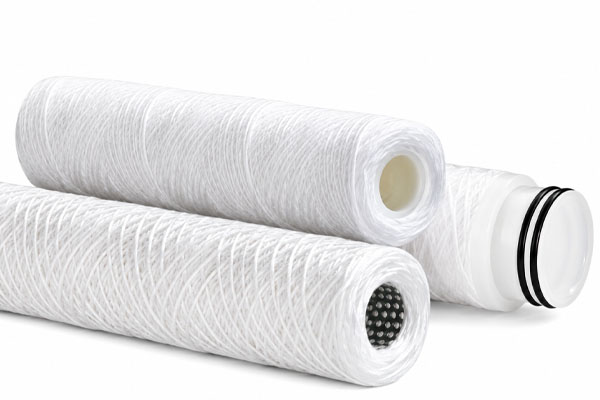
Ecofiltrone string wound filter cartridges are manufactured with premium yarns and robust center cores to deliver high dirt-holding capacity, stable performance and long service life in industrial filtration systems.
✓ PP, Cotton and Glass Fiber Yarn Options
✓ Multiple Micron Ratings from 1 to 100 μm
✓ PP and Stainless Steel Core Options
✓ Standard Lengths from 5″ to 50″
✓ Suitable for Water, Oil, Chemical and More
Product Overview
String wound cartridges — nominal depth filtration for prefiltration and particle removal
A string wound filter cartridge is formed by winding yarn under controlled tension around a rigid center core. The winding pattern creates a porous matrix with a gradient density structure: coarser inter-fibre spacing toward the outer surface and progressively finer spacing toward the core. Liquid passes from the outside surface inward, and particles are captured at different depths depending on their size.
String wound cartridges are positioned as nominal depth filtration products. They provide useful particulate reduction in prefiltration, equipment protection and moderate-to-high suspended-solids loading applications. They are not absolute-rated and are not suitable for sterile filtration or validated microbial retention.
ECOFILTRONE supplies string wound cartridges across a range of yarn materials, core materials, micron ratings, cartridge dimensions and end-connection configurations. Selection should be based on process fluid, contaminant type, required nominal rating, chemical compatibility, mechanical requirements and the installed housing interface.
Industrial prefiltration
Upstream particle removal before membrane systems, heat exchangers, pumps and other process equipment.
Moderate–high loading
Gradient depth structure supports sustained dirt-holding capacity for feeds with significant suspended-solids content.
Wide media options
PP, cotton, glass fibre, polyester and nylon yarn cover a broad range of fluid and temperature requirements.
Heavy-duty configurations
Stainless-steel core, reinforced winding structure and higher yarn compression available where mechanical strength is required.
Filtration Technology and Construction
Construction variables determine pore structure, dirt-holding capacity and mechanical strength
The filtration matrix is formed entirely by the winding process. Yarn diameter, winding tension, winding angle, winding speed, layer density, core diameter and final outside diameter all affect the resulting pore-size distribution and nominal depth filtration performance.
Flow passes from the outside surface toward the center core. Larger particles are captured in the outer layers; progressively finer particles are captured closer to the core. This gradient distribution supports higher contaminant-loading capacity before differential pressure rises to the change-out threshold.
What depth filtration means for selection — Because particles are captured through the media thickness, dirt-holding capacity depends on contaminant loading, particle size distribution, flow rate and the selected pore rating. Differential pressure monitoring helps determine cartridge replacement timing. For a detailed treatment of depth filtration behavior, see the filter cartridge differential pressure technical guide.
Construction variables and their effect
| Variable | Effect on performance |
|---|---|
| Yarn diameter | Affects inter-fibre spacing and base pore size |
| Winding tension | Controls fibre compression and pore tightness |
| Winding angle | Influences flow path and filtration depth |
| Winding speed | Affects layer density and uniformity |
| Layer density | Determines dirt-holding capacity distribution |
| Core diameter / final OD | Sets overall structural strength |
Standard configuration
- PP core
- PP, cotton or polyester yarn
- DOE or 222/226 end
- Standard OD and length
Heavy-duty configuration
- SS304 / SS316 core
- Higher yarn compression
- Reinforced winding structure
- Custom OD and long lengths
Filter Media and Configuration Options
Five yarn materials, four core materials, standard and heavy-duty configurations
The table below reflects general product-family direction. Lengths, micron ratings and operating limits must be verified against the selected series before ordering.
| YARN MEDIA | MAIN CHARACTERISTIC | TYPICAL SELECTION DIRECTION | NOTE |
|---|---|---|---|
| Polypropylene (PP) | Broad ↗ chemical compatibility, low extractables, thermally stable to approx. 60–82 °C depending on construction | Industrial water, RO prefiltration, chemical liquids, food and beverage prefiltration | Confirm temperature limit and seal compatibility for the specific application |
| Cotton (bleached / natural) | Natural fibre; bleached cotton reduces contaminant contribution | General water treatment, industrial water, potable water prefiltration | Not recommended for strong acids, alkalis or solvents |
| Glass fibre | High-temperature capability, good chemical resistance for many acids and alkalis | High-temperature liquid filtration, chemical process liquids, oil filtration | Confirm fibre-release risk; not suitable where fibre ingestion is a concern |
| Polyester | Good chemical resistance for many acids and alkalis, moderate temperature capability | Chemical process liquids, industrial water, general industrial filtration | Confirm compatibility for specific fluid concentration, temperature and pH |
| Nylon | Good abrasion resistance, compatible with many solvents and alkaline fluids | Solvent filtration, alkaline process liquids | Check compatibility with acidic fluids |
Core: PP
Standard for most water, chemical and general industrial applications.
Core: SS304
Increased mechanical strength for higher differential pressure applications.
Core: SS316 / SS316L
Improved corrosion resistance for aggressive chemical service.
Core: Tinned steel
Available in selected configurations; confirm suitability for the process fluid.
Technical Specifications
Compatibility applies to the complete cartridge, not only the PP media
| ITEM | DOCUMENTED OPTIONS OR GUIDANCE |
|---|---|
| Yarn media | PP, cotton (bleached and natural), glass fibre, polyester, nylon |
| Core material | PP, SS304, SS316 / SS316L, tinned steel |
| Micron rating range | ~0.5–150 μm nominal; common ratings include 1, 5, 10, 25, 50, 75, 100 μm — confirm for selected series |
| Standard outside diameter | 63.5 mm (2.5"); Big Blue / Jumbo OD also available — confirm for housing |
| Standard lengths | 5, 10, 20, 30, 40 inch; custom and long lengths available |
| Max operating ΔP | ~4–4.5 bar at ambient temperature; configuration-dependent. See ↗ filter cartridge differential pressure guide. |
| PP yarn temperature limit | ~60–82 °C depending on construction; confirm for specific configuration |
| End connections | DOE, 222 / Flat, 222 / Fin, 226 / Flat, 226 / Fin; extended core available |
| Seal materials | EPDM, silicone, NBR / Buna, FKM / Viton — confirm ↗ chemical compatibility |
| Rating type | Nominal — not absolute-rated; not suitable for sterile filtration or validated microbial retention |
⚠ Nominal rating is not absolute retention. Where verified efficiency data or absolute retention is required, a different filter product must be evaluated. See the filter cartridge micron rating and nominal depth filtration technical pages.
End Connections and Seal Options
Connection type and seal material must match the installed housing
| CONNECTION | CONFIGURATION DETAIL |
|---|---|
| DOE | Double open end — confirm housing gasket seating and seal material |
| 222 / Flat | Flat terminal; confirm housing knife-edge or land seating |
| 222 / Fin | Fin terminal; confirm bayonet or spring seating in housing |
| 226 / Flat | Flat terminal for 226-pattern housings |
| 226 / Fin | Fin terminal for 226-pattern housings |
| Extended core | Available for selected housing types; confirm core length and interface |
Seal material selection
Seal material must be reviewed for the process fluid, chemical concentration, temperature and any chemical exposure applied to the housing.
| EPDM | Good general aqueous compatibility; check for hydrocarbon exposure |
| Silicone | Wide temperature range; check for solvent and oxidiser exposure |
| NBR / Buna | Good oil and fuel resistance; not for strong oxidisers |
| FKM / Viton | Broad chemical resistance; confirm for specific fluid and concentration |
Typical Industrial Applications
Eight process positions where string wound cartridges are commonly used
01
Industrial Water Treatment
Challenge
Variable suspended solids from source water, seasonal changes and upstream treatment variation.
Product direction
PP or cotton yarn for industrial water treatment prefiltration; confirm micron rating against downstream protection requirement.
02
RO Pretreatment
Challenge
Suspended solids upstream of RO membranes increase fouling risk and cleaning frequency.
Product direction
Cost-effective particulate reduction ahead of RO. See RO pretreatment application page. Micron rating based on feed-water quality and membrane sensitivity.
03
Power Generation
Challenge
Makeup water, cooling water or process streams with moderate solids loading.
Product direction
SS core for higher differential pressure; confirm yarn media and temperature limits for the stream.
04
Chemical Processing
Product direction
Polyester, PP or glass fibre depending on fluid chemistry. Confirm core, seal and end-cap compatibility. See process filtration solution page.
05
Oil & Petrochemical
Challenge
Hydrocarbon streams and produced water with particulate loading upstream of separators and heat exchangers.
Product direction
SS core with polyester or glass fibre for hydrocarbon service. Seal material confirmed for the specific fluid.
06
Food & Beverage
Challenge
Low-extractable prefiltration for water, sugar solutions and brewing liquids.
Product direction
PP or bleached cotton for food and beverage filtration prefiltration. Membrane cartridges required where biological load reduction is needed. Material compliance verified separately.
07
Electronics & Process Liquids
Challenge
Particle reduction upstream of finer filtration in high-purity process water or chemical streams.
Product direction
PP construction for upstream prefiltration only. String wound cartridges are not final filtration for high-purity applications.
08
Non-Critical Pharma Prefiltration
Challenge
Upstream particle reduction in non-sterile pharmaceutical water or process-liquid prefiltration stages.
Product direction
PP for prefiltration only. Where validation or sterile-grade retention is required, a membrane cartridge must be evaluated. Material requirements verified against the specific application.
Selection Guide
Seven steps to a verified string wound cartridge specification
1⃣️
Define the process fluid: water, chemical solution, hydrocarbon, food-grade liquid or other. Confirm whether PP or an alternative yarn and core material is compatible with the fluid at the operating concentration and temperature.
2⃣️
Select the nominal filter cartridge micron rating based on contaminant size and downstream protection requirement. A finer nominal rating is not always better — confirm the trade-off between particle retention, pressure drop and cartridge life.
3⃣️
Identify contaminant type and loading: suspended solids, sand, sediment, rust, corrosion products or organics. High loading applications benefit from the gradient depth structure and higher dirt-holding capacity.
4⃣️
Review chemical compatibility for the yarn, core, end caps and seal material. Chemical concentration, temperature, pH, solvent content, oxidising conditions and exposure duration all affect suitability.
5⃣️
Confirm operating conditions: flow rate, maximum differential pressure, temperature and fluid viscosity. Confirm whether PP or SS core is required. See filter cartridge differential pressure guide for change-out criteria.
6⃣️
Confirm cartridge dimensions: length, OD, ID. Do not assume dimensional interchangeability between manufacturers. Verify against the housing drawing or existing cartridge measurement.
7⃣️
Confirm end connection (DOE / 222 / 226), terminal style (Flat / Fin), extended-core requirement and seal material. See the replacement cartridge evaluation checklist for the full interface verification list.
String wound cartridges are not suitable for sterile filtration or validated microbial retention. Where these requirements apply, evaluate a membrane pleated cartridge with appropriate validation data.
Replacement and Compatibility
Dimensional similarity does not confirm a compatible replacement
Two cartridges with matching nominal length and micron rating may have different OD, core material, end connection, terminal style, seal position or housing interface. These differences can prevent installation or allow bypass in service.
For replacement cartridge evaluation, provide: existing manufacturer and model number, length and OD, yarn media, core material, nominal micron rating, end connection, terminal style, seal material, housing model, process fluid and operating conditions. Cartridge photographs help confirm the interface when the original model code is unclear.
Dimensional check
Overall length, OD, ID, end geometry, core material and housing seating dimensions.
Connection check
End connection (DOE / 222 / 226), terminal style (Flat / Fin), extended core and seal position.
Operating check
Flow, pressure, temperature, fluid chemistry, contaminant type and current change-out interval.
ECOFILTRONE Engineering Support
Selection, replacement evaluation and custom configuration
| INFORMATION TYPE | USEFUL DETAILS TO PROVIDE |
|---|---|
| Application | Industry, ↗ process filtration position, current filtration problem (short life, rapid ΔP, bypass, seal failure) |
| Process fluid | Fluid name, concentration, pH, temperature and mixture composition |
| Contaminant | Type, estimated concentration, particle size if known |
| Filtration requirement | Required nominal ↗ filter cartridge micron rating , downstream equipment sensitivity |
| Operating conditions | Flow rate, pressure, ↗ filter cartridge differential pressure at change-out, current cartridge life |
| Existing cartridge | Manufacturer, model, length, OD, yarn media, core material, micron rating, photos |
| Housing interface | Housing model, end connection, terminal style, seal material |
| Documentation | Drawings, photos, operating data or sample cartridge |
Frequently Asked Questions
Melt blown filter cartridge — technical questions
What is a string wound filter cartridge?
A cartridge formed by winding yarn under controlled tension around a rigid center core. The winding pattern creates a gradient depth filtration matrix. Liquid flows outside-to-center, and particles are captured at different depths according to size.
How do I choose the right micron rating?
Based on contaminant size and downstream equipment sensitivity. A finer nominal rating can increase pressure drop and reduce cartridge life without improving protection. See the filter cartridge micron rating guide.
When should I use a stainless-steel core?
Where mechanical strength requirements exceed PP core capability — higher differential pressure, elevated temperature, reverse pressure or aggressive chemical exposure. SS316 / SS316L offers improved corrosion resistance.
Are string wound cartridges suitable for sterile or pharmaceutical use?
No. They are nominal-rated depth filtration products — not suitable for sterile filtration or validated microbial retention. A membrane pleated cartridge with appropriate validation data is required for those duties.
What is nominal depth filtration?
Nominal rating indicates the size at which a significant proportion of particles are removed — not a guaranteed cutoff. For absolute retention, a membrane cartridge must be used. See the nominal depth filtration technical page.
Which yarn material should I select?
PP for broad chemical use and most water applications. Bleached cotton for general water with low-extractable requirement. Glass fibre for high-temperature or fine chemical service. Polyester for many acid and alkali liquids. Nylon for solvent and alkaline service. Confirm chemical compatibility for the specific fluid, concentration and temperature.
Can string wound cartridges be used for RO pretreatment?
Yes, for upstream particulate reduction ahead of RO membranes where membrane-grade microbial retention is not required. See the RO pretreatment application page for complete guidance.
What information is needed for a replacement evaluation?
Existing manufacturer, model, dimensions, yarn media, core material, micron rating, end connection, terminal style, seal material, housing model, process fluid and operating conditions. See the full replacement cartridge evaluation checklist.
Request a Selection Review
Send your process conditions and current filtration problem
Include current filtration problem (short life, rapid ΔP, seal failure, replacement compatibility), process fluid, pH, temperature, contaminant type, required micron rating, flow rate, operating pressure, change-out differential pressure, existing manufacturer and model, dimensions, end connection, seal material, housing model and photographs where available.