Case Study: Reinforced Washable PP Filter Bag for Industrial Water Filtration
A customer from Saudi Arabia was using Size #2 filter bags in an industrial water filtration system.
| The operating condition was relatively stable in terms of pH and temperature, but the filter bags were cleaned frequently by water gun and chemical washing. | Item | Customer Condition |
|---|---|---|
| Filter bag size | Size #2 | |
| pH | 7–7.5 | |
| Temperature | 25–40°C | |
| Operating pressure | 6–7 bar | |
| Cleaning method | Water gun cleaning | |
| Cleaning water gun pressure | Around 5 bar | |
| Cleaning frequency | Every 24–48 hours | |
| Chemical cleaning | Caustic soda / EDTA | |
| Damage position | Always from the bottom |
Customer Problem
The customer reported that the filter bags were repeatedly damaged from the bottom area after operation and cleaning.
From the customer’s feedback and onsite photos, the main symptoms included:
bottom area becoming weak after repeated washing
visible deformation and fiber loosening
damage concentrated at the bottom instead of evenly across the bag body
reduced reusability after repeated water-gun cleaning
risk of premature bag failure during operation
This indicates that the issue was not only related to filtration accuracy, but more strongly related to mechanical strength, bottom seam durability, and resistance to repeated cleaning impact.
Failure Analysis
Based on the operating condition, the filter bag was exposed to three types of stress:
- Continuous operating pressure
The system operates at around 6–7 bar, which creates continuous load on the filter bag during filtration.
For a washable filter bag, this pressure level requires stronger fabric structure and better seam strength, especially at the bottom where solids tend to accumulate.
- Repeated water-gun cleaning impact
The filter bags were cleaned every 24–48 hours using a water gun at around 5 bar.
This cleaning method can help remove surface contaminants, but it also creates repeated mechanical impact on the filter media.
If the PP felt structure is not dense enough, the fibers may gradually loosen, deform, or become weaker after repeated washing.
- Bottom stress concentration
The damage always appeared at the bottom.
This is an important diagnostic point.
In bag filtration, the bottom area usually carries more stress because:
solids accumulate at the bottom during operation
cleaning impact is often concentrated near the bottom
the bag bottom bears more deformation during pressure fluctuation
the seam area is the weakest point if stitching is not reinforced
So the failure was likely caused by a combination of solids loading + repeated cleaning impact + insufficient bottom seam strength.
Our Solution
For this customer, the recommended solution is not simply to change the micron rating.
The better direction is to upgrade the filter bag structure for stronger washability and longer reuse life.
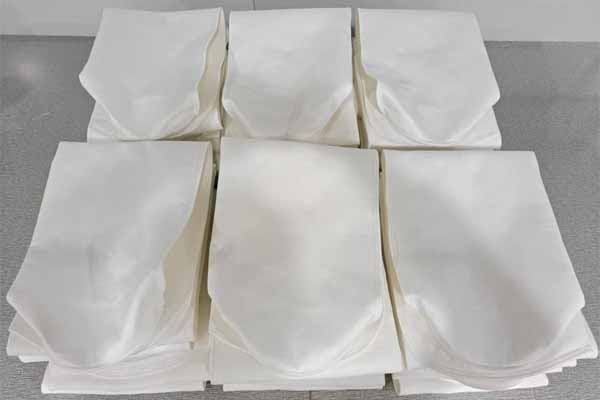
We proposed a reinforced washable PP filter bag with the following improvements:
- Higher-density PP filter media
We selected a denser PP felt structure to improve mechanical strength and cleaning resistance.
Compared with a lighter or looser PP structure, the higher-density PP media provides:
better resistance to fiber loosening
stronger dimensional stability after washing
improved durability under repeated cleaning
better support during 6–7 bar operation
longer reusable service life
This is especially important because the customer is not using the bag as a one-time disposable filter.
They are cleaning and reusing it every 24–48 hours.
- Reinforced bottom sewing design
Because the customer’s damage always occurred from the bottom, the bottom structure must be strengthened.
The optimized design uses:
double stitching at the bottom
reinforced seam area
stronger thread selection
improved sewing density
better edge finishing to reduce tearing risk
The purpose is to reduce bottom seam failure caused by repeated pressure and water-gun cleaning.
- Stronger washable bag construction
The upgraded filter bag is designed for applications where customers require repeated cleaning and reuse.
The structure focuses on:
stronger bottom support
better resistance to washing impact
improved shape retention
reduced risk of bottom rupture
more stable performance during repeated cycles
For this type of application, the key performance target is not only filtration efficiency, but also reusability and structural durability.
Engineering Recommendation
For washable filter bags under this type of condition, we recommend customers evaluate the bag from three aspects:
- Media density
If the media is too loose, the bag may clean easily at first, but the fibers may also deform or loosen faster under repeated washing.
- Bottom seam strength
If damage always starts from the bottom, the solution should focus on bottom reinforcement, not only changing the material.
- Cleaning pressure and cleaning angle
A 5 bar water gun can generate strong local impact.
If the nozzle is too close to the bag surface, especially near the bottom seam, it may accelerate fiber damage and seam weakening.
A more controlled cleaning distance and angle can help extend the service life of the bag.
Case Takeaway
This case shows that washable filter bag failure is not always caused by chemical incompatibility or wrong micron rating.
In this Saudi customer’s application, the key issue was more related to:
repeated water-gun cleaning
bottom stress concentration
insufficient seam reinforcement
media strength under reuse conditions
Therefore, the solution should focus on a stronger washable PP structure and reinforced bottom sewing design.
For customers who clean filter bags every 24–48 hours, the filter bag should be designed as a reusable mechanical component, not only as a filtration consumable.