What a Rapid ΔP Rise Tells You About Cartridge Fouling
Rapid Answer
A rapid △P rise tells you unequivocally that your filter is suffering from surface blinding, hydraulic compaction, or a catastrophic upstream failure, rather than normal end-of-life depth loading. When a cartridge filter operates correctly, it traps particulate matter evenly throughout the entire depth of its media, generating a slow, predictable, and linear increase in differential pressure (△P) over weeks or months. A sudden, vertical spike in the △P curve is a mechanical distress signal; it means the fluid dynamics of the system or the physical nature of the contaminants have violently shifted, instantly choking the filter’s remaining porosity.
The Physics of the Rapid Spike
To accurately diagnose why a filter fouled so rapidly, process engineers must look beyond the micron rating and understand how different contaminants interact with the media’s void volume under pressure. A rapid △P rise generally points to one of three specific fouling mechanisms:
1. The Surface Blinding Phenomenon (The Gel Block)
Standard suspended solids (like sand, rust, or scale) stack together to form a porous, breathable filter cake. Deformable foulants do not.
- The Mechanism: If your system is suddenly hit with soft, gelatinous contaminants—such as biological Extracellular Polymeric Substances (EPS), trace oils, or overdosed liquid coagulants—these substances flatten out against the outer surface of the filter.
- The Diagnostic Meaning: The rapid △P rise tells you that a continuous, non-porous liquid or gel film has formed across the outermost layer of the cartridge. The filter is entirely sealed shut from the outside, even though 95% of its internal matrix remains perfectly clean.
2. The Upstream "Crud Burst" (The Overload)
Security filters are designed to capture a low, steady baseline of fine particulates, not bulk dirt loads.
- The Mechanism: If an upstream working filter (like a Multimedia Filter or an Ultrafiltration system) experiences a mechanical failure, it releases a highly concentrated wave of raw solids into the piping.
- The Diagnostic Meaning: The sudden △P spike tells you that the filter was forced to process weeks’ worth of solid dirt in a matter of minutes. The physical void volume of the filter was instantly overwhelmed and filled to maximum capacity.
3. Hydraulic Compaction (The Velocity Shock)
Filter media relies on a gentle, consistent fluid velocity (flux rate) to maintain the porosity of the trapped dirt.
- The Mechanism: If feed pump Variable Frequency Drives (VFDs) surge or valves actuate too quickly, the system experiences a massive hydraulic flow shock. Because △P rises with the square of fluid velocity, the kinetic energy is immense.
- The Diagnostic Meaning: The rapid △P rise tells you that a sudden flow surge violently crushed the existing dirt load deep into the roots of the pleats. This permanently destroys the breathability of the filter cake, instantly sealing the remaining open pores.
Diagnostic Cross-Validation Matrix
Do not throw away a filter that has experienced a rapid △P spike. Perform a physical autopsy to validate what the pressure curve is telling you.
| Visual Inspection of the Exhausted Filter | What It Tells You About the System | Required Engineering Action |
|---|---|---|
| Filter feels slick/sticky; inner pleats are pristine white. | Upstream chemical dosing control has failed (polymer carryover). | Optimize clarifier/DAF jar testing to stop unreacted coagulant bypass. |
| Filter is coated in a thick, clear/brown slimy gel. | Severe biological sloughing in the upstream piping or permeate headers. | Implement a shock-chlorination or biocide protocol to strip biofilms. |
| Filter is heavily packed with raw brown/green dirt. | Upstream primary filtration has suffered a mechanical bypass. | Conduct a Direct Integrity Test (DIT) on the upstream UF or MMF system. |
| Filter looks clean but the pleats are physically deformed/crushed. | Severe flow surges or extreme flux rates are occurring. | Tune VFD PID loops and evaluate upgrading the housing for lower flux velocity. |
The Engineering Solution: Increasing Buffer Capacity
When a system is prone to the transient shocks that cause rapid △P spikes, simply replacing standard filters more frequently will destroy your maintenance budget. You must alter the fluid dynamics.
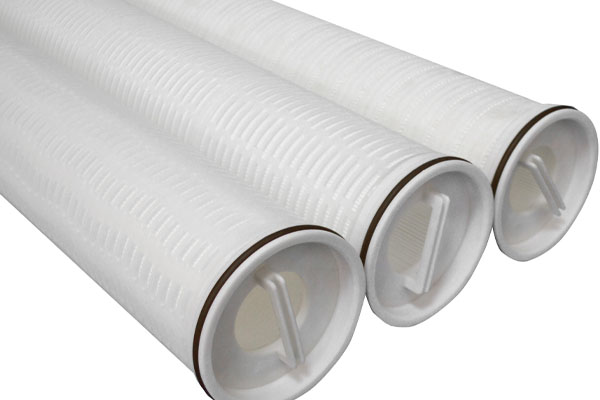
To protect the system and stabilize the △P curve, upgrade to High-Flow Pleated Cartridges.
By transitioning to a high-flow geometry, you exponentially increase the total filtration surface area. This massive area acts as a hydraulic shock absorber. It drops the fluid velocity (flux rate) to a gentle crawl, preventing soft gels from compacting into an impermeable seal and providing the buffer capacity needed to absorb upstream "crud bursts" without triggering an immediate plant shutdown.
Are there any specific industrial applications—like petrochemical processing or seawater desalination—you would like to tailor the next article’s diagnostics toward?