Why Filter Cartridge △P Increases Suddenly Instead of Gradually?
Rapid Answer
A sudden, vertical △P (differential pressure) spike is never a sign of normal filter exhaustion; it is the definitive symptom of a catastrophic shift in your fluid dynamics or upstream chemistry. Under normal operating conditions, a properly sized filter undergoes "depth loading," where particles are trapped evenly throughout the entire 3D matrix of the media, resulting in a slow, gradual, and predictable linear rise in △P over weeks or months. When the △P remains flat and then suddenly spikes vertically within hours or days (a "hockey-stick" curve), it means the system has suffered a transient shock—such as colloidal blinding, a hydraulic flow surge, or an upstream mechanical failure—that has instantly eliminated the filter’s remaining porosity.
The Physics of the "Hockey-Stick" Curve
To understand why pressure doesn’t always rise gradually, you must understand how fluid resistance works on a microscopic level.
Filtration is a game of open void volume. When a filter is brand new, it might have millions of open microscopic flow paths.
- The Flat Baseline: As the first 80% of these pores fill up with dirt, the water simply redirects to the remaining 20% of open pores. Because water is incompressible, the remaining open pores handle the flow easily, and the △P gauge barely moves. The curve looks flat.
- The Exponential Spike: Once the filter reaches its critical threshold (e.g., only 5% of pores remain open), all the fluid velocity is forced through a microscopic bottleneck. At this exact moment, any additional dirt seals the final remaining paths simultaneously. Hydraulic resistance goes to infinity almost instantly, causing the △P curve to shoot straight up.
When a filter hits this exponential phase prematurely, it is driven by one of three specific engineering failures.
The 3 Triggers of a Sudden △P Spike
If your plant is experiencing sudden pressure spikes, process engineers must investigate these three specific failure modes.
1. Surface Blinding via Deformable Foulants (The Liquid Seal)
Standard depth loading relies on capturing hard, solid particles (like sand or scale) that stack like bricks, leaving microscopic gaps for water to flow through.
- The Mechanism: If the feed water is suddenly contaminated with soft, deformable materials—such as biological slime (EPS), trace oil emulsions, or unreacted polymeric coagulants—these foulants do not stack. When they hit the filter media under high pressure, they flatten out and fuse together.
- The Result: This forms a continuous, non-porous liquid or gel film across the outermost surface of the cartridge. The pores are sealed shut simultaneously, triggering an instant △P spike while leaving the internal matrix of the filter completely clean.
2. Transient Hydraulic Shocks (The Compaction Effect)
A filter cake (the layer of trapped dirt) relies on steady fluid velocity to remain porous.
- The Mechanism: If a feed pump Variable Frequency Drive (VFD) surges, or if an operator opens a valve too quickly, the system experiences a massive, instantaneous flow surge.
- The Result: Because △P rises with the square of fluid velocity, this kinetic shock wave violently slams into the filter. It physically crushes the existing, breathable filter cake deep into the pleat roots, permanently destroying the media’s porosity in a fraction of a second.
3. Upstream Mechanical Failure (The Crud Burst)
Security filters are designed to handle a steady, low-level load of fine particulates.
- The Mechanism: If an upstream working filter fails—for example, a broken Ultrafiltration (UF) hollow fiber or a channeled Multimedia Filter (MMF)—a massive, concentrated wave of raw bulk solids is released into the pipe.
- The Result: The security filter is forced to process 30 days’ worth of dirt in 30 minutes. Its void volume is overwhelmed instantly, leading to a vertical step in the △P curve.
Diagnostic Cross-Validation Matrix
Do not simply discard the plugged filter. Perform a physical autopsy to cross-reference the sudden △P spike with the actual root cause.
| Physical Autopsy of the Filter | Plant Data Cross-Validation | Engineering Root Cause |
|---|---|---|
| Filter looks clean, but feels slick/sticky; inner pleats are dry. | Recent increase in upstream clarifier chemical dosing. | Polymer / Coagulant Overdose: Liquid glue has surface-blinded the filter instantly. |
| Filter has a hard, compacted crust; pleat spacing is deformed. | History of VFD hunting or rapid valve actuations. | Hydraulic Compaction: A flow surge crushed the filter cake and eliminated porosity. |
| Filter is heavily caked in raw brown/green sludge. | Upstream UF turbidity spiked / MMF backwash failed. | The Crud Burst: Sudden mechanical failure of the upstream primary filtration system. |
| Filter is coated in a thick, gelatinous brown/clear slime. | Temperature change in raw water; inconsistent biocide dosing. | Bio-Sloughing (EPS Wave): A massive colony of bacteria sheared off the upstream piping. |
Engineering Solutions to Prevent Sudden Spikes
If a system is plagued by sudden △P spikes, simply swapping out identical commodity filters will not solve the problem. You must alter the fluid dynamics of the housing.
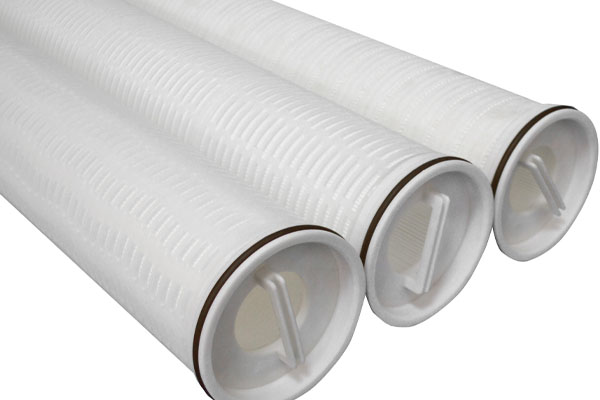
- Radically Decrease the Flux Rate: Sudden spikes are driven by high fluid velocity forcing pore closure. By upgrading the housing to accept High-Flow Pleated Cartridges, you multiply the available surface area. This drops the flux rate (velocity) to a gentle crawl, preventing soft gels from compacting into an impermeable seal.
- Increase Buffer Capacity: A massive pleated surface area acts as a hydraulic shock absorber. When a transient "crud burst" hits the housing, the high surface area spreads the dirt load out thinly, absorbing the shock and transforming what would have been a vertical △P spike into a manageable, gradual curve.
- Stabilize Upstream Chemistry: The mechanical filter cannot compensate for broken chemical loops. Aggressively tune your upstream DAF/Clarifier PID controllers to prevent the overdosing of polymers that cause immediate surface blinding.