Why Cartridge Life Becomes Unstable in RO Pretreatment Systems
Rapid Answer
Filter cartridge life becomes unstable not because the filters are defective, but because the upstream pre-treatment system has lost its steady-state balance, bombarding the filters with unpredictable chemical and hydraulic shocks. In a perfectly tuned Reverse Osmosis (RO) pretreatment system, a security filter experiences a constant, predictable load of sub-micron particles, resulting in a stable 30 to 90-day lifespan. However, when operators complain that filter life is "erratic"—lasting 30 days one month, and 3 days the next—it is absolute proof of transient fouling. The security filter is being forced to absorb sudden, concentrated waves of unreacted polymers, sheared biological slime, or hydraulic flow surges that it was never designed to handle, causing unpredictable and vertical △P (differential pressure) spikes.
The 3 Drivers of Instability (The Transient Shocks)
To regain control over your OPEX (Operational Expenditure) budget, process engineers must stop treating the symptom (changing filters) and identify which of the three transient shocks is destabilizing the plant.
1. Chemical Dosing Lags (The Polymer Rollercoaster)
Upstream Clarifiers and Dissolved Air Flotation (DAF) units rely on precise chemical dosing. If the raw water quality changes rapidly, the dosing pumps often lag behind.
- The Instability: If the control loop overcompensates and injects too much coagulant or polymer, the unreacted liquid chemical bypasses the clarifier and hits the RO security filter in a concentrated wave.
- The Result: This liquid polymer acts as an invisible glue, instantly sealing the pores (surface blinding). A filter that should have lasted 40 days is hydraulically choked in 48 hours, creating massive lifespan volatility.
2. Hydraulic Surges (The Velocity Multiplier)
Filter media relies on a gentle, consistent fluid velocity (flux rate) to capture dirt deeply within its matrix.
- The Instability: If feed pump Variable Frequency Drives (VFDs) are poorly tuned and "hunt" for a setpoint, or if operators rapidly open valves when switching parallel filtration trains, the system experiences massive flow surges.
- The Result: Because △P rises with the square of the fluid velocity, a sudden 20% surge in flow does not just push more water; it violently compacts the existing dirt deeper into the pleat roots, permanently destroying the filter’s porosity and triggering premature failure.
3. Biological Sloughing (The EPS Avalanche)
If a plant draws from open seawater, rivers, or wastewater, biological loads are heavily influenced by temperature and sunlight, making them inherently unstable.
- The Instability: Bacteria form colonies (biofilms) in the upstream piping and UF permeate headers. If chlorination or biocide dosing is inconsistent, these colonies grow massive. Eventually, hydraulic friction shears them off.
- The Result: Instead of a steady trickle of bacteria, the filter is hit by a massive, gelatinous "avalanche" of Extracellular Polymeric Substances (EPS). This sticky slime flattens out against the filter media, creating an impenetrable liquid block that causes the △P to skyrocket instantly.
Diagnostic Cross-Validation Matrix
When your cartridge consumption becomes erratic, use this matrix to autopsy the failed filters and trace the instability back to its source.
| Pattern of Instability | Physical Autopsy of Filter | Engineering Root Cause to Investigate |
|---|---|---|
| Fails rapidly after heavy rain or season change | Heavy brown/grey silt, deeply embedded. | DAF/Clarifier Overload: Upstream settlement cannot handle the sudden raw water turbidity spike. |
| Lifespan fluctuates wildly day-to-day | Filter looks clean, but media feels slick/sticky. | Chemical Control Failure: The coagulant/flocculant PID loop is hunting, causing intermittent polymer carryover. |
| Fails suddenly after plant startup or train switch | Pleats are physically crushed or deformed. | Hydraulic Shock: Valves are opening too quickly, causing velocity compaction and water hammer. |
| Erratic failure during warm summer months | Coated in clear/brown snot-like gel; smells earthy. | Bio-Sloughing: Inconsistent biocide dosing is allowing biofilm to build and periodically break free. |
The ecofiltrone Engineering Solution: Building a Shock Absorber
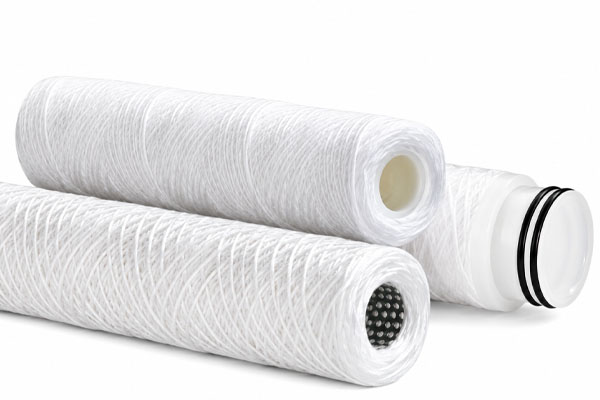
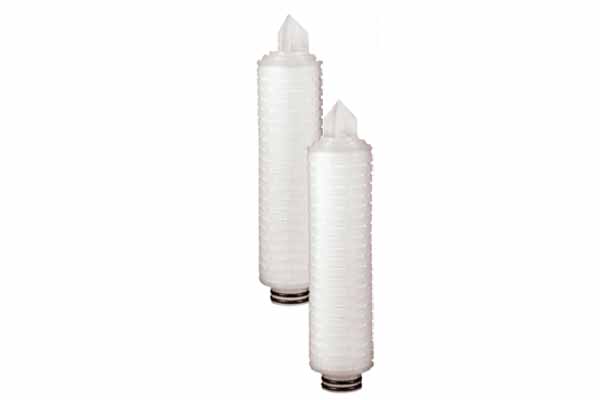
Standard 2.5-inch meltblown depth filters are extremely vulnerable to instability. Because they have a very small surface area, they possess zero "buffer capacity." The moment a chemical or biological shock hits them, they blind and fail.
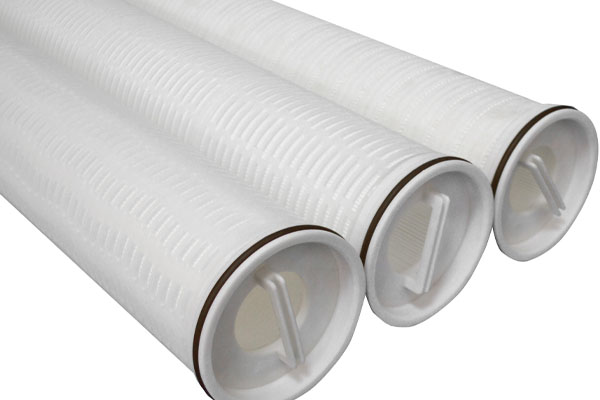
To stabilize your cartridge lifespan in an inherently unstable pretreatment environment, you must upgrade the mechanical buffer of your system by deploying ecofiltrone High-Flow Pleated Cartridges.
- Massive Surface Area as a Buffer: A single ecofiltrone high-flow cartridge provides up to 10 times the surface area of a standard filter. When a transient "crud burst" or polymer wave hits the housing, this massive area absorbs the shock, spreading the foulant out thinly rather than allowing it to form a localized, impermeable block.
- Diluting the Flux Rate: Because the surface area is so vast, the fluid velocity drops dramatically. At a low flux rate, flow surges and hydraulic shocks lose their kinetic energy, preventing the violent compaction of dirt into the pleat roots.
- Restoring Predictability: By upgrading to high-flow geometry, you engineer the volatility out of your system. Even if your upstream chemistry fluctuates, the immense dirt-holding capacity of the ecofiltrone cartridge acts as a shock absorber, smoothing out the △P curve and returning your plant to a predictable, budget-friendly 30-to-60 day change-out cycle.
Use this interactive simulation to visualize how upstream instability destroys standard filter lifespan, and how upgrading to high-flow geometry absorbs those shocks to restore predictability.
Would you like to explore how to draft a LinkedIn outreach script to target Plant Managers specifically suffering from these erratic OPEX costs?