Why Some 5 Micron RO Security Filters Clog Faster Than 10 Micron Cartridges
Rapid Answer
When a plant upgrades its Reverse Osmosis (RO) security filtration from 10-micron to 5-micron cartridges, operators are often shocked when the filter lifespan drops from a month down to just a few days. They frequently suspect a defective batch of filters. However, a 5-micron filter clogging significantly faster than a 10-micron filter is not a manufacturing defect; it is a manifestation of strict fluid dynamics and Particle Size Distribution (PSD).
Moving to a tighter micron rating triggers three compounding physical penalties: it drastically reduces the media’s open porosity, it intercepts a exponentially larger volume of suspended solids, and it forces a higher localized fluid velocity (flux rate) through the remaining pores. The 5-micron filter is clogging faster simply because it is finally doing the job the 10-micron filter was failing to do—catching the dirt before it destroys the RO membranes.
The Physics of the Upgrade: The Three Penalties
To explain to a plant manager why their consumable consumption just spiked, process engineers must break down the physical differences between the two media structures.
1. The Porosity Penalty (Reduced Open Area)
Filter media is not a solid wall with perfectly punched holes; it is a matrix of overlapping fibers.
- The Physics: To create a 5-micron absolute rating, the manufacturer must pack the micro-fibers much closer together than they do for a 10-micron rating.
- The Consequence: By packing the fibers tighter, the total "void volume" or open porosity of the filter drops significantly. Because there is less physical open space for the water to flow through, the clean initial △P (differential pressure) is naturally higher. You are starting the filtration cycle closer to the 2.5 bar change-out limit, giving you less "pressure runway" to accumulate dirt.
2. Intercepting the "Invisible" Bulk (The PSD Shift)
Water contaminants follow a Particle Size Distribution curve. In industrial water, there are always exponentially more small particles than large particles.
- The Physics: Imagine your feed water contains 100 kilograms of total dirt. Perhaps only 10 kg of that dirt is larger than 10 microns, while 60 kg of the dirt falls directly in the 5-to-10 micron range.
- The Consequence: The old 10-micron filter was only catching 10 kg of dirt, allowing the other 60 kg to pass straight through into the RO membranes. When you install the 5-micron filter, it suddenly has to capture and hold 70 kg of dirt. It clogs 7 times faster because it is doing 7 times the physical work.
3. The Velocity Multiplier (Flux Compaction)
This is the most destructive phase of the 5-micron upgrade.
- The Physics: You have reduced the open area (Porosity Penalty), but the main feed pump is still pushing the exact same volume of water (e.g., 100 m3/hr) through the housing.
- The Consequence: To squeeze the same amount of water through fewer, smaller pores, the fluid velocity must accelerate dramatically. This high-speed kinetic energy takes the massive new dirt load (the 60 kg of fine particles) and violently smashes it into the tight 5-micron matrix, compacting it into an impenetrable brick. The filter undergoes rapid surface blinding, and the △P spikes vertically.
Diagnostic Matrix: Explaining the Failure to Operations
When the control room complains about the new 5-micron filters, use this cross-validation matrix to prove that the filters are protecting the plant.
| Operator Observation | Engineering Reality & Process Proof |
|---|---|
| "The 10-micron filters lasted 30 days. These 5-micron filters died in 4 days." | Check the RO membrane △P history. During the days of the 10-micron filter, the RO membrane △P was likely rising steadily, requiring frequent CIPs. The 5-micron filter is now taking the hit instead of the $1,000 RO element. |
| "The exhausted 5-micron filter feels much heavier than the old 10-micron ones." | This proves the PSD theory. The 5-micron is capturing a massive volume of 6-9 micron silt and fine colloids that the 10-micron was completely missing. |
| "The △P curve was flat, then shot straight up (hockey-stick curve)." | The high fluid velocity through the tighter 5-micron pores caused the dirt to compact and seal the surface. The flux rate is too high for the current housing size. |
The ecofiltrone Engineering Solution: Balancing Microns and Surface Area
You cannot simply return to a 10-micron filter to save money on consumables; doing so will eventually destroy the downstream RO membranes. The engineering goal is to maintain the strict 5-micron absolute protection without sacrificing filter lifespan.
Because moving to a 5-micron rating reduces your open porosity, you must compensate by radically increasing your total media surface area.
This is where ecofiltrone High-Flow Pleated Cartridges solve the paradox:
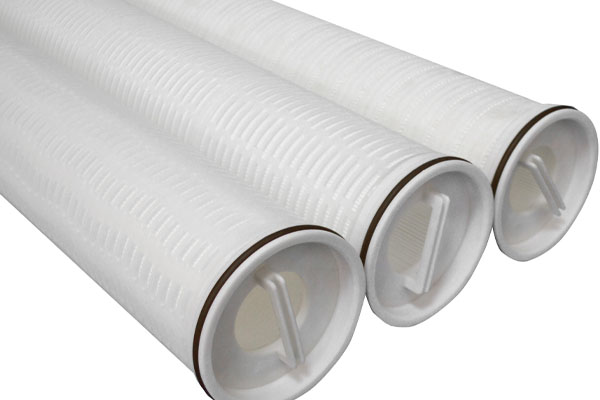
- Multiplying the Porosity: A standard 2.5-inch meltblown depth filter simply does not have enough physical mass to handle a 5-micron dirt load at industrial flow rates. An ecofiltrone high-flow cartridge features deep, high-density pleating, offering up to 10 times the surface area. This completely negates the Porosity Penalty.
- Dropping the Flux Rate: By spreading the water over a massive pleated surface, the velocity of the water drops to a crawl. The 5-micron to 9-micron particles are gently laid onto the media surface, building a breathable filter cake rather than being compacted into a solid block.
- The TCO Optimization: By upgrading the RO pre-filtration housing to accept high-flow pleated geometry, plants can safely deploy ultra-tight 5-micron or even 1-micron absolute ratings. The massive surface area absorbs the fine particulate load effortlessly, extending the change-out frequency back to 30 or 60 days, ensuring absolute RO protection while simultaneously slashing the annual consumable (OPEX) budget.