Surface Blinding vs. Depth Loading in RO Security Filters: How to Diagnose the Difference
Rapid Answer
In Reverse Osmosis (RO) pre-treatment, the operational goal of a security filter is depth loading—a process where hard particulates are captured throughout the entire 3D matrix of the filter media, utilizing 100% of the cartridge’s dirt-holding capacity.
Surface blinding, however, is a catastrophic failure mode. It occurs when deformable foulants, unreacted polymers, or ultra-fine colloids instantly seal the outermost layer of the filter. This creates an impenetrable barrier that chokes the flow, rendering 95% of the filter’s internal volume completely useless. Diagnosing the difference between normal depth loading and premature surface blinding requires field engineers to cross-reference the historical △P (differential pressure) curve with a physical autopsy of the exhausted cartridge.
The Physics of Filtration: Internal Matrix vs. External Barrier
To troubleshoot a filter that is failing too quickly, process engineers must understand how the physical morphology of the contaminant interacts with the filter media under high pressure.
1. Depth Loading (The Engineered Ideal)
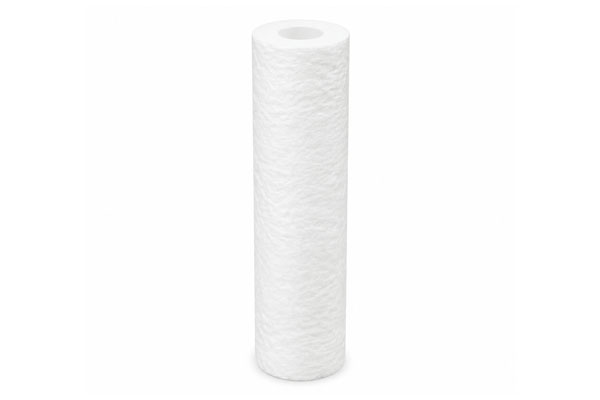
High-quality RO security filters (like advanced meltblown or micro-glass pleated media) are not flat screens; they are tortuous labyrinths.
- The Mechanism: When hard, suspended solids (like silica sand, scale, or rust) enter the filter, they navigate this labyrinth. Larger particles are caught near the surface, while smaller particles penetrate deeper before being trapped in the tighter inner layers.
- The Result: The dirt builds up slowly, forming a porous, breathable "filter cake." Fluid can still flow around the trapped particles. The △P rises in a slow, predictable, linear fashion over weeks or months. This means the plant is maximizing its OPEX investment.
2. Surface Blinding (The Premature Death)
Surface blinding defeats the engineering of the filter. It is almost always caused by a mismatch between the fluid velocity (flux rate) and the texture of the contaminant.
- The Mechanism: If the feed water contains soft, deformable contaminants—such as biological slime (EPS), oil emulsions, or overdosed liquid coagulants—these substances do not navigate the labyrinth. When they hit the outermost surface of the filter under high pressure, they flatten out and fuse together.
- The Result: This forms a continuous, non-porous liquid or gel film across the outside of the cartridge. The pores are sealed shut. The △P curve remains flat for a short time, then shoots vertically (a "hockey-stick" spike) in a matter of hours. The filter dies while its internal matrix remains perfectly clean.
Diagnostic Cross-Validation Matrix
When a security filter triggers a high △P alarm, do not just throw it away. Perform an autopsy by cutting the media open to diagnose exactly how it failed.
| Diagnostic Metric | Normal Depth Loading | Premature Surface Blinding | Engineering Root Cause of Blinding |
|---|---|---|---|
| SCADA △P Curve | Steady, gradual, linear climb over 30 to 90 days. | Flat baseline, followed by a sudden vertical spike within 2 to 5 days. | Transient "crud bursts" or unstable upstream UF operation. |
| External Visual Autopsy | Filter is heavily coated with a thick, gritty, porous crust. | Filter looks relatively clean, or has a thin, slimy, slick coating (water beads off). | Chemical carryover (polymer/coagulant) or heavy biological EPS forming a liquid block. |
| Internal Cross-Section Autopsy | Discoloration and dirt are visible deep inside the media fibers or pleat roots. | The inner layers or the roots of the pleats are pristine white and completely dry. | Flux Rate is Too High: High velocity violently compacted the foulants onto the surface before they could penetrate. |
| Weight of Exhausted Filter | Extremely heavy (full of solid particulate mass). | Relatively light (blocked by a micro-film, not physical mass). | Colloidal agglomeration sealing the surface pores. |
The Cascading O&M Consequences of Surface Blinding
Accepting surface blinding as "normal wear and tear" traps a desalination or wastewater reuse plant in a highly destructive operational loop:
- OPEX Budget Destruction: If filters are surface blinding, you are throwing away cartridges that have only utilized 5% of their engineered capacity. Your annual consumable spend will easily triple.
- Loss of RO Membrane Security: A surface-blinded filter operates under extreme hydraulic stress. As the pump forces water against the blinded surface, standard depth filters can stretch or tear (extrusion bypass). The sticky gels or polymers will then shoot directly into the RO spacer channels, causing irreversible membrane fouling.
- Feed Pump Cavitation: The vertical nature of the △P spike during a surface blinding event can catch operators off guard. The RO high-pressure pumps are suddenly starved of suction pressure, risking severe cavitation and mechanical seal failure.
The ecofiltrone Engineering Solution: Breaking the Blinding Loop
If your physical autopsy reveals pristine white pleat roots hidden beneath a slimy, blinded surface, changing the micron rating will not solve your problem. You must change the fluid dynamics.
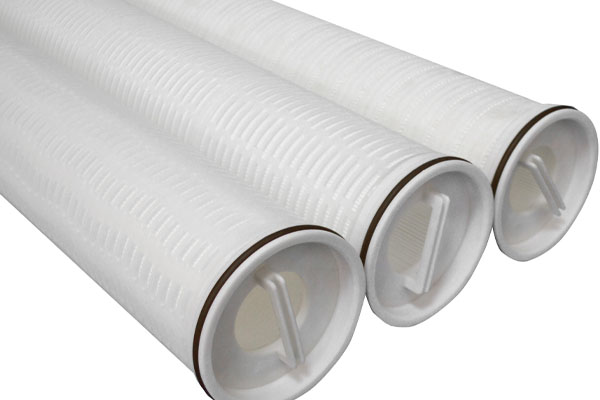
To break the surface blinding loop, the system requires ecofiltrone High-Flow Pleated Cartridges.
- Dropping the Flux Rate: Surface blinding is driven by high impact velocity. A single ecofiltrone high-flow cartridge provides up to 10 times the surface area of a standard 2.5-inch filter. By spreading the water over this massive area, the fluid velocity (flux) drops dramatically.
- Preventing Gel Compaction: At this ultra-low flux rate, soft biological gels, trace oils, and fine colloids are not violently smashed into the media surface. They are gently intercepted, allowing the fluid to continue passing through the surrounding pores without creating an impermeable film.
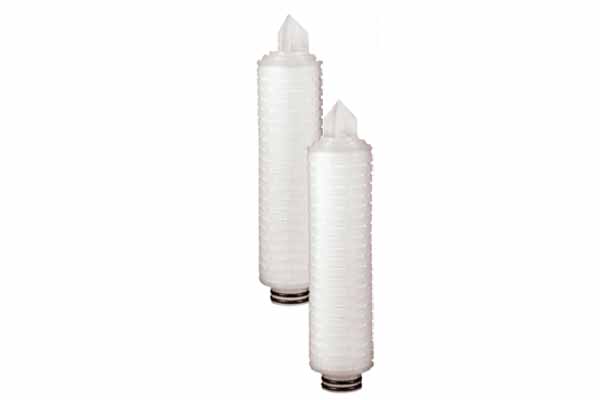
- True Depth Utilization: By combining low flux geometry with advanced, graded-density micro-glass or polypropylene media, ecofiltrone cartridges force contaminants to load deeply into the pleat matrix. This ensures you utilize 100% of the filter’s dirt-holding capacity, extending change-out intervals from days back to months.