Standard Operating Procedure (SOP): Diagnosing Premature Filter Clogging in the Field
Rapid Answer
When a customer reports that a filter cartridge designed to last 30 days has plugged in only 3 days, process engineers must establish an immediate baseline rule: It is rarely a manufacturing defect; it is an upstream process alarm. The filter is doing exactly what it was designed to do—sacrificing itself to arrest a sudden mechanical or chemical upset.
Throwing a new batch of filters into the housing without diagnosing the root cause will only burn through the plant’s operational expenditure (OPEX) budget. A professional on-site Standard Operating Procedure (SOP) requires a systematic sequence: starting with SCADA control room data, moving to a physical "autopsy" of the exhausted cartridge, and cross-validating those findings with upstream fluid dynamics.
Phase 1: The Control Room (Data Analysis)
Before putting on PPE and opening the steel filter vessel, you must analyze the historical data leading up to the failure.
1. Analyze the Delta P (Differential Pressure) Curve
Ask the operator to pull the Delta P trend line from the DCS/SCADA system for the past 72 hours.
- The "Linear Climb": If the pressure rose steadily and predictably from day one to day three, the system is simply under-sized for the true Total Suspended Solids (TSS) load. The filter is catching solid dirt exactly as intended, but there is not enough media surface area for the volume of dirt.
- The "Hockey-Stick" Spike: If the pressure remained flat at 0.2 bar for two days, and then shot vertically to 2.5 bar in a matter of hours, you are dealing with a transient upset. This is a sudden "crud burst" of biological slime, an oil carryover event, or an upstream chemical overdose.
2. Verify Flow Rate and Temperature (Viscosity)
- Flow Surges: Did operations increase the flow rate to meet a production quota? Remember that pressure drop increases with the square of fluid velocity. A 20% increase in flow can instantly trigger a high Delta P alarm on a partially loaded filter.
- Temperature Drops: As liquid cools, its viscosity increases. If a petrochemical stream or heavy lube oil drops by 10 degrees Celsius overnight, the hydraulic friction through the micron-pores will skyrocket, mimicking a "clogged" filter.
Phase 2: The Physical Autopsy (Visual Diagnostic Matrix)
Once the housing is safely isolated and opened, the exhausted filter cartridge must be extracted and visually inspected. The physical state of the media tells you exactly what killed it.
| Physical Observation of the Filter | Diagnostic Inference (Root Cause) | Immediate SOP Action |
|---|---|---|
| Coated in a slick, clear, or brown slime | Biological Fouling (EPS) or Oil Emulsion: A gelatinous matrix has created a "liquid block" over the pores. The filter is blinded by liquid/gel, not solid dirt. | Check upstream DAF/Oil-Water separators. Shock-dose the system with biocide to kill active bacteria. |
| Hard, grey/white crust on the pleats | Inorganic Scaling or Coagulant Overdose: Upstream chemistry changed, precipitating silica or calcium, OR the upstream clarifier overdosed polymer/flocculant. | Test upstream water for supersaturation. Reduce coagulant dosing immediately. |
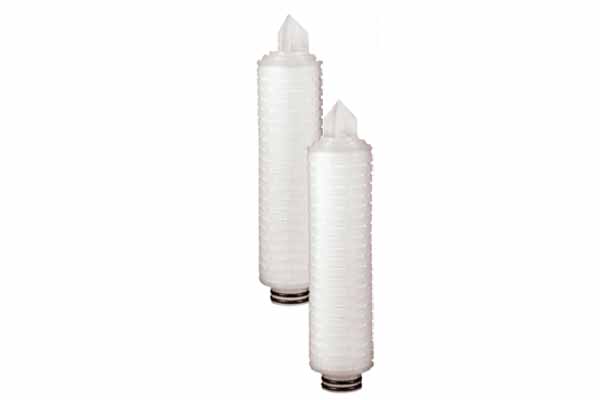
| Cartridge is physically swollen or jammed in housing | Chemical Incompatibility (Polymer Degradation): The fluid contains trace aromatics or hydrocarbons that have diffused into the Polypropylene (PP) matrix, swelling the plastic. | Stop using PP immediately. Upgrade to rigid, chemically inert Micro-Glass or PTFE cartridges. |
| Filter looks perfectly clean, but Delta P is high | Sub-Micron / Colloidal Blinding: The system is being fed microscopic particles (like colloidal silica) that perfectly match the pore size, plugging them internally without forming a visible surface cake. | Run a particle size distribution (PSD) test on the feed water. You may need to adjust the absolute micron rating. |
| Pleats are violently crushed or center core collapsed | Hydraulic Shock (Water Hammer): The filter was destroyed by a sudden pressure wave, usually caused by opening a downstream valve too quickly during start-up. | Review operator start-up procedures. Ensure valves are opened slowly to prime the housing gradually. |
Phase 3: Cross-Validating Upstream Variables
Once the autopsy gives you a physical theory (e.g., "This looks like an oil emulsion block"), you must prove it by walking the process line upstream.
- Check Chemical Injection Skids: If the filter is blinded by a sticky brown paste, check the upstream coagulant/flocculant pumps. Are they dosing based on a set timer rather than actual raw water turbidity? Overdosed polymer carries over and instantly glues filter pleats shut.
- Verify Upstream Separation: If you suspect oil blinding, sample the effluent from the upstream API separator or hydrocyclone. Standard pleated water filters will fail within hours if free oil exceeds 5 ppm.
- The "Empty Housing" Test: If the plant insists the water is perfectly clean, remove the filter cartridges entirely, close the housing, and run the pump. If the Delta P gauge still reads 0.5 bar, the filter is not the problem. The inlet/outlet pipes are undersized, creating massive hydraulic friction before the water even touches a filter.
The Engineering Resolution
When reporting back to the Plant Manager, frame the premature clogging not as a failure, but as a successful interception of a process anomaly that would have otherwise destroyed downstream assets (like RO membranes or reactor catalysts).
To resolve the issue permanently, present the engineering upgrade path:
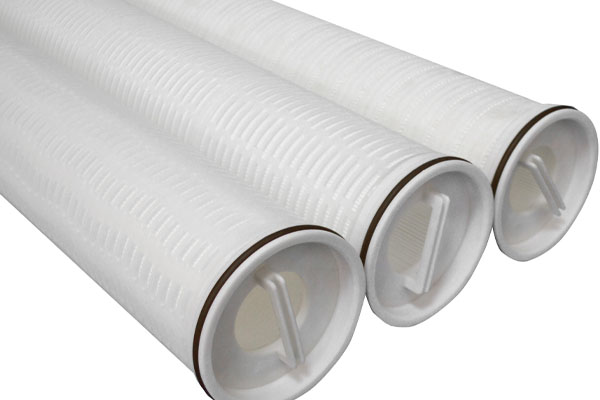
- If the issue is sheer volume (Linear Climb): Do not change the micron rating. Instead, upgrade from standard depth filters to High-Flow Pleated Cartridges to multiply the available surface area by 10x, dropping the flux rate and extending the lifespan proportionally.
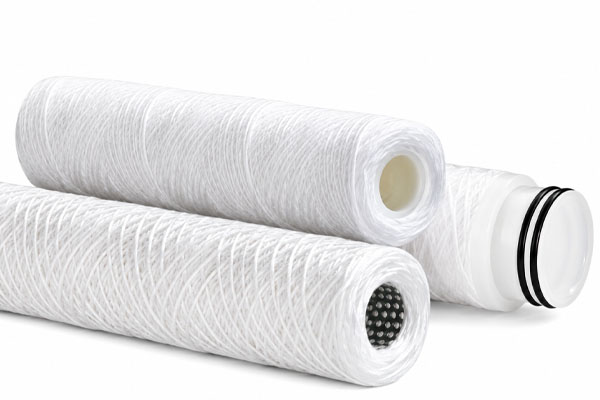
- If the issue is deformable gels/oil (Hockey-Stick Spike): Deploy a sacrificial depth pre-filter (like an oil-absorbing cellulose blend) upstream to catch the gels, protecting the expensive absolute-rated pleated filters downstream.
- If the issue is chemical swelling: Shift the material specification from Polypropylene to PTFE or Micro-Glass, guaranteeing absolute structural rigidity regardless of hydrocarbon spikes.