What Are the Common Types of Suspended Solids in Refinery Water Treatment (Water Injection Systems)?
Rapid Answer
In refinery water treatment and water injection systems (often handling produced water, desalter effluent, or stripped sour water), suspended solids are not merely "dirt." They are a highly complex, dynamic matrix of inorganic precipitates, corrosion by-products, heavy organics, and biological matter.
If these solids are not aggressively filtered before injection, they will quickly plug the microscopic pore throats of the receiving reservoir. This leads to a severe decline in well injectivity, localized formation fracturing, and millions of dollars in deferred production or well workover costs.
Understanding the specific type of suspended solid is critical, as each requires a fundamentally different filtration and chemical treatment strategy.
The Matrix of Suspended Solids in Injection Water
Suspended solids in refinery and petrochemical injection water are generally categorized into five primary types based on their chemical origin and physical behavior.
1. Corrosion Products (Iron Sulfides & Iron Oxides)
In systems handling sour gas or high-sulfur crudes, corrosion products are often the most dominant and problematic solid.
- Iron Sulfide (FeS): Generated when hydrogen sulfide ($H_2S$) reacts with carbon steel piping. FeS is highly shear-sensitive, easily breaking down into sub-micron particles. It appears as "black powder" and can be pyrophoric.
- Iron Oxides (Rust): Generated by oxygen ingress into the system (e.g., through leaking pump seals or open tanks), converting ferrous iron into insoluble ferric oxide particulates.
2. Precipitated Inorganic Scales
Water injection systems often mix different water streams (e.g., produced water with aquifer makeup water). If these waters are chemically incompatible, or if pressure/temperature changes occur, dissolved ions will instantly precipitate into hard, crystalline solids.
- Calcium Carbonate ($CaCO_3$): Triggered by pressure drops that cause $CO_2$ to flash out of solution.
- Barium & Strontium Sulfate ($BaSO_4$, $SrSO_4$): Extremely hard scales formed when sulfate-rich water mixes with barium/strontium-rich water. Once formed, they are almost impossible to dissolve chemically and must be mechanically filtered.
3. Organic Colloids and Emulsions
Refinery water is never perfectly free of hydrocarbons.
- Free Oil Droplets: Microscopic oil-in-water emulsions that survived the upstream separators. While technically a liquid, these droplets act as suspended solids by physically blinding filter media and coating the injection formation (oil-wetting).
- Asphaltenes & Paraffins: Heavy, sticky hydrocarbon complexes that precipitate out of the oil phase when pressure drops or temperatures cool, acting as highly viscous, tar-like solids.
4. Biological Matter (Biomass & Slime)
Water injection systems provide an ideal environment (warm, watery, nutrient-rich) for bacterial growth.
- Sulfate-Reducing Bacteria (SRB): Anaerobic bacteria that consume sulfates and excrete $H_2S$, accelerating FeS corrosion.
- Biofilms / Slime: Dead bacterial bodies and the sticky extracellular polymers they secrete. This biomass acts as a "glue," binding sand, scale, and oil together into massive, gummy agglomerations that instantly blind filters.
5. Formation Fines and Silica
- Sand, Silt, and Clays: Inherent to the geological formation. While mostly removed in primary separation, fine clays (1 to 5 microns) can remain suspended and migrate through the system.
Operational Diagnostics: Identifying the Solid Source
When an injection well experiences a sudden loss of injectivity, or when the pre-injection filter differential pressure ($\Delta P$) skyrockets, field engineers must diagnose the specific solid causing the upset.
Injection Water Solid Diagnostic Matrix
| Correlated Operational Signals | Diagnostic Inference (Solid Type) | Typical Operator Action |
|---|---|---|
| Filter $\Delta P$ spikes rapidly + Filter media coated in opaque black slime | Iron Sulfide (FeS) + Oil Emulsion: Active sour corrosion combined with oil carryover binding the FeS. | Check upstream $H_2S$ scavengers and oil/water separator efficiency. Deploy absolute-rated, oil-absorbent filters. |
| Water analysis shows sudden drop in dissolved Barium + Hard crust on filter elements | Barium Sulfate Scale Precipitation: Incompatible water streams (e.g., seawater mixed with formation water) are precipitating out of solution. | Relocate scale inhibitor injection points further upstream; review water mixing models. |
| Filter media feels slick/gelatinous + Localized pitting corrosion observed on piping | Biological Fouling (SRB Biomass): Bacteria are colonizing the system, generating biomass and localized acidic micro-environments. | Initiate a high-dose biocide "shock" treatment; flush the system to remove dead biomass. |
| $\Delta P$ rises linearly + Dry, brown/grey particulate on filter | Standard Formation Fines / Silt: Normal accumulation of geological particulates. | Verify filter replacement intervals; no immediate chemical upset suspected. |
Field Experience: The "Black Slime" Blockage
At a refinery managing a produced water re-injection (PWRI) facility, operators experienced a severe operational bottleneck. The 10-micron absolute injection filters were reaching terminal differential pressure every 12 hours.
Initially, the operators suspected a massive ingress of formation sand. However, an autopsy of the exhausted filter cartridges revealed a sticky, dense, jet-black paste coating the pleats. The material could not be washed off with water but dissolved readily in a solvent wash.
Diagnostic cross-referencing revealed the root cause: an Iron Sulfide / Hydrocarbon emulsion block.
The facility had recently routed a new stream of stripped sour water into the injection tank. The $H_2S$ in the sour water reacted with the carbon steel piping, generating massive amounts of sub-micron FeS. Simultaneously, an upstream hydrocyclone was underperforming, allowing 50 ppm of free oil to carry over. The oil droplets acted as a binder, gluing the sub-micron FeS particles together into a gelatinous matrix that completely blinded the pleated filter media.
The solution was two-fold: optimizing the upstream hydrocyclone to reduce oil carryover below 10 ppm, and upgrading the injection filters to a specialized high-flow structure with an oleophilic (oil-absorbing) pre-layer designed to capture trace hydrocarbons before they could bind the FeS.
The Engineering Logic of Injection Water Filtration
The goal of injection water filtration is strict reservoir protection. The filtration system must be engineered to handle the specific physical nature of the solids present.
1. Absolute vs. Nominal Retention:
Because reservoir pore throats are fixed in size (often 2 to 10 microns depending on rock permeability), nominal depth filters are unacceptable. A pressure surge will extrude deformable solids (like FeS and biomass) through a nominal filter and directly into the formation. Injection systems require absolute-rated pleated filters to provide a hard mechanical barrier.
2. Managing Deformable Solids:
If the primary solids are organics, biomass, or emulsions, standard pleated micro-glass will blind instantly. The system requires specialized media with graded-density layers to absorb the gels and oils deeply into the filter matrix, preventing surface blinding.
3. High-Flow Structures:
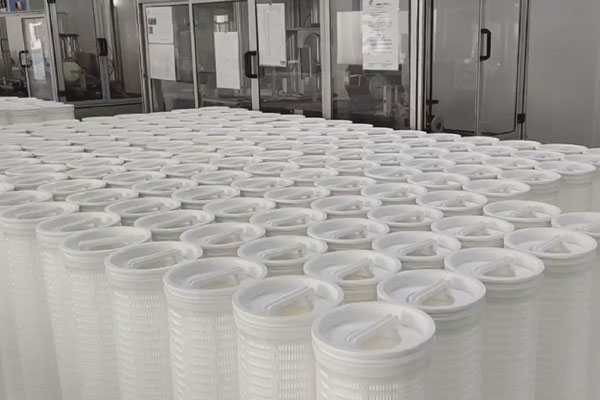
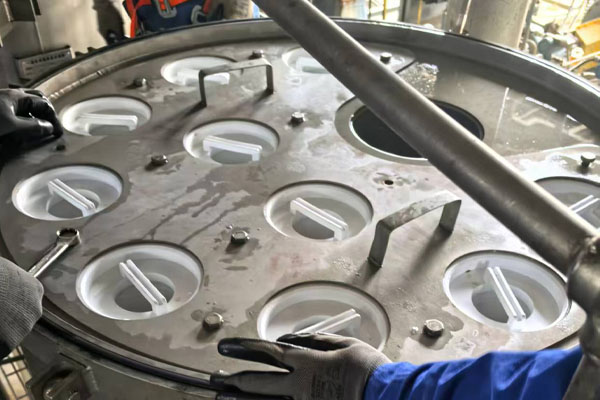
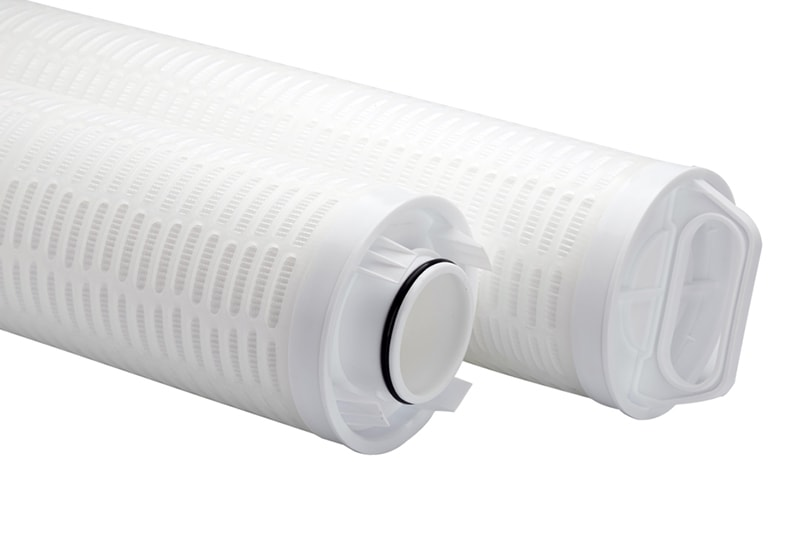
Injection systems process enormous volumes of water (often >50,000 barrels per day). Using high-flow, large-diameter (6-inch) filter structures ensures the fluid velocity through the media remains low. Low velocity is critical to prevent the hydraulic shearing and extrusion of fragile Iron Sulfide particles and oil droplets through the filter pores.