Why Do Amine Purification Systems in the Petrochemical Industry Require High-Performance, High-Flow Filter Cartridges?
Rapid Answer
In the petrochemical and natural gas processing industries, amine purification systems act as the "kidneys" of the facility, removing highly corrosive hydrogen sulfide (H₂S) and carbon dioxide (CO₂) from sour gas streams.
However, the amine solution itself continually degrades, generating massive quantities of sub-micron Iron Sulfide (FeS), heat-stable salts, and capturing entrained liquid hydrocarbons. If these contaminants are not aggressively filtered, they create particulate-stabilized foaming, foul the contactor tower, and trigger rampant flow-accelerated corrosion.
High-flow, high-performance filter cartridges are mandatory in these systems because they decouple massive hydraulic recirculation rates from particulate filtration. They prevent catastrophic foaming events, provide absolute retention of shear-sensitive FeS, and critically, minimize operator exposure to hazardous H₂S environments by utilizing high-capacity, inside-out flow geometries.
The Chemistry of Amine Degradation and FeS Generation
To understand the stringent filtration requirements, operators must look at the specific chemical environment inside an amine loop (whether using MEA, DEA, or MDEA).
The primary operational enemy in an amine system is Iron Sulfide (FeS), commonly referred to as "black powder."
When H₂S reacts with the carbon steel piping of the facility, it forms a microscopic layer of iron sulfide. The circulating amine solution continuously shears this FeS layer off the pipe walls, turning the normally pale-yellow amine into a dense, opaque black liquid.
The Threat of Particulate-Stabilized Foaming:
Clean amine does not foam easily. However, fine particulates like FeS ( < 5/mum ) and liquid hydrocarbons alter the surface tension of the amine. When the gas flows upward through the contactor tower, these particulates act as nucleation sites, creating a dense, unbreakable foam. This foam travels up the tower, causing massive amine carryover into the sales gas pipeline, resulting in immediate off-spec product and severe financial penalties.
Operational Diagnostics: Cross-Referencing Amine Signals
Experienced process engineers do not wait for amine carryover to occur. They diagnose the health of the amine loop by cross-referencing filtration differential pressure (△P) with tower fluid dynamics and chemical consumption.
Amine Loop Diagnostic Matrix
| Correlated Operational Signals | Diagnostic Inference (Root Cause) | Typical Operator Action |
|---|---|---|
| Absorber △P fluctuating/rising + Anti-foam consumption ↑ | Particulate-Stabilized Foaming: Fine FeS or hydrocarbon emulsions are bypassing the current filters, altering surface tension and creating foam. | Check filter effluent quality. Upgrade to absolute-rated filters to remove < 5\mum nucleation sites. |
| Amine color turns opaque black + Filter △P remains low/flat | Filter Unloading / Bypass: Standard depth filters are channeling, or seals have failed. The FeS is bypassing the filter entirely. | Isolate housing. Inspect for O-ring failure or extruded filter media. Switch to rigid pleated structures. |
| Lean Amine Filter △P spikes rapidly + High make-up water usage | Crud Burst / Hydrocarbon Ingress: A process upset upstream has dumped liquid hydrocarbons or massive FeS loads into the loop. | Prepare for frequent high-flow cartridge replacements to catch the transient crud burst; check upstream inlet separators. |
Field Experience: Diagnosing "The Phantom Foam"
At a large natural gas processing facility, operators were battling a severe foaming issue in their high-pressure amine contactor. To maintain production, they were continuously injecting hundreds of gallons of expensive anti-foam chemicals per week.
Initially, the plant chemistry team suspected heavy hydrocarbon carryover from the inlet gas separator. However, diagnostic trending revealed a specific disconnect: the foaming persisted even when inlet gas hydrocarbon content was verified as strictly zero.
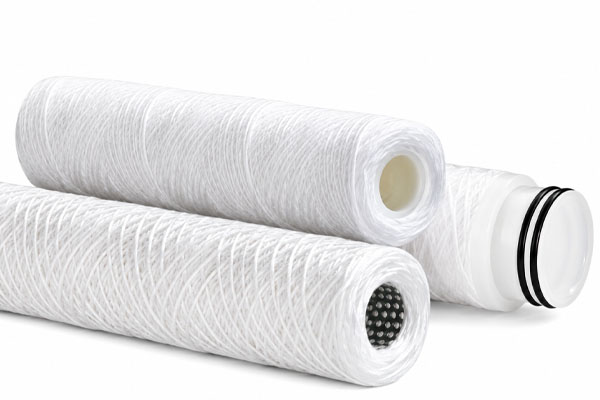
A physical inspection of the lean amine filtration skid revealed the true root cause. The plant was using standard, nominal 10-micron meltblown depth filters. Iron sulfide particles are highly deformable and shear-sensitive. Under the high differential pressure of the amine pumps, the 2-to-3 micron FeS particles were physically squeezing and "extruding" through the meltblown media.
These bypassing sub-micron FeS particles were acting as microscopic foam stabilizers inside the contactor. The anti-foam was only treating the symptom, not the cause.
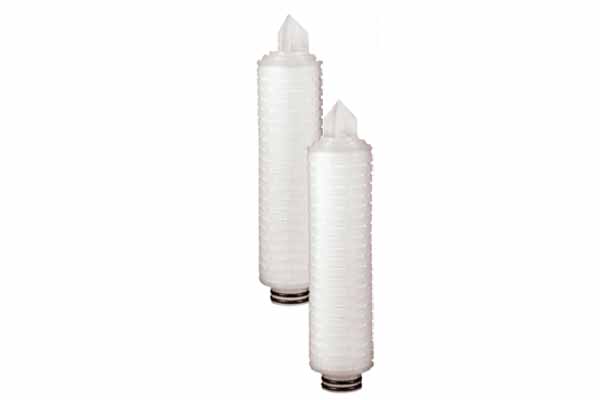
The engineering solution was to replace the nominal depth filters with absolute-rated, high-flow pleated micro-glass elements (rated at 2 microns). The rigid pleated media physically arrested the FeS. Within 48 hours, the amine color transitioned from black back to pale yellow, the contactor △P stabilized, and the plant completely halted the injection of anti-foam chemicals.
The Engineering Logic of High-Flow Amine Filtration
Because amine loops circulate massive volumes of fluid ( often 200 to 1000m³/hr) and are highly toxic, standard operational filtration logic poses severe mechanical and safety risks.
Why Standard Filtration Configurations Fail
A traditional approach using 2.5-inch diameter filters to process 500m³/hr of amine requires a massive steel vessel holding roughly 350 individual cartridges.
- Mechanical Bypass Risk: 350 filters mean 700 individual knife-edge seals. Iron sulfide will find the weakest spring or misaligned seal and bypass the entire array.
- Media Extrusion: Amine has a higher viscosity than water. Standard depth media cannot withstand the hydraulic drag and will compress, releasing previously trapped FeS downstream.
The Operational Justification for High-Flow Structures
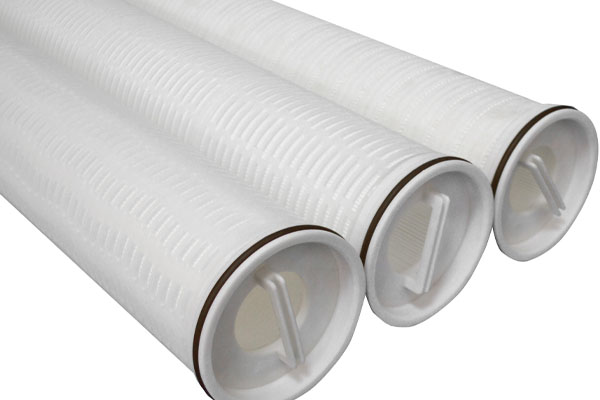
Petrochemical operators mandate large-diameter (6-inch), high-flow pleated filter structures for amine loops based on three specific engineering pillars:
- Inside-Out Flow Trajectory (The Safety Pillar):
High-flow cartridges flow from the inside out. All the captured Iron Sulfide—which can be pyrophoric (spontaneously combusting when exposed to oxygen)—is trapped safely inside the core of the filter. When operators remove the element, the hazardous FeS and toxic $H_2S$-laden amine stay contained within the filter body, keeping the housing clean and drastically reducing chemical exposure during maintenance. - ALARA and Downtime Reduction:
Replacing 350 standard filters in an H₂S environment requires operators to wear supplied-air respirators (SCBA) and spend 6 to 8 hours leaning over a toxic open vessel. Upgrading to a high-flow configuration replaces 350 elements with just 12 to 15 cartridges. This reduces hazardous maintenance exposure time from an entire shift to under 45 minutes. - Absolute Pleated Retention:
The rigid support core and advanced pleated micro-glass or synthetic media of high-flow elements provide absolute micron retention. They do not unload or extrude FeS during pump start-ups or hydraulic transients, ensuring that the amine entering the contactor is physically incapable of particulate-stabilized foaming.
Conclusion
In petrochemical amine purification, filtration is not a passive utility; it is an active chemical safeguard. By cross-referencing absorber differential pressures with amine clarity and chemical consumption, operators can detect the mechanical precursors to catastrophic foaming and corrosion.
Strategically deploying absolute-rated, high-flow pre-filtration ensures that transient Iron Sulfide is mechanically arrested, eliminating foam nucleation sites, reducing hazardous maintenance exposure, and preserving the thermodynamic efficiency of the entire gas sweetening process.