Why MGF Iron Carryover Causes Rapid Cartridge Fouling
Iron Carryover from MGF Systems Often Leads to Premature Surface Fouling
In many RO pretreatment systems, rapid cartridge fouling begins upstream at the multimedia filter (MGF) stage.
When iron particles are not removed effectively inside the MGF system, fine ferric contaminants may carry downstream into the RO security filter. These particles often accumulate rapidly on the cartridge surface, causing unstable ΔP increase and shortened filter life.
【Onsite Evidence Suggestion】
- cartridgeChange in replacement cycle :Normal cartridge life: 18–25 days
After MGF iron carryover: 4–7 days- ΔPrisetime :Normal condition: ΔP increased from 0.15 bar to 0.45 bar over 10 days
After MGF upset: ΔP increased from 0.15 bar to 0.75 bar within 48 hours- MGFTime of abnormal occurrence :The timing of MGF abnormal operation should be compared with the downstream cartridge ΔP trend. If cartridge ΔP begins to rise shortly after MGF outlet turbidity or iron increases, the fouling is likely linked to upstream iron carryover
- backwash change :Normal backwash interval: every 24 hours
Abnormal period: every 8–12 hours
After backwash, outlet turbidity remained unstable for 30–60 minutesExample:
“Cartridge replacement interval dropped from 8 days to less than 2 days after MGF differential pressure instability appeared.”
![Iron carryover from multimedia filter causing rapid fouling in RO security filter]
What Operators Usually Observe
Operators commonly notice:
- rapid ΔP increase
- reddish-brown fouling deposits
- uneven cartridge loading
- shortened filter lifetime
- slimy or compact contamination layers
- unstable cartridge replacement intervals
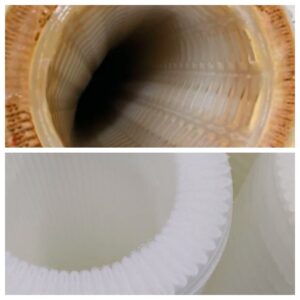
In many cases, removed cartridges show heavy fouling mainly concentrated on the outer pleat layer.
“Removed cartridges showed reddish-brown deposits concentrated mainly on the inlet surface while inner pleats remained relatively clean.”
What Usually Causes It
Poor MGF Backwash Efficiency
Insufficient backwash intensity or frequency may allow iron contaminants to accumulate inside the multimedia filter.
Over time, trapped iron particles may break through and enter downstream filtration stages.
Example:
“MGF backwash frequency increased significantly before cartridge fouling accelerated.”
Incomplete Iron Oxidation
If oxidation reactions are incomplete, dissolved iron may convert into extremely fine ferric colloids downstream.
These particles are often difficult to remove uniformly through standard filtration depth.
Example:
“Ferric fouling increased after oxidation chemical dosage adjustment.”
Iron Colloid Surface Blinding
Fine ferric particles frequently accumulate mainly on the cartridge surface instead of distributing gradually through the media depth.
Once surface pores become blocked, rapid ΔP increase occurs even though much of the internal filtration structure remains underutilized.
Example:
“Outer pleats formed a dense iron fouling layer while inner filtration layers remained partially unused.”
What Should Be Checked Onsite
Inspect Removed Cartridges
Check:
- fouling color
- reddish-brown deposits
- slime or dry contamination
- fouling penetration depth
- uneven loading patterns
【Onsite Evidence Suggestion】
- cartridge Disassemble the photo:
Review MGF and Operating Data
Review:
- MGF ΔP trend
- backwash frequency
- iron concentration trend
- turbidity fluctuation
- SDI changes
- oxidation dosing records
Rapid cartridge fouling often reflects unstable upstream iron control rather than cartridge structure alone.
Example:
“Iron concentration increased significantly during the rapid fouling period despite stable turbidity readings.”
Engineering Insight
In many systems, MGF iron carryover causes rapid cartridge fouling not because the total solids load is extremely high, but because fine ferric particles are too small to distribute evenly through the filtration depth.
Once iron colloids accumulate mainly on the outer filtration surface, premature surface blinding occurs rapidly.
This usually results in:
- unstable ΔP growth
- shortened cartridge lifetime
- uneven fouling distribution
- reduced dirt-holding utilization
| Onsite Symptom | Possible Cause | What to Check |
|---|---|---|
| Rapid ΔP increase | Surface blinding | Inspect outer pleat fouling |
| Reddish fouling layer | Iron carryover | Review MGF performance |
| Uneven cartridge loading | Flow maldistribution | Check contaminant penetration |
| Short filter life | MGF instability | Review backwash and iron trend |
FAQ
Why does iron carryover rapidly foul security filters?
Fine ferric particles often accumulate mainly on the cartridge surface instead of penetrating gradually through the filtration depth.
What does reddish-brown fouling usually indicate?
It often suggests ferric oxide or iron colloid contamination originating upstream from MGF or oxidation stages.
Can poor MGF backwash increase cartridge fouling?
Yes. Poor backwash performance may allow accumulated iron contaminants to break through downstream.
Engineering Perspective
In many RO pretreatment systems, rapid cartridge fouling caused by iron carryover is primarily a contaminant distribution problem rather than simply a filtration precision problem.
Stable depth loading and controlled upstream iron removal are often critical for maintaining stable ΔP behavior and extending cartridge lifetime.