🛑 Why Do High Flow Filters Clog Faster After UF Instability?
Core Cause: The Shift from "Deep Filtration" to "Surface Blocking"
- Impurity Leakage: Unstable UF (Ultrafiltration) causes a large number of tiny particles, colloids, and organic matter to breach the pretreatment defenses and flood into the security filter.
- Surface Blocking: Overloaded particles rapidly accumulate on the outer layer of the filter element, forming a dense cake layer.
- Sudden Pressure Drop: The cake layer clogs the filtration channels, resulting in a sharp reduction in the effective filtration area. The differential pressure (ΔP) enters a "rapid rise phase," drastically shortening the filter element’s lifespan.
💡 Solution Suggestion:
- Gradient Radial Structure: Using gradient density filter media allows some particles to penetrate deeper, mitigating surface blockage.
- Reinforced Support: Ensure the use of a one-piece external frame to prevent filter element deformation and bypass leakage during rapid pressure drops.
⚠️ Main Causes
1. Quantitative and Qualitative Changes in Impurity Loading
When a UF system experiences physical damage, incomplete chemical cleaning, or fluctuations in operating pressure, impurities that were originally trapped will flood downstream in large quantities:
- Leakage of colloids and organic matter: Damage to the integrity of the UF membrane can cause colloidal silica and large organic molecules to break through the barrier. These impurities have extremely strong adhesive properties and will quickly cover the filter element fiber surface like "glue."
- Influx of microparticles: Micron-sized suspended particles that should have been intercepted by the UF directly impact the security filter, causing the particle loading to instantly exceed the filter element’s design capacity.
2. The Malignant Transformation of the Filtration Mechanism from "Deep" to "Surface"
- Normal Conditions (Deep Filtration): The filter element achieves deep filtration through its gradient density structure. Particles penetrate the outer layer and are evenly distributed at various depths of the filter media. The pressure increase is slow and stable.
- UF Unstable State (Surface Clogging): Due to excessively high impurity concentration, a large number of particles rapidly accumulate on the outermost layer of the filter element, forming a dense "filter cake" with extremely poor permeability.
- Pore Clogging: Tiny colloids penetrate into the pores of the filter media surface and seal them off, preventing liquid from entering the deeper internal spaces. This results in a significant waste of the filter element’s internal dirt-holding capacity.
🔍 What Should Be Checked: An Engineering Diagnostic Logic
1. Ultrafiltration System Performance (UF Performance)
Since the security filter is the last line of defense in pretreatment, fluctuations in UF are the primary cause of scaling on the filter element surface.
- UF Backwash Frequency and Pressure: Check if the backwash frequency has increased and whether the transmembrane pressure differential (TMP) after backwashing returns to normal levels.
- Inlet SDI Trend: Record and analyze the Silt Density Index (SDI) at the security filter inlet. If SDI > 5 (for seawater desalination) or continues to rise, it indicates that the UF membrane may have physical damage or chemical fouling.
- Turbidity Fluctuations: Monitor the turbidity of the UF effluent in real-time. Even a small increase in turbidity (e.g., from 0.05 NTU to 0.2 NTU) means a massive wave of tiny particles is flowing towards the filter.
2. Water Chemistry and Chemical Dosing
- Flocculant/Coagulant Dosing Control: Check the dosage of FeCl3 or polymers. Overdosing causes unreacted chemicals to enter the pre-filter, forming a difficult-to-wash, sticky filter cake.
- Scale Inhibitor Compatibility: Ensure that the scale inhibitor does not react with upstream flocculants to form artificial precipitation.
3. Filter Cartridge Autopsy (Visual Inspection)
Removing the failed filter cartridge for visual inspection is a core part of the diagnostic framework:
- The Touch (Viscous or Dry?):
- Slimy: Usually suggests biological contamination (Bio-fouling) or an overdose of chemicals (sticky coating from bacterial slime, algae, or excessive flocculants).
- Dry/Gritty: Usually physical impurities, such as iron oxide scale, sand, or mineral deposits from pipeline rust.
- Contaminant Color:
- Reddish-brown: Iron oxide particles.
- Viscous colloid: Bacterial slime, organics.
- Powdered particles: Fine sand/minerals not intercepted by the UF.
- Deformation Inspection: Observe if the filter shows signs of flattening, twisting, or end cap detachment. If deformation occurs, the DP rose too quickly, exceeding the filter’s strength. (A series with a reinforced support cage is highly recommended here).
- Fouling Distribution (Uniform or Local?):
- Uniform Fouling: Flow channel design is reasonable; all filters bear the same load.
- Localized Fouling: Indicates poor flow distribution. Some cartridges fail prematurely due to overload, while others remain underutilized.
4. Operational Metrics Comparison
- DP Analysis: Record the initial pressure drop (new filter) and final pressure drop (replacement time). 2.5 Bar is the recommended terminal DP.
- Replacement Interval: Calculate the average lifespan. If the interval has shrunk to less than 2-4 weeks, systematic optimization is necessary.
⚙️ Product Structure Logic: Engineering the Upgrade
1. Gradient Density
- Problems Solved: Surface blocking and insufficient dirt-holding capacity.
- Structural Logic: The pore size gradually decreases from the outside to the inside. This "loose outside, tight inside" design allows large particles to be intercepted in the outer layer, while tiny particles penetrate deeper, converting the entire media thickness into effective dirt-holding space.
2. Depth Loading
- Problem Solved: Rapid increase in pressure drop (ΔP).
- Structural Logic: Unlike single-layer surface interception, multi-layer composite media achieves "three-dimensional filtration." Particles are distributed at different depths, delaying cake layer formation and keeping the DP curve stable.
3. Stable Pleat Structure
- Problems Solved: Limited filtration area and high flow rate impact.
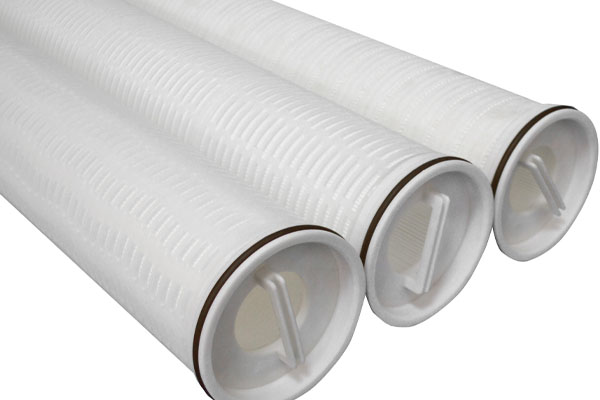
- Structural Logic: Advanced "W"-shaped folding technology significantly increases the effective filtration area (e.g., 8 m² in the HFM series). This lowers flow velocity per unit area and prevents media from agglomerating and causing dead zones.
4. Reinforced Cage
- Problems Solved: Filter cartridge deformation and bypass flow.
- Structural Logic: Employs an integrated high-strength outer frame design. Under strong internal pressure, the high-rigidity frame ensures the media does not deform under a 2.5 Bar DP, eliminating the risk of bypass leakage.
5. Optimized Flow Distribution
- Problems Solved: Localized clogging and low filter utilization.
- Structural Logic: Specially designed end caps ensure liquid is evenly distributed to each element. Optimized flow channels eliminate turbulence and dead zones, synchronizing the lifespan of the entire filter set.
❓ FAQ
Why does ΔP rise suddenly?
Sudden pressure drop (ΔP) spikes are typically caused by surface blocking. When particle loading exceeds the media’s capacity, a dense cake layer forms on the outer surface, drastically reducing the effective filtration area.
Can UF instability shorten filter life?
Yes. UF instability causes "breakthroughs" of colloids and fine particles that bypass upstream treatment. These contaminants overwhelm the security filter, forcing a shift from long-term depth filtration to rapid surface clogging.
What causes surface blinding?
Surface blinding is caused by excessive particle concentration or incompatible chemical dosing (like over-flocculation). It also occurs if a cartridge lacks a gradient density structure, failing to distribute particles into the deeper media layers.
📩 Action Required:
If your RO system is facing these issues, our engineering team provides free technical assessments. Our commitment: not just replacement, but upgrade.
✅ 100% Physical Compatibility: Directly replace your existing Pall, 3M, or Parker systems without modifying the piping.