How Gradient Density Media Stabilizes ΔP in High Flow Filtration Systems
Stable ΔP Growth Depends on Proper Contaminant Distribution
Gradient density media helps stabilize pressure drop (ΔP) by distributing contaminants gradually throughout the filtration depth instead of concentrating fouling only on the filter surface.
In many RO pretreatment and industrial filtration systems, unstable ΔP growth is often caused by premature surface blinding. Gradient density filtration structures are designed to improve contaminant penetration, increase dirt-holding utilization, and maintain more stable flow channels under varying solids loading conditions.
What Is Gradient Density Media?
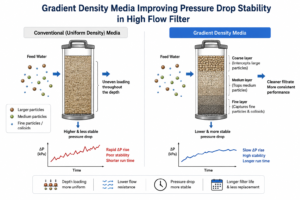
Gradient density media uses multiple filtration layers with progressively tighter pore structures.
Typically:
- outer layers capture larger particles
- middle layers retain medium-sized contaminants
- inner layers trap finer particles
This staged filtration approach helps prevent excessive contaminant accumulation on a single filtration layer.
Compared with uniform-density structures, gradient density media usually provides:
- slower ΔP increase
- improved dirt-holding capacity
- more stable filtration performance
- longer cartridge service life
Why Standard Surface Loading Causes Rapid ΔP Increase
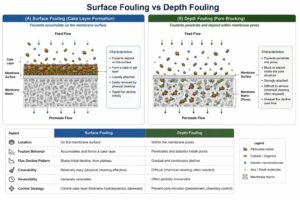
In conventional surface-loading filters, contaminants accumulate mainly on the outer media layer.
Once the surface pores become blocked:
- flow resistance increases rapidly
- ΔP rises sharply
- effective filtration area decreases
- cartridge life shortens significantly
This is especially common in systems with:
- colloidal fouling
- sticky organics
- unstable UF permeate quality
- high suspended solids loading
![Surface fouling compared with depth loading filtration behavior]
—
How Gradient Density Media Improves ΔP Stability
1. Gradual Contaminant Penetration
Instead of trapping all contaminants immediately at the outer surface, gradient density media allows particles to distribute progressively through the filtration depth.
This helps:
- reduce localized fouling
- improve media utilization
- maintain stable flow distribution
- slow pressure rise
As a result, the cartridge experiences more controlled ΔP growth over time.
2. Reduced Surface Blinding
Surface blinding occurs when contaminants rapidly block the outer filtration layer.
Gradient density structures reduce this effect by allowing larger particles to be captured earlier while finer particles penetrate deeper into the media structure.
This helps maintain open flow channels longer during operation.
3. Improved Dirt-Holding Capacity
Because contaminants distribute more evenly throughout the filter depth, gradient density media typically achieves higher dirt-holding utilization.
This may help:
- extend replacement intervals
- reduce cartridge consumption
- improve operational stability
- lower total filtration cost
In many RO pretreatment systems, dirt-holding performance directly affects cartridge lifetime stability.
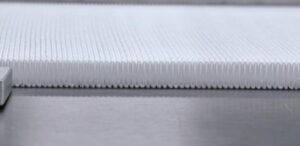
![Depth loading structure inside pleated high flow filter cartridge]
—
4. More Stable Flow Distribution
Uneven contaminant accumulation can create localized blockage zones inside the cartridge.
Gradient density structures help maintain more uniform flow distribution across the filtration surface.
Stable flow channels often reduce:
- sudden ΔP spikes
- uneven fouling
- premature collapse risk
- localized overload conditions
This becomes especially important in high-flow industrial applications.
Why Gradient Density Media Matters in RO Pretreatment
In RO pretreatment systems, filtration conditions often fluctuate because of:
- UF instability
- SDI variation
- seasonal algae blooms
- colloidal breakthrough
- raw water quality changes
Under these unstable conditions, standard surface-loading filters may foul rapidly.
Gradient density filtration structures are often better suited for handling variable contaminant loading because they improve contaminant distribution throughout the cartridge depth.
This may help operators maintain:
- more stable ΔP behavior
- longer cartridge life
- fewer replacement interruptions
- improved RO protection
Surface Fouling vs Gradient Depth Loading
| Filtration Behavior | Surface Loading | Gradient Depth Loading |
|---|---|---|
| Contaminant distribution | Mainly outer surface | Distributed through media depth |
| ΔP behavior | Rapid increase | More stable growth |
| Dirt-holding utilization | Lower | Higher |
| Cartridge lifetime | Shorter | Longer |
| Fouling pattern | Localized | More uniform |
Engineering Recommendations for Stable ΔP Operation
Optimize Pretreatment Stability
Stable upstream pretreatment significantly improves filter performance.
Recommended monitoring areas include:
- UF permeate quality
- SDI fluctuations
- turbidity spikes
- colloidal loading trends
Avoid Excessive Surface Loading
Operators should evaluate:
- coagulant dosing
- biological fouling control
- suspended solids concentration
- seasonal contaminant variation
Reducing sticky fouling helps improve depth-loading behavior.
Select Media Structure Based on Fouling Characteristics
Filtration structure selection should consider:
- particle size distribution
- contaminant type
- solids loading behavior
- operational stability requirements
In many systems, media structure design is more important than simply selecting tighter micron ratings.
How Optimized High Flow Filter Structures Improve Operational Stability
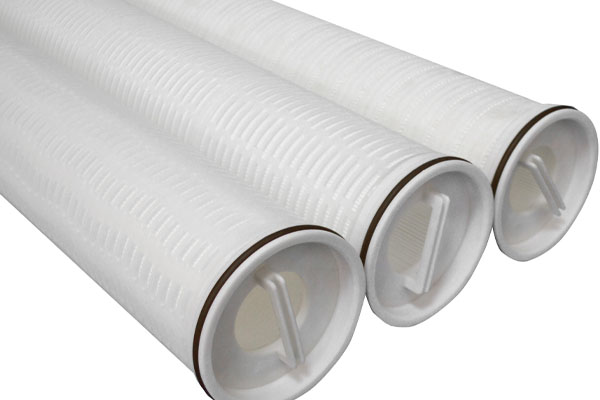
High flow filters designed with gradient density media and reinforced pleat structures can help maintain stable filtration behavior under varying contaminant conditions.
Compared with conventional surface-loading designs, optimized depth-loading structures may help:
- stabilize ΔP growth
- reduce premature fouling
- improve contaminant distribution
- extend cartridge replacement cycles
For industrial RO pretreatment systems, stable depth-loading performance is often critical for reducing operational instability and protecting downstream membranes.
—
FAQ
What is gradient density media?
Gradient density media uses multiple filtration layers with progressively tighter pore structures to distribute contaminants more evenly throughout the filter depth.
Why does gradient density media reduce rapid ΔP increase?
Because contaminants are distributed gradually instead of accumulating only on the outer surface, flow resistance increases more slowly over time.
How does gradient density media improve dirt-holding capacity?
By utilizing more of the filtration depth, contaminants spread throughout the media structure instead of blocking only the surface layer.
Is gradient density media better for unstable RO pretreatment conditions?
In many cases, yes. It is often more effective at handling fluctuating solids loading and colloidal fouling conditions.
Engineering Support for Stable High Flow Filtration
If your filtration system is experiencing unstable ΔP increase or rapid cartridge fouling, engineering evaluation should focus on:
- contaminant loading behavior
- fouling characteristics
- pretreatment stability
- depth-loading performance
- media structure optimization
Stable contaminant distribution is often the key to improving high flow filtration performance and extending cartridge lifetime.