Why Do High Flow Filters Clog Faster After UF Instability?
Rapid Filter Fouling Often Begins with UF Performance Fluctuation
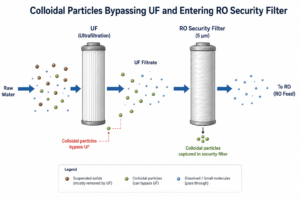
High flow filters frequently clog faster after ultrafiltration (UF) instability because more colloidal particles, suspended solids, and organic contaminants bypass the UF system and enter the downstream security filter.
In many RO pretreatment systems, the high flow cartridge becomes the first component reacting to unstable UF permeate quality. Once contaminant loading exceeds the filter’s depth-loading capacity, rapid surface fouling occurs, causing accelerated ΔP increase and shortened cartridge life.
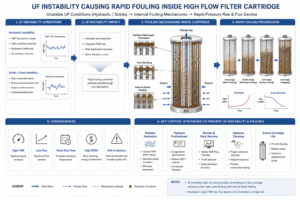
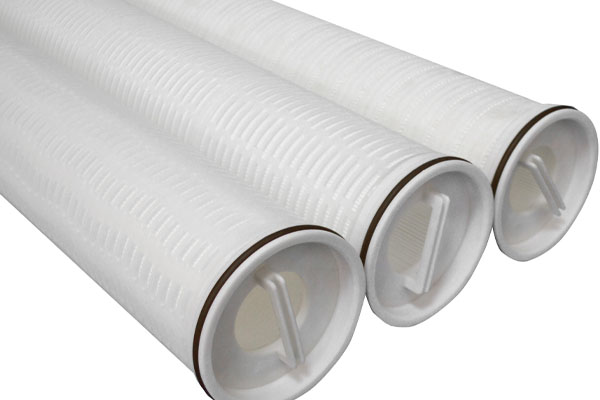
[UF instability causing rapid fouling inside high flow filter cartridge]
Main Causes of Rapid High Flow Filter Fouling After UF Instability
1. Increased Colloidal Particle Carryover
When UF performance weakens, fine colloidal particles can pass through the membrane system and accumulate rapidly inside the high flow cartridge.
These particles are often difficult to capture evenly because of their extremely small size and unstable distribution.
Typical symptoms include:
- sudden ΔP increase
- uneven fouling patterns
- reduced cartridge lifetime
- unstable flow behavior
In many desalination plants, operators notice cartridge fouling increasing rapidly shortly after UF backwash inefficiency or membrane integrity problems appear.
![Colloidal particles bypassing UF and entering RO security filter]
—
2. Organic Fouling and Biological Loading
UF instability may also allow higher levels of organic contaminants and biological material to pass downstream.
This is especially common during:
- algae bloom seasons
- warm water conditions
- surface water fluctuations
- insufficient UF cleaning cycles
Organic contaminants often form sticky fouling layers on the cartridge surface, reducing effective filtration area and accelerating pressure drop growth.
3. Surface Blinding Instead of Depth Loading
Under stable operating conditions, high flow filters are designed to distribute contaminants gradually through the media depth.
However, after UF instability, excessive contaminant loading may concentrate mainly on the outer media surface.
This creates:
- premature surface blinding
- localized fouling
- sharp ΔP increase
- poor dirt-holding utilization
Once the outer layer becomes blocked, flow resistance increases rapidly even though much of the internal media remains unused.
4. Sudden SDI and Turbidity Fluctuations
UF instability often causes rapid changes in SDI and turbidity levels entering the RO pretreatment stage.
These fluctuations may overload the cartridge filtration structure and create unstable fouling behavior.
Operators frequently observe:
- unstable replacement intervals
- inconsistent ΔP trends
- abnormal contaminant accumulation
- shortened operating cycles
In many systems, SDI fluctuations are one of the earliest indicators of UF instability.
Why the Security Filter Reacts First
The high flow security filter usually responds faster than other downstream equipment because it directly captures contaminants escaping from upstream pretreatment stages.
When UF conditions fluctuate, the cartridge immediately experiences:
- higher solids loading
- uneven particle distribution
- rapid fouling concentration
- unstable flow channels
This is why rapid cartridge clogging is often a system stability issue rather than simply a filter quality issue.
Surface Fouling vs Stable Depth Loading
Surface Fouling
Characteristics:
- contaminants accumulate mainly on the outer surface
- rapid ΔP increase
- short cartridge life
- low media utilization
Common after sudden UF instability.
Stable Depth Loading
Characteristics:
- contaminants distribute gradually through media depth
- slower ΔP increase
- improved dirt-holding capacity
- more stable filtration behavior
Stable depth loading is preferred for RO pretreatment systems.
Engineering Recommendations to Reduce Rapid Fouling
Improve UF Stability
Operators should focus on:
- UF membrane integrity monitoring
- optimized backwash cycles
- stable permeate quality
- SDI control
Stable UF operation often has the greatest impact on cartridge lifetime.
Monitor ΔP Trends Continuously
Rapid ΔP increase often appears earlier than visible water quality problems.
Continuous monitoring helps identify:
- UF performance drift
- colloidal breakthrough
- abnormal fouling behavior
- pretreatment instability
Reduce Organic and Biological Loading
Recommended actions may include:
- improving upstream clarification
- optimizing coagulant dosage
- controlling biological growth
- stabilizing raw water intake conditions
Reducing sticky contaminants helps minimize premature surface blinding.
Optimize Filter Media Structure
Gradient-density media structures may help:
- improve contaminant distribution
- reduce localized fouling
- stabilize ΔP increase
- improve dirt-holding utilization
In many applications, filtration structure design is more important than simply tightening micron rating.
![Gradient density media helping stabilize fouling behavior]
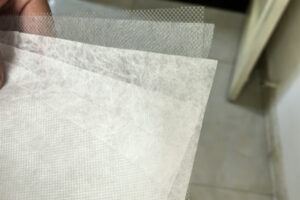
How Optimized High Flow Filters Help Stabilize RO Pretreatment
High flow filters designed with stable pleat geometry and reinforced filtration structures can help maintain more uniform flow distribution under fluctuating contaminant loading conditions.
Compared with conventional surface-loading designs, optimized depth-loading structures may help:
- reduce premature fouling
- improve contaminant penetration
- stabilize cartridge lifetime
- lower replacement frequency
For RO systems operating under unstable pretreatment conditions, structural stability becomes critical for maintaining filtration performance.
Recommended Comparison Table
| UF Condition | Filter Fouling Behavior | ΔP Trend | Cartridge Lifetime |
|---|---|---|---|
| Stable UF operation | Gradual depth loading | Stable ΔP growth | Longer |
| UF instability | Surface blinding | Rapid ΔP increase | Shorter |
FAQ
Why do high flow filters clog suddenly after UF instability?
UF instability allows more colloidal particles and organic contaminants to pass downstream, rapidly increasing filter fouling and pressure drop.
Can poor UF backwash performance affect cartridge life?
Yes. Inefficient UF cleaning may increase contaminant carryover and shorten downstream filter lifetime significantly.
Why does ΔP rise faster after SDI fluctuations?
Rapid SDI changes often indicate unstable solids loading entering the cartridge, causing uneven fouling and accelerated pressure increase.
Is rapid cartridge fouling always caused by poor filter quality?
Not necessarily. In many cases, rapid fouling reflects unstable upstream pretreatment conditions rather than cartridge structure alone.
Engineering Support for UF and RO Pretreatment Optimization
If your high flow filters are clogging rapidly after UF instability, system-level evaluation should focus on:
- UF permeate stability
- SDI fluctuation trends
- colloidal fouling behavior
- biological loading
- filter media structure
- depth-loading performance
Improving upstream stability is often the most effective way to extend cartridge life and stabilize RO pretreatment operation.