
How are "absolute accuracy" and "nominal accuracy" defined in laboratory testing and industrial applications?
You bought a 10-micron filter, but your analysis shows 15-micron particles are still contaminating your system. This confusing rating game is costing you money and product quality.
An "absolute" rating is a performance guarantee, meaning the filter removes at least 99.9% of particles at a specific micron size. A "nominal" rating is an estimate, indicating the filter removes a majority, like 85%, of particles at that size.
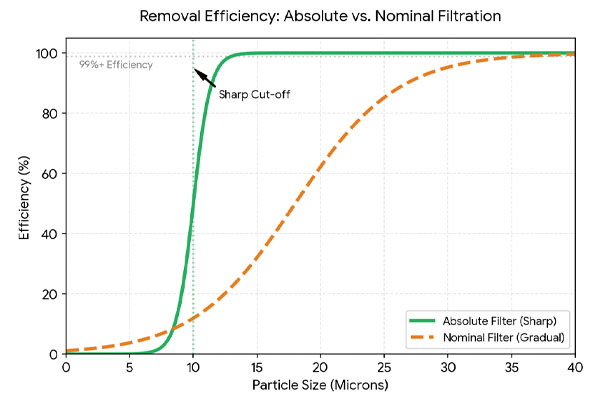
When I was just starting out, I learned this lesson the hard way. A client was upset because the "5-micron" filters I recommended were letting larger particles through, threatening their sensitive RO membranes. They were nominal-rated filters, which I thought was sufficient for pre-filtration. I had to explain that a "5-micron nominal" rating doesn’t promise to stop all 5-micron particles, just most of them. It was a difficult conversation, but it taught me that clearly defining these terms isn’t just technical jargon; it’s about managing expectations and protecting a client’s process. The difference between absolute and nominal isn’t just in the lab—it has real financial consequences on the plant floor.
What does an "absolute" rating really guarantee?
Your process cannot tolerate any oversized particles. A single failure could ruin a batch or damage critical equipment. You need a filter rating that is a reliable promise, not a suggestion.
An absolute rating guarantees a specific, high level of filtration efficiency, typically defined by a Beta Ratio. For example, a filter rated "absolute at 5 microns" will remove 99.9% or more of all particles 5 microns and larger.
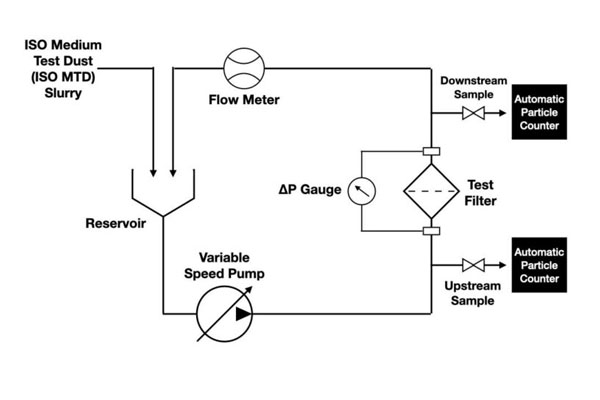
An absolute rating is all about verifiable performance. It’s not an opinion; it’s a number backed by standardized testing, usually a multi-pass test like ISO 16889. In this test, fluid containing particles of a known size distribution is passed through the filter multiple times. We count the particles upstream (before the filter) and downstream (after the filter) to calculate the Beta Ratio. The Beta Ratio is simply the number of upstream particles divided by the number of downstream particles. A higher Beta Ratio means higher efficiency. For a filter to earn an "absolute" rating, it must achieve a very high Beta Ratio at its stated micron size. For example, our High-Flow filters often have a Beta 5000 rating, which means they are 99.98% efficient. You choose an absolute-rated filter for critical applications where you need a performance guarantee, such as protecting delicate machinery or ensuring final product purity.
Understanding Beta Ratio and Efficiency
| Beta Ratio (β) | Removal Efficiency (%) | What it Means |
|---|---|---|
| β 200 | 99.5% | For every 200 particles upstream, 1 gets through. |
| β 1000 | 99.9% | For every 1000 particles upstream, 1 gets through. |
| β 5000 | 99.98% | For every 5000 particles upstream, 1 gets through. |
Why would you ever choose a "nominal" filter?
Your budget is tight, and you’re dealing with a high volume of dirt. An expensive absolute-rated filter would clog too quickly, but you still need to clean up your fluid.
Nominal-rated filters are a cost-effective solution for bulk particle removal. They are perfect for pre-filtration duties, where they protect more expensive absolute filters downstream by capturing the majority of larger contaminants.
A nominal rating is less precise but very useful. Think of it as a general guideline. A filter with a "10-micron nominal" rating will capture a good percentage, maybe 80% or 90%, of 10-micron particles. The problem is that there is no industry standard for what "nominal" means. One company’s 90% might be another’s 75%. So why use them? Because they are excellent workhorses for removing a large amount of dirt at a low cost. I often design two-stage systems for clients. We might use an inexpensive 20-micron nominal filter as a first pass to catch all the big "rocks and sticks." This takes the heavy load off a 5-micron absolute filter downstream, which can then focus on removing the fine particles. This approach is far more economical. The nominal filter drastically extends the life of the expensive absolute filter, saving a lot of money on replacements and labor over time. It’s not a lesser filter; it’s a strategic tool for a different job.
Conclusion
Absolute filters provide a guaranteed level of purity for critical final-stage applications. Nominal filters offer a cost-effective way to handle bulk removal, perfectly suited for pre-filtration tasks.