What are the differences between side-stream and full-flow filtration in terms of system design and cartridge load?
Choosing between full-flow and side-stream filtration is confusing. The wrong choice leads to oversized systems, high costs, or ineffective cleaning, hurting both your budget and performance.
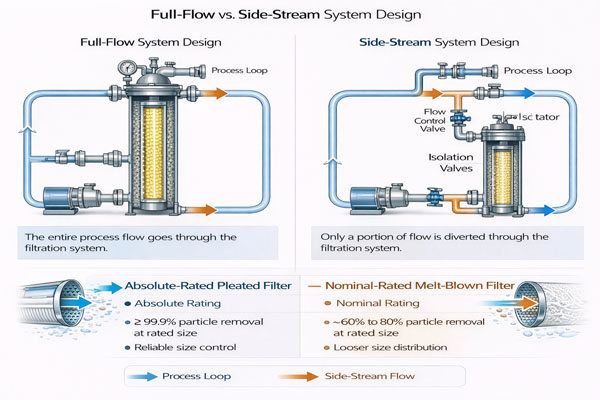
Full-flow filtration treats 100% of a system’s flow rate, requiring large filters to handle the full load. Side-stream filtration treats only a small portion (5-20%) of the flow in a separate loop, gradually cleaning the entire system with smaller equipment.
I remember a project for a large cooling tower system. The client initially wanted a massive full-flow filtration unit installed on their main circulation line. When we calculated the size of the housing and the sheer number of high-flow cartridges needed, the cost was huge. I asked them a simple question: "Why do you need to filter every single drop of water on every pass?" That question opened the door to discussing a much more efficient side-stream approach. To make the right call for your own system, you first need to understand exactly how each method works and where it is most effective.
How Does Full-Flow Filtration Work and When Is It Necessary?
Your critical equipment has zero tolerance for contamination. A single stray particle could cause a catastrophic failure, leading to expensive repairs and even more expensive downtime.
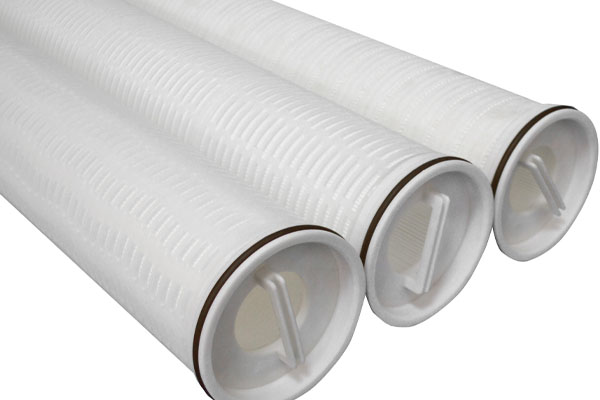
A full-flow filter is installed directly in the main process line, treating the entire fluid stream before it reaches sensitive components. This design is essential for protecting equipment like RO membranes or heat exchangers, where immediate and complete particle removal is non-negotiable.
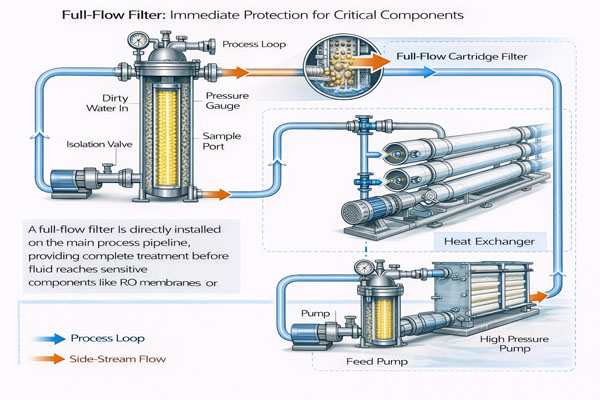
Think of full-flow filtration as your system’s primary guardian. It stands directly in the path of the fluid and acts as a barrier. Every drop of liquid must pass through the filter media before it moves on. This is a brute-force approach, but it is absolutely necessary in many situations. For example, in an RO pre-filtration system, you cannot risk letting any silt or debris reach the delicate RO membranes. One mistake could lead to permanent fouling. The system design is straightforward: you size a filter housing and the cartridges inside to handle the maximum flow rate of your main process line. If your pump moves 1,000 gallons per minute, your filter must be able to handle 1,000 gallons per minute. This often means a large physical footprint, a significant initial investment, and a higher operational cost due to the intense load on the cartridges. Every particle in the entire flow hits the filters on every pass, which means they can clog up faster. But for critical protection, it is the only way to guarantee the fluid is clean.
What Makes Side-Stream Filtration a Smart Choice for Large Systems?
You need to maintain cleanliness in a huge volume of fluid, like in a cooling tower or chilled water loop. A full-flow filter for such a system would be enormous and incredibly expensive.
Side-stream filtration is smart for large recirculating systems because it treats a small percentage of the flow (e.g., 5-10%) on a separate loop. This lets you use a much smaller, cheaper filter system to gradually clean the entire volume over time.
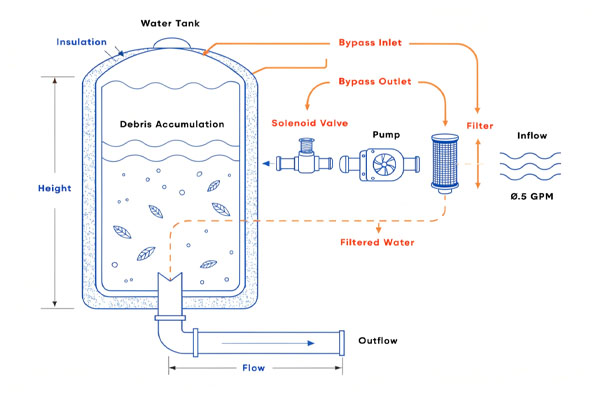
Side-stream filtration is all about maintenance and long-term cleanliness, not immediate critical protection. It is the perfect solution for large, closed-loop or recirculating systems where the main goal is simply to prevent dirt and contaminants from building up. Instead of trying to filter the entire massive flow, you install a small filter system on a separate bypass loop. This loop continuously pulls a small portion of the water out of the main system, cleans it very well, and then returns it. Over several hours, the entire volume of water gets turned over and filtered. This method keeps the overall system clean without the massive cost and complexity of a full-flow unit. For an engineer like Jacky working on a power plant’s cooling water system, this is a game-changer. The system design is much simpler, requiring only a small booster pump and a compact filter housing. The load on the cartridges is much lower and more consistent, which means they last much longer and reduce maintenance costs.
How Do You Calculate Cartridge Load for Each Filtration Type?
You need to choose the right number of filter cartridges for your system. Guessing wrong means you will either be doing frequent, costly change-outs or wasting money on a system that is too big.
For full-flow, divide the main system’s total flow rate by the single cartridge’s recommended flow rate. For side-stream, first calculate the required side-stream flow based on your desired turnover rate, then divide that smaller flow by the cartridge’s capacity.
Calculating the number of cartridges you need is a critical step in system design. The math is different for each method, but it is straightforward.
Full-Flow Calculation
This is a direct calculation. You simply take the total flow rate of your main pipe and divide it by the ideal flow rate for a single filter cartridge.
- Formula:
Number of Cartridges = Total System Flow Rate / Recommended Flow per Cartridge - For example, if your system runs at 500 m³/hr and each of our high-flow cartridges can handle 50 m³/hr effectively, you would need
500 / 50 = 10cartridges in your housing. It is always better to use the recommended flow rate, not the absolute maximum, to ensure longer filter life.
Side-Stream Calculation
This requires two simple steps. First, you decide how quickly you want to "turn over" or filter the entire system volume.
- Step 1: Find the side-stream flow rate. Imagine you have a 100,000-liter cooling tower basin and you want to turn over the entire volume every 5 hours. Your required flow rate is
100,000 L / 5 hr = 20,000 L/hror 20 m³/hr. - Step 2: Calculate cartridges. Using the same cartridge that handles 50 m³/hr, you would only need
20 / 50 = 0.4. In this case, just one cartridge is more than enough.
Conclusion
Full-flow offers critical, immediate protection by filtering 100% of the stream. Side-stream provides cost-effective, long-term maintenance for large, recirculating systems by cleaning a small portion over time.