How does a biofilm form inside the pipe? How does it cause filter clogging?
Your water looks crystal clear, yet your filters are clogging at an alarming rate with a strange, slimy gunk. You’re facing costly downtime and can’t find the source.
This is the work of biofilm. It forms when bacteria attach to pipe surfaces, creating a protective slime. Chunks of this slime detach, travel downstream, and plaster themselves over your filter media, causing a rapid and catastrophic blockage.
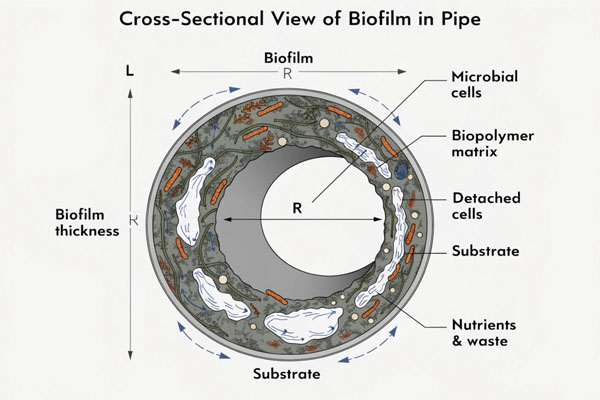
I’ll never forget a visit to a food processing plant that was having this exact problem. They were fanatical about hygiene. Their water analysis reports showed no issues, and their stainless steel pipes were sparkling on the outside. But every few days, the high-flow filters protecting their bottle-washing station would fail. The differential pressure would shoot up for no reason. When we pulled the cartridges, they were covered in this clear, gelatinous slime. It didn’t look like dirt. It felt slick and was incredibly hard to wash off. The plant manager was frustrated, thinking we had sold him faulty filters. It took some convincing to explain that the problem wasn’t the water or the filter; it was an invisible factory of slime growing right inside his pristine-looking pipes.
How Does an Invisible Threat Grow in Your Pipes?
You can’t see any dirt in your pipes, and your water tests clean. Yet, you’re being told that a hidden colony of bacteria is growing inside them, ready to cause havoc.
Biofilm formation is a multi-stage process. It begins when a few free-floating bacteria land on a pipe surface. They anchor themselves, multiply, and start secreting a sticky, protective slime that allows the colony to grow and mature.
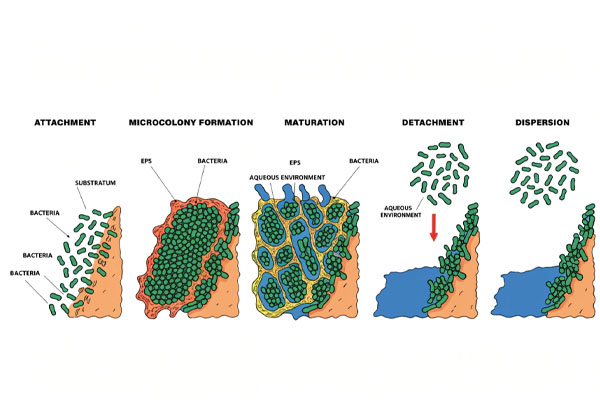
Think of it like a city being built. It doesn’t happen all at once. It starts small. At first, a few lone "planktonic" bacteria just floating by in the water current decide to land on the pipe surface. This initial attachment is weak and reversible. But if they stay, they put down roots and the attachment becomes permanent. This is when they start building. They secrete a substance called EPS, or Extracellular Polymeric Substances. This is the slime. It’s a complex and incredibly effective mix of sugars, proteins, and DNA that acts like both the bricks and mortar of their city. This sticky matrix protects the bacteria from chemicals and traps passing nutrients, allowing more bacteria to join and the colony to grow from a small village into a sprawling, three-dimensional metropolis with its own internal channels for water and nutrients.
The Five Stages of Biofilm Growth
| Stage | Description | What’s Happening |
|---|---|---|
| 1. Initial Attachment | A few free-floating bacteria land on a surface. | Weak, reversible bonding. Bacteria can still leave. |
| 2. Irreversible Attachment | Bacteria anchor themselves firmly. | The "pioneers" decide to stay and build. |
| 3. Maturation I | Bacteria multiply and start producing EPS slime. | Microcolonies form. The "city" foundation is laid. |
| 4. Maturation II | A complex 3D structure develops. | The mature biofilm "city" is established and growing. |
| 5. Dispersion | Chunks of biofilm break off. | The city sends out colonists to start new biofilms elsewhere. |
Why Is Biofilm So Deadly for High-Flow Filters?
You understand that biofilm is a slime. But you may not realize just how efficiently this slime can blind your expensive high-flow filters, often much faster than regular dirt or silt.
Biofilm doesn’t clog filters by gradually filling up pores like silt. Instead, large, slimy, and deformable chunks break off and slap onto the filter’s surface, creating a non-porous layer that instantly blocks flow and causes pressure to skyrocket.
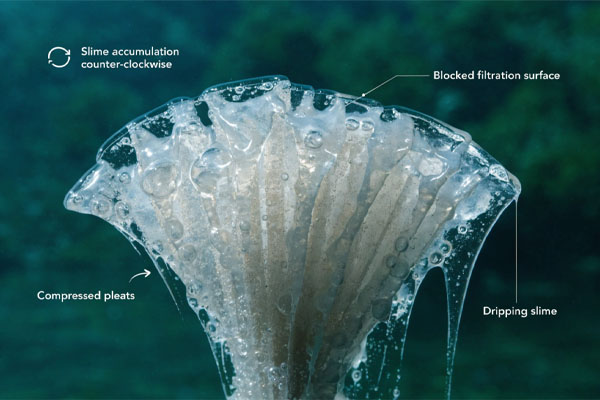
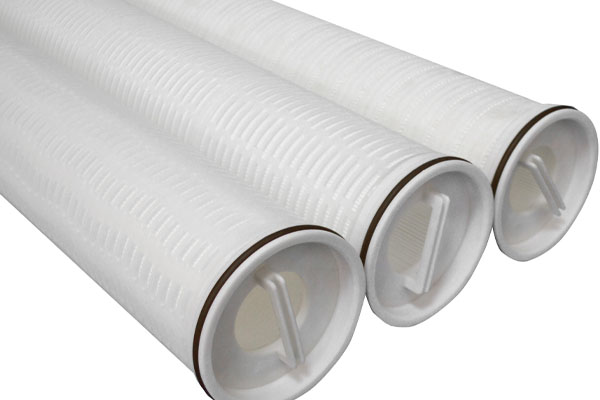
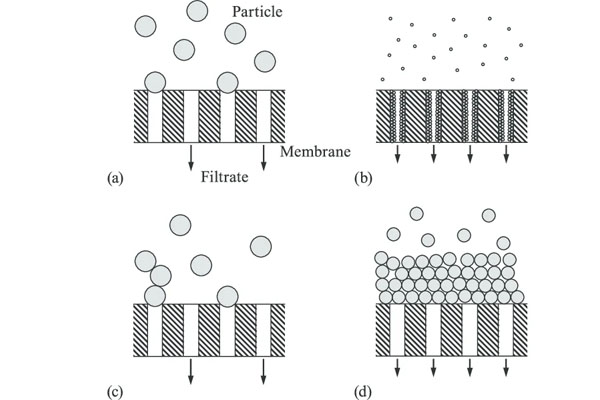
This is a completely different fouling mechanism called "surface blinding." Normal particulate fouling, from things like sand or rust, is a process of "depth loading." The particles are rigid and get trapped within the depth of the filter media. The pressure rises slowly and predictably as the filter fills up. Biofilm is an ambush predator. When a large, gelatinous chunk from the dispersion stage hits the filter pleats, like on our Ecofiltrone HFK series, it doesn’t get trapped in the pores. The water pressure flattens it out like spreading jelly on toast. It smears across the surface, instantly blocking hundreds of thousands of pores at once. Because the EPS slime is sticky and non-porous, water simply cannot get through. This is why you see the differential pressure gauge go from green to red in minutes or hours, not days or weeks.
Biofilm Fouling vs. Particulate Fouling
| Characteristic | Biofilm Fouling | Particulate (Silt) Fouling |
|---|---|---|
| Mechanism | Surface Blinding | Depth Loading |
| Fouling Material | Soft, slimy, deformable chunks | Hard, rigid, individual particles |
| Clogging Speed | Very Fast (Minutes to Hours) | Gradual (Days to Weeks) |
| Pressure Profile | Sudden, catastrophic spike | Slow, linear, predictable increase |
| Appearance | Gelatinous, slimy coating | Discoloration, particles visible in media |
How Can You Fight Back Against Biofilm?
You’ve finally identified biofilm as the enemy. But it feels like you’re fighting an invisible monster that keeps growing back, no matter how many filters you replace.
A successful strategy involves a dual approach. First, physically remove and chemically kill the existing biofilm. Second, create conditions in your system that prevent it from growing back, using regular sanitization and smart system design.
You cannot win this fight with filtration alone. Filters only catch the chunks that break off; they don’t solve the root problem growing in your pipes. The first step is an aggressive clean-in-place (CIP) procedure. This usually involves flushing the system with a strong alkaline cleaner to break down the EPS slime, followed by an acid wash, and then a thorough rinse. Once the system is physically clean, you must sanitize it to kill any remaining bacteria. Common biocides include chlorine, chlorine dioxide, ozone, or peracetic acid. For an engineer like Jacky, the real work begins after the cleaning. The key to long-term control is prevention. This means implementing a regular, low-level sanitization schedule, ensuring adequate flow rates throughout the entire piping system to avoid stagnant "dead legs" where bacteria love to settle, and designing systems with smooth, easy-to-clean pipes.
Conclusion
Biofilm is a hidden threat, a bacterial colony in your pipes that sheds slime and causes rapid filter failure. Winning this battle requires proactive cleaning, chemical sanitization, and smart system design.