SWRO Extreme Water Quality Survival Guide: How SWRO Plants Can Prevent Catastrophic Pre-Filter Collapse During Red Tides & Sandstorms
In daily Seawater Reverse Osmosis (SWRO) operations, the ultimate fear isn’t high salinity—it’s sudden, extreme Total Suspended Solids (TSS) spikes caused by Red Tides (algal blooms) and sandstorms.
During these extreme events, conventional pre-treatment systems (MMF or UF) are often overwhelmed. The cartridge filters then become the final, critical barrier protecting the expensive RO membranes. However, over 70% of plants experience catastrophic failure at this exact stage.
Here is the practical breakdown of why this happens and how to engineer a solution that survives the surge.
1. The Invisible Killer of Red Tides: TEP (Transparent Exopolymer Particles)
When a Red Tide occurs, the problem isn’t just the increased algae cell count; it’s the massive release of TEP from dead algae and metabolic processes. These are extremely sticky, gel-like biopolymers.
- The Failure: Standard melt-blown or densely pleated filters suffer from immediate "Surface Blinding" upon contact with TEP. Water cannot penetrate the media, causing the differential pressure (ΔP) to spike from 0.1 bar to over 2.5 bar within just 2 to 4 hours.
- The Consequence: Under massive pressure without a high-strength core, the filter cartridge physically collapses or deforms. TEP and dead algae instantly bypass the filter, triggering severe biofouling in the RO system and leading to irreversible chemical CIP (Clean-In-Place) or total membrane replacement.
TEP (Transparent Exopolymer Particles) are highly sticky, gel-like biopolymers (Learn more about TEP biopolymer characteristics)
https://www.google.com/search?q=https://www.sciencedirect.com/topics/engineering/transparent-exopolymer-particles
2. The Physical Impact of Sandstorms: Fine Silt Overload
Sandstorms introduce massive amounts of ultra-fine inorganic silt into the intake seawater, rapidly filling the filter’s void volume.
- The Failure: ΔP rises exponentially. Under the dual stress of high flow velocity and extreme pressure, inferior filter media experiences tearing. Abrasive particles then bypass directly into the high-pressure pumps, severely wearing down pump impellers and scratching the RO membrane surfaces.
3. ecofiltrone’s Practical Solution: Surviving the "ΔP Strike"
Under extreme TSS loading, a filter’s job isn’t to "never clog" (which defies physics). Its job is to hold the line, refuse to collapse, and prevent bypass until operators can switch to standby systems. To solve this, our filter design adheres to strict industrial standards:
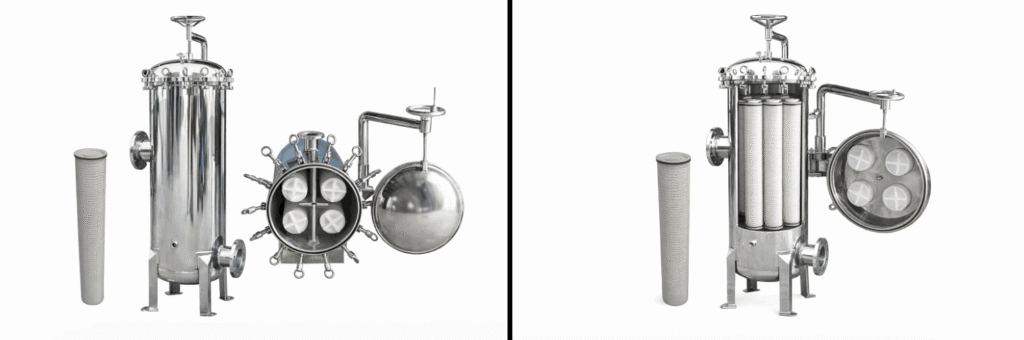
- Rigid Core Technology: We completely abandon the fragile, thin-walled cores common in the market. ecofiltrone High Flow filters feature an integrated heavy-duty center core capable of withstanding sudden ΔP shocks exceeding 3.5 bar. This ensures 100% structural integrity, buying your control room crucial time to adjust dosing or switch trains.
- Wide-Pleat & Gradient Depth Media: Engineered specifically for the sticky nature of TEP, we optimized the pleat pitch to prevent "pleat crowding." This allows viscous organics to penetrate deep into the media bed rather than sealing the surface, extending filter survival time during extreme conditions from mere hours to several days.
Technical Comparison: Handling Algal Bloom Stress
Conclusion: In an SWRO system, a cartridge filter is not just a consumable; it is the "mechanical fuse" for multi-million-dollar equipment. Ensure your fuse doesn’t set fire to your core assets before it blows.