⚡"Low-carbonization" and energy-saving optimization of seawater desalination systems
📌 Executive Summary (For Plant Managers):
- The Bottleneck: The High-Pressure (HP) Pump accounts for 30% to 50% of an SWRO plant’s total energy cost.
- The Energy Trap: 80% of the HP pump’s energy fights natural osmotic pressure. The remaining 20% fights membrane resistance.
- The Fatal Flaw: Cheap, nominal-rated security filters allow 1-5 micron colloids to bypass. This creates a micro-fouling layer on the RO membrane, forcing the HP pump to ramp up feed pressure by 2-3 Bar to maintain flow.
- The Solution: Upgrading to ecofiltrone Absolute (Beta 5000) High-Flow Cartridges guarantees zero colloidal bypass. This prevents RO micro-fouling, locks your HP pump at its lowest possible feed pressure, and drastically reduces your plant’s kWh/m³ footprint.
Engineering Logic: The Specific Energy Consumption (SEC) of an SWRO plant is a function of total dynamic head. While osmotic pressure is a thermodynamic constant, Membrane Resistance is an operational variable. By utilizing Absolute Beta 5000 High-Flow Cartridges, plants eliminate sub-micron colloidal fouling, preserving the membrane’s design permeability and preventing the High-Pressure Pump from ramping up 2-3 Bar of wasted energy.
As a filtration diagnostic specialist auditing global SWRO facilities, I constantly see Plant Managers investing millions in Isobaric ERDs (Energy Recovery Devices) and high-efficiency motors to hit their decarbonization targets.
Yet, they are missing the most critical hydrodynamic bottleneck in their entire plant.
If you want to push your energy limits, you must stop looking at the pump, and start looking at what you are feeding it. Here is the engineering reality of how a "cheap" filter is sabotaging your OPEX.
1. The SWRO Bottleneck: The Physics of the HP Pump
Why does the High-Pressure Pump consume up to 50% of your plant’s electricity? It comes down to basic thermodynamics.
To produce fresh water, the HP pump must overcome the ocean’s natural Osmotic Pressure (typically 25 to 30 Bar). You cannot change physics; that energy expenditure is fixed.
However, the pump must also overcome the Physical Resistance of the RO membrane itself. This is the only variable you can control. If the membrane is perfectly clean, the resistance is low. If it is dirty, the resistance skyrockets.
2. The Fatal Chain Reaction: Why the HP Pump Surges
What does a plastic filter housing have to do with the HP pump’s energy consumption? Everything.
When a plant uses standard, cheap security filters to "save money," a lethal chain reaction begins:
- The Bypass: Cheap filters use "nominal" ratings. They visually clear the water but allow invisible 1-5 micron colloids and organic matter to slip through.
- The Micro-Fouling: These bypassed particles do not immediately block the RO feed spacer. Instead, they form a highly compressible, microscopic "cake layer" directly on the membrane surface, drastically reducing its water permeability (the A-Value).
- The Energy Spike: To maintain the plant’s promised permeate flow against this newly fouled membrane, the DCS (Distributed Control System) has no choice. It forces the HP Pump to ramp up the feed pressure by an extra 2 to 3 Bar.
Every extra Bar of pressure generated by a massive SWRO High-Pressure Pump burns catastrophic amounts of megawatts. You are burning raw electricity to push water through dirt that your security filter should have caught.
3. What NOT to Use: The "False Economy" Filters
To achieve extreme energy optimization, you must ban these filters from your plant:
- Nominal Melt-Blown/Pleated PP: They bleed fine colloids, guaranteeing RO micro-fouling.
- High Initial DP Filters: If a filter inherently restricts flow, your upstream Booster Pump must work harder, wasting even more electricity before the water even reaches the HP pump.
4. The ecofiltrone Solution: Engineered for Thermodynamics
A high-flow filter is not a trash can; it is the ultimate guardian of your plant’s energy efficiency.
At ecofiltrone, we engineer Absolute High-Flow Cartridges specifically designed to squeeze the lowest possible kWh/m³ out of your system:
- ✅ Absolute Beta 5000 Rating: We trap the 1-5 micron colloids dead. Your RO membranes stay pristine, ensuring your HP pump never has to ramp up pressure to overcome micro-fouling.
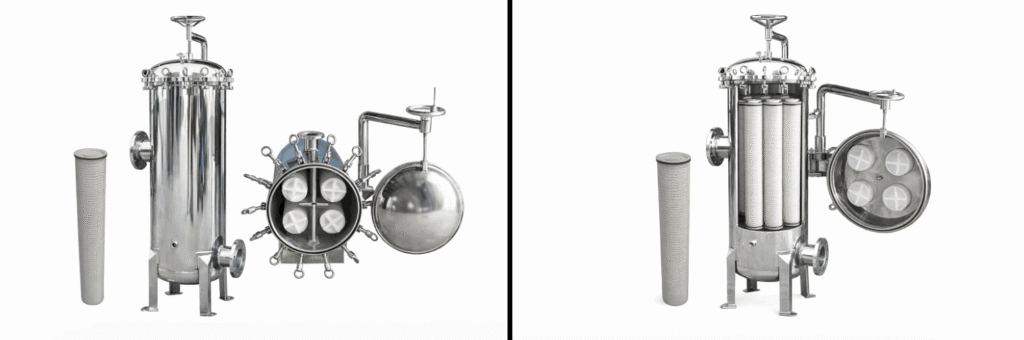
- ✅ Gradient-Density Deep Pleats: This architecture creates massive dirt-holding capacity with ultra-low flow resistance. Your Booster Pump stays perfectly on its Best Efficiency Point (BEP).
- ✅ Drop-In Optimization: Direct replacements for Pall, Parker, and 3M housings. No CAPEX required.
5. The Real ROI: Stop Counting Pennies, Start Counting Megawatts
Let’s do the math.
Procurement might save $500 a month by buying cheap nominal filters. But that micro-fouling just forced your HP pump to consume an extra $2,000 a day in electricity.
You are not buying an ecofiltrone cartridge; you are buying thermodynamic stability.
📩 Audit Your Energy Loss:
Is your HP pump working harder than it should? Send me your current OEM Part Number via DM. The ecofiltrone engineering team will provide an energy-optimized, absolute-rated replacement quote within 24 hours. Let’s drop your carbon footprint and your OPEX.